
Self-driving car accident attorney clearwater: Secure 2025
Understanding the New Landscape of Autonomous Vehicle Accidents
A self-driving car accident attorney in Clearwater handles the unique legal complexities that arise when autonomous vehicle technology fails. Unlike traditional car accidents, liability can extend beyond the driver to vehicle manufacturers, software developers, and maintenance providers. When sensors fail or software glitches cause a crash, victims face a legal maze that requires specialized technical and legal expertise to answer the question: Who is responsible when no one is driving?
Self-driving cars are already on Clearwater roads. As this technology becomes more common, accidents involving these vehicles will inevitably rise. Florida law, including the four-year statute of limitations for personal injury claims, still applies, but proving fault is far more complex. It involves analyzing automation levels, black box data, and manufacturer records—evidence that requires a skilled legal team.
I’m Thomas W. Carey, a board-certified civil trial lawyer. Since 1988, my firm has handled complex product liability and auto accident cases across Florida. We are positioned to effectively represent clients seeking a self-driving car accident attorney in Clearwater who understands both the technology and the evolving legal frameworks governing these unprecedented cases.
How Self-Driving Car Accidents in Clearwater Are Different
An accident involving a self-driving car is a new category of legal complexity. The investigation shifts from simple driver error to a high-tech mystery. We’re no longer just asking, “Did the driver run a red light?” Instead, we must investigate if a sensor malfunctioned, if the software misread the situation, or if a hardware component failed.
This technological complexity creates two major challenges: determining liability and securing evidence.
Complex Liability: In a typical crash, fault usually lies with one of the drivers. With autonomous vehicles, the list of potentially liable parties expands to include the vehicle manufacturer, the software developer, the parts supplier, the vehicle owner, or a fleet operator. Each of these entities has deep pockets and legal teams dedicated to shifting blame.
Unique Evidence: Autonomous vehicles are rolling data centers that record every sensor reading and software decision. This “black box” data is crucial for proving what happened, but accessing and interpreting it requires specialized legal tools and technical experts that most law firms lack.
As self-driving technology becomes more common on the roads of Pinellas County, which saw 15,646 car collisions in 2022, these complex accidents will increase. This is especially concerning as Florida is already the third most dangerous state for drivers. For more on local trends, see our Clearwater Auto Accident Statistics.
Solving Liability: Who Is at Fault?
Figuring out who’s at fault requires investigating multiple parties. Often, more than one is responsible.
- Product Liability: Was there a defect in the vehicle’s design, a manufacturing flaw, or inadequate warnings about the system’s limits? If so, the manufacturer can be held liable.
- Manufacturer Negligence: Did the company rush an unsafe product to market, skip crucial testing, or oversell the system’s capabilities? This negligence can lead to accountability.
- Software Developer Error: A single bug or flawed algorithm in the vehicle’s code can cause a crash. The companies that wrote the code can be liable for these errors.
- Vehicle Owner/Operator Negligence: Owners must properly maintain their vehicles and keep software updated. Operators in lower-level autonomous cars must remain attentive and ready to take control. Failure to do so can result in shared liability.
Our experience in traditional fault determination, as detailed in our guide on How to Tell Who is at Fault in a Car Accident, provides a strong foundation for these complex cases.
The Role of Automation Levels in Determining Fault
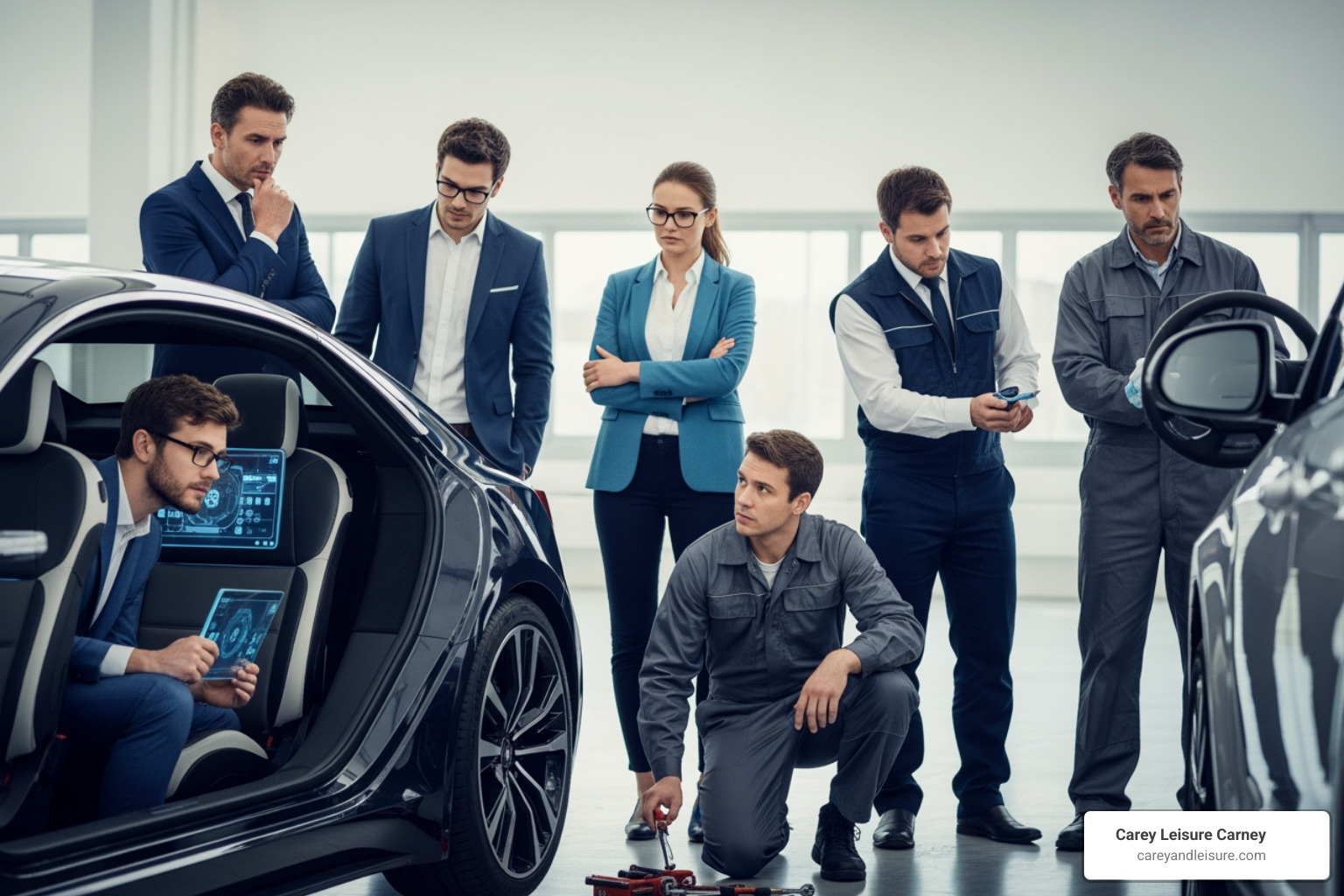
The Society of Automotive Engineers (SAE) defines six levels of automation (0-5), which are critical in determining responsibility.
Levels 0-2 (Driver Support): The human driver is legally responsible. These levels include features like adaptive cruise control or lane-keeping assistance (e.g., Tesla’s Autopilot, GM’s Super Cruise). The driver must constantly supervise the vehicle and be ready to intervene. If they fail to do so, liability typically falls on them.
Levels 3-5 (Automated Driving): Responsibility shifts toward the manufacturer. In Level 3, the car drives itself under certain conditions but may require the driver to take over. If the system fails to provide adequate warning or makes an error, the manufacturer is likely liable. In Levels 4 and 5, the vehicle operates fully autonomously within specific (Level 4) or all (Level 5) conditions. In these cases, an accident caused by the vehicle’s operation is almost certainly the manufacturer’s responsibility.
Proving fault requires analyzing the vehicle’s black box data to see if the system was engaged and what decisions it made. Accessing and interpreting this data is a challenge that requires legal action and forensic experts. The Use of Expert Witnesses is essential to explain these technical details and establish liability.
Immediate Steps After an Autonomous Vehicle Crash in Clearwater
Being in an accident with a self-driving car can be disorienting. What you do in the first few moments is critical for your safety and your legal rights. Stay calm and follow these steps.

Prioritize Safety and Call 911: Check for injuries and move to a safe location if possible. When you call 911, tell the dispatcher and responding officers that a vehicle was in autonomous or self-driving mode. This detail is vital for the official police report.
Seek Medical Attention: Adrenaline can mask serious injuries like whiplash or internal trauma. Get a medical evaluation immediately to document any injuries and link them to the crash. This is crucial for any future injury claim.
Preserve Vehicle Data: A self-driving car’s “black box” data is the most important evidence, but it can be easily erased or overwritten. If it’s your vehicle, instruct your insurance company and repair shop not to perform any updates or repairs. A self-driving car accident attorney in Clearwater can take immediate legal action to preserve this data.
Do Not Admit Fault: Stick to the facts when speaking with anyone. Avoid making statements like “I wasn’t paying attention” or “The car did it on its own.” Liability is complex, and fault should be determined by a thorough investigation.
Document Everything: Use your phone to safely take pictures and videos of the scene. For more guidance, review our resource on What to do after a car accident Florida.
Crucial Evidence to Collect
Gathering the right evidence at the scene can make or break your case. Focus on collecting the following:
- Police report number: Get this from the responding officers.
- Photos and videos: Capture the overall scene, road conditions, traffic signs, vehicle damage from multiple angles, and any visible sensors or cameras on the autonomous vehicle.
- Visible injuries: Photograph any cuts, bruises, or other visible injuries you or your passengers sustained.
- Witness information: Get names and contact details from anyone who saw the accident.
- Dashcam footage: Preserve your own footage and ask others if they are willing to share theirs.
- Vehicle data recorder (black box): You cannot access this yourself, but it is the most critical piece of evidence. Your attorney will take legal steps to secure this data, which records the vehicle’s speed, braking, sensor readings, and software decisions.
For more strategies, see our article on Documenting Evidence in Personal Injury Claims.
Navigating Florida Law: Insurance, Compensation, and Your Rights
Understanding how Florida’s insurance system applies to a self-driving car accident is key to protecting your rights.
Florida is a “no-fault” state, meaning you first turn to your own insurance policy after a crash. Your Personal Injury Protection (PIP) coverage pays for 80% of your initial medical bills and 60% of lost wages, up to a $10,000 limit. Crucially, you must seek medical treatment within 14 days of the accident to be eligible for PIP benefits.
For severe injuries, $10,000 is often not enough. If your injuries meet Florida’s “serious injury threshold” (e.g., significant disfigurement, permanent injury), you can step outside the no-fault system to file a lawsuit against the at-fault party for full compensation. This is where a self-driving car accident attorney in Clearwater is essential, as the at-fault “party” may be a large corporation like a vehicle manufacturer or software company. Learn more about the Types of Car Accident Injuries that often qualify.
Another key principle is Florida’s Dangerous Instrumentality Doctrine, which can hold a vehicle’s owner liable for an accident even if someone else—or the car itself—was operating it. This provides another potential avenue for compensation. When dealing with insurers, remember they are businesses focused on minimizing payouts. Our guide on The Role of Insurance Companies in a Car Accident explains their tactics.
What Compensation Can You Recover?
When you pursue a claim against the at-fault parties, we fight to recover compensation for all your damages, including:
- Medical Expenses: All costs from the ambulance ride and ER visit to surgery, rehabilitation, and future medical care.
- Lost Wages and Earning Capacity: Compensation for the income you lost while recovering and for any long-term reduction in your ability to earn a living due to your injuries.
- Pain and Suffering: Damages for the physical pain, emotional trauma, and loss of enjoyment of life caused by the accident.
- Property Damage: Costs to repair or replace your vehicle, including its diminished value after the crash.
To understand how these factors are valued, see our guide on What is My Personal Injury Case Worth?.
Be aware of strict deadlines. In Florida, you generally have four years from the accident date to file a personal injury lawsuit. This filing deadline (statute of limitations) under Florida law still apply. Evidence disappears quickly, so it is vital to contact an attorney as soon as possible.
Why You Need an Experienced Self-Driving Car Accident Attorney in Clearwater

Handling a self-driving car accident claim on your own is nearly impossible. You are facing complex technology, evolving laws, and opponents like Tesla, GM, or Waymo, who have vast legal resources. You need more than just any personal injury lawyer; you need a self-driving car accident attorney in Clearwater with specialized knowledge and proven experience.
What to Look For in an Attorney—And What We Provide
Choosing the right attorney is the most important decision you will make. Here’s what sets our firm apart:
Specialized Expertise and Resources: These cases require technical knowledge of LIDAR, machine learning algorithms, and vehicle data logs. We have the resources to hire software engineers, AI specialists, and accident reconstruction experts to analyze the evidence and prove your case. We fund these complex investigations at no upfront cost to you.
A Thorough Investigative Process: Our first step is to legally secure the vehicle’s “black box” data before it is deleted or altered. Our experts then analyze this data, review manufacturer safety records obtained through legal findy, and depose corporate engineers and executives to uncover negligence. This rigorous process is detailed in our guide on How Attorneys Use Investigations for Your Personal Injury Claim.
Board-Certified Trial Lawyers: Less than 2% of Florida attorneys are Board-Certified in Civil Trial Law. This distinction signifies the highest level of expertise and a proven track record in the courtroom. Our firm has board-certified attorneys ready to fight for you.
Proven Trial Experience: We are not a settlement mill. Insurance companies know which firms are willing to go to trial to secure fair compensation. Our reputation as experienced trial lawyers gives your case immediate credibility and leverage in negotiations.
Direct Attorney Access: We limit our caseload to provide every client with personalized service and direct access to their attorney. You will not be passed off to a case manager. We believe this is essential, as explained in our guide on Why You Need a Personal Injury Lawyer.
With over 115 years of combined experience, our firm has the financial strength, technical understanding, and courtroom-tested skill to take on large corporations and maximize your compensation. For more on selecting the right firm, see our tips on Hiring a Law Firm What You Need to Know.
Frequently Asked Questions about Self-Driving Car Accidents
How do the levels of autonomous driving (0-5) affect my accident case?
The SAE automation level is critical for liability. In lower levels (0-2), the human driver is responsible for supervising the vehicle. In higher levels (3-5), where the car drives itself, responsibility shifts to the manufacturer. If the technology fails in these modes and causes a crash, the manufacturer or software developer is typically liable under product liability law.
Who pays for my medical bills first in a self-driving car crash in Florida?
Under Florida’s no-fault law, your own Personal Injury Protection (PIP) insurance provides initial coverage. It pays for 80% of medical costs and 60% of lost wages up to $10,000, regardless of fault. You must seek medical care within 14 days of the crash to qualify. For serious injuries with costs exceeding your PIP limit, you can then pursue a claim against the at-fault party.
Can I sue the car manufacturer if their self-driving technology failed?
Yes. If a defect in the vehicle’s design, software, or sensors caused the accident, you can file a product liability lawsuit against the manufacturer. Proving that the technology was defective and caused your injuries is complex and requires significant technical and legal expertise. Our firm is equipped to handle these claims against major auto manufacturers.
Secure Your Future with a Knowledgeable Clearwater Attorney
The road ahead for self-driving technology is full of promise, but as we’ve seen, when accidents happen, the legal journey can be anything but straightforward. These cases involve complex technology, multiple layers of liability, and evidence that requires specialized expertise to interpret and present effectively.
If you’ve been injured in a self-driving car accident here in Clearwater, you’re likely facing a whirlwind of medical appointments, insurance calls, and uncertainty about what comes next. The reality is that immediate action is crucial. From preserving critical vehicle data to documenting your injuries and protecting your legal rights, every step you take in those first hours and days can significantly impact the outcome of your case.
Florida’s no-fault insurance system means your PIP coverage will handle your initial bills, but serious injuries often far exceed those limits. When you’re dealing with catastrophic injuries, mounting medical expenses, lost income, and life-altering changes, you need more than just a basic insurance payout. You need someone who understands how to steer both traditional insurance claims and cutting-edge product liability law—someone who can take on major manufacturers and their legal teams without backing down.
That’s where we come in. As board-certified civil trial lawyers, we represent the top tier of legal expertise in Florida—a distinction achieved by less than 2% of attorneys in our state. Since 1984, our firm’s mission at Carey Leisure Carney has been singular: to stand up for injured individuals who have been the victim of negligence. Whether that negligence comes from a distracted driver or a faulty algorithm in a multi-million-dollar autonomous vehicle, we bring the same relentless dedication to every case.
Our team has handled roughly 40,000 injury matters across Florida, and we bring 115+ years of combined experience to your case. We’re not intimidated by complex technology or corporate legal departments. We have the resources to hire the software engineers, accident reconstruction experts, and technical specialists needed to build an ironclad case. We know how to secure and analyze black box data, depose corporate representatives, and present technical evidence in a way that resonates with judges and juries.
More importantly, when you work with us, you get direct attorney access and personalized service. You’re not just a case number in a system. You’re a person who’s been through something traumatic, and you deserve to have your questions answered, your concerns addressed, and your voice heard throughout the entire process.
The clock is ticking on your case. Florida’s statute of limitations gives you four years to file a personal injury lawsuit, but evidence can disappear, memories can fade, and critical data can be overwritten. The sooner you reach out, the better we can protect your interests.
Don’t face the complexities of a self-driving car accident alone. You’ve already been through enough. Let us handle the legal battles while you focus on healing and rebuilding your life. Contact our Clearwater personal injury lawyers for a free consultation to protect your rights. We’re here to help you steer this new frontier of personal injury law and secure the compensation you truly deserve.
Your future doesn’t have to be defined by this accident. With the right legal team fighting for you, you can move forward with confidence. Let’s start that conversation today.