When Big Loads Mean Big Problems: Finding the Right Oversize Load Attorney
When an Oversize Load Truck Accident Turns Your Life Upside Down
If you need an oversize load trucking accident attorney, here is what you should know right away:
- These cases involve multiple liable parties — not just the driver
- Evidence disappears fast — acting quickly protects your claim
- Florida’s statute of limitations gives you two years to file
- Specialized legal representation dramatically increases compensation
- Carey Leisure Carney handles oversize load truck accident cases across the Tampa Bay area, including Clearwater, Pinellas, and Pasco counties
Accidents involving oversize load trucks are among the most devastating crashes on Florida roads. These vehicles — carrying loads that exceed standard legal limits for width, height, weight, or length — create dangers that ordinary truck accidents simply do not. When something goes wrong, the results are often catastrophic: severe injuries, permanent disability, or death.
What makes these cases especially difficult is their complexity. Multiple companies, contractors, and regulators may share responsibility. Insurance carriers move quickly to protect their clients. And critical evidence — black box data, driver logs, permit records — can vanish within days.
You deserve an attorney who understands every layer of that complexity.
I’m Thomas W. Carey, founding partner of Carey Leisure Carney and a board-certified civil trial lawyer with decades of experience handling serious trucking injury cases throughout Florida, including cases involving oversize load trucking accident claims where multiple parties and federal regulations are at the center of the dispute. I’ve guided tens of thousands of injury matters since 1988, and I know how quickly the legal landscape shifts after a catastrophic truck crash — which is exactly why the sections below are designed to give you clear, actionable guidance from the moment after impact through final resolution.
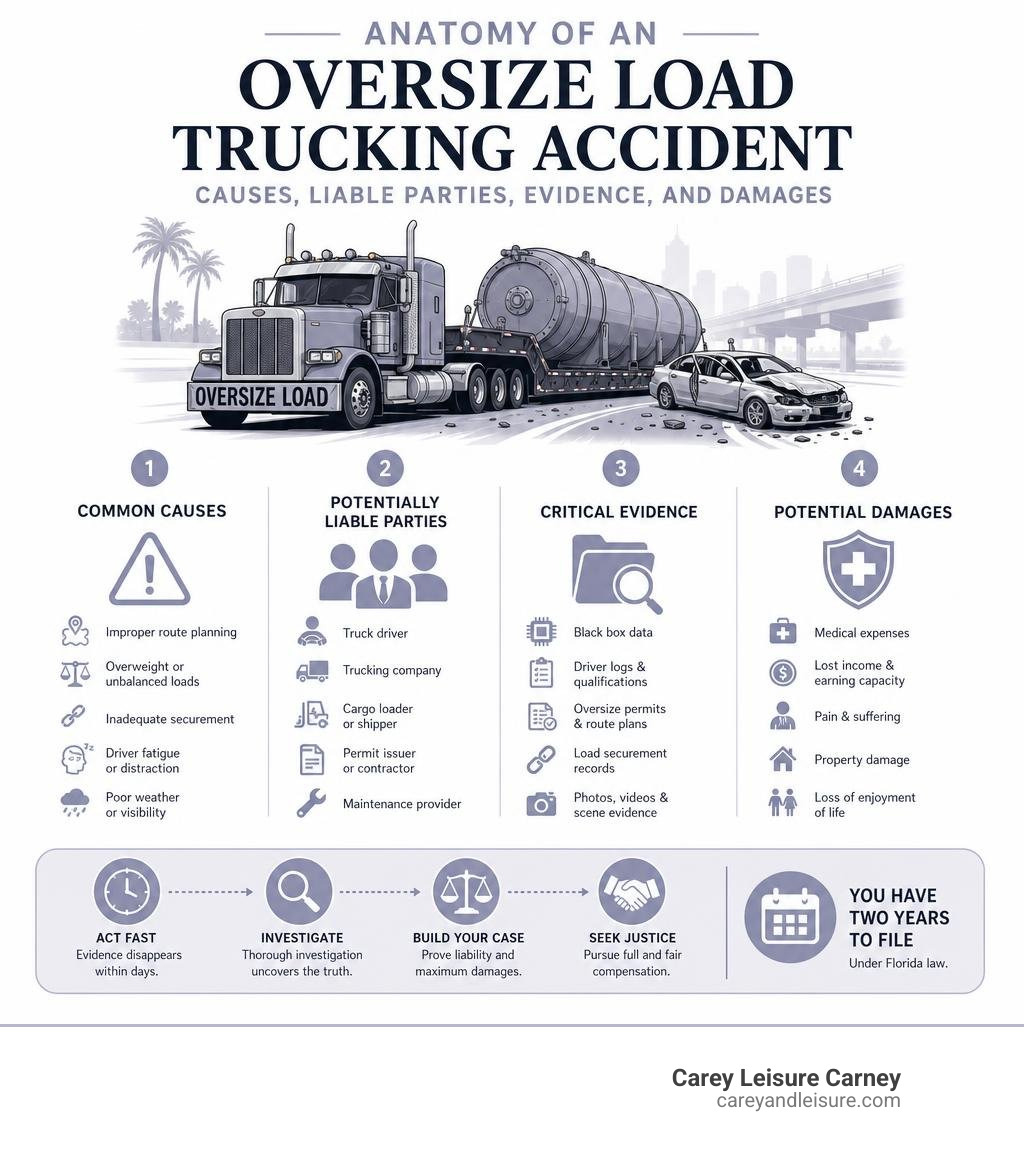
Basic oversize load trucking accident attorney vocab:
Understanding Oversize Loads and Their Unique Safety Risks

Commercial trucking is the backbone of our economy, but when cargo exceeds standard dimensions, it transforms a standard semi-truck into an inherently hazardous road hazard. Federal and state governments strictly define what constitutes an “oversize” or “overweight” load to protect the motoring public.
Under the Federal Motor Carrier Safety Administration (FMCSA) and the Florida Department of Transportation (FDOT), any commercial vehicle configuration exceeding standard legal dimensions must obtain special permits. In Florida, standard legal limits are strictly enforced to prevent catastrophic road damage and collisions. If a trucking company or driver attempts to move cargo exceeding these thresholds without specialized planning, the legal consequences are severe.
To understand why these loads are so dangerous, we first have to look at what is considered “standard” versus what qualifies as “oversize” under Florida law:
| Dimension / Limit | Standard Commercial Truck Limit | Florida Oversize Permit Required |
|---|---|---|
| Gross Weight | 80,000 lbs. | Exceeds 80,000 lbs. |
| Width | 8.5 feet (102 inches) | Exceeds 8.5 feet |
| Height | 13.5 feet | Exceeds 13.5 feet |
| Trailer Length | 53 feet | Exceeds 53 feet (or combination limits) |
When a truck exceeds any of these parameters, it is legally classified as an oversize or overweight load. Operating these vehicles requires specialized routing, safety equipment, and often escort pilot cars. If you have been injured in an accident involving a massive commercial vehicle, working with a specialized Oversize Load Trucking Accident Attorney – Carey Leisure Carney is critical to identifying whether the trucking company operated outside these strict legal boundaries.
Why Oversize Loads Pose Extreme Hazards on Florida Roads
The physics of an oversize load truck make it uniquely dangerous compared to standard passenger cars or even standard 18-wheelers. When passenger vehicles share local roads—like US-19 in Clearwater or State Road 54 in Wesley Chapel—with these giants, the margin for error is virtually zero.
These massive vehicles present several distinct mechanical and operational hazards:
- Massive Blind Spots: Standard semi-trucks already have significant “no-zones” where passenger vehicles disappear from view. An oversize load—especially one carrying overwidth cargo like mobile homes, industrial wind turbines, or construction cranes—drastically expands these blind spots, making lane changes and turns incredibly perilous.
- Extreme Stopping Distances: An overweight truck exceeding 80,000 pounds requires substantially more highway distance to come to a complete stop. If traffic suddenly halts on Interstate 4 or I-75, an overweight rig may simply be unable to stop in time, leading to devastating rear-end collisions.
- Increased Rollover Risks: Oversize loads often have a much higher center of gravity (especially overheight loads). This makes them highly susceptible to rolling over when taking sharp curves, navigating Florida’s highway off-ramps, or reacting to sudden crosswinds.
- Violent Cargo Shifts: If heavy cargo is improperly secured, the sheer momentum of a sudden turn or brake can cause the load to shift. This can break tie-downs, cause the trailer to swing uncontrollably, or spill heavy debris directly onto adjacent passenger lanes.
These unique hazards explain why collisions involving these massive vehicles are disproportionately lethal. According to federal crash data, oversize and overweight load trucks are involved in approximately 12% of all fatal large-truck crashes in the United States, despite representing a tiny fraction of overall highway traffic. Alarmingly, between 2011 and 2021, the number of fatal crashes involving oversize/overweight trucks increased by over 40% nationwide. When these heavy loads collide with passenger vehicles, the results are rarely minor fender-benders; they are life-altering events. You can learn more about how these collisions compare to standard car crashes by reading our guide on Truck Accidents and Car Crashes.
Common Causes and Liability in Oversize Load Trucking Accidents
When we investigate these crashes at Carey Leisure Carney, we rarely find that they were “accidents” in the true sense of the word. Instead, they are almost always the direct result of negligence, corner-cutting, or outright safety violations by one or more corporate entities.
The most common causes of oversize load crashes include:
- Improper Cargo Securement: FMCSA investigations reveal that improperly secured or shifting cargo contributes to roughly 25% of all oversize load truck accidents. When a loader fails to use heavy-duty chains, straps, or tensioners correctly, the cargo can break free or shift, causing immediate loss of control.
- Negligent Route Planning: Oversize trucks cannot just drive anywhere. They must follow strict, pre-approved routes that avoid low-clearance bridges, narrow lanes, and weight-restricted overpasses. If a trucking company fails to plan the route or a driver relies on standard consumer GPS, they can strike overpasses or get stuck on tight municipal roads.
- Inadequate or Missing Escort Vehicles: Florida law requires “pilot cars” or escort vehicles for loads exceeding specific width or length thresholds. These escort vehicles are supposed to warn oncoming traffic, clear lanes, and check clearances. When escort drivers are poorly trained, distracted, or entirely absent, catastrophic collisions occur.
- Driver Fatigue and Inexperience: Operating an oversize rig requires specialized training and endorsements. Trucking companies sometimes put inexperienced, standard CDL holders behind the wheel of a complex oversize load to save money. Combined with long hours and driver fatigue, this is a recipe for disaster.
- Equipment Failure: The extreme weight and size of these loads place immense stress on the truck’s brakes, tires, suspension, and coupling systems. If the trucking company neglects routine maintenance, mechanical components can fail catastrophically at highway speeds.
If you have been injured due to any of these negligent actions, consulting an experienced Clearwater Truck Accident Attorney – Carey Leisure Carney will help you uncover the underlying cause of your crash and protect your rights.
Who is Liable When an Oversize Load Crashes?
In a standard car accident, liability is usually straightforward: one driver made a mistake. In an oversize load trucking accident, however, multiple corporate entities may share the blame. Finding every pocket of liability is the only way to secure the full compensation needed to cover catastrophic medical bills and lifelong care.
Depending on the facts of the case, we may pursue claims against:
- The Truck Driver: For speeding, driving distracted, driving while fatigued, failing to check blind spots, or ignoring route restrictions.
- The Trucking Company (Carrier): For negligent hiring, failing to train drivers, violating hours-of-service regulations, neglecting vehicle maintenance, or forcing drivers to operate without proper permits.
- The Cargo Loading Company: For failing to properly balance, distribute, or secure the heavy cargo on the flatbed or lowboy trailer.
- The Shipper: For misrepresenting the actual weight or dimensions of the cargo to avoid paying permit fees or hiring escort vehicles.
- Pilot Car / Escort Operators: If the escort drivers failed to properly warn the truck driver of upcoming hazards, failed to clear traffic, or operated their warning equipment negligently.
- Equipment Manufacturers: If a defective strap, chain, brake component, or tire failed under the load and caused the crash.
Navigating this web of corporate defendants requires a legal team that knows how commercial logistics operations work. For a deeper look into how an attorney unravels these complex relationships, read our Truck Accident Attorney Role Guide.
How Violations of Federal and Florida Regulations Prove Negligence
One of the strongest tools we have in proving an oversize load injury case is showing that the defendants violated state or federal safety regulations. This is known legally as “negligence per se.” If a trucking company violates a safety law designed to protect the public, and that violation causes your crash, the court can find them negligent as a matter of law.
Key regulations we analyze in every oversize load case include:
- FDOT Permitting Violations: Trucking companies must secure specific permits from the Florida Department of Transportation before moving a load. These permits outline precise travel times (often restricting travel to daylight hours or non-holiday periods) and specific highways. Operating without a valid permit is a major safety violation. In fact, trucking companies and drivers operating without proper oversize permits account for nearly 30% of all citations issued during commercial vehicle enforcement operations.
- Route Restrictions: Permits designate exact roads. If a truck wanders off its permitted route to take a shortcut and causes a crash, the carrier is highly liable.
- Federal Hours of Service (HOS): Drivers of oversize loads must adhere to strict FMCSA rest break requirements. Driver logs are cross-referenced with electronic logging devices (ELDs) to prove if the driver was operating illegally while fatigued.
- Escort Vehicle Compliance: Florida has strict rules regarding when pilot cars must have flashing amber lights, warning signs, and two-way radio communication with the truck driver.
Violations of these rules can turn a difficult case into a clear-cut claim for maximum damages. To understand how these state and federal regulations impact your injury claim, read our Truck Accident Injury Attorneys Complete Guide.
Crucial Evidence and Damages in an Oversize Load Case
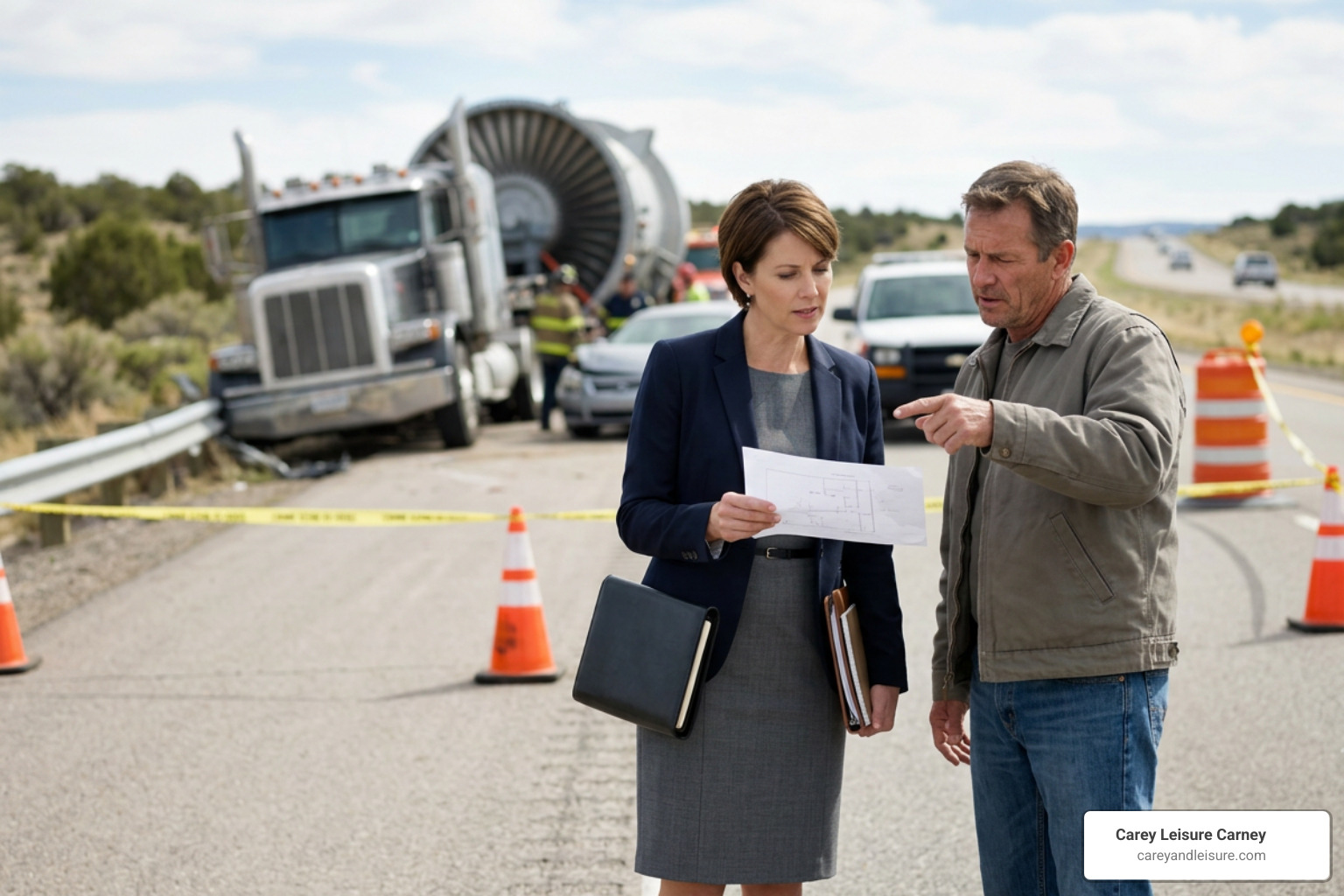
Proving negligence in an oversize load truck accident requires immediate, aggressive evidence preservation. Trucking companies and their multi-billion-dollar insurance carriers have rapid-response teams that deploy to crash scenes within hours. Their goal is simple: control the narrative and minimize their financial exposure.
To level the playing field, we must collect and analyze specialized evidence that is unique to commercial trucking litigation:
- Black Box (ECM) Data: Modern commercial trucks are equipped with Electronic Control Modules. This “black box” records critical telemetry data in the seconds leading up to a crash, including vehicle speed, braking status, throttle position, and steering angles.
- Electronic Logging Devices (ELD): ELD data shows exactly how many hours the driver had been behind the wheel, helping us prove fatigue.
- Permit Documentation: We obtain the official FDOT oversize/overweight permit to verify if the trucking company was on their approved route, traveling during legal hours, and utilizing the required number of escort vehicles.
- Driver Qualification Files: This includes the truck driver’s commercial driver’s license (CDL) records, medical examiner certificates, drug and alcohol testing history, and past safety violations.
- Maintenance and Inspection Records: We review pre-trip and post-trip inspection logs to determine if the truck had existing mechanical defects—such as worn brakes or bald tires—that contributed to the crash.
- Cargo Loading Manifests: These documents show the exact weight, dimensions, and tie-down configurations used by the cargo loaders.
Gathering this evidence requires swift legal action, often starting with a formal spoliation letter that legally bars the trucking company from destroying or altering any records. If you are dealing with a crash in Hernando County, working with a specialized Spring Hill Truck Accident Lawyer – Carey Leisure Carney ensures that all local and federal evidence is secured before it can be deleted or lost.
Recoverable Damages for Victims of an Oversize Load Trucking Accident
Because of the immense weight and size of oversize loads, the injuries sustained in these crashes are often catastrophic. Victims frequently face lifetime physical limitations, cognitive deficits, and astronomical medical bills.
Under Florida law, victims are entitled to pursue comprehensive compensatory damages, which are split into economic and non-economic categories:
- Medical Expenses: This covers all emergency room visits, surgeries, hospital stays, physical therapy, prescription medications, assistive devices, and estimated future medical care (such as lifelong rehabilitation or in-home nursing).
- Lost Wages and Earning Capacity: If your injuries prevent you from returning to work, you can recover your lost income. If you suffer a permanent disability that prevents you from ever working again, we calculate your future lost earning capacity over your remaining working years.
- Pain and Suffering: This compensates you for physical pain, mental anguish, emotional distress, loss of enjoyment of life, and the psychological trauma of surviving a near-death experience.
- Punitive Damages: In rare cases where the trucking company or driver acted with gross negligence or intentional misconduct—such as operating an overweight rig with known brake failures or driving under the influence—the court may award punitive damages to punish the wrongdoer and deter similar behavior.
Because the stakes are so high, insurance policies for oversize trucks are significantly larger than standard auto policies, often reaching millions of dollars. The average settlement or verdict in oversize load truck accident cases handled by specialized trucking attorneys exceeds $1.2 million when serious injury or fatality is involved. To understand how expert witnesses and medical life-care planners help us maximize these recoveries, read our guide, When Big Rigs Collide: A Guide to Truck Accident Injuries.
Immediate Steps to Preserve Evidence After a Crash
If you or a loved one has been involved in an oversize load truck accident, what you do in the hours and days following the crash can dramatically impact your legal recovery.
If you are physically able, take the following steps to protect yourself and your claim:
- Call 911 Immediately: Ensure that the Florida Highway Patrol or local police (such as the Pinellas County Sheriff’s Office) dispatch officers to the scene. An official police report is a foundational piece of evidence.
- Seek Immediate Medical Attention: Even if you feel okay, let emergency medical personnel examine you. Adrenaline can mask severe injuries, including internal bleeding, spinal damage, and traumatic brain injuries. Establishing a medical record immediately after the crash prevents insurance companies from claiming your injuries were pre-existing.
- Document the Scene: Use your phone to take photos and videos of the crash site. Capture vehicle damage, license plates, trucking company logos, the cargo itself, tire skid marks, road conditions, and any warning signs on the truck or escort vehicles.
- Gather Witness Information: If anyone stopped to help, obtain their names, phone numbers, and email addresses. Witness statements can be invaluable if the truck driver lies about how the crash occurred.
- Avoid Making Statements: Do not apologize to the truck driver or make statements to the trucking company’s insurance adjusters. Anything you say can be twisted and used against you later.
- Consult a Specialized Attorney: Contact a dedicated truck accident attorney as soon as possible to begin the formal investigation. If the crash occurred in Pasco County, reaching out to a Truck Accident Attorney New Port Richey will ensure that experienced local advocates immediately step in to handle the insurance companies on your behalf.
Navigating the Legal Process with an Oversize Load Trucking Accident Attorney
Dealing with commercial insurance companies after an oversize load crash is nothing like handling a standard fender-bender claim. Trucking insurers employ highly aggressive tactics to protect their bottom line. They may offer you a quick, lump-sum settlement within days of the accident. While these offers can look attractive when medical bills are piling up, they are almost always “lowball” settlements designed to get you to sign away your rights before you know the true, long-term cost of your injuries. Once you sign a release, you can never ask for more money, even if you require additional surgeries years down the road.
Furthermore, Florida has strict deadlines for filing personal injury lawsuits. Under Florida’s statute of limitations, you have exactly two years from the date of the crash to file a lawsuit for personal injury. If you miss this deadline, you lose your right to seek compensation forever.
To ensure you do not fall victim to insurance company tactics or missed deadlines, we recommend contacting a St. Petersburg Truck Accident Lawyer – Carey Leisure Carney to guide you through the complex Florida legal process.
Why You Need a Specialized Oversize Load Trucking Accident Attorney
Oversize load truck accidents are highly technical. They are governed by a dense web of Federal Motor Carrier Safety Regulations (FMCSRs) and state-specific DOT guidelines. A general practice personal injury lawyer who primarily handles minor car accidents may not have the specialized knowledge or financial resources required to litigate against massive transportation companies.
At Carey Leisure Carney, we stand out because we offer:
- Board-Certified Expertise: Our firm features Board-Certified Civil Trial Lawyers—a distinction held by less than 2% of all attorneys in Florida. This certification recognizes our specialized knowledge, trial skills, and ethical standards.
- Over 100 Years of Combined Experience: We have spent decades fighting for injury victims across Pinellas, Pasco, and Hernando counties. We know the courts, the local judges, and the tactics used by commercial insurance defense firms.
- Direct Attorney Access: We believe in personalized, compassionate representation. When you hire us, you work directly with your attorney, not just a paralegal or case manager.
- No Fee Unless We Win: We operate on a contingency fee basis. You pay absolutely nothing upfront, and we only collect a fee if we successfully recover compensation for you.
To learn more about what to look for when choosing legal representation for a major commercial crash, read our Truck Accident Attorney Complete Guide.
Frequently Asked Questions About Oversize Load Accidents
What is the statute of limitations for an oversize load accident in Florida?
Under Florida law, you have two years from the date of the accident to file a personal injury lawsuit. If the accident resulted in a tragic loss of life, a wrongful death claim must also be filed within the same two-year window. Because investigating an oversize load crash and securing electronic trucking data takes time, it is vital to contact an attorney as soon as possible to ensure your claim is filed well before the deadline.
How do escort or pilot vehicles affect liability in a crash?
Escort or pilot vehicles play a crucial role in public safety. In Florida, if a load exceeds certain width, height, or length thresholds, the trucking company is legally required to hire certified escort vehicles. If an escort driver fails to warn oncoming traffic, fails to properly measure an upcoming bridge clearance, or drives distracted, they can be held partially or fully liable for the resulting crash. Our legal team thoroughly investigates the actions of the pilot car operators to determine if their negligence contributed to your injuries.
Can I still recover compensation if the truck had a valid oversize permit?
Yes, absolutely. Having a valid permit from the FDOT simply means the trucking company had permission to transport the load on Florida roads. It does not give the truck driver a license to drive negligently, speed, ignore blind spots, or operate while fatigued. Furthermore, a permit does not excuse improper cargo securement or mechanical failures. If driver error or carrier negligence caused the crash, the existence of a permit will not shield them from liability.
Conclusion: Secure Your Recovery with Carey Leisure Carney
An oversize load truck accident can shatter your health, your finances, and your family’s peace of mind in a single instant. When you are facing off against multi-million-dollar trucking corporations and their aggressive insurance adjusters, you should not have to fight alone.
At Carey Leisure Carney, we have dedicated our lives to standing up for injury victims. With our Board-Certified trial attorneys and over 100 years of combined legal experience, we have the resources, the knowledge, and the passion to hold negligent trucking companies accountable. We represent clients throughout the Tampa Bay area, with convenient office locations in Clearwater, Largo, New Port Richey, Spring Hill, St. Petersburg, Trinity, and Wesley Chapel.
Do not let an insurance company dictate the value of your recovery. Contact us today for a free, no-obligation consultation, and let us help you secure the justice and compensation you deserve. Reach out directly through our Truck Accident Attorney page to start your recovery journey.