
Anxiety After an Accident: What’s Your Settlement Worth?
When Anxiety After a Crash Is Worth More Than You Think
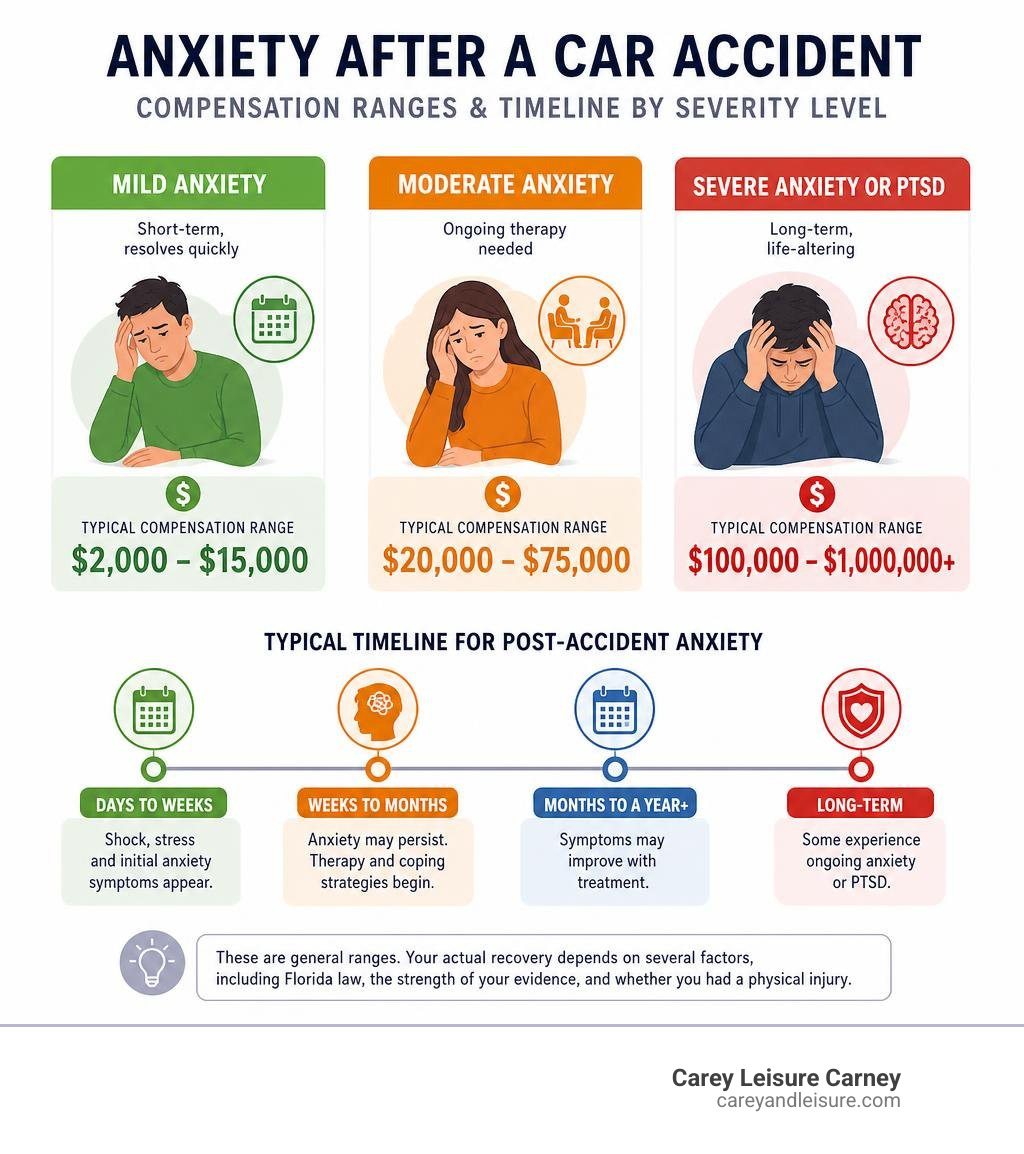
How much compensation for anxiety after a car accident can you actually recover? Here’s a quick answer:
| Severity Level | Typical Compensation Range |
|---|---|
| Mild anxiety (short-term, resolves quickly) | $2,000 – $15,000 |
| Moderate anxiety (ongoing therapy needed) | $20,000 – $75,000 |
| Severe anxiety or PTSD (long-term, life-altering) | $100,000 – $1,000,000+ |
These are general ranges. Your actual recovery depends on several factors — including Florida law, the strength of your evidence, and whether you had a physical injury.
Most people expect a car accident settlement to cover their car repairs and hospital bills. What surprises many Florida accident victims is that the emotional fallout — the panic attacks, the nightmares, the dread of getting behind the wheel again — can also be compensated.
Anxiety and other psychological injuries are real, recognized damages under Florida personal injury law. But they’re also among the hardest to prove and the easiest for insurance companies to dismiss.
This guide walks you through what your anxiety claim may be worth, what Florida law requires, and how to protect your right to full compensation.
I’m Thomas W. Carey, founding partner of Carey Leisure Carney and a board-certified civil trial lawyer with over 35 years of experience handling Florida personal injury cases — including claims where emotional distress and psychological trauma formed a central part of the damages. Having personally witnessed the devastating aftermath of a traumatic crash, I understand how how much compensation for anxiety after a car accident matters to real people trying to rebuild their lives, and I’ll walk you through exactly what drives those numbers in Florida.
Know your how much compensation for anxiety after car accident terms:
- compensation for ptsd after car accident
- depression after car accident compensation
- compensation for pain and suffering after a car accident
How Much Compensation for Anxiety After Car Accident Claims Can You Expect in Florida?

When we sit down with clients in Clearwater, Largo, or St. Petersburg, one of the first questions they ask is: “What is my mental peace worth under Florida law?”
In Florida, anxiety, depression, panic attacks, and post-traumatic stress disorder (PTSD) are legally classified as non-economic damages. Unlike a medical bill or a car repair estimate, there is no barcode on a panic attack. There is no standard receipt for a sleepless night.
Because emotional distress is subjective, determining Compensation After Accident claims requires looking at the big picture. When evaluating What Is My Personal Injury Case Worth?, we must weigh the severity of your psychological symptoms, the cost of your mental health treatment, and how heavily your anxiety interferes with your daily life and ability to work.
Let’s break down the typical settlement tiers we see in Florida courts and insurance negotiations.
Average Settlement Ranges for Mild to Moderate Anxiety
For many people, the anxiety that follows a crash is real but manageable. You might find your heart racing when you drive past the intersection where the crash occurred. Maybe you have trouble sleeping for a few weeks, or you experience occasional mild panic attacks when traffic gets heavy on US-19 or the Howard Frankland Bridge.
- Mild Anxiety ($2,000 to $15,000): These claims typically involve short-term emotional distress that resolves within a few weeks or months. You might have seen a primary care doctor or attended a couple of therapy sessions, but your daily routine, job, and relationships remained largely intact.
- Moderate Anxiety ($20,000 to $75,000): This category involves anxiety that significantly alters your lifestyle. You might require months of professional cognitive behavioral therapy (CBT), prescription anti-anxiety medications, and experience a pronounced fear of driving that adds hours to your weekly commute. If your anxiety causes you to miss work or withdraw from social and family obligations, your claim moves firmly into this moderate range.
Severe PTSD and Long-Term Mental Anguish Payouts
When an accident is particularly violent, the psychological damage can be catastrophic and permanent. Roughly 25% to 33% of motor vehicle accident survivors develop PTSD within the first few months of a crash. When this happens, the compensation ranges can climb from $100,000 to well over $1 million.
Severe psychological trauma payouts often involve:
- An official DSM-5 diagnosis of severe PTSD or panic disorder.
- An inability to drive or even ride as a passenger in a vehicle, severely limiting employment opportunities and personal freedom.
- Chronic insomnia, night terrors, and severe depression that strain marriages and family life.
- A lifetime of specialized psychiatric care, support groups, and medical management.
If you are experiencing these debilitating symptoms, it is vital to understand how Florida law treats PTSD After a Car Accident Understanding Your Claim to ensure you do not settle for a fraction of what you actually need to recover.
Florida’s Impact Rule and How It Affects Your Anxiety Claim
Florida has a unique and sometimes frustrating legal hurdle known as the “Impact Rule.” If you are seeking Compensation for Pain and Suffering in Florida What You Need to Know, you must understand how this rule dictates your ability to recover money for emotional distress.
Historically, the Florida Supreme Court has ruled that a person cannot recover damages for purely emotional or mental injuries unless those emotional injuries are tied to a physical impact or physical injury. The law requires a “physical hook” to prevent people from filing frivolous lawsuits over minor frights.
This means that if you are in a minor fender-bender in Spring Hill, walk away without a single scratch, bruise, or sore muscle, but develop driving anxiety, Florida’s Impact Rule makes it incredibly difficult to recover compensation for that anxiety alone.
Can I Claim for Anxiety If I Had No Physical Injuries?
Yes, but it is an uphill battle with very strict parameters. To claim emotional distress without a direct physical injury to yourself, you must generally fall under a few narrow, legally recognized exceptions to the Impact Rule.
The most common exception is the Bystander Claim (Negligent Infliction of Emotional Distress). To succeed under this exception in Florida, you must prove that:
- You witnessed a close family member suffer a severe, traumatic physical injury or death in the accident.
- You were at or near the scene of the crash when it happened.
- Your emotional distress caused by witnessing the event led to physical manifestations (such as ulcers, heart palpitations, severe depression-induced physical decline, or physical illnesses).
Because these cases are highly technical, trying to navigate them without an experienced personal injury attorney is a recipe for a quick denial from the insurance company.
How Pre-Existing Mental Health Conditions Impact Your Claim
Many people worry that if they already struggled with generalized anxiety, depression, or panic attacks before the crash, their claim is ruined.
Fortunately, Florida law protects you under a legal concept known as the “Eggshell Skull Rule.” This rule states that a negligent driver must take the victim as they find them. If you had a pre-existing mental health condition and the trauma of the car accident severely exacerbated or worsened your symptoms, the at-fault driver is still legally responsible for that worsening.
The key to a successful “eggshell” claim is documentation. We must be able to show a clear baseline of your mental health before the crash compared to the severe spike in symptoms and treatment required afterward.
Key Factors That Determine the Value of Your Emotional Distress Claim

When we build an emotional distress case, we look at several moving parts. Insurance adjusters don’t just take your word for it when you say you feel anxious. They look for cold, hard evidence.
To understand how a claim is valued, you can also read this external guide on How much compensation for anxiety can I get after a car accident? for a broader perspective on national trends. In Florida, however, the value of your anxiety claim is heavily anchored to the following factors.
How Much Compensation for Anxiety After Car Accident Claims Is Influenced by Physical Injuries
There is an undeniable link between physical pain and mental suffering. Under Florida law, if you have a qualifying physical injury, the door to non-economic damages swings wide open.
When you suffer from Pain and Suffering After a Car Accident Your Guide to Fair Compensation, physical pain acts as a constant trigger for your anxiety. For instance, dealing with Chronic Pain After a Car Accident What You Need to Know About Compensation often leads to deep depression and generalized anxiety because your quality of life has plummeted.
Consider these common physical injuries and how they compound emotional distress:
- Whiplash and Soft Tissue Injuries: Constant stiffness and Neck Pain After a Car Accident Securing Your Compensation can make driving feel unsafe, magnifying your fear of being rear-ended again.
- Back and Spine Trauma: Dealing with daily, radiating discomfort is exhausting. Our guide on Navigating Back Pain Compensation After a Car Accident A Comprehensive Guide explains how physical limitations directly feed into feelings of hopelessness and anxiety.
- Upper Body Injuries: Simple acts like getting dressed or holding a steering wheel become agonizing when dealing with shoulder trauma. You can read more about securing Getting Your Due Shoulder Pain Compensation After a Car Accident to see how these physical limits strengthen your psychological claim.
The Role of Professional Diagnosis and Consistent Therapy Records
To win an anxiety claim, you need a paper trail written by licensed medical professionals.
If you tell an insurance adjuster, “I feel really anxious when I drive,” they will likely offer you a couple of hundred dollars to go away. But if we present them with a formal diagnosis of Generalized Anxiety Disorder or PTSD from a licensed psychologist, backed by six months of consistent therapy notes and a prescription for anti-anxiety medication, they have to take the claim seriously.
Consistency is everything. If you skip therapy appointments or stop taking your prescribed medication, the insurance company will argue that your anxiety isn’t as severe as you claim.
How Insurance Companies and Courts Calculate Anxiety Damages
Insurance companies use proprietary software programs to calculate pain and suffering damages, while courts and lawyers rely on two traditional, time-tested methods.
| Calculation Method | How It Works | Best Used For |
|---|---|---|
| The Multiplier Method | Multiplies your total economic damages (medical bills + lost wages) by a number between 1.5 and 5, depending on severity. | Cases with high medical bills and clear physical-psychological links. |
| The Per Diem Method | Assigns a specific daily dollar amount (often a day’s wages) for every day you suffer from anxiety until you reach maximum medical improvement. | Cases with prolonged, daily emotional disruptions but lower medical bills. |
Proving Your Case: Evidence That Strengthens Your Claim
To maximize your anxiety compensation, we must build an ironclad case. The most powerful evidence includes:
- A Daily Symptom Journal: Write down every panic attack, nightmare, and instance of driving avoidance. Note how your anxiety affected your day, your job, and your family.
- Before-and-After Witness Statements: Statements from coworkers, neighbors, or friends who can testify to how your personality and behavior changed after the accident are incredibly persuasive.
- Detailed Therapy Records: Notes from your therapist detailing your coping mechanisms, panic triggers, and progress.
- Proof of Financial Losses: Receipts for therapy copays, prescription medications, and wages lost because you were too anxious to work.
How Much Compensation for Anxiety After Car Accident Claims Is Affected by Florida’s Statute of Limitations
Time is not on your side. Under Florida law (Florida Statute 95.11), the statute of limitations for personal injury claims — including those involving emotional distress and anxiety — is two years from the date of the accident.
This is a critical deadline. Florida lawmakers reduced this window from four years to two years in 2023. If you do not file a lawsuit or settle your claim within this two-year window, you lose your right to seek compensation forever. Because psychological injuries like PTSD can take months to fully manifest, it is vital to contact a lawyer as soon as you notice symptoms.
Frequently Asked Questions about Anxiety After a Car Accident
Do I need a formal diagnosis to claim compensation for anxiety?
Legally, yes, if you want a meaningful settlement. While you can technically claim “pain and suffering” without a formal diagnosis, insurance adjusters are highly skeptical of undocumented mental health claims. A formal diagnosis from a psychiatrist, psychologist, or licensed clinical social worker (LCSW) provides the objective medical evidence required to prove your claim.
What is the difference between a personal injury claim and a separate emotional distress claim?
In Florida, you rarely file a “separate” emotional distress claim after a car accident. Instead, your anxiety, depression, and mental anguish are included as “non-economic damages” within your broader personal injury claim. This ensures all your physical, financial, and emotional losses are negotiated together under one comprehensive settlement.
How do insurance companies evaluate anxiety claims?
With extreme skepticism. Insurance companies are businesses looking to protect their bottom lines. They will often monitor your social media accounts to see if you are posting happy photos or traveling, using those images to argue that your anxiety isn’t real. They may also request an Independent Medical Examination (IME) with a doctor of their choosing, who is paid to find reasons to minimize your psychological symptoms.
Conclusion
Recovering from a car accident isn’t just about healing broken bones or repairing a dented bumper. It’s about reclaiming your peace of mind, your confidence behind the wheel, and your quality of life.
If you are struggling with anxiety, panic attacks, or PTSD after a crash in Clearwater, Largo, St. Petersburg, New Port Richey, Spring Hill, Trinity, or Wesley Chapel, you do not have to carry this heavy burden alone.
At Carey Leisure Carney, our board-certified personal injury attorneys have over 100 years of combined experience fighting for the rights of accident victims. We pride ourselves on offering direct attorney access and highly personalized, compassionate service. We will handle the aggressive insurance adjusters so you can focus entirely on your mental and physical recovery.
Contact us today to speak with an experienced personal injury attorney for a free, no-obligation consultation. Let us help you get the fair compensation you deserve.