

Chronic Pain After a Car Accident: What You Need to Know About Compensation
What You Need to Know About Chronic Pain After Car Accident Compensation
Chronic pain after car accident compensation is something many Florida crash victims are entitled to — but few know how to claim it effectively.
Here is a quick overview of what you can recover:
| Type of Compensation | What It Covers |
|---|---|
| Medical expenses | Past and future treatment costs |
| Lost wages | Income lost during recovery and beyond |
| Pain and suffering | Physical and emotional distress |
| Loss of enjoyment | Inability to do activities you once could |
Key facts to know right away:
- Chronic pain is defined as pain lasting 3 to 6 months or longer after an injury
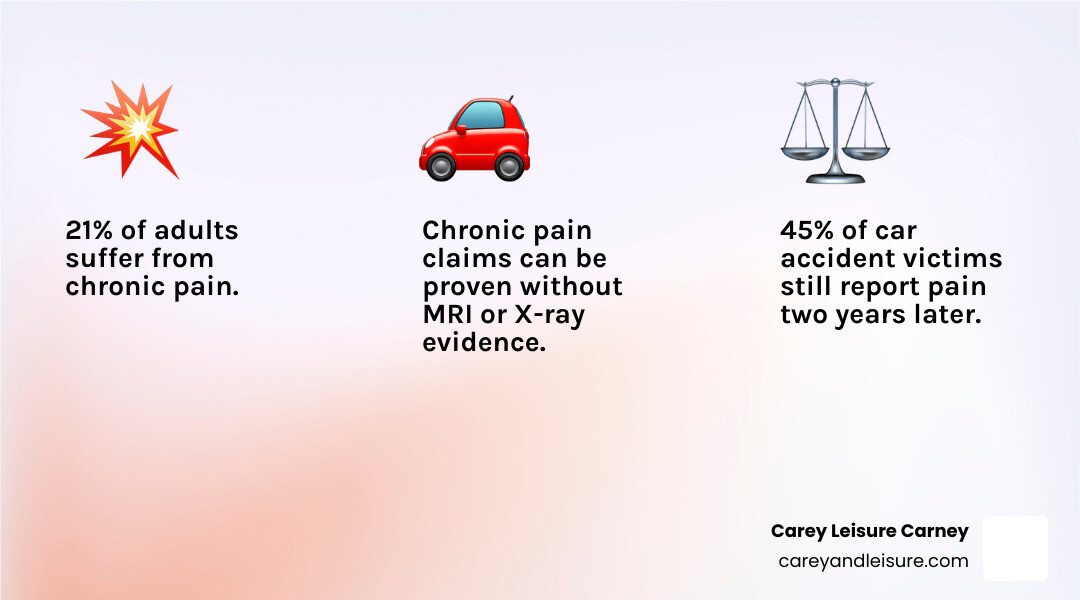
- You can claim compensation even without clear MRI or X-ray evidence
- Florida’s no-fault system limits initial claims, but serious injuries allow you to sue the at-fault driver
- Around 21% of adults suffer from chronic pain — and roughly 45% of crash victims still report accident-related pain two years later
The claims process is harder than most people expect. Insurance companies routinely undervalue or deny chronic pain claims. This guide walks you through everything you need to know.
I’m Thomas W. Carey, founding partner of Carey Leisure Carney and a board-certified civil trial lawyer with over 35 years of experience handling personal injury cases across Florida, including complex chronic pain after car accident compensation claims. In that time, I have guided or overseen roughly 40,000 injury matters and secured multi-million-dollar results for seriously injured clients throughout the Tampa Bay area.
Know your chronic pain after car accident compensation terms:
- compensation after accident
- compensation for ptsd after car accident
- depression after car accident compensation
Understanding Chronic Pain After Car Accident Compensation in Florida
In the legal world, as persistent pain lasting beyond the typical healing window—usually three to six months—chronic pain is a life-altering reality. In Florida, navigating a claim for this type of injury requires an understanding of our specific insurance landscape. We operate under a “no-fault” system, which means your own Personal Injury Protection (PIP) insurance is the first line of defense.
However, PIP is often just a drop in the bucket. It typically caps at $10,000, covering only 80% of medical bills and 60% of lost wages. For those suffering from long-term agony, $10,000 barely covers the initial diagnostic phase. To step outside the no-fault system and sue the negligent driver for “pain and suffering,” you must meet the “tort threshold.” This requires proving a permanent injury within a reasonable degree of medical probability.
Because chronic pain is often subjective, meeting this threshold is the primary battleground in Florida car accident cases. You can read more info about pain and suffering in Florida to see how these non-economic damages are handled in our local courts.
Proving Chronic Pain After Car Accident Compensation Without an MRI
One of the most frustrating hurdles victims face is the “invisible” nature of their injuries. Insurance adjusters love to say, “If it’s not on the MRI, it’s not there.” We know that’s simply not true. Many conditions that lead to chronic pain after car accident compensation claims do not show up on standard imaging.
It is important to understand that even if you are still in pain but don’t have clear imaging evidence, soft tissue damage, nerve impingement, and myofascial pain syndrome are very real and very painful. These “invisible injuries” occur when muscles, tendons, or nerves are stretched or compressed during a collision. While an X-ray checks for broken bones, it won’t show the microscopic tears in your soft tissue that cause inflammation and nerve fire for years. If you are struggling with these symptoms, our neck and back injury lawyers specialize in documenting the clinical evidence needed when scans come back “normal.”
Factors Influencing Chronic Pain After Car Accident Compensation
The “value” of a chronic pain claim isn’t pulled out of thin air. Several factors influence the final settlement or verdict:
- Injury Severity: A spinal cord nick is viewed differently than a muscle strain, though both cause chronic pain.
- Impact on Daily Life: Can you still lift your toddler? Can you sit at a desk for eight hours? High-impact chronic pain (HICP) that limits at least one major life activity significantly increases claim value.
- Emotional Well-being: Chronic pain rarely travels alone; it usually brings depression and anxiety along for the ride.
- Age and Health: A younger person facing 50 years of daily pain may receive higher compensation for future damages than someone much older.
A Journal of Transport and Health study on long-term crash pain revealed that 45% of victims still reported road-crash-related pain two years later. This statistic is vital because it proves to insurers that your situation isn’t an anomaly—it’s a statistically significant outcome of vehicular trauma.
Common Injuries and Evidence Needed for Your Claim

To secure chronic pain after car accident compensation, we must link your current suffering to a specific physical trauma sustained during the crash. Common culprits include:
- Whiplash: Often dismissed as a minor “neck ache,” whiplash can lead to years of cervicogenic headaches and restricted motion.
- Herniated Discs: When the “jelly” inside your spinal discs leaks out, it can press on nerves, causing radiating pain (sciatica) that may never fully resolve.
- Spinal Cord Trauma: Even minor bruising of the cord can cause permanent neuropathic pain. You can find more info about spinal cord injuries here.
- Traumatic Brain Injury (TBI): Chronic post-traumatic headaches and “brain fog” are common following a concussion. Check out our guide on post-concussion syndrome for more details.
Essential Evidence for Proving Persistent Pain
Since we can’t always “see” your pain on a screen, we build a “mountain of evidence” to make it undeniable:
- Medical Records: Consistency is king. If you tell your doctor your back hurts every visit for a year, that is powerful evidence.
- Expert Testimony: We use medical experts to explain to a jury why your nerves are misfiring even if the MRI is clean.
- Pain Journals: A daily log of your pain levels (1-10) and what you couldn’t do that day (e.g., “Couldn’t drive to Publix because of leg numbness”) provides a human narrative.
- Functional Capacity Evaluations (FCE): This is a physical test that objectively measures your ability to perform tasks like lifting, walking, and reaching.
- Independent Medical Examinations (IME): The insurance company will send you to their “independent” doctor (who is often anything but). We help you navigate these high-stakes appointments.
For cases involving permanent lifestyle changes, our catastrophic injury complete guide provides deeper insight into the evidentiary requirements.
How to Calculate the Value of Your Chronic Pain Claim
Calculations for chronic pain after car accident compensation are split into two categories: economic (the bills) and non-economic (the human cost).
| Method | How It Works | Best Used For |
|---|---|---|
| Multiplier Method | Takes your total economic damages (bills + lost wages) and multiplies them by a number (usually 1.5 to 5). | Severe, permanent injuries with high medical costs. |
| Per Diem Method | Assigns a daily “rate” for your pain (e.g., $200/day) and multiplies it by the number of days you’ve suffered. | Cases where a specific recovery timeline is expected. |
Knowing what your case is worth involves projecting future medical costs—like physical therapy, injections, or potential surgeries—and lost earning capacity if you can no longer work in your chosen field.
The Role of Psychological Impact in Settlements
We don’t just treat the body; we acknowledge the mind. Chronic pain is exhausting. It leads to:
- PTSD: Flashbacks of the crash triggered by driving.
- Depression: Feeling hopeless because the pain won’t stop.
- Loss of Enjoyment of Life: If you can no longer golf at the Vinoy or walk along Clearwater Beach, that is a compensable loss.
Juries in the Tampa Bay area often respond strongly to the emotional toll of an accident. We encourage you to look into psychological trauma payouts and PTSD after a car accident to understand how these “invisible” mental scars are valued.
Navigating Insurance Tactics and Legal Requirements
Insurance adjusters are not your friends. They are trained to save the company money. In chronic pain cases, they often use these tactics:
- Undervaluation: Offering a “nuisance settlement” of a few thousand dollars before you realize the pain is permanent.
- Blaming Pre-existing Conditions: They will scour your medical history from ten years ago to find a “sore back” and claim your current pain is just “old age.”
- Surveillance: They might hire a private investigator or watch your social media. If you post a photo of yourself smiling at a birthday party, they will argue you aren’t actually in pain.
In Florida, we use the “Eggshell Skull Rule.” This legal principle states that a defendant is liable for all damages they cause, even if the victim was more susceptible to injury due to a pre-existing condition. If the crash aggravated your old back injury and turned it into chronic agony, they are still responsible for that aggravation.
Don’t miss the deadline! Per Florida Statutes § 95.11, the statute of limitations for personal injury in Florida was recently shortened. For most accidents occurring after March 2023, you generally have only two years to file a lawsuit. In Clearwater and surrounding areas, waiting too long can permanently bar you from recovery.
Frequently Asked Questions about Chronic Pain Settlements
Are pain and suffering settlements for chronic pain taxable?
Generally, no. According to IRS guidelines, compensation received for physical injuries or physical sickness is not considered taxable income. This includes the “pain and suffering” portion of your settlement, as long as it originates from a physical injury. However, be careful: punitive damages and interest on a settlement are taxable. Always consult with a tax professional regarding your specific payout.
Can I claim compensation if the accident aggravated a pre-existing condition?
Yes. As mentioned with the eggshell skull rule, you are entitled to compensation for the new harm. If you had manageable arthritis that became debilitating chronic pain after a rear-end collision on US-19, the at-fault driver is responsible for that decline in your quality of life. We use expert witnesses to compare your “before” and “after” medical records to prove the aggravation.
What steps should I take immediately to document chronic pain?
- Seek Medical Care Now: Even if you think it’s “just a stiff neck.”
- Be Consistent: Don’t skip physical therapy. Gaps in care give insurers an excuse to say you aren’t really hurt.
- Journal Everything: Note your pain levels and the activities you miss out on.
- Watch Your Mouth: Don’t tell the insurance adjuster “I’m fine” out of politeness.
Conclusion
Securing chronic pain after car accident compensation is a marathon, not a sprint. At Carey Leisure Carney, we understand that while your bones may have knit back together, your life hasn’t. We are a boutique personal injury firm in Clearwater, Florida, specializing in helping our neighbors in Largo, St. Petersburg, and across the Tampa Bay area.
What sets us apart? Our attorneys are Board-Certified—a distinction held by only the top 2% of lawyers in Florida. With over 100 years of combined experience, we don’t pass you off to a paralegal. You get direct attorney access and a legal team that treats you like family, not a file number.
If you’re tired of being told your pain “isn’t real” by insurance companies, let us tell your story. Contact a Clearwater personal injury attorney at Carey Leisure Carney today for a free, no-obligation consultation. We don’t get paid unless we win for you.