
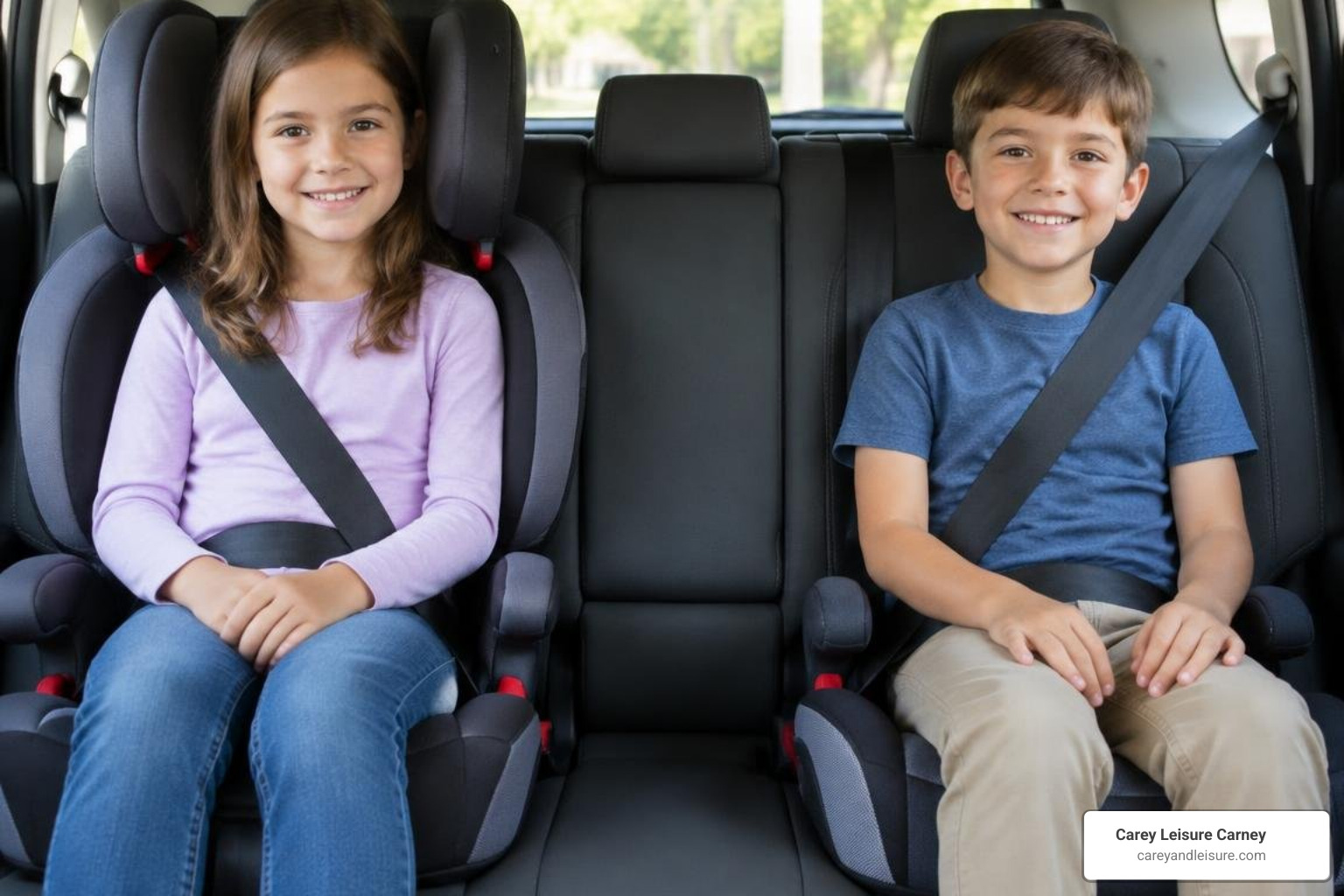
Parent’s Guide to Booster Seat Height and Weight Milestones
Standard Height and Weight for Booster Seat by Restraint Stage
Standard height and weight for booster seat milestones generally begin at 40 pounds and 38 to 57 inches tall, but children should remain in a forward-facing 5-point harness until they reach that seat’s maximum limits. Understanding when your child outgrows one restraint stage and is ready for the next requires looking beyond birthdays. Children grow at vastly different rates, and vehicle safety equipment is engineered around physical body dimensions rather than calendar age. While standing height gives parents an initial reference point, seated height—the distance from the vehicle seat cushion to the top of the child’s head and shoulders—determines how vehicle belts interact with their skeleton.
Navigating restraint transitions requires balancing manufacturer specifications with safety recommendations. Our child car seat laws guide 2025 details how car seats and boosters fit into an overarching vehicle safety plan.

Minimum Height and Weight for Booster Seat in Harness Mode
Combination seats (also known as harness-to-booster seats) feature an internal 5-point harness for younger children that can later be converted into a belt-positioning booster. In harness mode, these seats secure children from a minimum of 25 pounds up to 65 pounds, with a maximum standing height limit of 54 inches (137 cm).
To ensure safety in forward-facing harness mode:
- The child must be at least 2 years old.
- The harness straps must be threaded at or above the child’s shoulders.
- The chest clip must rest level with the armpits across the sternum.
- The harness must pass the “pinch test”—if you can pinch excess webbing vertically at the collarbone, it is too loose.
A child should never transition to booster mode simply because they meet the minimum weight of 40 pounds. Safety experts, including the American Academy of Pediatrics (AAP) and the National Highway Traffic Safety Administration (NHTSA), advise keeping children in a 5-point harness until they reach the maximum weight (typically 65 pounds) or maximum height (54 inches) allowed by the manufacturer.
| Restraint Mode | Minimum Weight | Maximum Weight | Minimum Height | Maximum Height | Minimum Age |
|---|---|---|---|---|---|
| Forward-Facing Harness | 25 lbs (11.4 kg) | 65 lbs (29.5 kg) | N/A | 54 in (137 cm) | 2 Years |
| High-Back Booster | 30–40 lbs (13.6–18 kg)* | 100 lbs (45.3 kg) | 38 in (97 cm) | 57 in (145 cm) | 4 Years |
| Backless Booster | 40 lbs (18 kg) | 110 lbs (50 kg) | 38–44 in (97–112 cm)* | 57 in (145 cm) | 4 Years |
*Note: Sizing minimums vary by model; always confirm with your specific seat manual.
Adjusting Height and Weight for Booster Seat Usage by Model
Booster seats serve one primary purpose: lifting the child so the vehicle’s adult lap-and-shoulder belt rests across strong skeletal bones rather than soft abdominal organs. Once converted to belt-positioning booster mode, combination seats and dedicated boosters typically accommodate children between 40 and 100 pounds (or up to 110 pounds on select models) who stand between 38 and 57 inches tall.
For instance, the KidFit Booster Instruction Manual specifies that high-back mode supports children from 30 to 100 pounds (38 to 57 inches), while backless mode supports children from 40 to 110 pounds (38 to 57 inches). Using any child restraint outside these engineered height and weight boundaries compromises its crashworthiness.
High-Back vs. Backless Booster Sizing and Head Support
Choosing between a high-back and a backless booster depends on your vehicle’s interior geometry and your child’s physical development. Both models use the vehicle’s 3-point lap-and-shoulder belt to secure the passenger, but they provide different levels of upper-body positioning and head protection.
High-Back Booster Sizing and Headrest Adjustment
High-back boosters support children starting at 30 to 40 pounds up to 100 pounds, with standing height limits of 38 to 57 inches. They are strongly recommended for younger booster users (ages 4 to 6) and vehicles lacking tall rear seatbacks or adjustable headrests.
A high-back booster features an integrated backrest with side-impact wings and adjustable shoulder belt routing guides. To adjust the seat correctly:
- Position the backrest so the integrated headrest supports the child’s head, ensuring the tops of their ears remain below the top of the booster headrest.
- Route the shoulder belt through the designated red or color-coded guide.
- Verify that the belt guide sits just above the child’s shoulder, directing the belt flat across the collarbone without rubbing against the neck or slipping off the shoulder joint.
Most modern high-back boosters provide multi-position headrest adjustments (often 8 to 10 height settings) to accommodate upper-body growth spurts.
Backless Booster Requirements and Seating Criteria
Backless boosters accommodate children weighing between 40 and 110 pounds who stand between 38 and 57 inches tall (some models require a minimum height of 44 inches). Because a backless booster is simply a raised cushion with belt-positioning armrests, it relies entirely on the vehicle’s interior to provide whiplash and head protection.
You should only use a backless booster if the vehicle seatback is tall enough to support the child’s head. The vehicle seat cushion or headrest must extend at least to the top of the child’s ears. If your vehicle has low seatbacks without head restraints, you must use a high-back booster to prevent severe cervical spine injuries during a rear-impact collision.
When using a backless model, the vehicle lap belt must be routed underneath both lower armrests to keep the belt low across the upper thighs.
Graduating from Boosters: The 5-Step Belt Fit Test

Many parents wonder when their child can stop using a booster seat altogether. The transition from a booster seat to an adult seat belt alone is governed by height and skeletal development, not a specific birthday. The standard safety benchmark is 4 feet 9 inches (57 inches), a height most children do not reach until between 9 and 12 years of age.
Rushing this transition puts children at risk of severe injury. According to NHTSA crash data, children who leave booster seats prematurely are over twice as likely to suffer severe trauma during a crash compared to those properly restrained in a belt-positioning seat.
The Biomechanics of Proper Lap and Shoulder Belt Fit
Adult vehicle seat belts are designed for adult bodies. An adult pelvis features developed anterior superior iliac spines—bony hip crests that hold the lap belt low across the pelvis during rapid deceleration. A young child’s pelvis is rounder and less defined.
When a child sits directly on a vehicle seat without a booster before they are tall enough:
- The seat cushion is too deep, causing them to slouch.
- Slouching forces the lap belt up into the soft abdomen rather than across the upper thighs.
- During a frontal impact, the child risks “submarining”—sliding forward under the belt—which causes the belt to crush internal organs (spleen, liver, intestines) and fracture lumbar vertebrae. This trauma is known clinically as Seat Belt Syndrome.
- If the shoulder belt rubs against their neck or face, children often place it behind their back or under their arm, eliminating upper-body restraint and risking head trauma or ejection.
Conducting the 5-Step Fit Test in Your Vehicle
Before retiring the booster, test your child in the specific vehicle and seating position they use every day:
- Back Flat: Does the child sit all the way back against the vehicle seatback without slouching?
- Knees Bent: Do the child’s knees bend naturally over the front edge of the vehicle seat cushion without them having to slide forward?
- Lap Belt Position: Does the lap belt lie low and flat across the upper thighs and hip bones, touching the pelvic region rather than the stomach?
- Shoulder Belt Position: Does the shoulder belt cross snugly over the center of the collarbone and sternum, away from the neck and without slipping off the shoulder?
- Posture Endurance: Can the child remain seated in this exact position for the entire trip without slouching, leaning over, or tucking the belt?
If the answer to any of these five questions is “no,” the child must remain in a booster seat.
Florida Restraint Laws and Safe Installation Guidelines
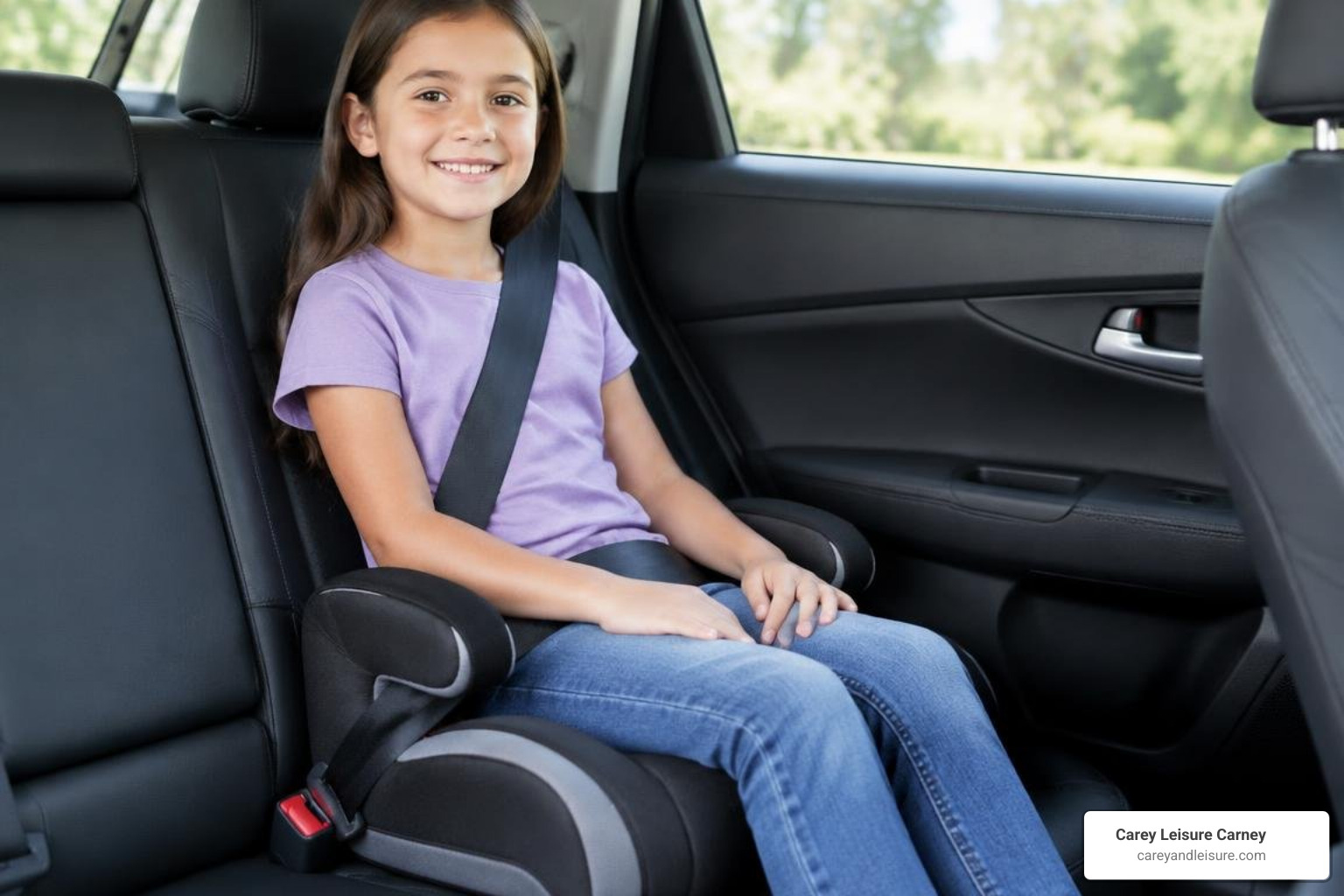
Florida motorists must adhere to state traffic laws, but every parent should understand that legal minimums do not represent optimal crash protection. Reviewing the official Florida Child Restraint Statutes alongside the Florida Department of Highway Safety Guidelines shows where statutory law leaves off and biomechanical best practices begin. For broader family vehicle awareness, our team has also compiled guidelines for child vehicle safety.
Florida Legal Minimums vs. Safety Best Practices
Florida law requires children aged 5 and younger to be secured in a crash-tested, federally approved child restraint device. Children aged 0 through 3 must use a separate carrier or integrated child seat, while children aged 4 through 5 may use a separate carrier, integrated child seat, or booster seat. Under Florida law, a driver carrying an unrestrained 4- or 5-year-old faces a moving violation, a $60 base fine, and 3 driver’s license points.
However, Florida statutes do not mandate booster seats for children aged 6 and older. This statutory cutoff creates a dangerous gap: a typical 6-year-old is far shorter than the 4-foot-9 threshold required for an adult seat belt to fit safely. Following only the statutory minimum exposes young children to severe abdominal and spinal injuries. We advise all parents across Clearwater, Largo, St Petersburg, New Port Richey, Spring Hill, Trinity, and Wesley Chapel, Florida to follow AAP guidelines and keep children in boosters until they fully pass the 5-Step Belt Fit Test.
LATCH Lower Anchor Limits and Seat Belt Anchoring
The Lower Anchors and Tethers for Children (LATCH) system secures child restraints to vehicle frames. When installing seats, keep these weight thresholds in mind:
- Harness Mode LATCH Limits: Federal safety rules establish a 65-pound combined weight limit for lower LATCH anchors (the weight of the car seat plus the weight of the child). Most car seat manufacturers require switching from lower LATCH anchors to the vehicle seat belt once the child reaches 40 to 45 pounds. Always use the top tether strap in forward-facing harness mode, regardless of whether lower anchors or the vehicle belt secure the base.
- Booster Mode LATCH Use: In belt-positioning booster mode, the vehicle’s lap-and-shoulder belt holds the child in place. If your booster features rigid or flexible lower LATCH connectors, you may attach them to keep the booster stable and prevent it from shifting. This also stops an unoccupied booster seat from becoming a projectile in a crash when your child isn’t in the car.
- Lap-Only Belt Prohibition: Never use a booster seat with a lap-only seat belt. Booster seats require a 3-point lap-and-shoulder belt to prevent severe head and torso excursion during an impact.
Frequently Asked Questions About Booster Seat Sizing
At what weight should a child transition from a forward-facing harness to a booster seat?
Children should not transition to a booster seat at the bare minimum weight of 40 pounds unless they have maxed out their forward-facing harness. Children are safest remaining in a 5-point harness until they reach the upper weight limit (typically 65 pounds) or upper height limit (typically 54 inches) of their harness. Additionally, children must be at least 4 years old and mature enough to sit upright without slouching or playing with the seat belt.
Can lower LATCH anchors be used with a belt-positioning booster seat?
Yes, if the booster manufacturer permits it. In booster mode, the lower anchors simply keep the seat secured to the vehicle cushion; they do not restrain the child. The vehicle’s 3-point lap-and-shoulder belt provides all crash restraint. Securing the booster with lower LATCH anchors prevents it from flying forward and injuring other passengers when unoccupied.
What happens if a child stops using a booster before reaching 4 feet 9 inches?
When a child transitions out of a booster too early, the vehicle lap belt rests across the soft abdomen rather than the pelvis, and the shoulder belt crosses the neck or face. In a collision, this poor belt alignment can cause Seat Belt Syndrome—a pattern of severe internal injuries, abdominal organ lacerations, and spinal fractures caused by the belt cutting into the abdomen—as well as traumatic brain injuries or ejection.
Conclusion
Making sure your child is secured in the right seat for their size is one of the most effective steps you can take to protect them on the road. Do not rush transitions based on birthdays or peer milestones. Keep your child in each restraint stage—from rear-facing to forward-facing harness, to high-back booster, to backless booster—until they reach the maximum height and weight limits set by the manufacturer. Only transition them to an adult seat belt once they pass every step of the 5-Step Belt Fit Test.
For families across Clearwater, Largo, St Petersburg, New Port Richey, Spring Hill, Trinity, and Wesley Chapel, Florida, motor-vehicle safety is a priority. If your family has been impacted by a traffic collision, the Board-Certified trial attorneys at Carey Leisure Carney bring over 100 years of combined legal experience to personal injury and child safety matters. Review our guide on childrens car seat laws to stay informed, protect your passengers, and travel with confidence.