
Understanding Florida PIP Coverage Changes and Deadlines Explained
Introduction
The new Florida PIP law 2023 keeps mandatory $10,000 Personal Injury Protection coverage but ties full benefits to an Emergency Medical Condition (EMC) diagnosis, caps non-emergency care at $2,500, and requires initial treatment within 14 days. The same 2023 tort reforms also shortened the negligence statute of limitations to two years, restricted medical evidence to actual amounts paid or Medicare-based benchmarks, and repealed one-way attorney fees in PIP disputes. Understanding how no-fault insurance operates alongside these legislative reforms is critical for any injured motorist. Navigating the aftermath of a car crash across Tampa Bay communities like Clearwater, Largo, St Petersburg, New Port Richey, Spring Hill, Trinity, or Wesley Chapel requires strict adherence to statutory deadlines and procedural hurdles. When Florida enacted comprehensive tort reform through House Bill 837 in 2023, it dramatically reshaped the personal injury landscape, creating intricate connections between routine insurance claims and third-party litigation.
Key Provisions of the New Florida PIP Law 2023
Florida’s Motor Vehicle No-Fault Law continues to serve as the first line of financial defense for drivers injured in motor vehicle collisions. Every vehicle owner registered in the state must maintain a minimum of $10,000 in Personal Injury Protection (PIP) coverage. While the fundamental architecture of no-fault benefits remains in place, the legislative reforms of 2023 shifted how these claims intersect with broader civil actions and claim valuations.
Benefit Caps Under the New Florida PIP Law 2023
The core financial structure of PIP centers around the determination of an Emergency Medical Condition (EMC). Under Chapter 627 Section 736 – 2023 Florida Statutes, an injured motorist can access up to the maximum $10,000 in medical benefits only if a licensed physician, dentist, physician assistant, or advanced practice registered nurse documents that the patient suffered an EMC. An EMC is statutorily defined as a medical condition manifesting itself by acute symptoms of sufficient severity such that the absence of immediate medical attention could result in serious jeopardy to patient health, serious impairment to bodily functions, or serious dysfunction of any bodily organ or part.
If an injured individual seeks treatment but does not receive an official EMC diagnosis from a qualified medical professional, their available medical reimbursement is capped at $2,500.
To access any benefits at all, the claimant must seek initial medical services within 14 days of the motor vehicle accident. Missing this strict 14-day window results in a complete forfeiture of all PIP benefits, leaving the injured party personally responsible for all treatment expenses. Under statutory pip coverage limits, PIP reimburses 80% of reasonable and medically necessary expenses up to the applicable limit, leaving the remaining 20% as an out-of-pocket responsibility or a balance to be covered by medical payments (MedPay) or health insurance. Reviewing what is covered under personal injury protection can help clarify which treatments qualify under this standard.
Disability, Death Benefits, and Excluded Treatments
In addition to medical expenses, PIP provides essential economic loss benefits:
- Disability Benefits: Reimburses 60% of verified loss of gross income and loss of earning capacity resulting from the injury, distributed bi-weekly. It also covers 100% of reasonable expenses incurred for necessary household services that the injured person would have performed without injury.
- Death Benefits: Provides up to $5,000 per deceased individual, payable to the personal representative or heirs. This is paid in addition to any medical and disability benefits disbursed prior to death.
Despite broad coverage for diagnostic testing, hospital visits, surgery, and chiropractic care, Florida law strictly excludes certain therapies. Even if prescribed by a licensed physician, massage therapy and acupuncture are completely non-reimbursable under PIP. Understanding what is pip insurance florida requires recognizing these hard statutory boundaries.
Evidentiary Standards and Medical Expense Admissibility
The 2023 legal reforms introduced massive changes to how medical bills are presented to juries during third-party personal injury trials. Under Florida Statute § 768.0427, the legislature created uniform standards that restrict plaintiffs from presenting inflated “sticker price” medical charges to establish damages.
Letters of Protection and Actual Amounts Paid
For years, injured individuals without health insurance obtained care through Letters of Protection (LOPs), which allowed providers to treat patients in exchange for payment directly from any eventual settlement or verdict. The 2023 law establishes strict rules governing the admissibility of these medical expenses in court:
- Satisfied Charges: If a medical bill has already been paid by PIP, private health insurance, Medicare, or Medicaid, evidence of that expense is strictly limited to the actual amount paid and accepted by the provider, not the original billed amount.
- Unsatisfied Charges With Health Coverage: If a claimant has health insurance but chooses to treat under an LOP, the admissible evidence is limited to the amount the health insurer would have paid under its contract, plus the claimant’s required copay or deductible.
- Uninsured Claimants: If the claimant has no health insurance, admissible past and future medical evidence is capped at 120% of the Medicare reimbursement rate (or 170% of the applicable state Medicaid rate if no Medicare rate exists).
- LOP Transparency: Claimants must produce full copies of any LOP, complete itemized billings with standard CPT and diagnostic coding, and disclose whether the provider sold or factored the account receivable to a third-party medical funding company.
| Claimant Insurance Status | Admissible Past Paid Medical Expenses | Admissible Unsatisfied / Future Medical Expenses |
|---|---|---|
| Private Health Insurance | Actual amount paid and accepted by provider | Contracted rate the insurer would pay plus patient copay |
| Medicare / Medicaid | Actual statutory amount paid and accepted | Official Medicare / Medicaid statutory fee schedule rate |
| Uninsured (Cash / LOP) | Actual amount paid (if satisfied) | 120% of Medicare Part B fee schedule (or 170% of Medicaid) |
Negligence Statute of Limitations and Bad Faith Reforms
One of the most consequential aspects of the 2023 tort reform bill was the overhaul of Florida Statute § 95.11. The legislative text documented in CODING: Words stricken are deletions; words underlined are additions. cut the general statute of limitations for negligence claims in half—from four years down to two years for accidents occurring on or after March 24, 2023. While direct first-party contract lawsuits against your own insurer for unpaid PIP benefits still follow standard breach of contract timelines, any third-party bodily injury lawsuit against the at-fault driver must be formally filed within two years.
The legislation also overhauled bad faith litigation under Florida Statute § 624.155:
- 90-Day Safe Harbor: An insurer cannot be held liable for bad faith if it tenders the lesser of its policy limits or the amount demanded by the claimant within 90 days after receiving formal notice of the claim and sufficient supporting evidence.
- Higher Liability Standard: The law codified that mere negligence alone is insufficient to sustain a bad-faith claim against an insurance carrier.
These shifts make managing your no-fault insurance florida claims quickly and accurately essential to preserving your right to seek full financial recovery.
Legal Claims, Pre-Suit Demands, and Attorney Fees
Litigating disputed insurance claims underwent a structural transformation when the Florida Legislature eliminated longstanding fee-shifting provisions that previously favored consumers.
Litigation and Attorney Fee Shifts Under the New Florida PIP Law 2023
Historically, Florida Statute § 627.428 allowed policyholders and medical providers with an assignment of benefits to recover their reasonable attorney fees from an insurer if they prevailed in a dispute for unpaid benefits, even if the disputed balance was small. The 2023 legislation repealed § 627.428 and significantly amended § 627.736(8), eliminating this one-way attorney fee entitlement in standard PIP lawsuits.
The law introduced several critical shifts regarding attorney fees:
- Lodestar Fee Presumption: Courts now operate under a strong statutory presumption that a standard lodestar fee (reasonable hourly rate multiplied by reasonable hours expended) is sufficient. Contingency fee multipliers are now restricted to rare and exceptional circumstances where evidence proves competent counsel could not otherwise be retained.
- Declaratory Judgment Actions (§ 86.121): Insured policyholders—though not third-party medical provider assignees—may still recover attorney fees if they prevail in a declaratory judgment action following an insurer’s complete denial of coverage.
- Proposals for Settlement (§ 768.79): Claimants and insurers must now rely on Florida’s Offer of Judgment statute. If a claimant serves a formal settlement proposal that is rejected by the insurer and later obtains a judgment at least 25% greater than the offer, fee shifting may apply.
These legislative adjustments were detailed extensively as the new bill enacts changes to pip insurance across state courts.
Statutory Pre-Suit Demand Letters and Claim Timelines
Before filing any lawsuit against an auto insurer for overdue PIP benefits, a claimant or medical provider must comply with the strict pre-suit notice requirements of Florida Statute § 627.736(10).
A claimant must send a formal pre-suit demand letter via certified or registered mail, allowing the insurer 30 days to review and pay the disputed amount plus applicable interest and a 10% statutory penalty (up to a maximum penalty of $250). To be legally sufficient, the demand letter must include:
- The exact name of the insured and the specific policy number.
- An itemized statement specifying each exact medical service, treatment date, and CPT billing code in dispute.
- The exact amount claimed to be overdue.
- An accounting of all prior payments made by the insurer.
- An executed assignment of benefits if submitted by a healthcare provider.
If the insurer pays the demanded amount along with interest and the penalty within the 30-day window, no lawsuit may be filed. Insurers also retain the broad right to conduct an Examination Under Oath (EUO) of the claimant. Submitting to an EUO is a mandatory condition precedent to coverage; an unexcused failure to attend relieves the insurer of its obligation to pay benefits.
Healthcare Provider Rules and Fraud Investigation Protocols
Medical practices treating auto accident victims face stringent billing requirements and scrutiny under statutory anti-fraud guidelines.
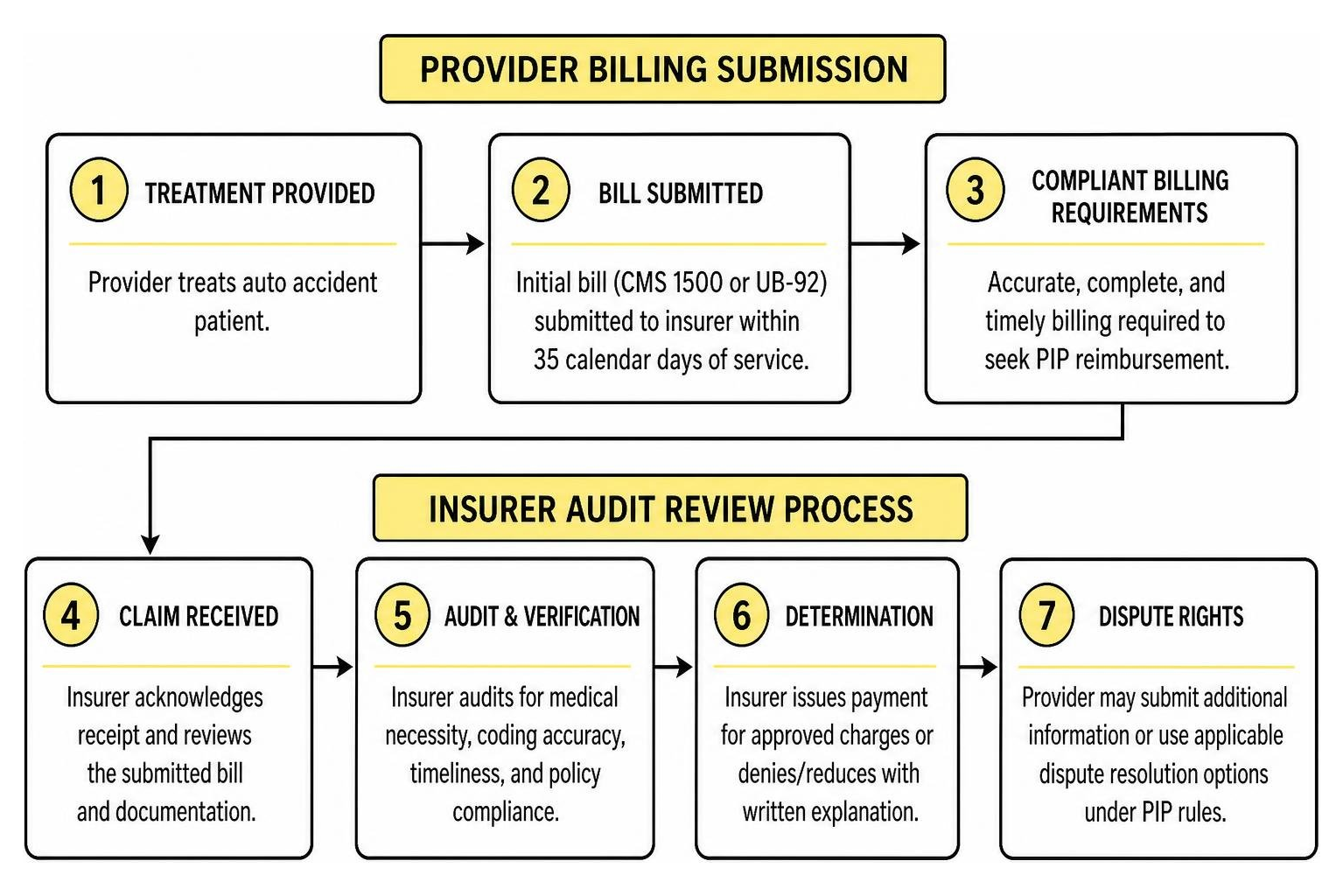
Medical Billing Deadlines and Submission Requirements
To secure reimbursement under PIP, medical clinics must submit their charges within rigid timeframes:
- The 35-Day Rule: Initial bills for medical services must be submitted to the insurer on standard CMS 1500 or UB-92 forms within 35 calendar days after the date of service.
- The 75-Day Rule: If the healthcare provider submits a timely written notice of initiation of treatment within 21 days of the first visit, the provider receives an extended 75-day window from the date of service to submit the complete billing statement.
Bills submitted after these deadlines are deemed overdue and non-compensable unless the provider demonstrates reasonable cause for the delay. An overview of how florida no-fault car accidents explained simply details how these billing rules protect accident victims from surprise balance bills.
Fraud Investigation Procedures and Insurer Safe Harbors
The statute provides insurance carriers with extended investigative timelines when fraud is suspected:
- 30-Day Fraud Notice: If an insurer has a reasonable belief that a PIP claim is fraudulent, it must notify the claimant or provider in writing within 30 days of receiving the claim.
- 60-Day Investigation Extension: Providing written notice automatically grants the insurer an additional 60 days to investigate, creating a total 90-day safe-harbor window during which payments are not considered overdue.
- $5,000 Emergency Reserve: Insurers are required to reserve $5,000 of the total PIP benefit pool specifically for emergency medical service providers and hospital emergency departments for 30 days following notice of the crash.
If an investigation reveals that a claim is fraudulent, the insurer may deny all benefits and pursue civil recovery of any overpayments. Reading through personal injury protection pip insurance 101 part 2 provides deeper context on how insurance carriers execute these fraud audits.
Frequently Asked Questions About Florida PIP Law
How does the 14-day rule affect PIP medical coverage in Florida?
You must receive initial medical care within 14 calendar days of your motor vehicle collision. If you fail to seek treatment from a licensed physician, dentist, chiropractor, hospital, or ambulance provider within those first two weeks, you lose 100% of your PIP benefits, regardless of how severe your injuries are.
What is the difference between EMC and non-EMC benefit limits?
An Emergency Medical Condition (EMC) determination unlocks the full $10,000 PIP benefit limit. Without a formal EMC diagnosis documented in your medical records by an authorized medical provider, Florida law caps your available PIP medical benefits at $2,500.
Can you still recover attorney fees if an insurer denies your PIP claim?
While the blanket one-way attorney fee statute (§ 627.428) was repealed, individual insured policyholders can still recover attorney fees under § 86.121 if they prevail in a declaratory judgment action following a complete denial of coverage. Litigants may also utilize formal Proposals for Settlement under Florida Statute § 768.79 to shift attorney fees if their final recovery beats their settlement offer by 25% or more.
Conclusion
Understanding the modern no-fault system and related statutory deadlines is essential for safeguarding your financial recovery after a car crash. The changes from Florida’s 2023 tort reform make early action, meticulous documentation, and seasoned legal guidance more important than ever.
At Carey Leisure Carney, our Board-Certified civil trial attorneys—a distinction earned by fewer than 2% of lawyers in Florida—bring over 100 years of combined legal experience to every case. We provide direct attorney access and personalized representation to injured clients across Clearwater, Largo, St Petersburg, New Port Richey, Spring Hill, Trinity, and Wesley Chapel. If you have questions about how these legislative changes impact your accident claim, contact our team to discuss your legal options and learn more about new pip florida law changes.