Fatal Accident Claims 2025: Secure Justice
Understanding Your Rights After Losing a Loved One
Fatal accident claims offer a legal path for families to seek compensation when a loved one’s death is caused by another’s negligence. These claims help cover financial losses and acknowledge the emotional devastation families endure.
Quick Overview: What You Need to Know
- Two types of claims exist: A survival action for the deceased’s losses and a wrongful death action for the family’s losses.
- Eligible claimants include spouses, children, parents, and certain dependent relatives.
- Compensation covers economic losses (medical bills, lost income) and non-economic losses (loss of companionship).
- Florida’s deadline is typically two years from the date of death to file a claim.
- A personal representative must be appointed by the court to file the lawsuit.
When a death results from someone else’s carelessness—a drunk driver, a negligent employer, or a reckless motorist—the pain is compounded by anger and financial strain. While no amount of money can replace a loved one, Florida law provides a way for families to recover from the financial harm of losing a provider and caregiver.
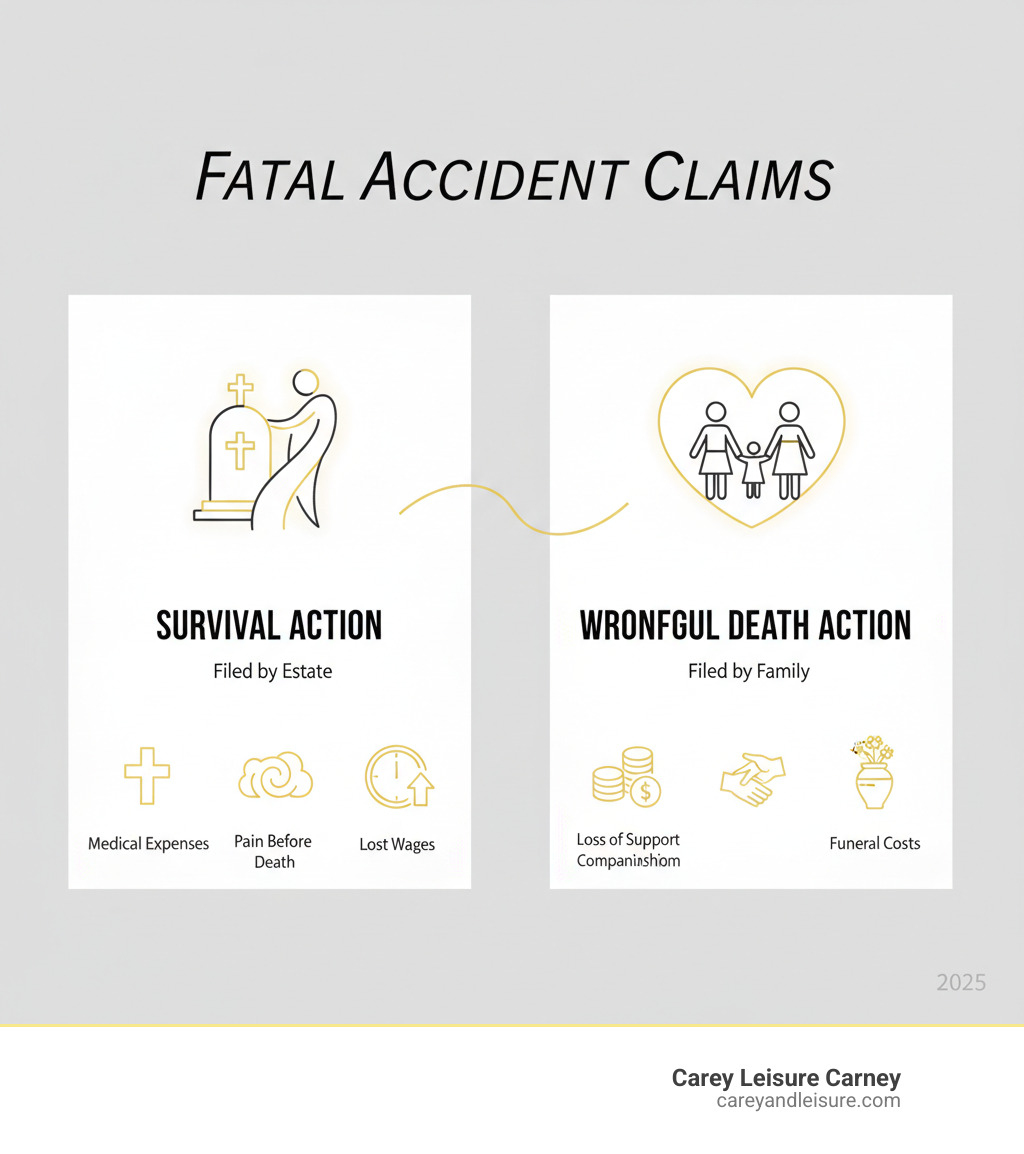
Florida’s Wrongful Death Act creates two legal actions: one for the deceased’s estate (recovering medical expenses and pain suffered before death) and another for surviving family members (recovering lost financial support and companionship).
As Thomas W. Carey, founding partner of Carey Leisure Carney, I’ve guided families through these claims for over three decades. My personal experience—losing my wife Joni to a drunk driver—fuels my commitment to helping families steer these devastating cases with legal expertise and genuine compassion.
Understanding Fatal Accident Claims and Who is Eligible
When someone dies due to another’s negligence, a fatal accident claim is the legal process for seeking compensation. In Florida, these cases are governed by the Florida Wrongful Death Act, which outlines who can file a claim and what damages they can receive.
The law recognizes two distinct types of harm. A survival action compensates the deceased’s estate for losses the person suffered before death, such as pain, medical bills, and lost wages. A wrongful death action compensates surviving family members for their own losses, like the income, support, and companionship they will now live without. Both claims are typically filed together in a single lawsuit.

Florida law specifies who can benefit from a wrongful death claim. These individuals are known as “survivors” and include:
- Spouses, for the loss of their partner’s companionship, protection, and support.
- Children (of any age), for the loss of parental guidance, support, and love.
- Parents of a deceased minor child, or of an adult child if there are no other survivors.
- Dependent blood relatives who relied on the deceased for financial support or services.
However, individual survivors cannot file a lawsuit on their own. Florida law requires a court-appointed personal representative to file the claim on behalf of the estate and all eligible survivors. This ensures the legal process is managed in a coordinated way. Our attorneys help families steer the probate process to appoint a representative and ensure every survivor is properly identified. For more details, see our page on More info about Wrongful Death Lawyer.
The Florida Wrongful Death Act clearly separates what the estate can recover versus what family members can. The survival action (estate claim) covers the deceased’s personal losses, including pain and suffering experienced before death, all medical expenses from the injury to death, and any lost wages during that period. These damages become part of the estate and are distributed according to the will or state law.
The wrongful death action (family claim) compensates survivors for their future losses. This includes loss of financial support and the value of services the deceased provided (like childcare or household maintenance). It also covers non-economic damages like loss of companionship, mental pain and suffering, and for children, the loss of parental guidance. Funeral expenses are also recoverable by the survivors who paid them. This compensation goes directly to the eligible family members. Our team carefully develops both parts of the claim to ensure your family receives full compensation for every loss.
Calculating Compensation in a Fatal Accident Case
While no amount of money can replace a loved one, fatal accident claims are designed to provide financial security and acknowledge the profound losses families suffer. Calculating compensation involves assessing both tangible economic losses and intangible emotional damages.
Our goal is to maximize compensation by examining every way the death has impacted your family, from immediate bills to a lifetime of lost support and companionship.

Florida law divides damages into two categories. For more on case valuations, see our guide on What is my Personal Injury Case Worth?
| Pecuniary (Economic) Damages | Non-Pecuniary (Non-Economic) Damages |
|---|---|
| Loss of financial support (past and future) | Loss of companionship and protection |
| Loss of services (e.g., childcare, household duties) | Mental pain and suffering of survivors |
| Funeral and burial expenses | Loss of parental guidance and instruction |
| Medical expenses incurred before death | Loss of consortium (for spouse) |
| Lost net accumulations (for the estate) |
Pecuniary (Economic) Damages You Can Claim
Pecuniary damages are the measurable financial losses. They require careful analysis and often expert testimony to project accurately.
- Loss of support and services: This includes the income your loved one would have contributed and the monetary value of services they provided, like childcare or home maintenance.
- Future loss of support: We work with economic experts to project future earnings based on age, health, and career path.
- Lost net accumulations: This is the wealth the deceased would have accumulated and left to their heirs, recovered by the estate.
- Medical expenses: All medical costs from the time of injury until death are recoverable by the estate.
- Funeral expenses: Reasonable costs for burial or cremation can be recovered. For more, see our page on Funeral Home Negligence Lawsuit Damage Claims.
Non-Pecuniary (Non-Economic) Damages
These damages address the profound emotional and relational losses that have no price tag but are recognized by law as deserving of compensation.
- Loss of companionship and protection: This compensates for the absence of love, comfort, and guidance from a spouse, parent, or child.
- Mental pain and suffering: This addresses the grief, anguish, and emotional trauma survivors endure.
- Loss of parental companionship, guidance, and instruction: This specifically recognizes the immense loss a child suffers when a parent dies.
There is no fixed formula for these damages. A jury considers the unique relationship you had with your loved one and the depth of your loss. Our job is to tell your story to help the court understand the magnitude of what you’ve lost.
What is a Statutory Bereavement Award?
You may have heard of a “statutory bereavement award,” a concept from the UK’s Fatal Accidents Act 1976 that provides a fixed payment for grief. Florida law does not have this. Instead, compensation for emotional suffering is determined on a case-by-case basis as part of the non-pecuniary damages, allowing for a valuation that reflects the unique nature of your family’s loss.
The Legal Process for Fatal Accident Claims
Navigating the legal system while grieving is an overwhelming burden. Our team at Carey Leisure Carney is here to shoulder that burden, handling the complexities of fatal accident claims so you can focus on your family.
The legal process involves proving negligence, gathering evidence, and either negotiating a settlement or taking the case to trial. With experienced representation, you can steer this process with confidence. Learn more about the court system in The Litigation Process.
Establishing Liability and Gathering Evidence
To succeed, we must prove the at-fault party was negligent. This means showing they had a duty of care (e.g., to drive safely), they breached that duty (e.g., by texting), this breach caused the death, and your family suffered damages as a result.
Evidence is critical. We begin gathering it immediately to build a strong case. Key evidence includes:
- Police Reports: These provide a preliminary assessment of fault. You can get a Florida crash report from the Florida Department of Highway Safety and Motor Vehicles’ portal.
- Witness Statements: Independent accounts of the accident are invaluable.
- Expert Testimony: Accident reconstructionists, medical experts, and economists can explain how the accident happened and quantify your financial losses.
- Physical Evidence: This includes medical records, photos and videos from the scene, and employment records to prove lost income.
Promptly hiring an attorney is crucial, as evidence like security footage can be lost if you wait. For more on this, see our guide on Documenting Evidence in Personal Injury Claims.
Navigating the Statute of Limitations for fatal accident claims
Florida law imposes a strict deadline, or “statute of limitations,” for filing a lawsuit. For most fatal accident claims, you have two years from the date of death to file. If you miss this deadline, you lose your right to seek compensation forever.
Two years may seem like a long time, but investigating an accident, gathering evidence, and negotiating with insurers takes time. Contacting an attorney early protects your family’s legal rights and ensures critical deadlines are not missed. While narrow exceptions exist, such as in some medical malpractice cases, it is never wise to delay. The time limits for different claims, like those detailed in How Long Do You Have to File a Medical Malpractice Lawsuit in Florida?, highlight the need for prompt action.
How a Lawyer Maximizes Compensation for fatal accident claims
While you can technically file a claim yourself, families represented by experienced attorneys almost always recover significantly more compensation. Insurance companies often make low offers to unrepresented claimants, hoping for a quick settlement.
An experienced lawyer levels the playing field and maximizes your recovery by:
- Accurately Valuing Your Case: We work with economists and other experts to calculate the full extent of your financial and emotional losses, ensuring no damage is overlooked.
- Negotiating Skillfully: We handle all communication with insurers, countering their tactics and building leverage for a fair settlement.
- Identifying All Liable Parties: In many cases, multiple parties (like a bar that overserved a drunk driver) share responsibility. Identifying them all can significantly increase the available compensation.
- Preparing for Trial: We prepare every case as if it will go to trial. This reputation for being trial-ready gives us significant leverage in negotiations, as insurers know we won’t back down from a fight for fair compensation.
Most importantly, we protect your family’s rights throughout the process. To understand more about why representation is so important, read Why You Need a Personal Injury Lawyer.
Common Causes of Fatal Accidents and Support for Families
Behind every fatal accident claim is a family in Clearwater, Largo, or our surrounding communities who has lost someone they love. These tragedies are almost always preventable, stemming from another party’s negligence.
Understanding the common causes of fatal accidents can help you recognize when you have grounds to seek justice. More importantly, knowing that legal and emotional support is available can provide a path forward.

Typical Causes of Fatal Accidents
Negligence can take many forms, but some causes of fatal accidents are more common than others:
- Car Accidents: As a leading cause of fatalities in Florida, these often involve distracted, reckless, or impaired driving. Our firm has experience in this area, including a specialized Drunk Driving Accident Claims Guide 2025.
- Truck and Motorcycle Accidents: The vulnerability of passenger cars and motorcyclists often leads to devastating outcomes. These cases can involve driver fatigue, poor maintenance, or simple inattention.
- Pedestrian Accidents: Florida’s busy roads pose a significant risk to pedestrians, especially children, when drivers fail to yield or pay attention.
- Workplace Accidents: Construction sites are particularly dangerous, with falls, equipment malfunctions, and electrocutions being common causes of death.
- Medical Malpractice: Fatalities can result from misdiagnosis, surgical errors, or medication mistakes, representing a breach of trust by medical professionals.
- Premises Liability: Property owners can be held liable for deaths caused by unsafe conditions like unsecured pools, poor maintenance, or inadequate security.
- Defective Products: Faulty brakes, dangerous drugs, or defective equipment can lead to fatal accidents, making the manufacturer liable.
Support Services for Grieving Families
I learned from personal experience, after losing my wife Joni to a drunk driver, that legal action alone cannot heal grief. While a successful claim provides financial security and a sense of justice, families need comprehensive support.
We believe in treating every client as a life, not a file. This means helping you find the resources you need to steer your grief. These can include:
- Grief Counseling: Professional therapists provide a safe space to process overwhelming emotions.
- Support Groups: Connecting with others who have experienced a similar loss can be incredibly healing and reduce feelings of isolation.
- Financial Planning Advice: Experts can help you restructure your finances and plan for the future after the loss of a provider.
- Crisis Support: For moments of overwhelming grief, resources like the National Suicide Prevention Lifeline (988) are available 24/7. While the link here is for an Australian service, Lifeline crisis support, similar resources are available locally.
Our firm is committed to providing compassionate guidance and connecting you with the support you need, whenever you need it. We understand that grief doesn’t keep business hours, and neither does our support for your family.
Frequently Asked Questions about Fatal Accident Claims
Families facing a sudden loss often have urgent questions. Here are answers to some of the most common questions we hear from families in Clearwater, St. Petersburg, and our surrounding communities.
What is the difference between a fatal accident claim and a wrongful death lawsuit?
In practice, the terms are often used interchangeably. A fatal accident claim is the general term for seeking compensation after a death caused by negligence. A “wrongful death lawsuit” is the specific legal action filed in court under the Florida Wrongful Death Act. Essentially, the lawsuit is the formal tool used to pursue the claim.
How much does it cost to hire a lawyer for a fatal accident claim?
Our firm, like most personal injury law firms, works on a contingency fee basis. This means you pay no upfront costs or hourly fees. Our fee is a percentage of the compensation we recover for your family. If we don’t win your case, you owe us nothing. This allows you to seek justice without any financial risk. For more details, visit our page on How Much Does It Cost to Hire a Personal Injury Attorney?.
How long does a fatal accident claim take to resolve?
The timeline for resolving a fatal accident claim varies greatly. A straightforward case with clear liability might settle in several months. However, complex cases involving disputed facts, multiple defendants, or uncooperative insurance companies can take much longer. If a case proceeds to trial, it can take two years or more. We strive to resolve cases efficiently but will never sacrifice the goal of achieving full and fair compensation for your family. We will keep you informed of the timeline every step of the way.
Securing Your Family’s Future After a Tragic Loss
No family should have to endure the loss of a loved one in a preventable accident. While you are grieving, the added weight of financial worries and legal questions can feel unbearable.
Pursuing a fatal accident claim is about more than money—it’s about holding the responsible parties accountable and securing your family’s financial future. Florida law allows you to recover compensation for lost income, medical and funeral bills, and the profound loss of companionship and guidance.
At Carey Leisure Carney, we understand this loss on a personal level. My own experience losing my wife to a drunk driver drives our firm’s commitment to every family we represent. Our board-certified attorneys, representing the top 2% in Florida, bring over 100 years of combined experience to your case. We provide direct access to your attorney and treat you with the compassion you deserve.
Let us handle the legal complexities so you can focus on healing. We offer a free, no-obligation consultation and work on a contingency fee basis, meaning you pay nothing unless we win.
Contact a Wrongful Death Attorney for a free consultation and let us start fighting for you today.