
Oil Rig Injuries: Your Guide to Finding a Specialized Accident Law Firm
When a Drilling Rig Accident Turns Your Life Upside Down
Finding the right drilling rig accident law firm can make the difference between a settlement that barely covers your bills and one that truly accounts for everything you’ve lost.
If you need a quick answer, here’s what to look for:
- Maritime law expertise — your attorney must know the Jones Act, LHWCA, and OCSLA inside out
- Board-certified trial experience — not just settlements, but proven courtroom results
- Investigation resources — ability to preserve evidence fast before companies destroy it
- Third-party claim capability — to pursue contractors, equipment makers, and site operators beyond basic workers’ comp
- No upfront fees — most reputable firms work on contingency, meaning you pay nothing unless you win
Drilling rig work is among the most dangerous jobs in America. Texas alone recorded 44 worker fatalities on oil rigs in a single year, and the injury and illness rate for well operations on the outer continental shelf has been climbing. Workers face blowouts, explosions, equipment failures, toxic chemical exposure, and falls from height — often miles offshore, far from immediate medical care. When something goes wrong, the physical, financial, and emotional toll on workers and their families is enormous.
The company’s lawyers start working the moment an accident happens. You deserve someone in your corner just as fast.
I’m Thomas W. Carey, founding partner of Carey Leisure Carney and a board-certified civil trial lawyer with decades of experience representing seriously injured Floridians — including those hurt in complex maritime and offshore incidents where choosing the right drilling rig accident law firm is critical to the outcome. My team is here to cut through the legal complexity so you can focus on recovering.
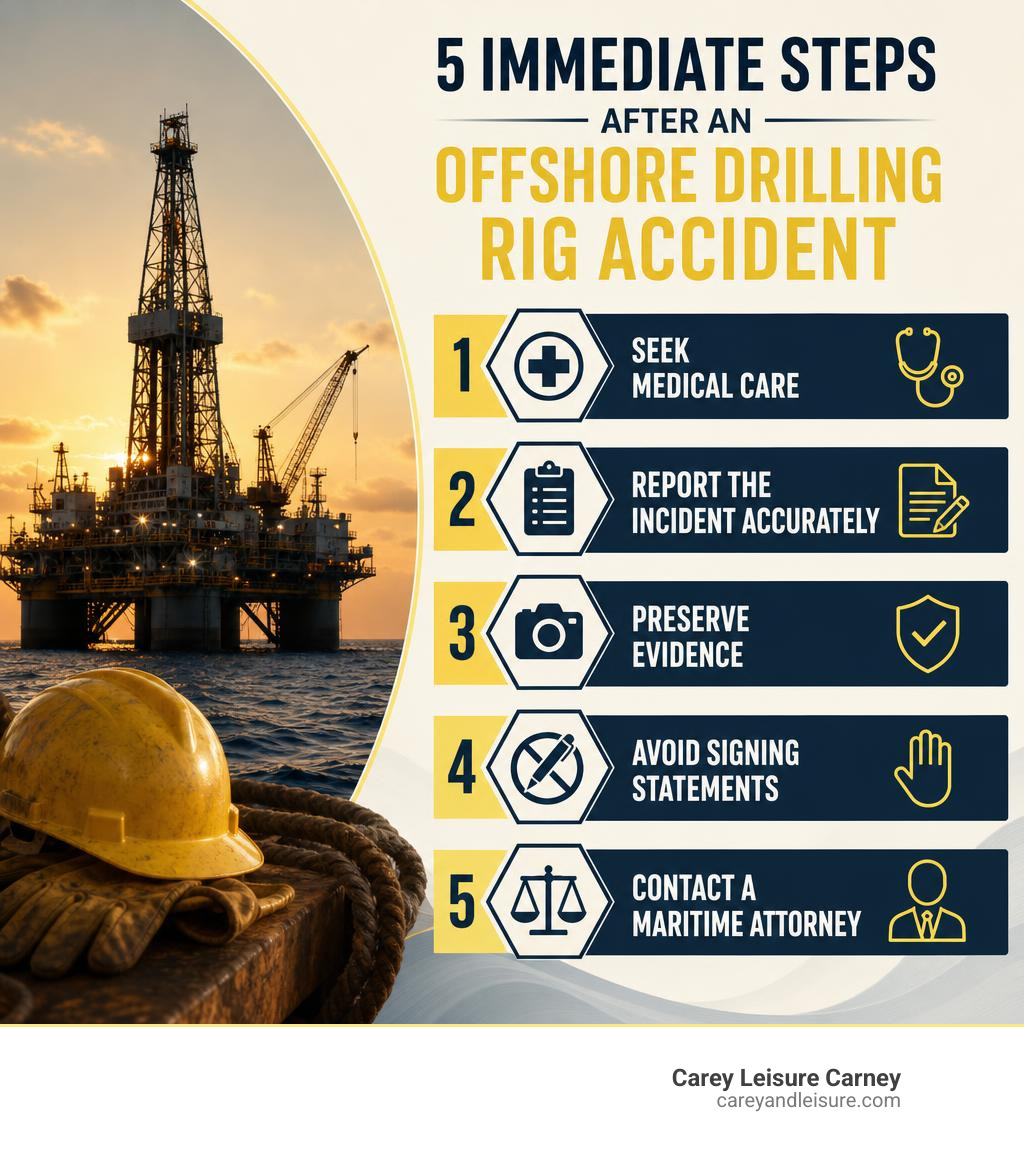
Easy drilling rig accident law firm word list:
Common Causes of Drilling Rig Accidents in the Gulf of Mexico
The Gulf of Mexico is a hub of offshore drilling, but it is also home to some of the most unforgiving work environments on Earth. On any given day, workers on drilling rigs are surrounded by volatile hydrocarbons, massive moving machinery, heavy high-pressure lines, and extreme weather. It only takes one small oversight, one skipped safety inspection, or one fatigued crew member to trigger a catastrophic event.
When we look at the cases handled by a specialized drilling rig accident law firm, several recurring hazards stand out. These aren’t just “unfortunate occurrences”—they are almost always the direct result of a company cutting corners to save time and protect its bottom line.
Common causes of these devastating accidents include:
- Blowouts and Well Control Failures: Uncontrolled releases of crude oil or natural gas can lead to massive explosions.
- Fires and Explosions: Rigs are packed with highly combustible materials, meaning a single spark from bad wiring or “hot work” can ignite an entire platform.
- Equipment and Machinery Failures: When cranes, top drives, or drawworks snap or fail, workers in the immediate vicinity stand little chance of escaping injury.
- Toxic Chemical Exposure: Workers frequently handle hazardous drilling muds, acids, and solvents, or face silent killers like hydrogen sulfide ($H_2S$) gas.
- Slips, Trips, and Falls: Working high up on a derrick or on a deck slick with oil, grease, or ocean spray makes falls a leading cause of severe injury.
If you have been hurt in the Gulf or while working on support operations onshore in Florida, securing representation from experienced Clearwater Personal Injury Attorneys is your first line of defense against the corporate legal teams already working to deny your claim.
Equipment Malfunctions and Well Control Failures
Drilling rigs rely on an array of highly specialized, heavy-duty machinery. When these systems are not maintained to strict industry standards, the results are catastrophic. Well control failures are particularly dangerous; in fact, industry data reveals that workover and completion operations account for roughly 35% to 40% of all blowouts and well control accidents.
The primary defense against a blowout is the Blowout Preventer (BOP). Unfortunately, BOP testing is occasionally neglected or rushed because operators want to avoid costly downtime. When a BOP fails to seal during a sudden pressure spike, the escaping gas can ignite instantly.
Beyond well pressure, other mechanical components pose daily threats to workers:
- Top Drive and Rotary Table Failures: These high-torque systems can fail, causing drill strings to drop or whip wildly across the rig floor.
- Crane and Rigging Failures: Rigs rely constantly on cranes to move heavy equipment. A snapped cable or structural crane collapse can crush anyone on deck.
- High-Pressure Piping and Mud Pump Failures: High-pressure lines can rupture, throwing metal fragments and toxic fluids at extreme velocities.
Investigating these equipment failures requires the same technical precision and attention to detail as investigating a commercial trucking disaster. Much like the steps outlined in our Truck Accident Injury Attorneys Complete Guide, holding a company liable for equipment failure requires securing maintenance logs, testing records, and manufacturer specifications before they can be altered or lost.
Human Error and Negligent Rig Operations
While mechanical parts do break, the root cause of almost every drilling rig accident is human error—specifically, systemic operational negligence by rig operators and third-party contractors.
Drilling operations run 24/7, and crew members are routinely subjected to grueling 12-hour shifts for weeks at a time. This level of physical and mental fatigue leads to slowed reaction times and lapses in judgment. To make matters worse, some operators place unqualified, poorly trained individuals in complex roles to fill labor gaps.
Contractor negligence is another major issue. A single drilling rig is a crowded ecosystem of direct employees, specialized subcontractors, equipment suppliers, and service vendors. When these entities fail to communicate, ignore OSHA or Bureau of Safety and Environmental Enforcement (BSEE) regulations, or skip basic lockout/tagout (LOTO) protocols, innocent crew members pay the price.
Legal Rights of Injured Offshore and Onshore Workers
If you are hurt on a drilling rig, your legal path to compensation depends entirely on where you were injured and what your specific job duties were. Unlike standard land-based jobs where state workers’ compensation is your only option, drilling rig injuries often fall under a complex web of federal maritime laws and specialized statutes.

Determining which laws apply to your accident requires a detailed jurisdictional analysis. If you were hurt onshore or on a fixed platform, your rights differ significantly from those of a worker injured on a floating, mobile rig. A specialized drilling rig accident law firm will evaluate your role to determine if you qualify under the Jones Act, the Longshore and Harbor Workers’ Compensation Act (LHWCA), or the Outer Continental Shelf Lands Act (OCSLA).
Understanding the Jones Act for Offshore Crew Members
The Jones Act (46 U.S.C. § 30104) is a powerful federal law designed specifically to protect maritime workers, legally classified as “seamen.” If you qualify as a seaman, the Jones Act grants you the right to sue your employer directly for personal injury damages resulting from employer or crew negligence.
To qualify for Jones Act protection, you must meet three main criteria:
- Vessel in Navigation: You must be assigned to a vessel that is “in navigation”—meaning it is afloat, operational, and capable of moving on navigable waters. This includes drilling ships, jack-up rigs, semi-submersibles, and tension-leg platforms.
- Connection to the Vessel: Your employment must contribute to the vessel’s function or the accomplishment of its mission.
- Temporal Connection: As a general rule, you must spend at least 30% of your total travel or work time on the vessel.
Under the Jones Act, the burden of proof for negligence is remarkably low—often referred to as a “featherweight” burden. You only need to prove that your employer’s negligence played a part, no matter how small, in causing your injury.
Longshore and Harbor Workers’ Compensation Act (LHWCA)
Not every offshore worker qualifies as a seaman. If you work on a fixed, permanently attached drilling platform, the law does not consider you a seaman because a fixed platform is not a “vessel in navigation.” Instead, your injuries will likely be covered under the Longshore and Harbor Workers’ Compensation Act (LHWCA), often extended offshore by the Outer Continental Shelf Lands Act (OCSLA).
The LHWCA is a federal workers’ compensation program that provides structured benefits to injured maritime workers, including harbor workers, shipbuilders, and fixed-platform operators.
Key aspects of the LHWCA include:
- No-Fault Benefits: You do not need to prove your employer was negligent to receive compensation.
- Medical Care Coverage: The program covers all reasonable and necessary medical treatment related to your work injury.
- Disability Compensation: It provides temporary or permanent disability payments, typically calculated at two-thirds of your average weekly wage, subject to federal caps.
While you cannot sue your direct employer under the LHWCA, you can still pursue a third-party personal injury lawsuit if a contractor, equipment manufacturer, or other outside entity caused your accident.
Maintenance and Cure vs. Full Jones Act Compensation
For qualifying seamen, it is vital to understand the difference between basic maritime benefits and a full negligence claim. If you are hurt on the job, you are immediately entitled to “maintenance and cure” benefits. However, if your employer’s negligence caused the accident, you can pursue a separate, full Jones Act compensation claim.
| Benefit Category | Maintenance & Cure (No-Fault) | Full Jones Act Claim (Negligence-Based) |
|---|---|---|
| Proof Required | None (only that injury occurred in service of vessel) | Must prove employer or crew negligence |
| Medical Expenses | Covered until Maximum Medical Improvement (MMI) | Covers past, present, and future medical bills |
| Lost Wages | Limited daily stipend (maintenance) | Full past lost wages and future loss of earning capacity |
| Pain & Suffering | Not covered | Fully covered (physical pain, mental anguish, loss of capacity) |
| Punitive Damages | Only if employer willfully refuses to pay maintenance/cure | Available in cases of gross, reckless negligence |
What is Covered Under Maintenance and Cure?
Maintenance and cure is an ancient maritime right that functions as a no-fault safety net. If you are injured or fall ill while working in service of a vessel, your employer must pay these benefits regardless of who was at fault for the accident.
- Maintenance: This is a daily stipend intended to cover your basic living expenses on land—such as food, rent/mortgage, utilities, and homeowners insurance—equivalent to what you would have received while living aboard the vessel.
- Cure: This covers all of your reasonable and necessary medical expenses, including surgeries, physical therapy, medications, and medical equipment.
These benefits must be paid until you reach a state of Maximum Medical Improvement (MMI). MMI means that your condition has stabilized, and no further medical treatment is expected to improve your physical recovery.
Unfortunately, many employers try to stop paying maintenance and cure early by pressure-testing company-friendly doctors to declare you “healed” before you actually are. This is why having an experienced drilling rig accident law firm monitoring your medical progress is so important.
Pursuing Additional Damages Under the Jones Act
While maintenance and cure keeps a roof over your head and pays your initial medical bills, it rarely covers the true, long-term costs of a life-altering injury. To recover full compensation, you must file a Jones Act negligence claim.
If we can prove your employer failed to provide a safe working environment, failed to maintain equipment, or failed to adequately train the crew, you can recover:
- Full Lost Wages: Not just a small daily stipend, but your actual past lost earnings.
- Lost Earning Capacity: If your injuries prevent you from ever returning to high-paying rig work, you can recover the difference in what you would have earned over your working lifetime.
- Pain and Suffering: Compensation for the physical agony, emotional trauma, and loss of enjoyment of life caused by your injuries.
- Future Medical Care: Coverage for ongoing surgeries, therapy, and adaptive equipment you will need long after reaching MMI.
Choosing the Right Drilling Rig Accident Law Firm
The legal teams representing oil companies and maritime insurers are highly specialized, aggressive, and well-funded. They go to work immediately after an accident to control the narrative, limit their liability, and pressure injured workers into signing lowball settlement agreements or liability waivers. To level the playing field, you need a specialized drilling rig accident law firm representing you.

When choosing a firm to handle your claim, you should look for specific credentials. In Florida, only a small percentage of attorneys are Board Certified in Civil Trial Law. This certification is the highest level of evaluation by the Florida Bar, identifying attorneys with proven courtroom competence and specialized experience.
At Carey Leisure Carney, our board-certified trial lawyers bring over a century of combined experience to every case. We provide our clients with direct attorney access—meaning you will speak directly with your lawyer, not just a paralegal or case manager.
If you are wondering about the financial side of hiring a lawyer, you can read our guide on How Much Does A Truck Accident Lawyer Cost to understand how contingency fee structures work. In short: we work on a “no win, no fee” basis, meaning we advance all litigation costs and you pay nothing upfront.
Key Qualities of a Top Drilling Rig Accident Law Firm
A general personal injury attorney who primarily handles minor car accidents is not equipped to handle the complexities of an offshore drilling rig case. Maritime law is a highly distinct legal system with its own rules of civil procedure, jurisdictional guidelines, and evidentiary standards.
When vetting potential law firms, ensure they possess these key qualities:
- Deep Maritime and Federal Law Expertise: They must have a proven track record of handling Jones Act, LHWCA, and OCSLA claims.
- Substantial Financial Resources: Investigating a rig accident requires hiring top-tier experts, including marine engineers, accident reconstructionists, and safety compliance consultants. Your firm must have the financial strength to fund these costly investigations.
- Willingness to Go to Trial: Insurers know which law firms settle every case for pennies on the dollar and which ones are ready to fight in a courtroom. A firm with board-certified trial lawyers commands respect and secures higher settlements.
If you live in or near Pasco County, consulting a New Port Richey Truck Accident Attorney with experience in heavy industrial accidents is an excellent starting point for protecting your rights.
How a Drilling Rig Accident Law Firm Maximizes Your Compensation
A dedicated law firm will look far beyond basic workers’ compensation to identify every potential source of recovery. This is particularly important because of the multi-employer nature of drilling rig operations.
We maximize your recovery by:
- Filing Third-Party Claims: While you generally cannot sue your direct employer outside of the Jones Act, we can file third-party liability lawsuits against negligent subcontractors, equipment manufacturers, or the rig owner.
- Combating Insurer Tactics: We protect you from recorded statements, pushy company doctors, and premature settlement offers designed to strip away your rights.
- Accurately Valuing Your Claim: We work with economic and medical experts to calculate your lifetime medical costs and lost earning capacity, ensuring no money is left on the table.
For residents in the New Port Richey area, working with a Truck Accident Attorney New Port Richey who understands complex corporate liability is essential to recovering the maximum compensation you deserve.
Frequently Asked Questions About Drilling Rig Injuries
What is the statute of limitations for an offshore drilling rig accident in Florida?
Under federal maritime law, including the Jones Act and the Death on the High Seas Act (DOHSA), the statute of limitations is generally three years from the date of the accident.
However, if your claim falls under Florida state jurisdiction or involves a third-party product liability claim, different deadlines may apply. Florida personal injury laws recently changed, shortening the state statute of limitations for standard negligence claims to two years.
Missing these strict deadlines will permanently bar you from recovering compensation. It is vital to consult a specialized attorney as soon as possible to ensure all protective claims are filed on time.
Can I file a third-party liability claim in addition to workers’ compensation?
Yes. If you are covered under the LHWCA or state workers’ compensation, you cannot sue your direct employer for negligence. However, you are fully entitled to file a third-party liability claim against any other negligent party that contributed to your injuries.
On a drilling rig, this often includes:
- Equipment Manufacturers: If a defect in a crane, valve, or blowout preventer caused the accident.
- Subcontractors: If a separate service contractor failed to follow safety protocols or improperly secured equipment.
- Vessel Owners: If you were injured due to the unseaworthiness of a vessel owned by a company other than your employer.
These third-party claims are vital because they allow you to recover damages not covered by workers’ compensation, such as full pain and suffering and lost future earning capacity. If you need help navigating these dual claims, consulting an Auto Accident Attorney Truck Accident Attorney who understands multi-party liability is highly recommended.
How do families pursue wrongful death claims after a fatal rig accident?
When a worker is killed in a drilling rig accident, their family can pursue a wrongful death claim under federal maritime laws. The specific legal remedy depends on where the death occurred:
- Within State Waters (within 3 nautical miles of shore): General maritime law and Florida state wrongful death statutes apply, allowing families to seek damages for funeral expenses, loss of support, and mental anguish.
- On the High Seas (beyond 3 nautical miles of shore): The Death on the High Seas Act (DOHSA) applies. DOHSA limits recovery strictly to “pecuniary damages”—meaning quantifiable financial losses such as lost wages, funeral expenses, and loss of financial support for dependents. It generally does not allow recovery for non-economic damages like pain and suffering or loss of companionship.
Conclusion
A drilling rig accident can change your life in an instant, leaving you with severe physical pain, mounting medical bills, and deep uncertainty about your professional future. During this incredibly stressful time, you should not have to fight multi-billion-dollar oil companies and their insurance adjusters on your own.
At Carey Leisure Carney, we have spent over four decades standing up to powerful corporations and securing justice for injured workers across Florida. With our board-certified trial attorneys, over 100 years of combined experience, and offices located in Clearwater, Largo, New Port Richey, Spring Hill, St. Petersburg, Trinity, and Wesley Chapel, we are uniquely positioned to provide the aggressive advocacy and personalized attention your case demands.
We offer free, confidential consultations and work on a contingency fee basis, meaning you pay us absolutely nothing unless we win your case. Let us handle the legal battle so you can focus on your recovery.
Secure the best legal help today by contacting Carey Leisure Carney or filling out our online form to schedule your free consultation.