
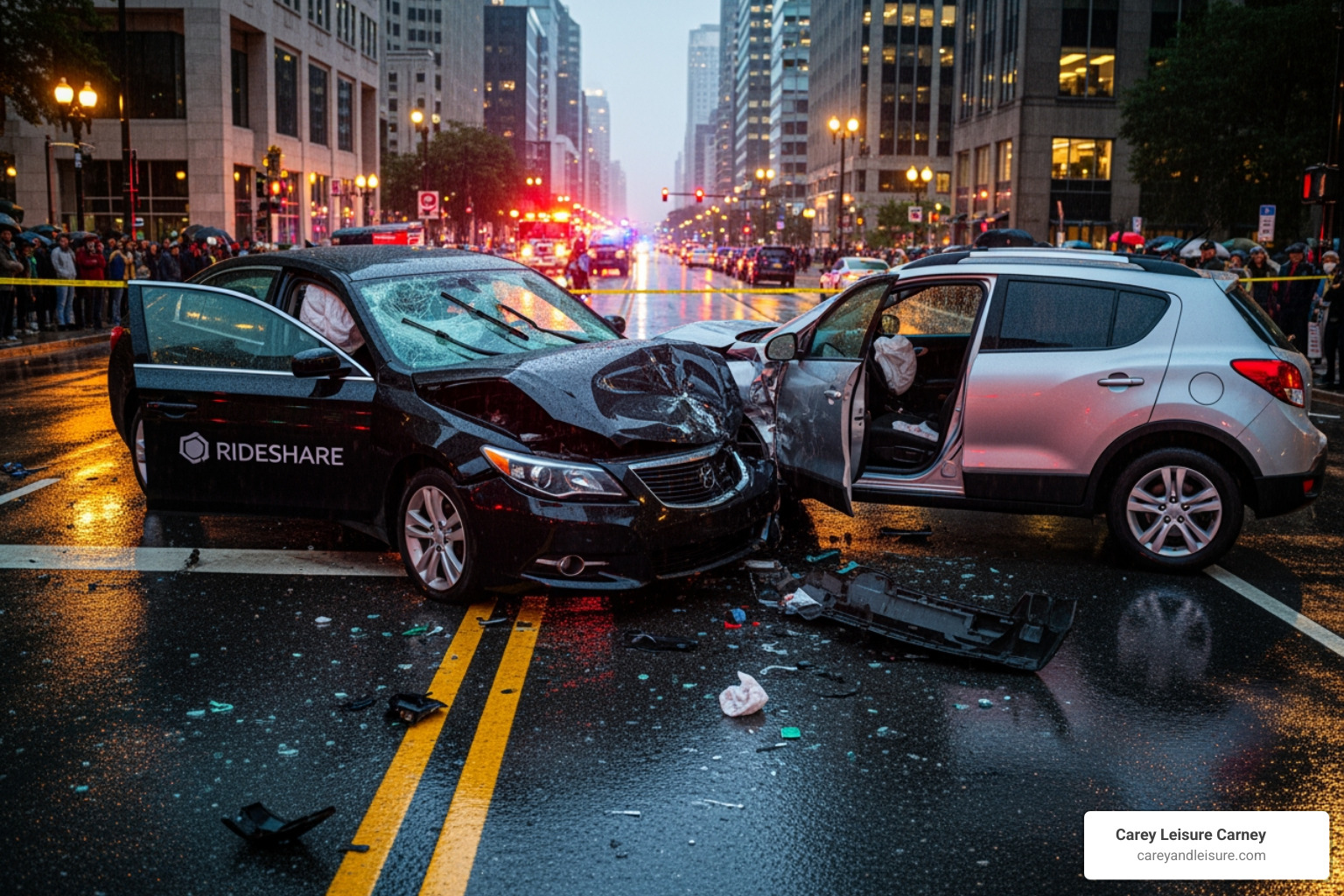
Don’t Get Taken for a Ride: How to Choose Your Uber/Lyft Accident Lawyer
When a Rideshare Trip Ends in an Accident—What You Need to Know
Uber car accident attorneys steer the complex insurance and liability issues of rideshare crashes. If you’re injured in an Uber or Lyft accident, you need a lawyer who can identify all insurance coverage, determine fault, and hold the right parties accountable—the driver, another motorist, or the rideshare company’s commercial policy.
What makes rideshare accident claims different:
- Three-period insurance structure – Coverage depends on whether the driver was offline, waiting for a ride request, or actively transporting a passenger
- Independent contractor status – Uber and Lyft classify drivers as contractors to limit their own liability
- Layered insurance policies – Claims may involve the driver’s personal policy, Uber/Lyft’s commercial coverage (up to $1 million), and third-party insurance
- Statute of limitations – Florida gives you two years from the accident date to file a personal injury lawsuit
- Recoverable damages – You may claim medical expenses, lost wages, pain and suffering, and property damage
Rideshare services like Uber and Lyft have transformed travel for millions. Uber completes over 40 million U.S. rides monthly, holding 77% of the market. But this convenience has risks—in 2018, 58 people died in accidents involving Uber drivers. When a rideshare trip ends in a crash, victims face a confusing maze of insurance policies and corporate legal teams.
Unlike a standard car accident, a rideshare crash involves multiple insurance policies that shift based on the driver’s app status. Uber and Lyft minimize their liability by classifying drivers as independent contractors, not employees. This makes it harder to hold the companies accountable and easier for their insurers to deny or undervalue your claim.
I’m Thomas W. Carey, founding partner of Carey Leisure Carney and a board-certified civil trial lawyer with over 35 years of experience fighting for injury victims in Florida. Our firm has guided roughly 40,000 injury cases, secured multi-million-dollar results, and we understand the unique challenges uber car accident attorneys face when pursuing fair compensation against large corporations.
Uber car accident attorneys vocab explained:
Step 1: Understand the Unique Legal Maze of a Rideshare Accident

An accident involving an Uber or Lyft is rarely as straightforward as a typical fender-bender. The rideshare company adds a complex legal and insurance maze, involving corporate policies, state regulations, and the unique status of drivers.
If you’ve been in an accident that wasn’t your fault, it’s crucial to know what steps to take to protect your rights. We have a guide on What to do after car accident that’s not your fault.
The Independent Contractor Dilemma
A major hurdle in rideshare claims is how Uber and Lyft classify their drivers as “independent contractors,” not employees. This is a strategic move to limit their liability. If drivers were employees, the company would be more directly responsible for their actions. As contractors, the companies argue they are just technology platforms, shielding themselves from direct liability.
This independent contractor status significantly impacts your claim. Instead of directly suing Uber or Lyft, you’ll often find yourself pursuing the individual driver’s insurance—which might be their personal policy or a commercial policy provided by the rideshare company. It makes it much harder to hold the multi-billion-dollar corporation directly accountable.
There are rare exceptions. If we can prove that Uber or Lyft was negligent in vetting or retaining a driver they knew to be unsafe (e.g., a driver with a history of dangerous driving or a known criminal record), then direct liability against the company might be possible. However, these cases are challenging to prove and require extensive investigation.
Navigating Complex Insurance Layers
The insurance landscape for rideshare accidents is confusing. Unlike a typical car accident, they can involve several layers of coverage that change based on the driver’s activity. Florida law (HB221, signed in 2017) established clear regulations for rideshare insurance requirements in our state.
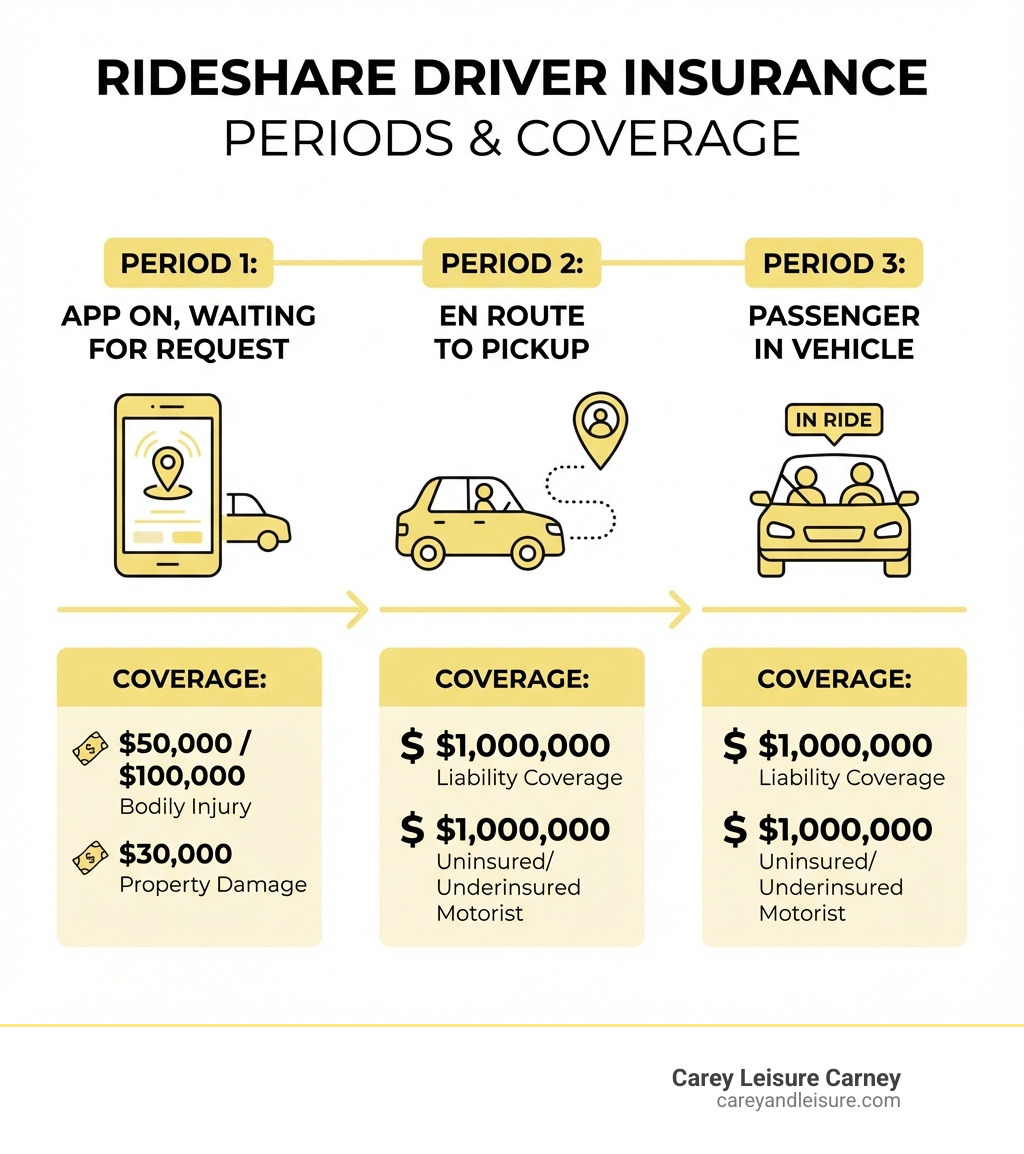
Florida’s rideshare laws define three crucial periods of a driver’s day that dictate which insurance policy applies:
- Offline (App Off): If the Uber or Lyft driver is not logged into the app and is using their vehicle for personal reasons, their personal auto insurance policy is primary. The rideshare company’s insurance generally does not apply here.
- Period 1 (App On, Waiting for a Request): The driver is logged into the Uber or Lyft app and is available to accept a ride request, but has not yet accepted one. During this “gap period,” Florida law mandates that rideshare companies provide specific coverage:
- $50,000 for bodily injury per person
- $100,000 for bodily injury per incident
- $25,000 for property damage per incident Many personal auto insurance policies exclude coverage when a vehicle is being used for commercial purposes, even if a ride hasn’t been accepted yet. This can create a significant “gap” in coverage, leaving drivers and accident victims vulnerable.
- Periods 2 & 3 (En Route to Pick Up or Passenger in Vehicle): This is when the driver has accepted a ride request and is either on their way to pick up the passenger (Period 2) or has the passenger in the vehicle (Period 3). During these periods, Florida law requires rideshare companies to provide much higher levels of coverage:
- $1 million for death, bodily injury, and property damage liability.
- Uninsured/Underinsured Motorist (UM/UIM) coverage is also required as per existing law. This $1 million policy is a significant safety net for passengers and other parties involved in an accident. You can find more details on Uber’s insurance policies directly from their website. These specific requirements are outlined in HB221 Regulation of ridesharing services in Florida, which ensures that rideshare drivers are insured while they are logged into the app.
Understanding these different coverage periods is paramount. An experienced uber car accident attorney knows how to investigate the driver’s status at the exact moment of the crash to ensure the correct insurance policy is triggered and that you receive the compensation you deserve.
Step 2: Protect Your Rights Immediately After the Crash

The moments after an Uber or Lyft accident are chaotic. What you do during this critical time can significantly impact your ability to recover compensation. While your safety is the priority, taking the right steps also protects your legal rights.
Rideshare accidents often stem from common causes we’ve seen in cases throughout Clearwater, Largo, New Port Richey, Spring Hill, St Petersburg, Trinity, and Wesley Chapel, Florida, including:
- Distracted Driving: Drivers glued to their phones for the app, GPS, or even personal messages are a major hazard.
- Driver Fatigue: Uber and Lyft drivers often work long hours, leading to exhaustion behind the wheel.
- Speeding: Rushing to pick up the next fare or complete a trip can lead to dangerous speeds.
- Aggressive Driving: Frustration with traffic or passengers can lead to reckless behavior.
- Unsafe Passing or Turns: Drivers making risky maneuvers to save time.
Your Post-Accident Checklist
If you’re in an Uber or Lyft accident, this checklist helps you gather crucial information while prioritizing safety:
- Ensure Safety & Call 911: First, check yourself and any passengers for injuries. If possible and safe, move the vehicles out of traffic. Call 911 immediately to report the accident and request medical assistance if anyone is injured. The police will create an official accident report, which is vital for your claim.
- Gather Evidence (Your Smartphone is Your Best Friend):
- Photos of the Scene and Damage: Take pictures and videos from multiple angles. Capture the position of the vehicles, damage to all cars involved, road conditions, traffic signs, skid marks, and any visible injuries.
- Witness Information: If anyone saw the accident, ask for their names and contact information. Their testimony can be invaluable.
- Driver Information: Get the Uber or Lyft driver’s name, phone number, insurance information, and vehicle license plate number. Also, try to get the other driver’s information if another vehicle was involved.
- Note Driver’s App Status: This is critical for rideshare cases. Was the driver logged into the app? Had they accepted a ride? Was a passenger in the car?
- Location and Time: Make a note of the exact location and time of the accident.
- Report the Accident to Uber/Lyft (Carefully): You should report the accident to Uber or Lyft through their app or website. However, we strongly advise you to consult with an uber car accident attorney before making any official statement to the rideshare company or their insurance adjusters. They are not on your side and may try to get you to say something that undermines your claim.
Seek Medical Attention and Avoid Insurance Pitfalls
Even if you feel fine, seek medical attention immediately after an accident. Adrenaline can mask pain, and serious injuries like whiplash, concussions (Traumatic Brain Injury or TBI), or internal injuries may have delayed symptoms.
Delaying medical care can jeopardize your health and your legal claim. Insurance companies often argue that if you didn’t seek immediate medical help, your injuries must not be severe or weren’t caused by the accident. Documenting your injuries through prompt medical attention creates a clear paper trail that supports your claim. We have more information on this crucial step in our guide, You’ve been in an accident, what’s next? Part 2: Medical Attention.
Be wary of any insurance adjuster. They may contact you quickly, offering a fast settlement or asking for a recorded statement. Do NOT give a recorded statement or sign anything without first consulting an uber car accident attorney. Anything you say can be used to limit your compensation. An insurer’s goal is to pay as little as possible. Early settlement offers are almost always lowball offers designed to close your case cheaply before you know the full extent of your damages.
Step 3: Know What Compensation You’re Entitled To
After an Uber or Lyft accident, you’ll want to know what compensation you can receive. Florida is a “fault-based” state, so the negligent party is responsible for damages. This could be the Uber driver, another motorist, or a third party like a vehicle manufacturer. Our guide explains How to tell who is at fault in a car accident.
Florida’s “pure comparative negligence” rule means you can recover compensation even if you were partially at fault. Your total award is simply reduced by your percentage of fault. For example, if you are 20% at fault for a $100,000 award, you would receive $80,000. Our job as your uber car accident attorneys is to minimize any fault assigned to you.
Types of Recoverable Damages
In an Uber or Lyft accident claim, we aim to recover both economic and non-economic damages for our clients:
Economic Damages: These are quantifiable financial losses directly resulting from the accident. They include:
- Medical Expenses: Past and future costs for doctor visits, hospital stays, surgeries, medications, physical therapy, and long-term care.
- Lost Wages: Income you’ve lost due to being unable to work during your recovery.
- Loss of Earning Capacity: If your injuries prevent you from returning to your previous job or earning the same income in the future.
- Property Damage: Costs to repair or replace your vehicle or other damaged property.
- Rehabilitation Costs: Expenses for ongoing therapy or specialized equipment.
- Funeral Expenses: In tragic cases involving wrongful death.
Non-Economic Damages: These are subjective, non-monetary losses that impact your quality of life. They include:
- Pain and Suffering: Physical pain and emotional distress caused by your injuries.
- Emotional Distress: Anxiety, depression, PTSD, or other psychological impacts.
- Inconvenience: Disruption to your daily life, loss of hobbies, or inability to perform daily tasks.
- Disfigurement: Compensation for scarring or permanent changes to your appearance.
- Loss of Enjoyment of Life: When injuries prevent you from engaging in activities you once loved.
- Loss of Consortium: Compensation for the impact on your relationship with your spouse or family. Florida places no cap on non-economic damages in personal injury cases. In rare instances of egregious negligence, punitive damages may be awarded to punish the at-fault party. For a deeper dive into these types of compensation, refer to our guide on Compensation for pain and suffering in Florida: What you need to know.
Deadlines and Claim Value
Time is critical. In Florida, the statute of limitations for most personal injury lawsuits, including Uber or Lyft accidents, is generally two years from the accident date (for accidents on or after March 24, 2023). The wrongful death statute of limitations is also two years. If a government vehicle was involved, the deadline can be as short as six months.
Missing these deadlines almost certainly means losing your right to seek compensation. Evidence can disappear, and witnesses’ memories fade. That’s why contacting uber car accident attorneys quickly is so important.
The value of your case is highly individual and depends on the severity of your injuries, medical costs, lost income, and the impact on your daily life. An experienced attorney can assess these factors to determine what your case is truly worth. For more insights, you can read our article, What is my personal injury case worth?.
How to Choose the Best Uber Car Accident Attorneys for Your Case
When a rideshare trip ends in a crash, choosing the right legal representation is critical. You need specialized uber car accident attorneys who understand the unique legal landscape. These cases are more intricate than standard car accidents, involving layered insurance, contractor issues, and aggressive corporate defense teams. This is Why you need a personal injury lawyer.
Criterion 1: Board Certification and Specialization
Look for attorneys who are Board-Certified in civil trial law. In Florida, Board Certification is the highest level of recognition for attorneys, signifying special knowledge, skills, and proficiency. Only a small percentage of Florida lawyers achieve this distinction—the top 2%.
Our attorneys at Carey Leisure Carney are Board-Certified, having undergone rigorous testing and peer review to demonstrate exceptional expertise. When facing large rideshare companies and their insurers, you need a specialist with proven ability in the courtroom and at the negotiation table, not a general practitioner.
Criterion 2: Verifiable Experience with Rideshare Cases
Your attorney must have specific, verifiable experience with rideshare accident cases. Ask about their track record:
- Specific Rideshare Case Results: Have they successfully handled cases involving Uber or Lyft? Can they discuss the unique challenges they faced and how they overcame them? Our firm has a strong history of guiding clients through rideshare accident claims in Clearwater, Largo, and throughout Florida.
- Understanding of TNC Insurance Policies: A knowledgeable uber car accident attorney will be intimately familiar with the nuances of Transportation Network Company (TNC) insurance policies – knowing when the $50k/$100k/$25k policy applies versus the $1 million policy, and how to steer the interplay between personal and commercial coverage.
- Knowledge of How to Access Rideshare Company Internal Driver Data: Uber, for instance, collects a wealth of data on its drivers, including tracking speed, harsh braking, and sudden turns. This internal data can be crucial evidence in proving negligence, but accessing it requires specific legal know-how and persistence. We know how to compel companies like Uber to provide this vital information.
Criterion 3: Why You Need Specialized Uber Car Accident Attorneys
Beyond certification and specific experience, the right uber car accident attorneys bring critical resources and a client-focused approach:
- Contingency Fee Structure: Most personal injury lawyers, including ours, work on a contingency fee basis. This means you pay nothing upfront, and we only get paid if we win your case. Our fee is a percentage of the compensation we recover for you. This ensures everyone can access top-tier legal representation.
- No Win, No Fee: This promise means you don’t have to worry about accumulating legal bills while you’re recovering. We bear the financial risk, allowing you to focus on your health.
- Understanding Costs vs. Fees: While attorney fees are contingent, there might be other costs associated with your case, such as court filing fees or expert witness fees. A transparent attorney will explain these potential expenses upfront. To learn more, read How much does it cost to hire a personal injury attorney?.
- Resources to Fight Large Corporations: Uber and Lyft are multi-billion-dollar companies with armies of investigators and experts whose sole job is to deny claims and protect profits. You need a law firm with the financial capital, legal expertise, and determination to stand up to these giants. Our firm has a proven track record of doing just that.
- Positive Client Reviews: Look for attorneys with strong client testimonials and positive reviews. These reflect a firm’s commitment to its clients and its ability to deliver results.
Frequently Asked Questions about Uber Accident Claims
Can I sue a rideshare company directly for an accident?
Suing Uber or Lyft directly is challenging because they classify drivers as independent contractors. The companies argue they are technology platforms, not transportation providers responsible for their drivers’ actions.
Your primary route to compensation is usually a claim against the driver’s insurance (personal or the rideshare’s commercial policy). An experienced uber car accident attorney knows how to sue the driver to access the rideshare company’s substantial insurance, especially the $1 million policy for Periods 2 and 3.
Exceptions where you might sue Uber or Lyft directly are rare but can include instances where the company was negligent in its own right, such as negligent hiring or retention of a driver they knew was unsafe. These exceptions require strong evidence and a skilled legal team to prove.
What happens if the at-fault driver is uninsured or underinsured?
This is a critical concern, and Florida’s rideshare laws provide significant protection. During Periods 2 and 3 (when the driver has accepted a ride or has a passenger), Uber and Lyft are required to provide $1 million in Uninsured/Underinsured Motorist (UM/UIM) coverage. If the at-fault driver (whether the Uber driver or another motorist) lacks enough insurance to cover your damages, you can tap into this substantial policy.
If the accident happened during Period 1 (app on, waiting for a request), the rideshare company’s UM/UIM coverage typically does not apply. You would then rely on your own personal UM/UIM policy, if you have one. This highlights the importance of having adequate personal UM/UIM coverage. For a more comprehensive understanding, refer to our guide on Understanding uninsured/underinsured motorist coverage.
How long does it take to settle a rideshare accident claim?
The timeline for settling a rideshare accident claim varies from months to years, depending on several factors:
- Case Complexity: Rideshare cases are inherently more complex due to layered insurance policies and the independent contractor status of drivers.
- Injury Severity: More severe injuries often require longer medical treatment. We typically advise waiting until you’ve reached Maximum Medical Improvement (MMI) before settling to fully assess your long-term damages.
- Clear vs. Disputed Liability: If fault is clear, the case might settle faster. If liability is disputed, it will prolong the process.
- Willingness of Insurance Companies: Some insurers are more willing to negotiate fairly than others. If they offer a lowball settlement, we may need to file a lawsuit to secure fair compensation.
- Negotiation vs. Litigation: Many cases settle out of court. However, if a fair settlement cannot be reached, filing a lawsuit and proceeding to trial will significantly extend the timeline.
While we strive for efficient resolutions, our priority is to secure the maximum compensation you deserve, even if it means a longer fight.
Conclusion: Take Control of Your Recovery
Rideshare services offer convenience but add complexity to car accident claims. If you’ve been injured in an Uber or Lyft accident in Clearwater, Largo, New Port Richey, Spring Hill, St Petersburg, Trinity, or Wesley Chapel, Florida, you’re not facing a simple claim. You’re navigating a maze of complex insurance policies, corporate liability shields, and independent contractor status.
This is precisely why you need specialized legal representation. Our Board-Certified uber car accident attorneys at Carey Leisure Carney have the knowledge, experience, and resources to handle these complexities. We understand Florida’s rideshare laws, the insurance periods, and how to stand up to powerful corporations to protect your rights.
You don’t have to face this journey alone. We are committed to providing personalized service, direct attorney access, and the aggressive advocacy you need to secure the compensation you deserve. Let us handle the legal traffic while you focus on your recovery.
Take control of your recovery today. Schedule a free, no-obligation consultation with our expert Rideshare Accident Attorney. We’re here to help you steer through the aftermath and drive your case to success.