Florida Alcohol Laws 2026: A Practical Guide to Sunshine State Drinking Rules
What Florida Alcohol Laws in 2026 Mean for You
Florida alcohol laws 2026 set a statewide drinking age of 21, generally allow alcohol sales from 7:00 a.m. to midnight, and leave many key rules – including Sunday hours and late-night sales – to local governments. Beer and wine are commonly sold in grocery and convenience stores, while distilled spirits are generally sold through licensed package stores.
For businesses, the rules cover licensing, delivery ID checks, direct wine shipping, taxes, promotional items, and the state’s three-tier system. For injured people and families, the most important rules often involve underage service, impaired driving, alcohol delivery, and whether a bar, restaurant, or other seller followed its legal duties.
Florida is one of the nation’s largest alcohol markets, with beer remaining the state’s largest category by volume. That scale makes careful compliance – and accountability when alcohol is served unlawfully – especially important.
I am Thomas W. Carey, a Florida board-certified civil trial lawyer who has spent decades handling injury and wrongful-death matters, including cases involving drunk driving and alcohol-related negligence. In this guide to Florida alcohol laws 2026, I will explain the rules in plain English and highlight the issues that may matter after a preventable injury.
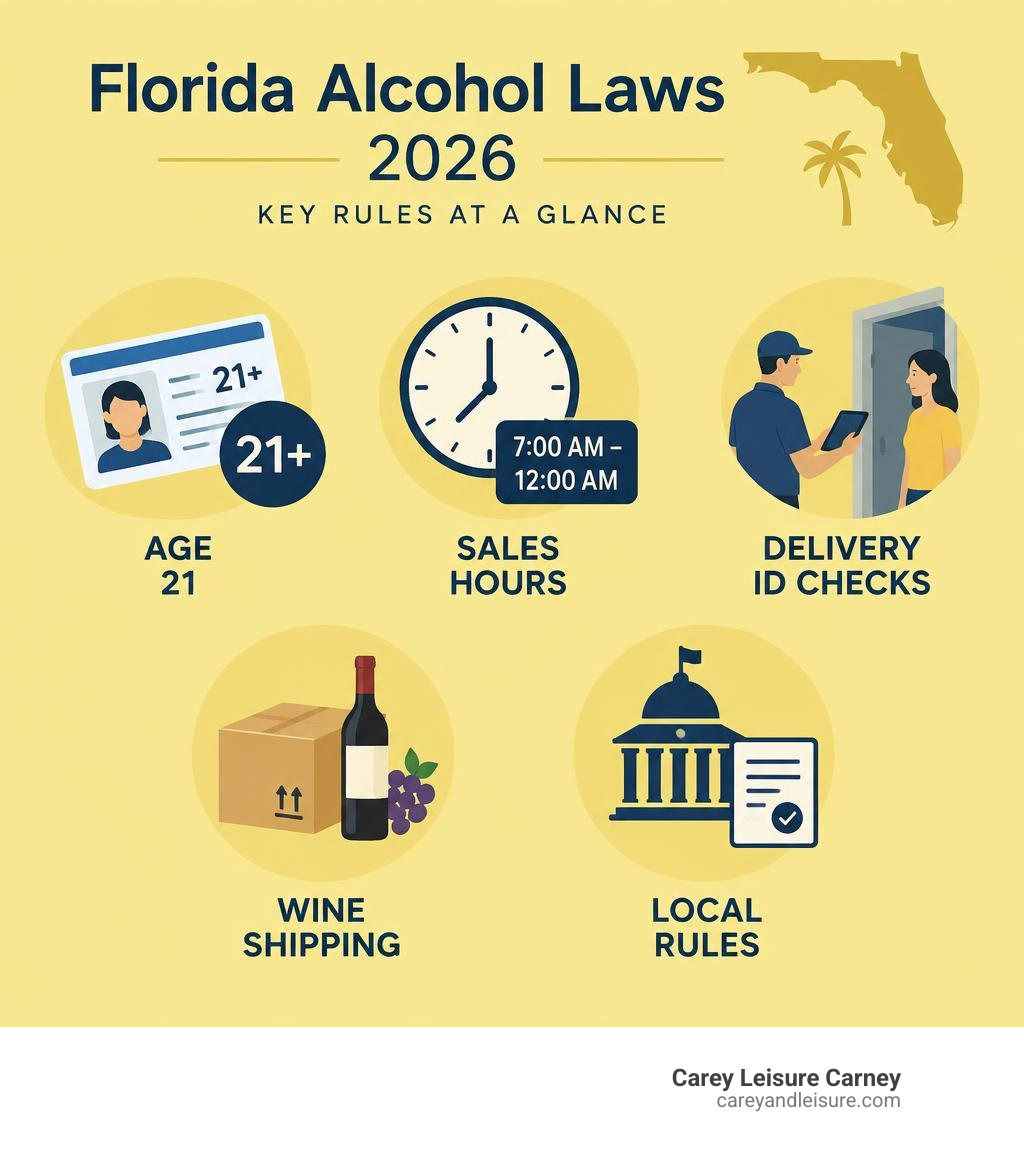
Quick florida alcohol laws 2026 terms:
Key Legislative Updates in Florida Alcohol Laws 2026
The Florida Legislature continuously refines beverage statutes to balance commercial hospitality growth with public safety. Enacted measures codified under Chapter 561 – 2026 Florida Statutes – The Florida Senate introduce modern standards for venue licensing, tax deductions, and distribution operations.
A major focus of the 2026 statutory updates involves Special Food Service (SFS) beverage licenses. These revisions adjust the minimum square footage and seating capacity thresholds for qualifying dining establishments. Rather than having to buy an expensive quota license on the open market, restaurants meeting specific floor space criteria and maintaining a strict food-to-alcohol sales ratio can obtain specialized liquor licenses to serve patrons responsibly on-site.
Furthermore, tax reporting modernizations now grant licensed distributors and manufacturers statutory deductions for unsalable inventory. Losses resulting from breakage, spoilage, or expiration during transit and warehousing can be credited against state excise liabilities, provided detailed inventory audits are submitted electronically.
Navigating Florida Alcohol Laws 2026 for Retailers and Venues
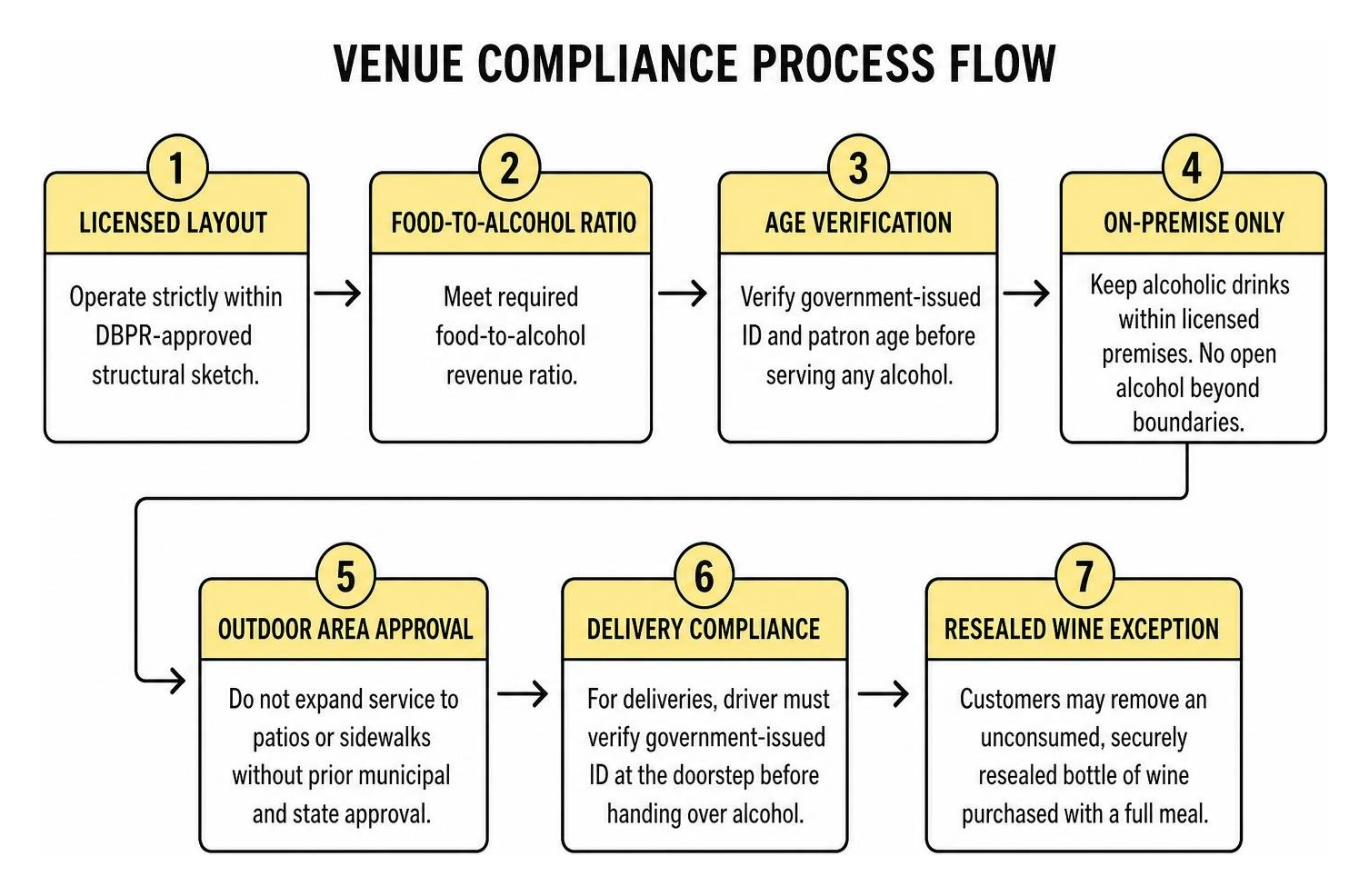
For venue operators across Clearwater, St Petersburg, and Tampa Bay, regulatory compliance is tied to physical space management and public safety mandates. Licensed premises must operate strictly within their approved structural sketches. Expanding service onto outdoor patios or sidewalks without prior municipal and state administrative approval constitutes an unlawful sale under Chapter 562 – 2026 Florida Statutes – The Florida Senate .
Patron safety on and off the premises is closely watched. Under the florida open container law, operators must ensure alcoholic drinks remain within licensed boundaries. The only exception is when a customer removes an unconsumed, securely resealed bottle of wine purchased alongside a full meal. Beyond the venue perimeter, open alcohol in a motor vehicle or public roadway invites civil infractions and local citations.
Compliance Under Florida Alcohol Laws 2026 for Delivery Services
The expansion of on-demand home delivery services has introduced strict regulatory standards:
- Third-Party Vehicle Deliveries: Retailers can contract independent third-party drivers to deliver sealed alcoholic beverages directly to consumers. However, the driver must verify government-issued photo identification at the doorstep before handing over the order.
- Promotional Glassware Restrictions: Distributors and manufacturers are legally barred from providing unlimited free supplies to retailers. Under state rules, manufacturers may gift no more than 10 cases of branded glassware per retail account per calendar year, and each glass cannot exceed 23 ounces.
- Intrastate Transit Exceptions: Intrastate trains traveling entirely within Florida borders may sell miniature liquor bottles (2 ounces or less) to seated passengers, an option prohibited on interstate routes.
Florida’s Three-Tier System, Licensing, and Manufacturing Rules
Florida enforces a strict three-tier regulatory framework to prevent monopolies and unfair trade practices. By law, the industry is split into three distinct categories governed by the Division of Alcoholic Beverages and Tobacco (ABT) within the Department of Business and Professional Regulation:
- Manufacturers (breweries, wineries, distilleries, and importers)
- Distributors (licensed wholesalers who warehouse and transport goods)
- Retailers (bars, restaurants, package stores, and grocery outlets)
Under “tied-house evil” statutes, manufacturers and distributors are prohibited from holding direct financial interests in retail establishments or offering unapproved gifts, loans, or equipment to influence retailer sales.
Licensing fees for on-premises consumption vendors are determined by county population tiers under Chapter 565 – 2026 Florida Statutes – The Florida Senate :
| License Tier / Category | Population Threshold | Base Annual License Fee |
|---|---|---|
| Tier 1: On-Premises Vendor | Counties > 100,000 residents | $1,820 |
| Tier 2: On-Premises Vendor | Counties 50,001 – 100,000 | $1,200 |
| Tier 3: On-Premises Vendor | Counties 25,001 – 50,000 | $800 |
| Tier 4: On-Premises Vendor | Counties ≤ 25,000 residents | $624 |
| Club License | Fraternal / Social Non-Profits | $400 |
Craft Breweries, Distilleries, and Wineries
Craft producers operate under carve-outs to the three-tier system:
- Craft Distilleries: Distillers producing up to 250,000 gallons per year can sell branded spirits directly to consumers for off-premises consumption through on-site tasting rooms and permitted local festivals.
- Growler Regulations: Under Chapter 563 Section 06 – 2026 Florida Statutes – The Florida Senate , craft breweries can fill growlers directly at the point of sale in standard 32-ounce, 64-ounce, or 128-ounce containers, provided the container is clearly labeled with the manufacturer, brand, and ABV, and sealed securely.
- Malt Beverage Imprints: Retail beer containers up to 32 ounces must feature an imprint of “Florida” or “FL” in at least 8-point type, unless the manufacturer maintains an approved electronic tracking system with at least 90% verification reliability.
Direct-to-Consumer Shipping and Retail Distribution
Under Chapter 564 – 2026 Florida Statutes – The Florida Senate , direct-to-consumer (DTC) shipping rules differ sharply depending on the beverage:
- Wine Direct Shipping: Licensed out-of-state and in-state wineries may ship wine directly to adult Florida residents for personal use. Carriers must require the recipient’s signature and proof of age (21+) upon arrival.
- Spirits DTC Prohibition: Distilled spirits cannot be shipped directly to consumers from out-of-state distillers. All packaged liquor over 6% ABV must pass through licensed wholesale distributors to brick-and-mortar package stores.
- Religious Sacramental Use: Religious organizations holding special division permits are exempt from standard commercial tax and distribution restrictions when ordering sacramental wines.
Operational Rules: Sales Hours, Taxes, and Location Variations
State law under The 2026 Florida Statutes sets a baseline default window for alcohol sales between 7:00 a.m. and midnight daily. However, the state grants broad authority to local county and municipal commissions to extend or restrict these hours.
In Pinellas County and surrounding communities like Clearwater and Largo, local ordinances permit bars and package stores to sell alcohol until 2:00 a.m. or 3:00 a.m. In contrast, other jurisdictions retain specific Sunday morning bans or limit late-night operating hours.
Florida Alcohol Excise Tax Rates and Trust Fund Allocations
The state collects excise taxes across all beverage classes, which are allocated to the Alcoholic Beverage and Tobacco Trust Fund, public health initiatives, and state general revenues:
- Malt Beverages (Beer): $0.48 per gallon.
- Wine (0.5% to 17.259% ABV): $2.25 per gallon.
- Fortified Wine (17.259% ABV and higher): $3.00 per gallon.
- Natural Sparkling Wines & Champagne: $3.50 per gallon.
- Cider: $0.89 per gallon.
- Distilled Spirits (17.259% to 55.78% ABV): $6.50 per gallon.
- High-Proof Distilled Spirits (>55.78% ABV): $9.53 per gallon.
Ten percent of total excise collections go to state regulatory trust funds, and 26% of remaining revenues are dedicated to funding Florida cancer research facilities.
Underage Drinking Penalties, Dram Shop Liability, and Safety Laws
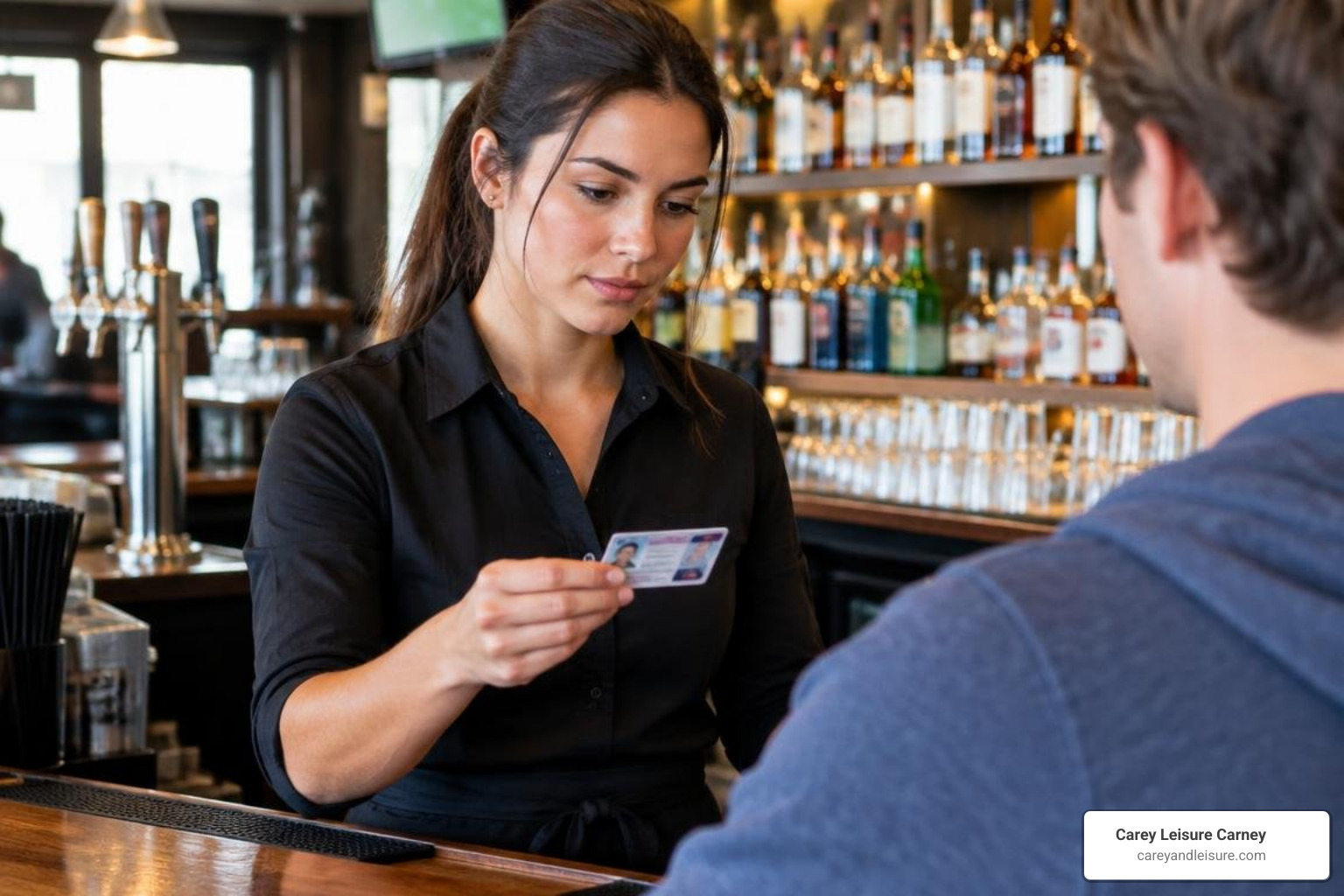
Under Chapter 562 Section 11 – 2026 Florida Statutes – The Florida Senate , selling or serving alcohol to a minor under 21 is a second-degree misdemeanor punishable by up to 60 days in jail and a $500 fine. A second conviction within one year escalates the crime to a first-degree misdemeanor, carrying up to one year in prison and fines up to $1,000.
In civil matters, knowing who is responsible when a minor is served alcohol depends on the standard established by the Christopher Fugate Act. Commercial vendors are protected from civil liability only if they can demonstrate that they acted in good faith, thoroughly examined a valid, unexpired government photo ID, and reasonably believed the patron was 21 or older.
Overdose Immunity and Minor Employment Exemptions
Florida law includes vital public-safety protections:
- Medical Overdose Immunity: Under Florida Statute Section 562.112, any individual who in good faith seeks emergency medical assistance for someone experiencing an alcohol or drug overdose is immune from arrest, charge, and prosecution for underage possession, provided they remain on the scene and cooperate with first responders.
- Educational Curricula: Postsecondary culinary and hospitality students aged 18 to 20 may taste alcoholic beverages without criminal penalty when it is a required element of an accredited curriculum under direct instructor supervision.
- Minor Employment: Individuals aged 18 and older may serve and sell alcoholic beverages in licensed restaurants and package stores. Minors under 18 cannot pour, serve, or handle open alcohol, though they may work in food preparation, table bussing, or grocery stocking under licensed supervision.
Impaired Driving Laws, Refusal Penalties, and Civil Liability
Florida enforces strict penalties to protect road users. Anyone who operates a motor vehicle on public roads gives implied consent to chemical testing under state law. Understanding what drivers face after an arrest begins with learning about impaired driving rules and DUI standards.
Under statutory reforms, refusing to submit to a lawful breath, urine, or blood test after a DUI arrest is a standalone second-degree misdemeanor carrying up to 60 days in jail, independent of the underlying DUI charge.
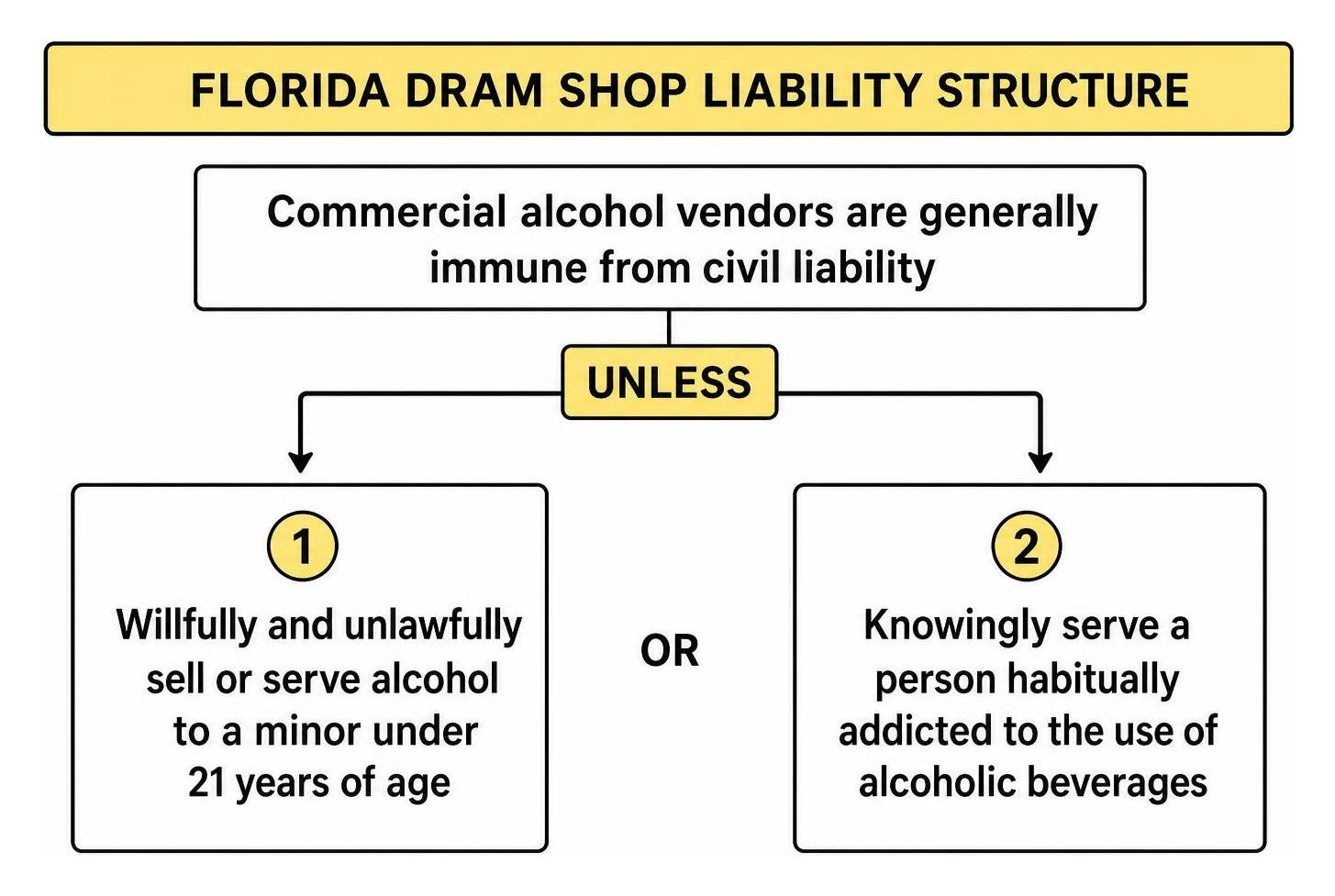
When impaired drivers cause catastrophic injuries or death, victims can seek compensation beyond the driver’s insurance policy. Our firm’s dram shop injury guide outlines how victims can recover compensation when establishments violate state law. Learn more about whether bars can be held liable for drunk drivers after an accident.
Frequently Asked Questions About Florida Alcohol Regulations
Can you buy liquor in grocery stores in Florida?
Grocery stores, gas stations, and big-box retailers throughout Florida can sell beer and wine. However, spiritous liquors containing more than 6% ABV may only be sold in dedicated, partitioned package stores with separate entrances.
What time can you buy alcohol on Sunday in Florida?
Statewide law permits alcohol sales to begin at 7:00 a.m. on Sundays. However, county or municipal blue laws can set different rules, so local city codes should always be checked.
Does Florida allow direct-to-consumer spirits shipping in 2026?
No. Florida law allows licensed wineries to ship wine directly to consumers, but out-of-state distilleries are prohibited from shipping spirits directly to residential addresses. All distilled spirits must be bought through licensed retail package stores.
Conclusion
Whether you are managing a hospitality business or spending an evening enjoying Florida’s dining and entertainment scene, staying informed about beverage laws helps you remain compliant and safe.
When commercial establishments ignore statutory safeguards by serving underage patrons or overserving habitually addicted individuals, the resulting drunk driving crashes can cause life-altering injuries. For over three decades, our board-certified civil trial attorneys at Carey Leisure Carney have fought to hold negligent establishments and drunk drivers accountable across Clearwater, Largo, St Petersburg, New Port Richey, Spring Hill, Trinity, and Wesley Chapel. If you or a loved one has been hurt in an alcohol-related crash, explore our overview of Florida alcohol laws and liability or call us directly to schedule a free case evaluation.