Florida Alcohol Laws: A Practical Legal Guide for Everyday Situations
Florida Alcohol Laws: The Everyday Rules That Matter
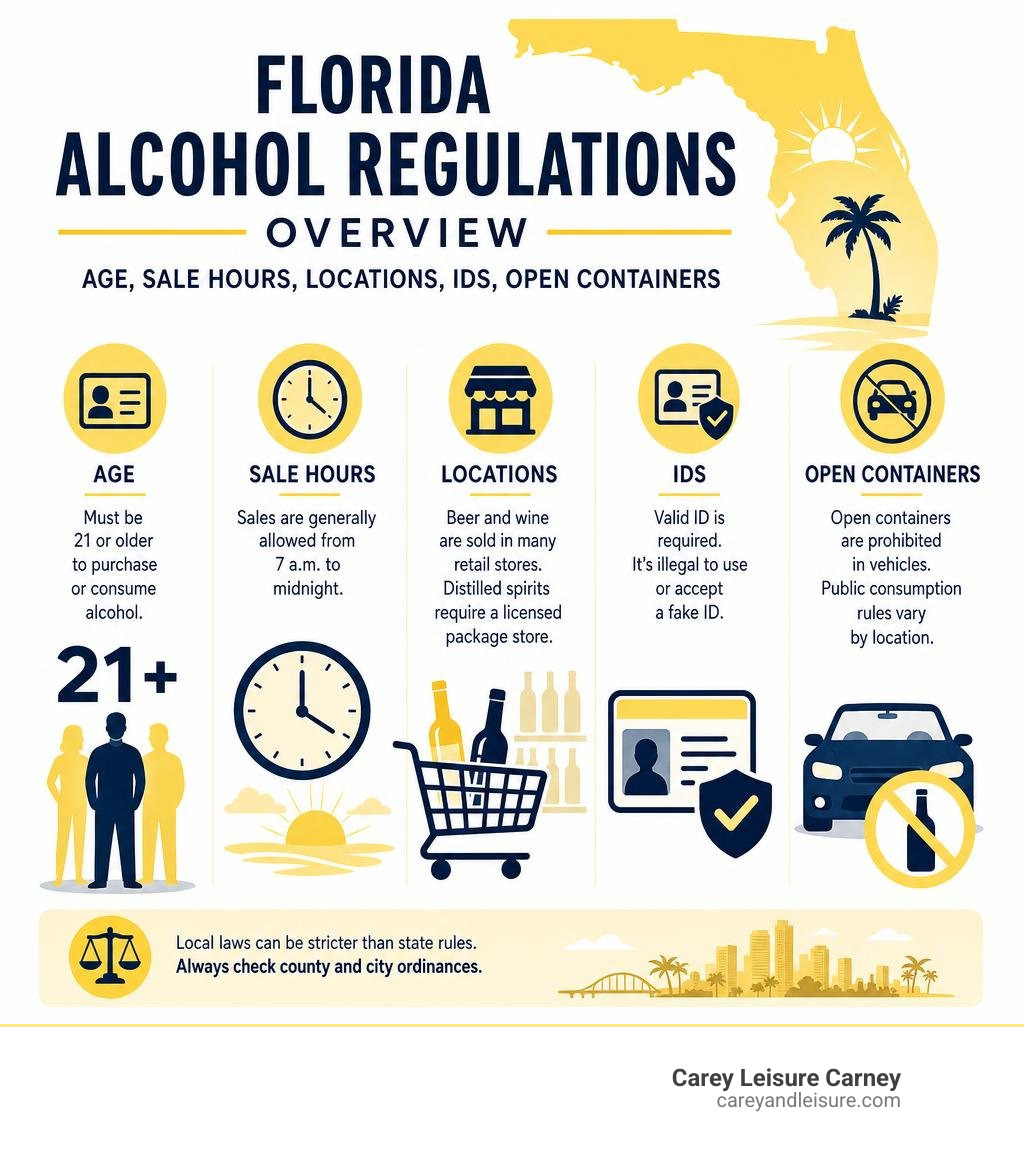
Florida alcohol laws establish a 21-year-old minimum drinking age, generally allow sales from 7 a.m. to midnight, and leave many key details to county and city rules. Grocery stores can typically sell beer and wine, while distilled spirits generally require a licensed package store. Selling alcohol to someone under 21, using a fake ID, driving with an open container, or drinking in prohibited public places can lead to fines, criminal charges, or both.
For a quick compliance check:
- Check ID carefully: A first unlawful sale or gift of alcohol to a person under 21 can mean up to 60 days in jail and a $500 fine.
- Check local sale hours: State law supplies a default rule, but local ordinances can extend or restrict hours, including on Sundays.
- Keep alcohol sealed in vehicles: Florida restricts open containers in vehicles, and local public-consumption rules can be stricter.
- Know the limits: Florida does not allow the sale or consumption of distilled spirits above 153 proof.
These rules matter beyond a purchase at a store or a drink at dinner. Alcohol service and impaired driving can affect injury claims after a crash, including questions about whether a vendor unlawfully served a minor or a habitually addicted person.
I am Thomas W. Carey, founding partner of Carey Leisure Carney and a board-certified civil trial lawyer who has handled or overseen thousands of Florida injury matters, including DUI-related cases. My work in anti-DUI advocacy and injury litigation informs this practical guide to florida alcohol laws 2022 and the ongoing rules that matter after an alcohol-related accident.
Understanding Florida Alcohol Laws: Purchase Hours, Locations, and Restrictions
Navigating the beverage landscape in the Sunshine State requires an understanding of both state statutes and local rules. The primary regulatory framework governing alcohol falls under Title XXXIV of the Florida Statutes, overseen by the Division of Alcoholic Beverages and Tobacco (ABT).
While state law creates a baseline, Florida gives broad authority to counties and municipalities to tailor retail sale hours, zoning buffers, and packaging requirements to fit their communities. Whether you are picking up craft beer in Clearwater or dining out in St. Petersburg, local ordinances directly shape when and where beverages are sold under The 2026 Florida Statutes covering beverage sales hours.
Default State Sale Hours and County Ordinances
Under Florida Statute 562.14, the statewide default window prohibits the sale of alcoholic beverages between midnight and 7:00 a.m. Unless a local ordinance establishes different operating hours, vendors cannot sell, serve, or permit the consumption of alcoholic beverages on their premises during those seven overnight hours.
However, local governments can pass ordinances extending or curtailing these times:
- Pinellas County: Municipalities such as Clearwater, Largo, and St. Petersburg generally allow retail sales and on-premise service starting at 8:00 a.m. on Sundays and 7:00 a.m. on weekdays and Saturdays, extending until 3:00 a.m.
- Pasco County: Areas like New Port Richey, Trinity, and Wesley Chapel operate under county codes that permit alcohol service from 7:00 a.m. until 2:00 a.m. daily.
- Hernando County: Communities like Spring Hill generally align with standard early-morning cutoffs around 2:00 a.m.
- Extended Jurisdictions: Certain designated entertainment zones across Florida permit extended or 24-hour retail sales and bar operations.
Historically, restrictive “blue laws” prohibited Sunday morning alcohol purchases entirely. While many Florida counties have repealed these restrictions to accommodate Sunday brunch patrons and early shoppers, you should always check the municipal code of the city you are in.
Grocery Stores vs. Dedicated Liquor Stores and Proof Limits
Florida regulates what types of alcoholic products can sit on standard supermarket shelves versus dedicated package stores.
Under 2022 Statutes Chapter 0565 | Florida House of Representatives, package stores operate under specific retail vendor licenses tailored to spirituous liquors. Supermarkets and convenience stores are permitted to sell beer, cider, wine, and low-proof malt-based beverages. However, distilled spirits (such as vodka, rum, whiskey, and gin) must be sold in a dedicated, freestanding package liquor store—even if it is owned by a grocery chain and located adjacent to the main store.
Florida law also enforces clear consumer product boundaries:
- 153-Proof Limit: Under Florida Statute 565.07, distilled spirits greater than 153 proof (76.5% ABV) cannot be legally sold or consumed in the state. Highly concentrated grain alcohol exceeding this threshold is illegal to retail.
- Growler Allowance: Retailers, breweries, and package shops can fill reusable beer growlers up to 64 ounces (1.9 liters), allowing craft beer enthusiasts to purchase fresh draft beer for off-premise consumption.
| Retail Setting | Beer & Cider Permitted? | Wine Permitted? | Distilled Spirits Permitted? | Notes |
|---|---|---|---|---|
| Grocery / Supermarket | Yes | Yes | No | Spirits require a separate, partitioned retail space |
| Dedicated Package Store | Yes | Yes | Yes (≤153 Proof) | May carry full inventory of distilled spirits, wine, and beer |
| Convenience Store | Yes | Yes | No | Limited to beer, wine, and malt-based canned beverages |
| Craft Brewery Taproom | Yes | Limited | No (unless dual-licensed) | May fill 32 oz, 64 oz, and 128 oz containers for off-premise use |
Dry, Moist, and Wet Florida Counties
Florida is one of over 30 states that allow local option elections, giving individual counties the right to vote on whether they are “wet” (allowing hard liquor sales), “moist” (permitting beer and wine while restricting distilled spirits), or “dry” (prohibiting all or most alcohol sales).
Over the last several decades, dry counties have rapidly disappeared across Florida:
- Washington County: Remained dry regarding distilled spirits for decades until residents voted in a special election to legalize hard liquor sales.
- Suwannee and Madison Counties: Suwannee County residents voted to go wet in 2011, followed by Madison County in 2012.
- Lafayette County: Considered the last truly restrictive county in the state, Lafayette County continues to ban sales of beverages exceeding 6.243% alcohol by volume, effectively prohibiting distilled spirits and high-gravity craft beers.
- Liberty County: Enforces strict distance buffer requirements, prohibiting alcohol sales within 300 feet of churches and schools.
Underage Drinking, Fake IDs, and Vendor Liability
Florida maintains strict statutory mechanisms to deter underage drinking and penalize establishments that serve alcohol to minors.
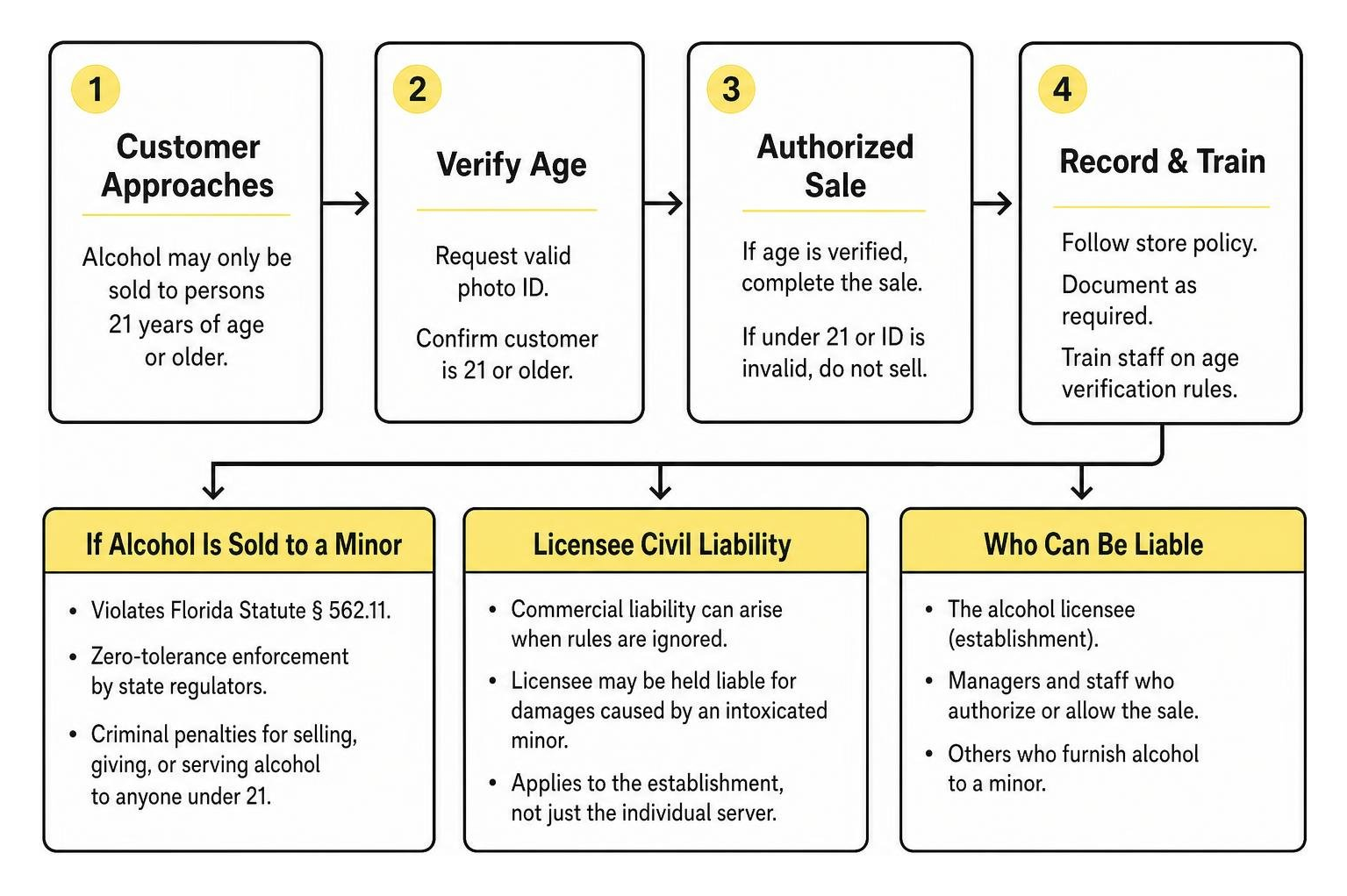
Under Chapter 562 of the Florida Statutes, state regulators enforce zero-tolerance standards across all licensed establishments. When a business ignores these rules, commercial liability issues often emerge. Learning about what happens when a minor served alcohol in Florida helps patrons, parents, and business owners understand the legal protections designed to prevent preventable accidents.
Minimum Drinking Age and Penalties for Underage Service
The minimum legal drinking and purchasing age across Florida is 21 years old. Selling, giving, or serving alcoholic beverages to anyone under 21 carries direct criminal sanctions under Florida Statute § 562.11:
- First Offense: A second-degree misdemeanor, carrying a penalty of up to a $500 fine and up to 60 days in jail.
- Second Offense (Within 1 Year): A first-degree misdemeanor, carrying a fine of up to $1,000 and up to 1 year in prison.
Beyond criminal charges against an individual bartender or cashier, commercial vendors face administrative penalties, including costly fines and license suspensions from the Division of Alcoholic Beverages and Tobacco.
Civil liability also plays a critical role in these cases. Under Florida’s dram shop statute (Florida Statute 768.125), vendors that willfully serve alcohol to an underage individual can be held liable for damages if that minor becomes intoxicated and causes injuries or fatalities in a car crash. Inquiring whether are bars liable for drunk drivers is a central step when evaluating negligence following a serious auto accident involving an intoxicated minor.
Fake ID Consequences and Statutory Defenses for Licensees
Using fraudulent identification to acquire alcohol carries penalties that shock many young people:
- Forged or Counterfeit IDs: Purchasing or attempting to purchase alcohol with an altered, forged, or counterfeit driver’s license is a third-degree felony under Florida law, punishable by up to 5 years in prison and a fine of up to $5,000.
- Lending or Borrowing an ID: Using another person’s valid driver’s license or lending an authentic ID to an underage person is a second-degree misdemeanor, carrying up to 60 days in jail and a $500 fine.
To balance these severe penalties, the Florida Legislature enacted statutory protections for business owners, known informally as the Christopher Fugate Act. Under Section 562.11, a licensee or employee has a defense against criminal charges and administrative license suspension if:
- The buyer falsely represented their age in writing or by presenting an official driver’s license, state ID, military ID, or passport.
- The physical appearance of the patron was such that an ordinarily prudent person would believe them to be 21 or older.
- The server or cashier carefully examined the identification card in good faith before completing the transaction.
Many retail shops, bars, and restaurants now utilize advanced digital ID scanners to document these verification checks and maintain compliance.
Legal Exceptions: Culinary and Educational Alcohol Consumption
Florida law recognizes narrow, structured exceptions where an individual under 21 may taste or handle alcoholic beverages:
- Post-Secondary Culinary Programs: Under Florida Statute 562.111, students aged 18, 19, or 20 enrolled in accredited post-secondary culinary, hotel management, or beverage management programs may taste (but not consume large volumes of) alcoholic beverages as part of an authorized curriculum. The alcohol must remain under the direct control and supervision of an instructor who is at least 21 years old, and students must sign appropriate program waivers.
- Employment Handling: Individuals aged 18 and older may be employed by licensed vendors to serve, stock, ring up, or deliver alcohol in commercial settings, provided they do not consume it.
- Religious and Medical Use: Minors may consume sacramental wine during recognized religious ceremonies or take physician-prescribed medications containing trace alcohol amounts.
Public Consumption, Open Container Regulations, and Vehicle Laws
Enjoying outdoor activities across the Tampa Bay area is part of daily life, but possessing an open container of alcohol in an unauthorized setting can lead to civil citations or criminal charges.
Reviewing what are the open container laws in Florida can help you prevent traffic stops and costly municipal fines when traveling between recreational destinations.
Vehicle Open Container Rules and State Infractions
Under Florida Statute 316.1936, it is illegal for anyone—driver or passenger—to possess an open container of alcoholic beverage while sitting in or operating a motor vehicle on any public roadway, street, or highway.
An open container is defined as any bottle, can, cup, flask, or receptacle that contains any amount of alcoholic beverage and is immediately capable of being consumed from, or has a broken seal.
The statutory framework differentiates between vehicle occupants:
- Driver Violations: Treated as a moving traffic violation, carrying a fine of up to $90 and assessing 3 points on the driver’s license.
- Passenger Violations: Treated as a non-moving civil infraction, carrying a fine of up to $60 without license points.
To legally transport opened containers of alcohol in a motor vehicle, the container must be placed in an area not readily accessible to the driver or passengers—such as the locked trunk, a locked glove box, or behind the last upright seat in a vehicle without a trunk (like an SUV or hatchback).
Detailed overviews of the Florida open container law highlight that commercial passenger vehicles—such as licensed limousines, party buses, and motorhomes—are generally exempt for non-driving passengers.
Public Consumption, Beach Ordinances, and Local Rules
While state law regulates highway transport, local municipalities set rules for drinking in public parks, sidewalks, and recreation areas:
- Clearwater Beach: Consuming alcoholic beverages on public sandy beaches is strictly prohibited under local ordinance, with violations resulting in municipal fines up to $500. Detailed guidelines are outlined in the official Clearwater Beach Rules & Information.
- Entertainment Districts: Cities like St. Petersburg have established designated open-container entertainment corridors where patrons can carry alcoholic beverages in approved plastic cups during permitted events.
- Resealed Wine Bottles: Under Florida Statute 564.09, patrons who purchase a bottle of wine with a full meal at a licensed restaurant may legally take the partially consumed bottle home, provided the restaurant securely reseals and re-corks the bottle and packages it in a transparent, tamper-evident, sealed bag with the original dining receipt attached.
Commercial Rules: Craft Distilleries, To-Go Drinks, and Transportation
Florida’s commercial beverage market has evolved to support hospitality businesses and expanding craft distilleries.
Understanding how alcohol service affects civil accountability is vital. When commercial establishments violate standard safety protocols, consulting a dram shop claims attorney provides clarity on establishing vendor negligence under Chapter 562 Section 07 – 2022 Florida Statutes – The Florida Senate.
Delivery, Takeout Cocktails, and Distilleries Under Florida Alcohol Laws
The passage of Senate Bill 148 permanently authorized licensed restaurants to sell beer, wine, and craft cocktails “to-go” alongside meal orders.
To remain compliant with takeout drink rules:
- Cocktails must be packaged in sealed, tamper-evident containers with no openings for straws.
- Takeout alcoholic beverages must be accompanied by the purchase of a meal.
- Delivery drivers transporting these orders must place all sealed beverages inside the vehicle trunk or an inaccessible rear compartment.
Florida craft distilleries have also expanded direct-to-consumer rights:
- Production Cap: Craft distilleries producing up to 250,000 gallons of distilled spirits annually can operate on-site tasting rooms and retail facilities.
- Direct Sales Limits: Distilleries may sell up to 75,000 gallons per calendar year directly to consumers at their licensed premises for off-premise consumption.
Transportation Rules and Licensing Limits
Florida strictly regulates the transport of bulk alcoholic beverages to prevent bootlegging and preserve excise tax compliance:
- 12-Bottle Non-Exempt Limit: Under Florida Statute 562.07, an individual may not transport more than 12 bottles of alcoholic beverages within the state without qualifying for a statutory exemption.
- Statutory Exemptions: Common carriers, licensed distributors, bonded freight operators, and individuals moving personal household goods for private non-resale use are exempt.
- Come-to-Rest Doctrine: Commercial alcohol distributed within Florida must physically come to rest at a licensed distributor’s warehouse before being delivered to retailers under Florida Statute 561.57.
When alcohol transport regulations are broken or commercial delivery drivers operate vehicles under the influence, contacting an alcohol-related accident lawyer is crucial for holding negligent transport entities accountable.
Frequently Asked Questions About Florida Alcohol Regulations
Can you buy alcohol on Sunday morning in Florida?
Yes, under statewide default rules, alcohol can be purchased starting at 7:00 a.m. on Sundays. However, specific county and municipal ordinances can set later starting times, such as 8:00 a.m. or 11:00 a.m. Always verify your local municipal code.
What is the maximum proof of liquor legally sold in Florida?
The maximum legal proof for distilled spirits sold or consumed in Florida is 153 proof (76.5% ABV). Spirits exceeding this concentration cannot be sold by licensed vendors.
Are there still dry counties in Florida?
While completely dry counties have essentially been eliminated, Lafayette County remains restrictive by banning sales of beverages exceeding 6.243% ABV. Washington County voted in 2022 to end its ban on hard liquor, and Liberty County maintains 300-foot buffer zones near schools and churches.
Conclusion: Protecting Your Rights and Staying Compliant in Florida
Understanding state and local alcohol laws helps protect businesses, motorists, and families from preventable legal challenges and dangerous roadway encounters. When vendors unlawfully serve minors or impaired drivers disregard open container safety standards, the consequences on our roads can be devastating.
At Carey Leisure Carney, our board-certified trial attorneys bring over 100 years of combined legal experience representing injured individuals across Clearwater, Largo, New Port Richey, Spring Hill, St. Petersburg, Trinity, and Wesley Chapel. If you or a loved one has suffered injuries due to an impaired driver, our team provides personalized legal guidance. Learn more about navigating Florida alcohol laws or consult an experienced drunk driving accident attorney New Port Richey FL by reaching out to our firm for a free case evaluation today.