
Filing a Lyft Accident Claim After a Crash Without Getting Shortchanged
Start Your Lyft Accident Claim Without Giving Up Key Evidence
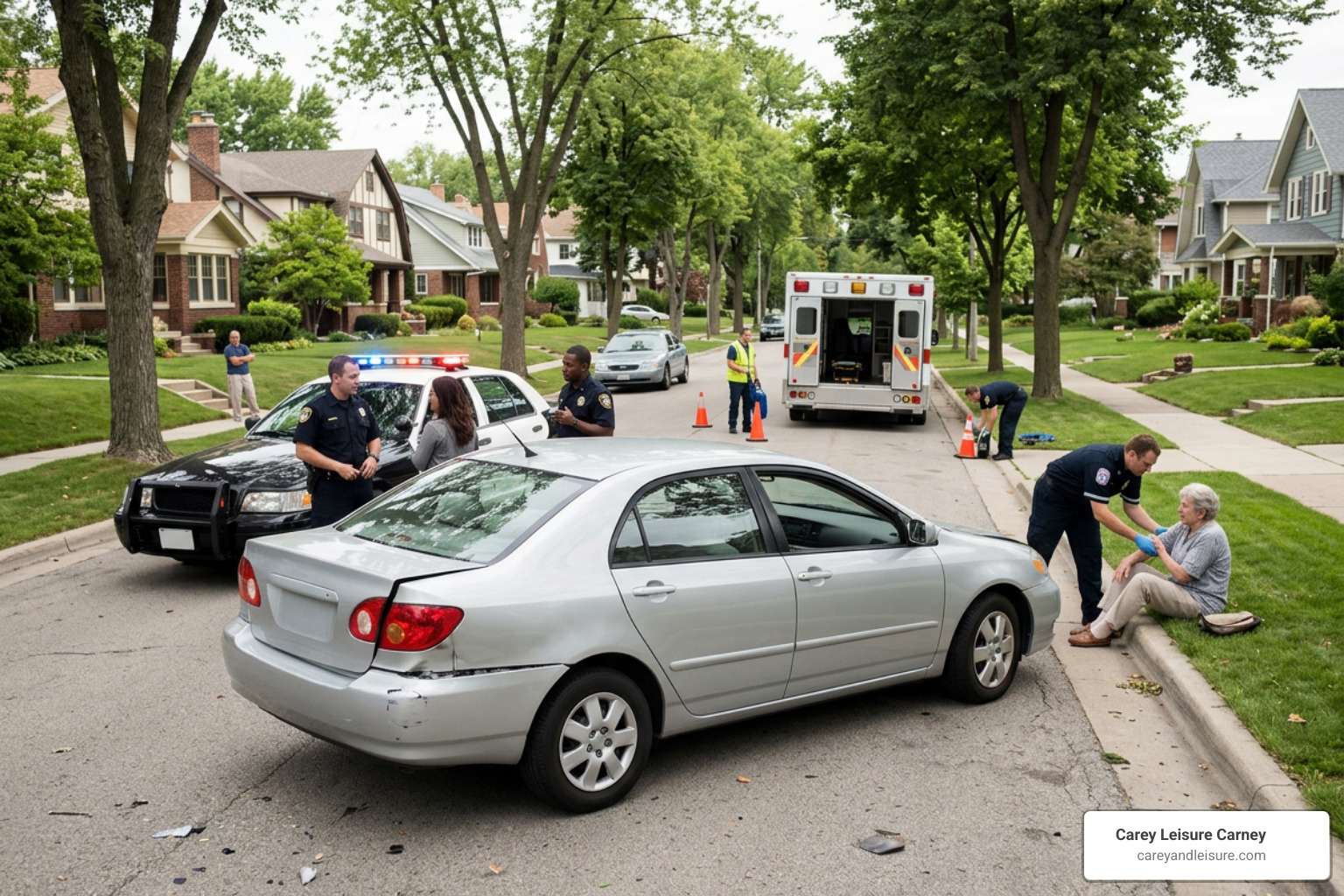
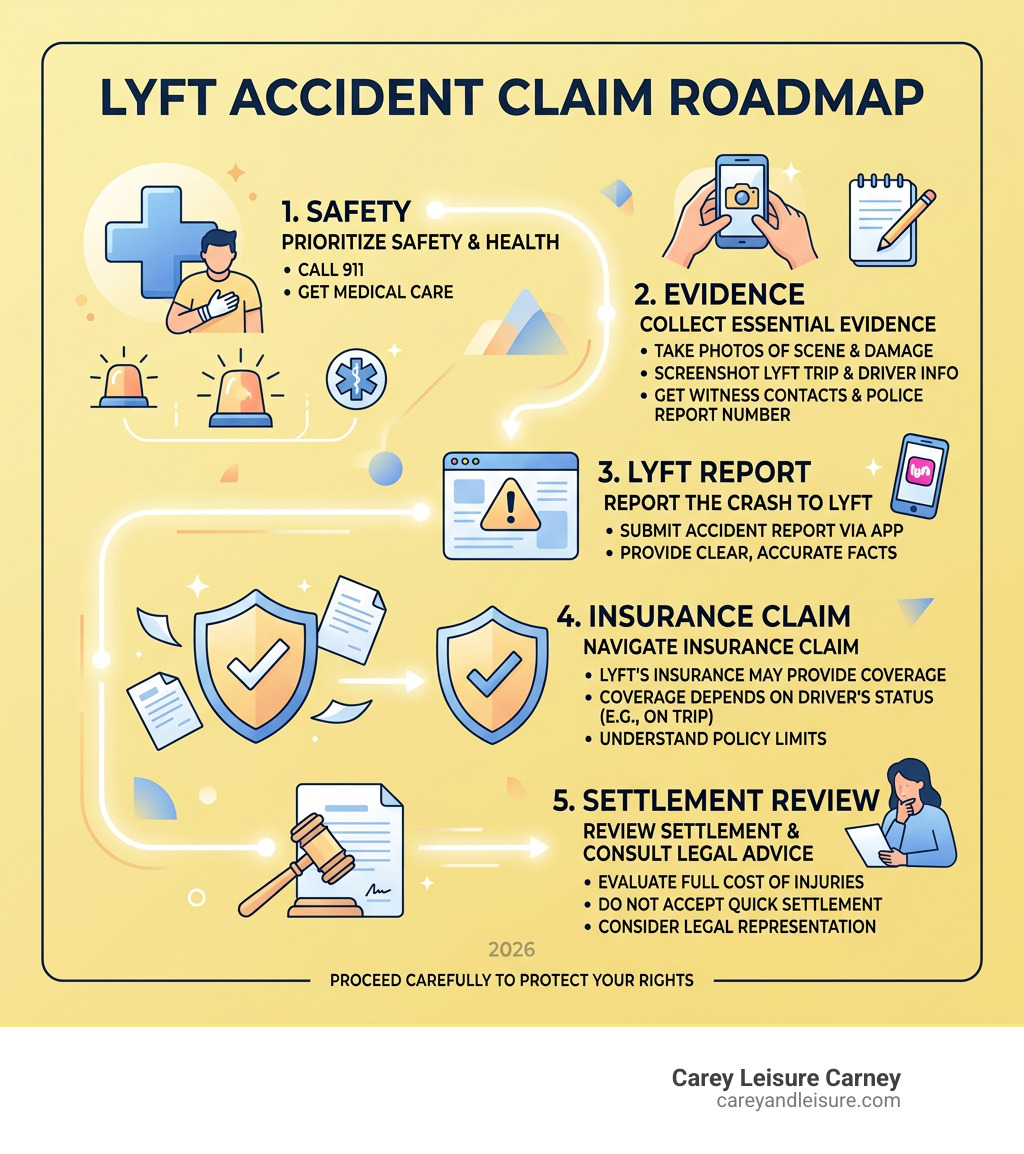
After a Lyft crash, protect yourself by taking these steps as soon as you can:
- Call 911 and get medical care, even if your pain seems minor at first.
- Take photos and screenshots of the crash scene, vehicle damage, your Lyft trip details, driver information, and messages in the app.
- Get the police report number and witness contact details.
- Report the crash to Lyft through its accident-report process, giving clear, accurate facts.
- Do not accept a quick settlement or recorded statement before you understand the full cost of your injuries.
Lyft accident claims can involve more than one insurance policy. The coverage available may depend on whether the driver was offline, waiting for a ride request, driving to a pickup, or carrying a passenger. That detail can affect who pays for medical bills, lost income, pain and suffering, and future care.
You do not need to prove every part of your claim at the roadside. But you do need to preserve what you can. A screenshot of the trip record, prompt medical records, and a complete crash report can make it much harder for an insurer to dispute what happened later.
I am Thomas W. Carey, a board-certified civil trial lawyer and founding partner of Carey Leisure Carney. Since 1988, I have handled and overseen thousands of Florida injury matters, including complex vehicle-collision cases that require the same careful evidence preservation and insurance analysis involved in Lyft accident claims.
Essential Lyft accident claims terms:
Understanding Insurance Periods That Dictate Lyft Accident Claims
Unlike standard two-car crashes where you simply exchange personal insurance cards, rideshare collisions operate on a layered commercial policy model. The amount of coverage available to pay for bodily injury and property damage hinges entirely on digital timestamps and app activity.
Lyft maintains commercial insurance policies through major carriers, but those policy triggers change the millisecond a driver taps a button on their smartphone screen. Understanding these distinct phases is essential so you do not get stuck with an unfair denial or an inadequate recovery.
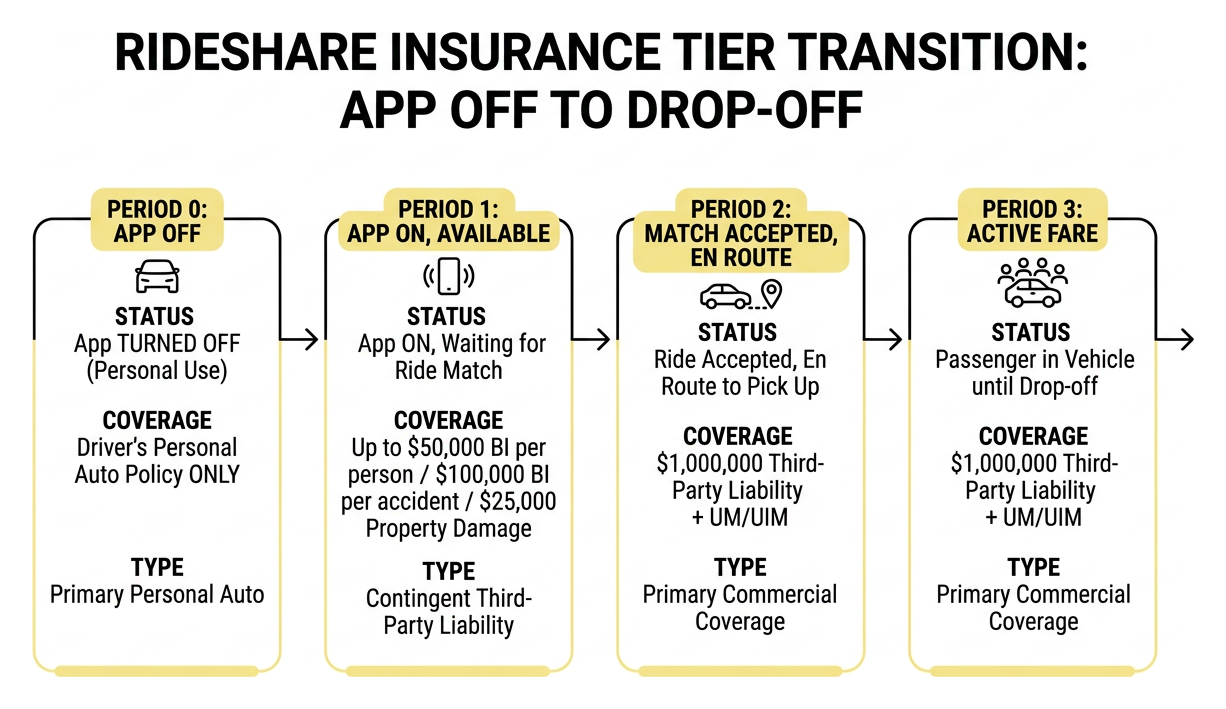
| Lyft Trip Phase | App & Driver Status | Available Insurance Coverage | Primary vs Contingent |
|---|---|---|---|
| Period 0 | App is turned OFF | Driver’s personal auto policy only | Primary personal auto |
| Period 1 | App ON, waiting for a ride match | $50,000 per person / $100,000 per accident (bodily injury), $25,000 property damage | Contingent third-party liability |
| Period 2 | Ride accepted, en route to pick up | $1,000,000 third-party liability + UM/UIM | Primary commercial coverage |
| Period 3 | Passenger in vehicle until drop-off | $1,000,000 third-party liability + UM/UIM | Primary commercial coverage |
Reviewing official Lyft insurance coverage tiers demonstrates how quickly liability limits swing from standard state minimums to a seven-figure commercial safety net.
Coverage Tiers: App Off, Waiting for Ride, and Active Trip
To evaluate your legal recourse, we categorize rideshare operations into four distinct periods:
- Period 0 (App Off): The driver is using their vehicle for personal errands. Lyft provides zero insurance coverage. Any crash falls under the driver’s personal policy.
- Period 1 (App On, Available): The driver is logged into the platform and actively seeking fares. If a crash occurs, Lyft provides contingent third-party liability coverage up to $50,000 for bodily injury per person, $100,000 total bodily injury per collision, and $25,000 for property damage.
- Period 2 (Match Accepted, En Route): The driver has accepted a dispatch and is driving to the pickup location. Lyft’s comprehensive $1,000,000 third-party liability policy activates.
- Period 3 (Active Fare): From the moment you enter the vehicle until the ride concludes in the app, the $1,000,000 commercial policy remains fully active.
When navigating these stages, you must also consider local rules like Florida PIP insurance laws, which require your own Personal Injury Protection to cover initial medical treatment regardless of fault.
How Driver Status Directly Affects Lyft Accident Claims
Driver status determines which insurance company writes the check. If a driver logs out seconds before a collision, or if they are driving between neighborhoods waiting for a ride (“deadhead miles”), Lyft’s insurance adjusters frequently argue that their primary commercial policy does not apply.
Personal auto insurance carriers routinely deny claims when they discover the vehicle was being used for commercial ridesharing without a specific policy endorsement. When insurers start pointing fingers at each other, pursuing uninsured and underinsured motorist coverage becomes vital to prevent you from being left without financial recovery.
Immediate Steps: How to Report and File a Claim After a Lyft Crash
What you do in the hours immediately following a collision directly impacts the strength of your claim. Taking the right legal actions early ensures vital electronic and physical evidence is not erased or rewritten. Learn how to handle an accident step by step to safeguard your physical health and your financial future.
Essential Scene Evidence and App Documentation Checklist
Rideshare data can disappear from your screen once a ride is canceled or marked complete. Before leaving the scene or closing the app, secure the following items:
- Screenshots of the App: Capture the driver’s profile, license plate number, vehicle make/model, route map, and the fare receipt.
- Law Enforcement Details: Request the responding officer’s name, badge number, and the official police crash report number.
- Visual Documentation: Take clear photographs and video of all vehicle damage, skid marks, road conditions, traffic control devices, and visible injuries.
- Third-Party Information: Collect names, phone numbers, and statements from eyewitnesses, nearby business owners with security cameras, and other motorists involved.
Following a systematic approach to documenting critical evidence gives your legal team the factual leverage required to hold corporate insurers accountable.
Reporting the Incident via the Lyft Portal and Claims Care
You must notify the platform about the crash, but you must do so carefully. You can initiate a report through the in-app help center or directly through the Lyft crash reporting portal.
Stick exclusively to the objective facts: time, location, vehicles involved, and that you were injured. Do not give a recorded statement to Lyft’s third-party claims administrators (such as Travelers or Progressive) without legal guidance. Adjusters are trained to interpret innocent remarks—like saying “I’m doing okay”—as an admission that your injuries are trivial.
Assessing Liability, Comparative Fault, and Potential Damages
A successful recovery requires calculating every expense caused by the crash. When we analyze a case, we assess current economic losses alongside long-term medical impacts to assist in evaluating personal injury case worth.
Economic and Non-Economic Compensation for Injured Victims
Compensation in a rideshare collision claim generally falls into two core categories:
- Economic Damages: Measurable financial losses, including ER visits, surgical care, diagnostic imaging, physical therapy, prescription medication, lost wages, and diminished future earning capacity.
- Non-Economic Damages: Intangible personal losses, including physical pain, emotional distress, physical impairment, and loss of enjoyment of life.
Securing full financial recovery means recovering pain and suffering compensation that accurately reflects how the trauma has altered your everyday lifestyle and family relationships.
Navigating Shared Fault and Florida Modified Comparative Negligence
Liability in rideshare wrecks can be messy. Crashes often involve sudden stops, erratic lane changes, or multiple at-fault motorists. In our state, claims are governed by Florida modified comparative negligence rules.
Under Florida’s 51 percent bar standard, you can recover damages as long as your share of fault does not exceed 50 percent. If you are found partially at fault, your final financial recovery is reduced proportionally. If you were a passenger riding in the backseat, you almost never bear any fault for the collision, placing you in an ideal legal position to recover full damages from the at-fault parties.
Strategic Roadblocks in Lyft Accident Claims and When to Sue
Navigating corporate claims involves clearing several tactical hurdles. Rideshare companies classify drivers as independent contractors rather than traditional employees, a legal distinction designed to shield corporate headquarters from direct vicarious liability.
Overcoming Insurer Lowball Tactics and Coverage Disputes in Lyft Accident Claims
Corporate insurance adjusters often employ standard delay-and-deny tactics. They may question the severity of your injuries, blame preexisting conditions, or make quick, lowball settlement offers before the full scope of your medical treatment is known.
Never sign a liability release or cash a settlement check until your medical providers have determined you reached Maximum Medical Improvement (MMI). Once you accept a payout, your claim is closed permanently—even if you discover months later that you require spinal surgery or ongoing physical rehabilitation.
Direct Negligence Lawsuits vs. Third-Party Commercial Coverage
While most claims resolve through negotiations under Lyft’s $1 million commercial policy, some circumstances justify filing a lawsuit directly against the company or third parties.
Understanding accident lawsuit procedures allows injury victims to file direct negligence claims against the parent rideshare company for:
- Negligent Hiring or Retention: Onboarding drivers with histories of reckless driving, violent offenses, or major traffic violations.
- App-Design Distractions: Interface mechanisms that force drivers to look at and interact with screens while operating vehicles on busy roads.
- Inadequate Vehicle Inspections: Allowing unsafe, poorly maintained vehicles to transport passengers.
Frequently Asked Questions About Lyft Accident Claims
How long do I have to file a Lyft accident lawsuit in Florida?
In Florida, you generally have two years from the date of the crash to file a personal injury lawsuit, as outlined in our guide on the Florida accident statute of limitations. Missing this strict statutory deadline permanently bars your right to pursue compensation in court.
Does Lyft’s insurance cover passenger injuries automatically?
Yes. As a paying passenger during an active trip (Period 3), you are covered by Lyft’s $1,000,000 commercial liability policy and uninsured/underinsured motorist coverage, regardless of whether your Lyft driver or a third-party motorist caused the collision.
What happens if the at-fault Lyft driver was using a rental car?
Lyft drivers operating vehicles through the Express Drive rental program are covered under the same insurance tiers while logged into the app. However, if the crash occurs while the driver is offline (Period 0), physical vehicle damage and liability are handled through the rental fleet agreement and personal insurance policies.
Conclusion
Getting fair compensation after a rideshare collision requires navigating overlapping insurance policies, strict statutory deadlines, and aggressive corporate claims adjusters. At Carey Leisure Carney, our board-certified civil trial attorneys bring over 100 years of combined legal experience to the table. We provide direct attorney access and dedicated representation to injury victims across Clearwater, Largo, New Port Richey, Spring Hill, St. Petersburg, Trinity, and Wesley Chapel.
Do not let corporate insurers shortchange your medical recovery. Protect your legal rights today by hiring an experienced rideshare accident lawyer to handle your case and secure the full compensation you deserve.