
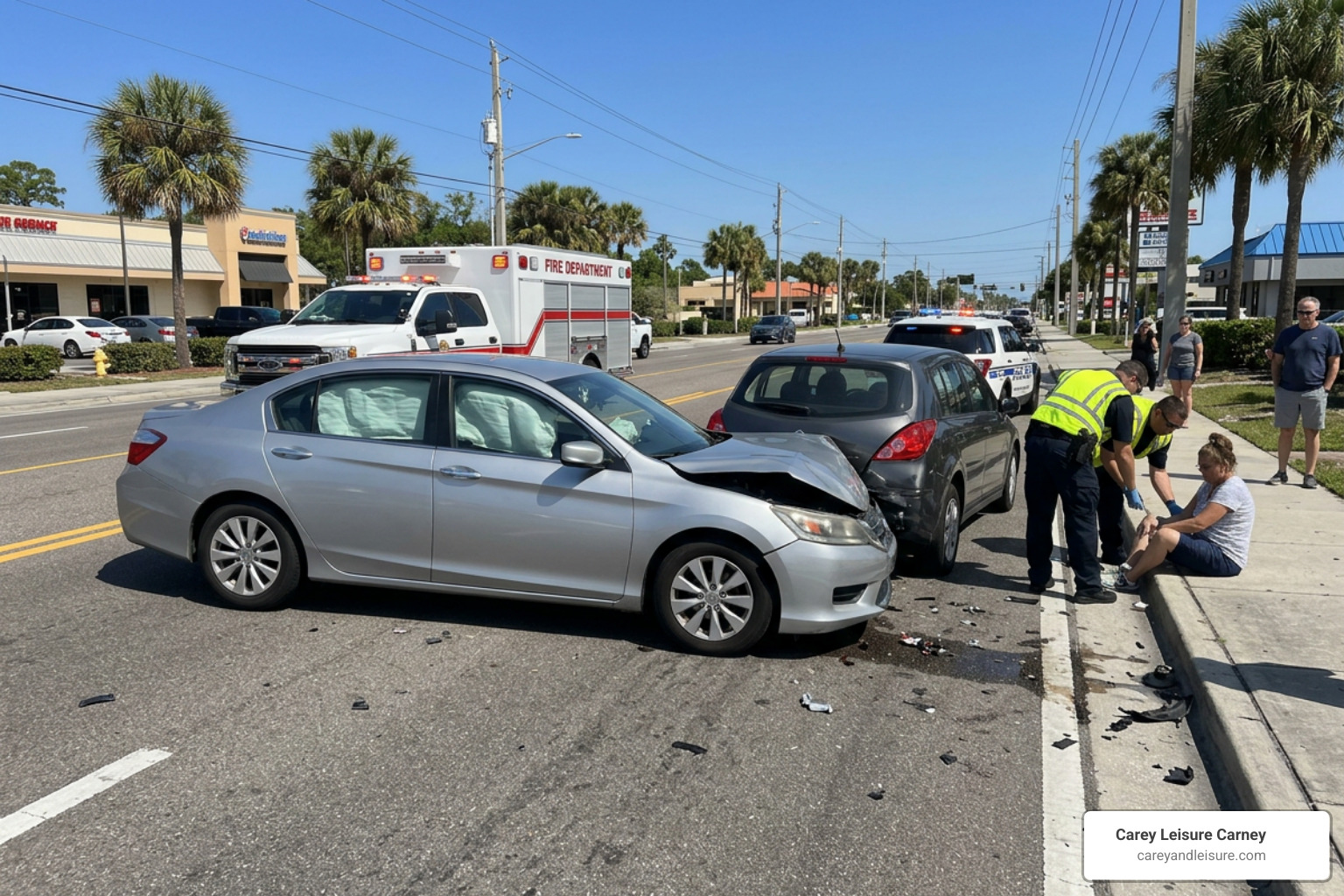
How to Handle a Lyft Accident Like a Pro
What to Know After a Lyft Driver Accident in Florida
A Lyft driver accident can turn your life upside down in seconds — and knowing what to do next makes all the difference.
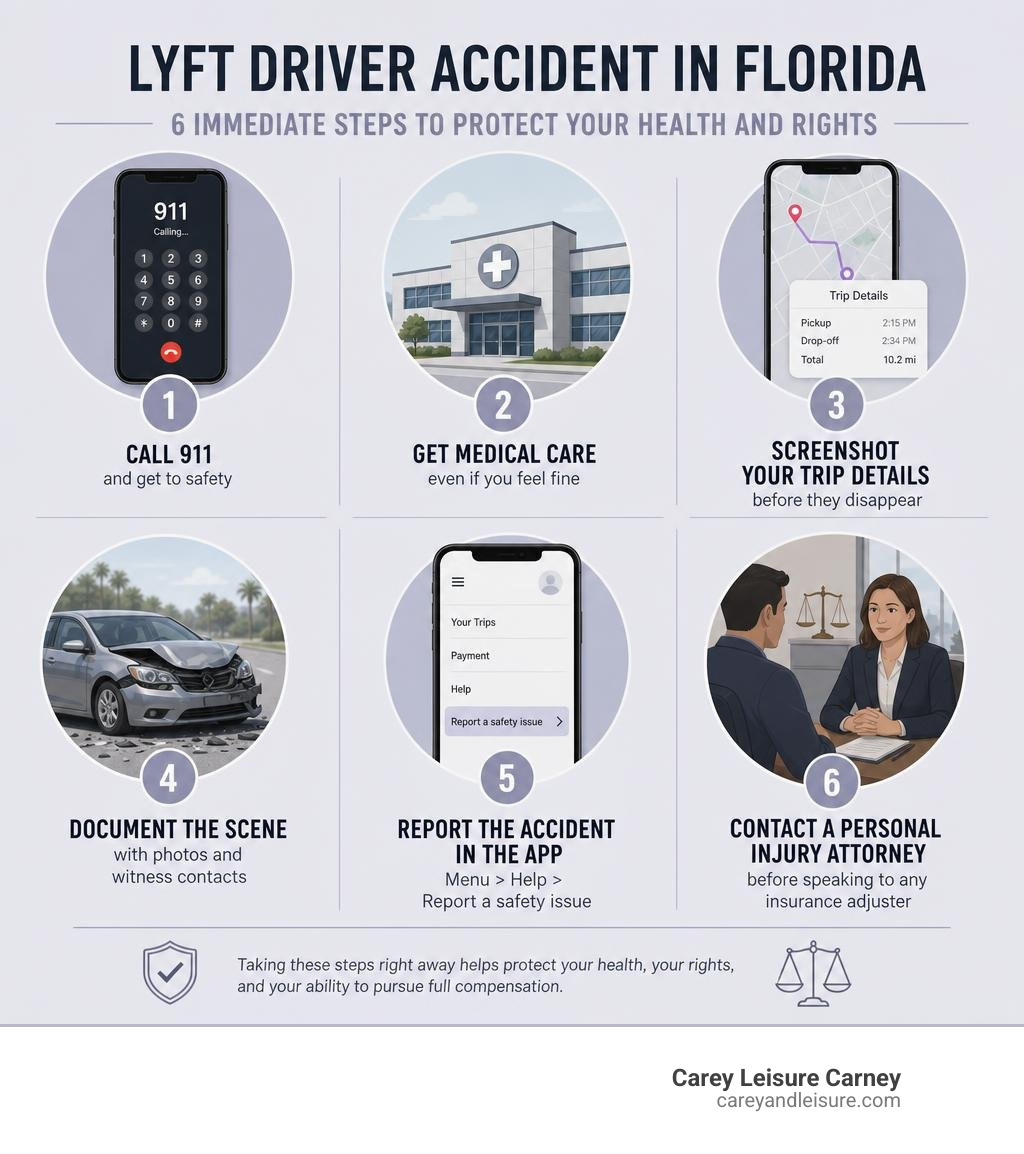
Quick answer — what to do right now:
- Call 911 and get to safety
- Get medical attention even if you feel fine
- Screenshot your Lyft trip details before they disappear
- Document the scene with photos and witness contacts
- Report the accident in the Lyft app (Menu > Help > Report a safety issue)
- Contact a personal injury attorney before speaking to any insurance adjuster
Lyft is one of the most popular ways to get around the Tampa Bay area — but Florida’s busy roads mean accidents happen. When they do, the claims process is far more complex than a standard car accident. You may be dealing with multiple insurance policies, a tiered coverage system that changes based on the driver’s app status, and a company whose primary goal is to limit what it pays out.
The average Lyft accident settlement is approximately $75,000, but values range from $6,000 for minor injuries to over $25 million for wrongful death cases. Where your claim falls on that spectrum depends heavily on how you handle the first hours and days after the crash.
I’m Thomas W. Carey, founding partner of Carey Leisure Carney and a board-certified civil trial lawyer with over 35 years of experience handling personal injury cases — including Lyft driver accident claims — across Clearwater and the greater Tampa Bay area. After guiding roughly 40,000 injury matters throughout Florida, I’ve seen how the decisions made immediately after a rideshare crash can make or break a victim’s recovery.
Lyft driver accident terminology:
What to Do Immediately After a Lyft Driver Accident

The moments directly following a Lyft driver accident are often chaotic and overwhelming. Whether you are an active passenger in the back seat, the Lyft driver yourself, or a motorist in another vehicle struck by a rideshare car, your immediate actions are vital. Taking the correct steps not only protects your physical health but also secures the evidence necessary for a successful injury claim.
First and foremost, prioritize safety. If you are on a busy road like US-19 in Clearwater or the Gandy Boulevard in St. Petersburg, try to move to a safe shoulder if the vehicles are operable. Turn on your hazard lights immediately.
Once you are out of immediate danger, your very first call must be to 911. Request both police officers and emergency medical services to the scene. Some people—especially at-fault drivers—might try to convince you to “settle things privately” without involving the police. Do not agree to this. A formal police report is a cornerstone of any future legal claim, providing an objective, third-party record of the crash.
For a comprehensive checklist of what to do on Florida roads, you can read our detailed guide on What To Do After A Car Accident Florida.
Step-by-Step Scene Protocol
To protect your rights and build a solid foundation for your recovery, follow this precise scene protocol:
- Seek Immediate Medical Attention: Even if you believe your injuries are minor, let paramedics evaluate you. Adrenaline can mask severe pain from injuries like whiplash, internal bleeding, or concussions. Securing medical documentation within 24 hours creates a clear, timestamped link between the crash and your physical condition.
- Take Comprehensive Photos and Videos: Use your smartphone to document the entire scene. Photograph vehicle damage (both interior and exterior), license plates, skid marks, traffic signals, road hazards, and any visible injuries you or your passengers sustained.
- Screenshot Your Lyft Trip Details: This is a crucial step unique to rideshare accidents. Open your Lyft app immediately and take screenshots of the driver’s name, vehicle details, map route, and the active status of your ride. Once a ride is ended or cancelled, this real-time data can become incredibly difficult to retrieve from the platform.
- Gather Witness Information: If anyone stopped to help or witnessed the collision, ask for their names, phone numbers, and brief statements of what they saw. Independent witness accounts are invaluable when insurance companies attempt to dispute fault.
Navigating these initial moments is just the beginning of your legal recovery. To learn more about how a personal injury case progresses, explore our guide on Your Legal Journey What To Do After A Rideshare Accident.
Reporting the Lyft Driver Accident in the App
Once you are safe and medical personnel have evaluated you, you must report the incident to Lyft. Both drivers and passengers can initiate this process directly through the app.
To report the crash:
- Open the Lyft app and navigate to the Menu.
- Tap on Help.
- Select Report a safety issue or Accident.
- Fill out the interactive accident report form. This form typically takes about 10 to 15 minutes to complete.
Be factual and concise. Avoid using language that admits fault or downplays your injuries (e.g., do not say “I’m fine” or “I think it was just a misunderstanding”). Lyft’s specialized Claims Customer Care team is available 24/7 to process these reports and will assign a reference number to your case.
For more details on how Lyft structures its internal reporting, you can review the official Insurance coverage while driving with Lyft – Lyft Help page.
Understanding Lyft’s 4-Period Insurance Coverage System
The single most important factor in a Lyft driver accident claim is identifying the driver’s app status at the exact second of the crash. Unlike standard car accidents where a single personal auto policy applies, rideshare claims rely on a tiered, four-period insurance system.
| Period | Driver App Status | Applicable Liability Limits | Collision & Comprehensive Coverage |
|---|---|---|---|
| Period 0 | App is completely turned off | Driver’s personal auto policy limits | Driver’s personal policy |
| Period 1 | App is on; waiting for a ride request | $50,000 per person / $100,000 per accident (bodily injury); $25,000 property damage | None provided by Lyft |
| Period 2 | Ride request accepted; en route to pick up | At least $1,000,000 third-party liability | Contingent coverage ($2,500 deductible) |
| Period 3 | Passenger is in the vehicle | At least $1,000,000 third-party liability | Contingent coverage ($2,500 deductible) |
Period 0 & Period 1: App Off vs. Waiting for Requests
During Period 0, the Lyft app is closed. The driver is using their vehicle for personal reasons, meaning Lyft’s corporate insurance provides absolutely zero coverage. Any accident claims must go entirely through the driver’s personal Florida auto insurance.
Period 1 begins the moment the driver opens the app and marks themselves as “available” to receive ride requests, but has not yet accepted a trip. Because the driver is technically working but does not yet have a passenger, Lyft provides a lower tier of third-party liability coverage if the driver’s personal policy does not apply:
- $50,000 per person for bodily injury
- $100,000 per accident for bodily injury
- $25,000 per accident for property damage
This period represents a major coverage gap. Most personal auto insurance policies in Florida contain strict “commercial use” exclusions. If a personal insurer discovers the driver was logged into Lyft during a crash, they may deny the claim entirely.
Period 2 & Period 3: En Route and Active Rides
The moment a driver accepts a ride request, the claim enters Period 2 (en route to pick up the passenger). Once the passenger steps into the vehicle, the ride enters Period 3 (active transport).
During both Period 2 and Period 3, Lyft maintains a robust $1,000,000 third-party auto liability policy. This commercial policy is designed to cover bodily injuries and property damage suffered by passengers, pedestrians, cyclists, and occupants of other vehicles if the Lyft driver is at fault.
Additionally, during these active periods, Lyft provides first-party coverages like Uninsured/Underinsured Motorist (UM/UIM) coverage in many markets. This ensures that if another driver hits your Lyft vehicle and flees the scene or lacks sufficient insurance, you still have access to compensation.
How Lyft’s Coverage Compares to Personal Auto Policies in Florida
Florida’s unique car insurance landscape adds another layer of complexity to any Lyft driver accident claim. Understanding how these commercial policies interact with local state laws is essential for anyone seeking medical or property damage compensation in Clearwater, Largo, or Wesley Chapel.
Florida No-Fault PIP and the $1 Million Liability Limit
Florida operates under a “no-fault” insurance system. By law, every motorist registered in the state must carry at least $10,000 in Personal Injury Protection (PIP) and $10,000 in Property Damage Liability (PDL).
Under this system, if you are injured in a car crash, your own PIP coverage is primary. It pays 80% of your necessary medical expenses and 60% of your lost wages, regardless of who caused the accident.
However, rideshare accidents quickly exhaust these modest limits. If you suffer severe, permanent injuries, Florida law allows you to step outside the no-fault system and file a bodily injury liability claim directly against the at-fault party. This is where Lyft’s $1 million policy becomes vital.
To explore how these complex rules apply to your specific situation, read through our Rideshare Accident Lawyer Complete Guide.
Resolving a Lyft Driver Accident Claim Dispute
Because of the vast difference in coverage limits between Period 1 ($50,000) and Periods 2/3 ($1,000,000), insurance companies routinely engage in “period disputes.” Lyft’s commercial insurer may argue the driver was merely waiting for a ride (Period 1) to limit their financial exposure, while the driver’s personal insurer may deny coverage altogether due to rideshare exclusions.
An excellent example of how these disputes impact real people is the Friday Night Rush: How One Bad Left Turn Cost a Lyft Driver Her Best Earning Week – American Deductible – Deductible Reimbursement Coverage story. In that case, a rideshare driver named Jasmine was involved in a serious T-bone collision while en route to pick up an airport passenger (Period 2). Even though the other driver was clearly at fault, Jasmine had to pay a massive $2,500 deductible out of pocket just to get her vehicle repaired and return to work. It took over six months of complex subrogation disputes between multiple insurers before she was finally reimbursed, illustrating how insurance companies drag their feet to protect their bottom lines.
To avoid falling victim to these delay tactics, it is helpful to understand how insurers operate. Read our legal breakdown on Beyond The Policy Decoding Bad Faith In Insurance Claims to learn more about your rights.
Settlement Values and Legal Rights for Injured Parties
When you are injured in a Lyft driver accident, your primary focus should be on physical recovery. However, medical bills, physical therapy costs, and lost time at work can quickly create immense financial stress. Determining the true value of your claim requires a careful analysis of your medical treatment and reaching Maximum Medical Improvement (MMI)—the point at which your doctor determines your condition has stabilized as much as medically possible.
For a comprehensive breakdown of how rideshare claims are evaluated, check out our Lyft Car Accident Settlement Ultimate Guide.
Typical Settlement Ranges by Injury Severity
Rideshare accident settlements vary heavily based on the severity of the injuries, the clarity of liability, and the quality of legal representation. On average, represented claimants recover 3.5 times more compensation than those who attempt to negotiate with insurance companies on their own.
According to data from the Lyft Accident Settlement Calculator & Guide 2026: Insurance, Values & Claims | SetCalc, typical settlement ranges in 2026 include:
- Minor Soft-Tissue Injuries (Whiplash): $6,000 to $25,000. These cases typically involve muscle strains, neck stiffness, and short-term physical therapy.
- Moderate Spinal Injuries (Herniated Discs): $100,000 to $1,350,000. These values apply to cases requiring invasive treatments, epidural steroid injections, or corrective spinal surgeries.
- Catastrophic Injuries & Wrongful Death: $1,000,000 to $25,000,000+. These catastrophic cases involve traumatic brain injuries (TBIs), permanent spinal cord damage, or fatal crashes, such as the tragic incident reported by Fox News where an ejected passenger was struck on a highway.
Passenger, Pedestrian, and Third-Party Rights
If you were a passenger inside a Lyft during a crash, you are almost always considered an innocent bystander. You do not have to worry about proving your own lack of fault; instead, the legal dispute will center on whether your Lyft driver or another motorist caused the collision.
Pedestrians, cyclists, and occupants of other vehicles struck by a Lyft driver have the exact same rights to pursue compensation under Lyft’s tiered policy. However, proving liability in these cases requires gathering extensive digital evidence, including the driver’s GPS logs, mobile phone records (to rule out distracted driving), and vehicle telematics.
To understand how our legal team uncovers this evidence to prove fault, read our detailed article, The Blame Game Unpacking Negligence In Rideshare Accidents.
Frequently Asked Questions about Lyft Accidents
How long do I have to file a Lyft accident claim in Florida?
In Florida, the statute of limitations for most personal injury claims—including rideshare accidents—is two years from the date of the crash. If you do not file a formal lawsuit within this strict window, you will lose your legal right to seek compensation forever.
While two years may seem like a long time, crucial evidence can disappear in a matter of days. Surveillance footage from local businesses near busy intersections in Largo or St. Petersburg is often overwritten within 48 to 72 hours. Witness memories fade, and physical vehicle damage is repaired. It is always best to consult an attorney immediately to preserve vital evidence.
Can I sue Lyft directly if the driver was at fault?
Generally, no. Lyft utilizes an independent contractor model, classifying its drivers as self-employed gig workers rather than direct employees. This legal shield protects Lyft from “vicarious liability” (being held automatically responsible for a driver’s negligent actions behind the wheel).
However, you can sue Lyft directly under theories of direct negligence if the company failed in its corporate duties. This includes:
- Negligent Screening/Hiring: Allowing a driver with a history of reckless driving or active DUIs onto the platform.
- Negligent Retention: Failing to deactivate a driver after multiple safety complaints. For instance, in severe cases like the Detroit Lyft driver accused of drunk driving, leading to violent crash report, direct corporate negligence may be explored if the platform ignored clear red flags.
To understand how a dedicated lawyer builds these complex cases against corporate entities, read From Crash To Claim How A Rideshare Accident Lawyer Handles Your Case.
What is the deductible for Lyft’s physical damage coverage?
If a Lyft driver is using their vehicle during Period 2 or Period 3, Lyft provides contingent comprehensive and collision coverage to repair the driver’s car. However, this coverage carries a steep $2,500 deductible.
Furthermore, this coverage is “contingent,” meaning Lyft will only pay if the driver already maintains comprehensive and collision coverage on their personal auto insurance policy. If the driver only carries the bare minimum Florida-required liability insurance, Lyft will not cover the physical damage to their vehicle at all.
Conclusion
A Lyft driver accident is far more than a simple insurance claim. It is a high-stakes legal battle involving multi-billion-dollar corporations, complex tiered policy periods, and aggressive insurance adjusters who want nothing more than to settle your case for pennies on the dollar.
At Carey Leisure Carney, we believe you shouldn’t have to fight these corporate giants alone. Based in Clearwater, Florida, and serving clients across Largo, New Port Richey, Spring Hill, St. Petersburg, Trinity, and Wesley Chapel, our firm brings over 100 years of combined legal experience to your side.
What makes us different?
- Board-Certified Expertise: Our attorneys are Board-Certified in Civil Trial Law—a distinction held by less than 2% of all lawyers in Florida.
- Direct Attorney Access: We don’t pass your case off to paralegals or case managers. When you work with us, you get direct access to your attorney’s personal cell phone number.
- A Proven Track Record: We have recovered millions of dollars for injured Floridians, helping them secure the medical care, lost wages, and peace of mind they deserve.
If you or a loved one has been injured in a rideshare crash, don’t wait for the insurance companies to dictate your recovery. Contact us today to schedule your free, no-obligation consultation. To learn more about how we can help you secure the compensation you deserve, visit our Auto Accident Attorney/Rideshare Accident Attorney page.