
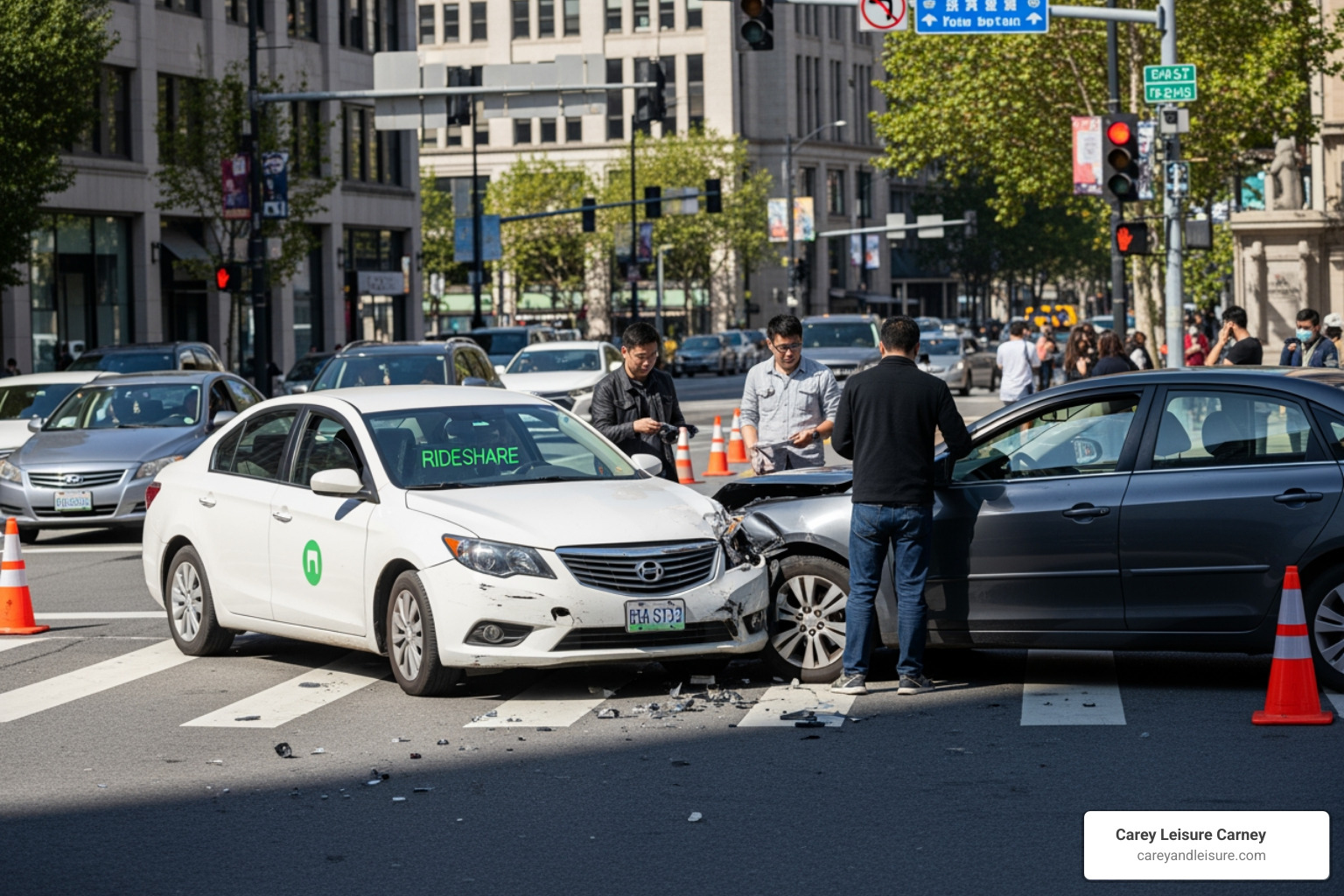
Wheels of Fortune: Navigating Vehicle Issues After a Rideshare Accident
Understanding Rideshare Accident Vehicles: What You Need to Know
Rideshare accident vehicles present unique challenges that differ from typical car crashes. When you’re involved in an Uber or Lyft accident, you’re dealing with layered insurance policies, independent contractor status, and questions about who’s responsible for vehicle repairs and replacement.
Key facts about rideshare accident vehicles:
- Insurance coverage depends on app status – Whether the driver was logged off, waiting for a ride, or actively transporting a passenger determines which policy applies
- Multiple parties may be liable – The rideshare driver, another driver, the rideshare company, or a combination
- Coverage can reach $1 million – When a passenger is in the car or the driver is en route to pick them up
- Personal auto policies often exclude rideshare work – Most standard car insurance won’t cover accidents that happen while driving for Uber or Lyft
- Vehicle replacement programs exist – Some rideshare companies offer replacement vehicles to eligible drivers after accidents
Ridesharing has transformed transportation, but it’s also created new accident scenarios. In the U.S., Uber alone has approximately 131 million monthly active users, and research from the University of Chicago shows that the arrival of ridesharing is associated with a 2-3% increase in fatal accidents. Even more striking, a University of Illinois Chicago study found that one-third of rideshare drivers have been involved in a crash while on the job.
As Thomas W. Carey, a board-certified civil trial lawyer with over 35 years of experience in Florida personal injury law, I’ve guided thousands of injury cases through complex insurance situations, including many involving rideshare accident vehicles. My firm focuses on securing fair compensation for accident victims navigating the unique challenges of rideshare crashes, where determining coverage and liability often requires specialized legal knowledge.
Explore more about rideshare accident vehicles:
The Aftermath: Your First Steps After a Rideshare Crash
Being involved in a car accident, especially one involving rideshare accident vehicles, can be a jarring and confusing experience. Whether you’re a rideshare driver, a passenger, or another driver involved, your immediate actions can significantly impact your safety, health, and potential legal claims. We always advise prioritizing safety first.
Safety First
After the initial shock, take a deep breath and assess the situation. Your safety and the safety of others are paramount.
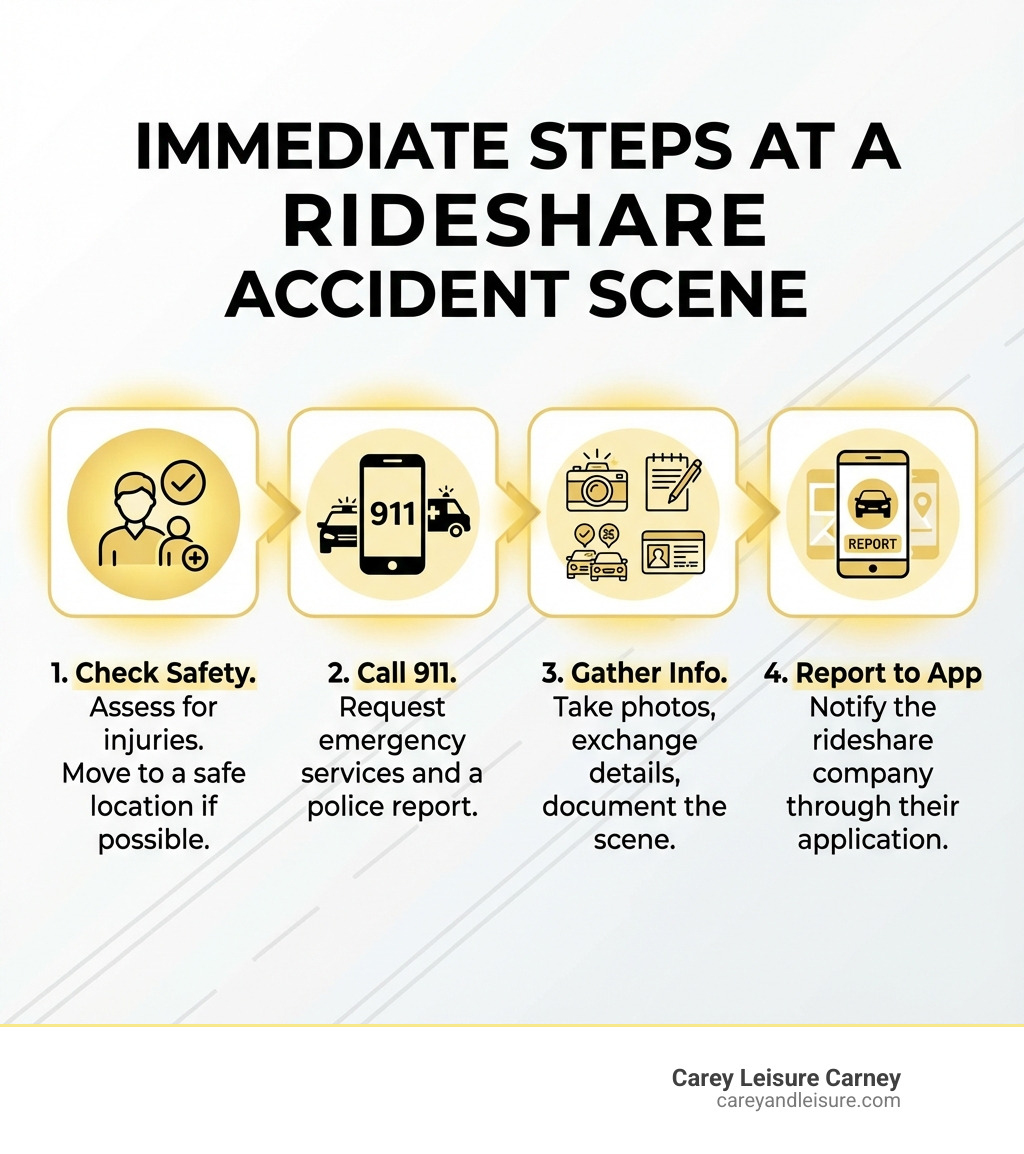
- Check for Injuries: First and foremost, check yourself and everyone else involved for any injuries. Even if you feel fine, some injuries, like whiplash or concussions, may not show symptoms right away but could worsen over time. If anyone is seriously injured, do not attempt to move them unless their immediate safety is at risk (e.g., fire, explosion).
- Call 911: Always call 911 immediately to report the accident to law enforcement and request emergency medical assistance if anyone is injured. An official police report is crucial for insurance claims and legal proceedings.
- Move Vehicles (If Safe): If the rideshare accident vehicles are operable and it is safe to do so, move them to the side of the road or a safer location to prevent further collisions. Activate your hazard lights to warn other drivers.
Police Report
When law enforcement arrives, they will investigate the scene and create an official police report. This report will contain vital information about the accident, including the date, time, location, parties involved, and often a preliminary determination of fault. Be sure to ask the responding officer for their name, badge number, and how you can obtain a copy of the police report. This document will be invaluable later on.
For a more general guide on what to do after any car accident in Florida, you can refer to our detailed article: What to do after a car accident in Florida.
Gathering Crucial Information at the Scene
Once the immediate safety concerns are addressed, gathering information at the scene is critical. This documentation will form the foundation of any insurance claims or legal actions related to the rideshare accident vehicles.
- Driver Information: Collect the full name, phone number, address, and driver’s license number from all drivers involved, including the rideshare driver.
- Passenger Details: If there were passengers in the rideshare vehicle or other cars, obtain their contact information as well. They could be valuable witnesses.
- Witness Contacts: Look for any bystanders who witnessed the accident. Their unbiased accounts can be extremely helpful. Get their names and phone numbers.
- Insurance Cards: Exchange insurance information with all drivers. Take pictures of their insurance cards. For rideshare drivers, their personal insurance might not cover commercial activity.
- License Plates: Note down the license plate numbers of all vehicles involved.
- Photo Evidence: Take comprehensive photos and videos of the accident scene. This includes:
- Damage to all rideshare accident vehicles from multiple angles.
- Any visible injuries you or others sustained.
- The position of the vehicles after the crash.
- Road conditions (e.g., skid marks, debris, potholes).
- Traffic signals, street signs, and any relevant landmarks.
- Weather conditions at the time of the accident.

- Video Documentation: A short video walkthrough of the scene can capture details that still photos might miss.
- Rideshare App Status: This is perhaps the most unique and crucial piece of information for rideshare accident vehicles. If you are the rideshare driver, note your app status (logged off, online waiting for a request, en route to pick up a passenger, or with a passenger). If you are a passenger, take screenshots of the rideshare driver’s profile in the app, including their name, vehicle make, model, and license plate. This information is vital for determining insurance coverage.
- Police Officer Details: As mentioned, get the officer’s name, badge number, and the report number.
Thorough documentation can make or break a personal injury claim. For more insights on this, read our guide on Documenting Evidence in Personal Injury Claims.
Who to Notify Immediately
Beyond calling 911, there are other parties you need to inform promptly about the accident.
- 911 and Paramedics: Already covered, but cannot be stressed enough if there are injuries.
- Police: Ensure a police report is filed.
- Rideshare Company (Uber/Lyft): If you are the rideshare driver or a passenger, you must report the accident to Uber or Lyft through their app as soon as possible. Both companies have specific features for reporting incidents. While reporting, be honest about the facts but avoid making statements that could imply fault or minimize your injuries.
- Your Personal Insurance Company: If you are the rideshare driver, you should also notify your personal auto insurance provider, even if you believe the rideshare company’s insurance will cover it. It’s best to be transparent. If you are another driver or passenger, notify your own insurance company as well.
Understanding the role of insurance companies in a car accident is vital. You can find more information here: The Role of Insurance Companies in a Car Accident.
The Insurance Maze: Understanding Coverage for Rideshare Accidents
Navigating insurance after an accident involving rideshare accident vehicles is often where things get complicated. Unlike a standard car crash, there are multiple layers of insurance that might apply, depending heavily on the rideshare driver’s status at the time of the incident.
How Your App Status Determines Your Coverage (Periods 1, 2, & 3)
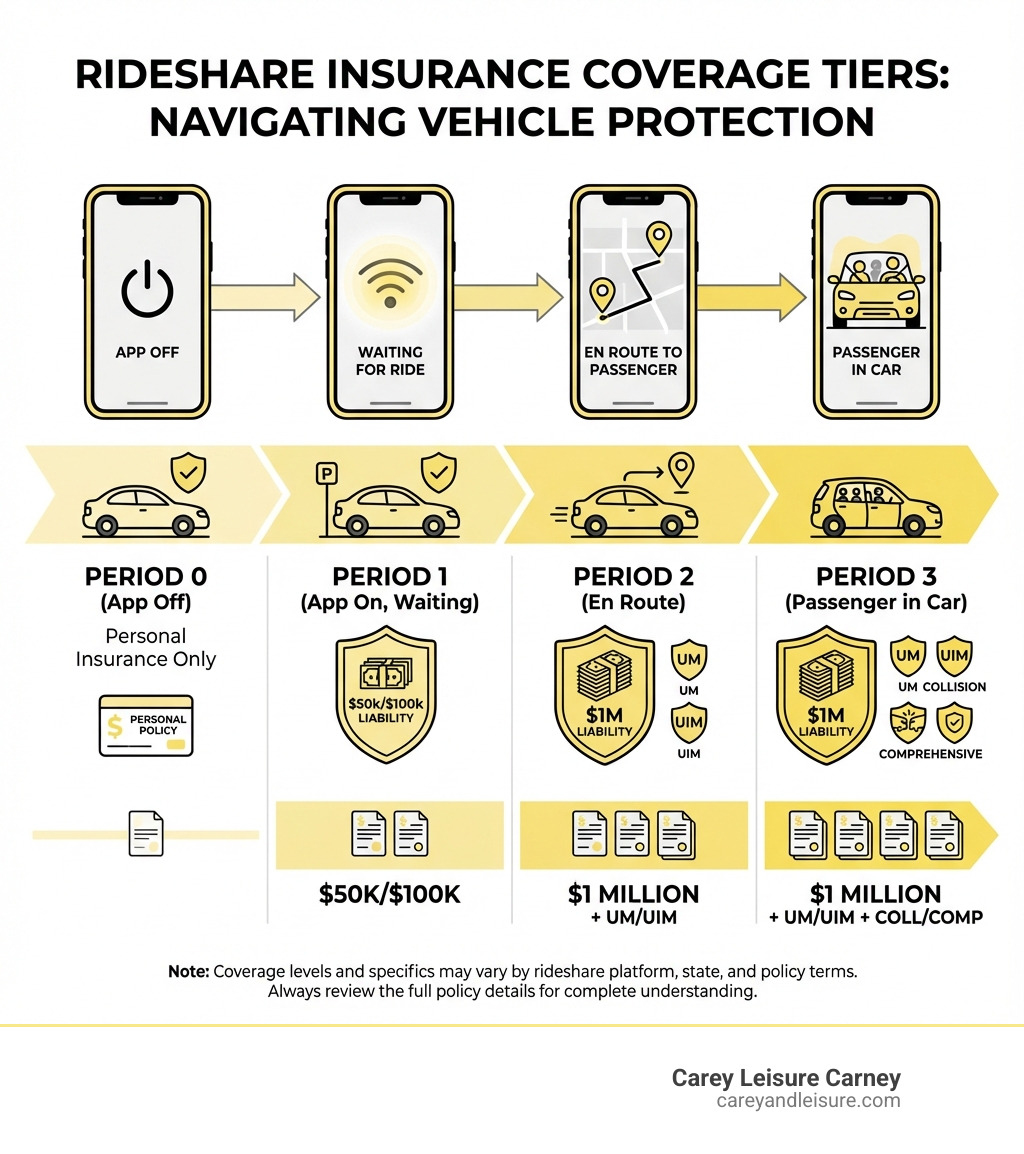
The key to understanding insurance coverage for rideshare accident vehicles lies in the driver’s “app status” at the moment of the crash. This is often broken down into different “periods” of activity.
- Period 0 (App Off): If the rideshare driver’s app is completely off, their personal auto insurance policy applies, just like any other private vehicle accident. In Florida, all drivers are required to maintain minimum amounts of insurance, including $10,000 in Personal Injury Protection (PIP) coverage and $10,000 in Property Damage Liability (PDL) coverage. However, most personal auto policies have a “business-use exclusion,” meaning they may deny coverage if they find out the driver was engaged in commercial activity, even if the app was off but they were on their way to pick up a passenger. This is why having a rideshare endorsement on your personal policy is crucial for drivers.
- Period 1 (App On, Waiting for a Request): When the rideshare driver is logged into the app and waiting for a ride request, but hasn’t accepted one yet, the rideshare company’s insurance provides limited liability coverage. For example, Uber and Lyft typically provide third-party liability coverage up to $50,000 per person for bodily injury, $100,000 total liability per accident, and $25,000 for property damage. This usually does not cover damage to the rideshare driver’s own vehicle or their own injuries.
- Period 2 (En Route to Pick-up) & Period 3 (Passenger in Car): These are the periods with the most comprehensive coverage from the rideshare companies. Once a driver has accepted a trip request and is either en route to pick up the passenger (Period 2) or has the passenger in the vehicle (Period 3), Uber and Lyft provide substantial commercial liability coverage, typically up to $1 million. This coverage is for third-party bodily injury and property damage. It also often includes Uninsured/Underinsured Motorist (UM/UIM) coverage and contingent collision/comprehensive coverage for the driver’s vehicle (subject to a deductible). This $1 million policy is a significant safety net.
Personal auto insurance policies typically exclude coverage for rideshare driving activities unless a specific rideshare endorsement or separate commercial policy is purchased. This is a critical point for any rideshare driver in Florida.
For more on UM/UIM coverage, which can be vital in these situations, check out: Uninsured vs. Underinsured Motorist Coverage Explained.
Insurance Coverage for Rideshare Accident Vehicles and Occupants
Let’s break down the types of coverage that might apply to rideshare accident vehicles and those inside them:
- Third-Party Liability: This covers injuries and property damage you cause to others. During Periods 2 and 3, Uber and Lyft provide $1 million in third-party liability coverage.
- Bodily Injury (BI): This pays for medical expenses, lost wages, and pain and suffering for individuals injured in the accident (excluding the at-fault driver).
- Property Damage (PD): This covers damage to other vehicles or property caused by the rideshare driver.
- Uninsured/Underinsured Motorist (UM/UIM): This coverage is designed to protect you if the at-fault driver has no insurance or insufficient insurance to cover your damages. In Florida, UM/UIM can be an important safeguard. During Periods 2 and 3, Uber and Lyft generally provide UM/UIM coverage for their drivers and passengers.
- Personal Injury Protection (PIP): As a no-fault state, Florida requires all drivers to carry PIP coverage, which covers medical expenses and lost wages up to $10,000, regardless of who was at fault. This applies to your own injuries. You can learn more about this crucial Florida coverage here: What is PIP Insurance Florida?.
- Contingent Collision Coverage: This is typically offered by rideshare companies during Periods 2 and 3 to cover damage to the rideshare driver’s own vehicle. However, it usually comes with a high deductible (often $2,500) and only applies if the driver already carries personal collision coverage on their own policy.
- Deductibles: Be aware that deductibles for rideshare company collision coverage can be quite high, meaning the driver will have to pay a significant amount out-of-pocket before coverage kicks in.
Navigating Repairs and Replacement for Rideshare Accident Vehicles
Beyond injuries, one of the biggest concerns for a rideshare driver after an accident is what happens to their rideshare accident vehicles. Their car isn’t just transportation; it’s their livelihood.
- Vehicle Damage: The extent of damage will determine whether the car can be repaired or is deemed a total loss.
- Repair Estimates: Obtaining accurate repair estimates is the first step toward getting your vehicle fixed.
- Total Loss: If the repair costs exceed a certain percentage of the vehicle’s actual cash value, the insurance company may declare it a total loss. This can be devastating for a driver who relies on their car for income. If your car is declared a total loss, we have a guide for you: What if my car is a total loss?.
- Diminished Value: Even if your vehicle is repaired, it may suffer from “diminished value,” meaning its market value is lower post-accident than it was before, even with quality repairs. In Florida, you may be entitled to compensation for this loss. Learn more about Compensation for Diminished Car Value After Accident Florida.
- Driver Downtime: While your vehicle is being repaired or replaced, you’re out of work. This loss of income can quickly become a significant financial burden.
The Uber Pro Vehicle Replacement Program
Some regions offer programs to help drivers mitigate downtime. For example, in certain Australian cities (Melbourne, Sydney, Brisbane, Adelaide, Canberra, or Perth), Uber Pro driver-partners (Gold, Platinum, or Diamond tier) who are involved in an “on-trip” accident may be eligible for a vehicle replacement program. An “on-trip” accident means it occurred after accepting a trip request, while on the trip, or up to 15 minutes after the trip ended.
This specific program, as detailed in the provided research, is for those Australian cities and is not currently available in Florida. However, it illustrates the kind of support that could exist to help rideshare drivers keep earning after an accident. If such a program were to become available in Florida, the eligibility and fault determination would likely follow similar principles: if you’re not at fault, the replacement vehicle costs are typically recovered from the at-fault party; if you are at fault, you might pay a rental fee.
For more information on the structure of such programs, you can read More on the Uber Pro program. Always check with Uber or Lyft directly for any current vehicle replacement options available to drivers in Florida.
Filing a Claim for Your Rideshare Accident Vehicles
Filing a claim after an accident with rideshare accident vehicles involves several steps:
- Reporting to Uber/Lyft: As mentioned, report the accident through the driver app. This initiates their internal claims process.
- Claim Process: Be prepared for a detailed process. The rideshare company’s insurer will investigate to determine fault and applicable coverage.
- Insurance Adjusters: You’ll likely interact with insurance adjusters from various companies (your personal, the rideshare company’s, and the other driver’s). Be cautious about what you say; avoid admitting fault or speculating.
- Repair Authorization: Once liability is determined and coverage confirmed, the insurance company will authorize repairs or declare a total loss.
- Documents for a Property Damage Claim: To facilitate your claim, you’ll need:
- The police report.
- Photos and videos of the damage.
- Repair estimates from certified shops.
- Proof of vehicle ownership and registration.
- Information on any outstanding loans on the vehicle.
- Documentation of rental car expenses (if applicable).
- Records of lost income due to vehicle downtime.
- Consequences for At-Fault Drivers: If you, as a rideshare driver, are found at fault for an accident, it can lead to higher insurance premiums, potential deactivation from the rideshare platform, and personal financial liability beyond insurance limits.
- Deactivation: Rideshare companies can deactivate drivers who are involved in accidents, especially if they are found at fault or if the accident impacts their safety record. This can immediately cut off a driver’s income source.
The Legal Route: When to Involve a Rideshare Accident Lawyer
Given the complexities of insurance, liability, and the potential for significant financial losses and injuries, involving a personal injury lawyer is often the smartest move after an accident with rideshare accident vehicles.
Complex Claims
Rideshare accident vehicles introduce layers of complexity that traditional car accidents don’t have. Determining who is liable—the rideshare driver, another driver, or even the rideshare company itself—can be challenging. The different insurance policies and their varying coverage limits based on the driver’s app status make these claims particularly intricate.
Research from John Barrios of the University of Chicago suggests that the rise of ridesharing is associated with an increase of 2-3% in fatal accidents, highlighting the serious nature of these incidents. When navigating such a complex situation, having an experienced legal team on your side is invaluable. We’ve put together a Rideshare Accident Lawyer Complete Guide to help you understand the process.
Identifying Liable Parties
In a standard car accident, identifying the at-fault party might be straightforward. With rideshare accident vehicles, it’s rarely that simple. We must consider:
- The Rideshare Driver: If their negligence caused the accident.
- Another Driver: If a third party’s actions led to the crash.
- The Rideshare Company (Uber/Lyft): While direct lawsuits against the company are less common, exceptions exist if the company failed in its duty to properly screen drivers or if there were vehicle maintenance issues they were responsible for.
- Multiple Parties: Often, fault can be shared between several parties, leading to comparative negligence claims.
Insurance Company Tactics
Insurance companies, whether personal auto or rideshare company insurers, are businesses whose primary goal is to minimize payouts. They may employ tactics to delay negotiations, deny claims, or offer settlements that are far below what you deserve. Without legal representation, you might find yourself at a disadvantage when dealing with experienced adjusters. Our attorneys are well-versed in these tactics and work tirelessly to protect our clients’ rights.
Compensation for Injured Passengers and Drivers
If you’ve been injured in an accident involving rideshare accident vehicles, whether as a passenger or a driver, you may be entitled to compensation for various damages:
- Medical Bills: This includes emergency care, hospital stays, doctor visits, prescription medications, physical therapy, and any future medical needs related to your injuries.
- Lost Wages: If your injuries prevent you from working, you can seek compensation for lost income, both past and future. For rideshare drivers, this also includes income lost due to vehicle downtime.
- Pain and Suffering: These are non-economic damages that compensate you for the physical pain, emotional distress, mental anguish, and loss of enjoyment of life caused by the accident.
- Property Damage: This covers the cost of repairing or replacing your vehicle, as well as any other personal property damaged in the crash.
To get a better understanding of what your personal injury case might be worth, we encourage you to read: What is my personal injury case worth?. For severe injuries, a Catastrophic Injury Complete Guide can provide more specific information.
Navigating the Statute of Limitations
Every state has a strict deadline, known as the statute of limitations, for filing a personal injury lawsuit after an accident. If you miss this deadline, you lose your right to seek compensation through the courts. For example, in Maryland, the general deadline is three years.
In Florida, the statute of limitations for most personal injury claims, including those arising from rideshare accident vehicles, is generally two years from the date of the accident. This is a critical deadline that we help our clients track carefully. The sooner you contact an attorney, the better equipped we are to gather evidence, build your case, and ensure all deadlines are met. This is just one of the many reasons Why You Need a Personal Injury Lawyer.
Frequently Asked Questions about Rideshare Accident Vehicles
We understand that accidents involving rideshare accident vehicles raise many questions. Here are some of the most common ones we encounter:
Does workers’ compensation apply to Uber or Lyft drivers?
Generally, no. Rideshare drivers are classified as independent contractors, not employees, by companies like Uber and Lyft. Because of this classification, they are typically not eligible for traditional workers’ compensation benefits if they are injured in an accident while driving. This means rideshare drivers in Florida must rely on their personal insurance, the rideshare company’s liability policy (if applicable), or a personal injury claim against an at-fault party to cover medical expenses and lost wages.
It’s worth noting that there are exceptions in some specific jurisdictions. For instance, in New York City, rideshare drivers are covered by the Black Car Fund, which provides some workers’ compensation-like benefits. However, this is specific to NYC and does not apply to drivers in Florida.
What happens if my personal auto insurance finds out I’m a rideshare driver?
This is a critical concern for rideshare drivers. Most standard personal auto insurance policies include a “business-use exclusion.” This means your personal policy will likely deny any claim if they find you were using your vehicle for commercial purposes, such as ridesharing, at the time of the accident.
If your insurer finds out you’re driving for a rideshare service without proper coverage, they could:
- Deny your claim: Leaving you responsible for all damages and injuries.
- Cancel your policy: Making it difficult and more expensive to find new insurance.
To protect yourself, we strongly advise rideshare drivers in Florida to be honest with their insurance provider and purchase a specific rideshare endorsement or a separate commercial rideshare insurance policy. This ensures you have coverage during all periods of your rideshare activity and prevents potential policy cancellation or claim denial.
As a passenger, what are my rights if my Uber or Lyft gets in a crash?
As a passenger in an Uber or Lyft, you have significant rights if your rideshare accident vehicles are involved in a crash. You have the right to:
- Safety: The expectation that your driver will operate the vehicle safely.
- Compensation: If you are injured due to someone else’s negligence (the rideshare driver, another driver, or both), you have the right to seek compensation for your medical bills, lost wages, pain and suffering, and other damages.
- Coverage Under Rideshare Policy: When you are a passenger in an Uber or Lyft, the rideshare company’s robust $1 million liability policy is typically in effect. This policy is designed to cover your injuries and damages.
Even if you feel fine immediately after the crash, it’s always wise to seek medical attention and consult with a personal injury attorney. We can help you understand your options and steer the claims process. For more specific advice on this in Florida, check out: What to do if your Uber gets into an accident in Florida.
Get Expert Guidance for Your Rideshare Accident Claim
Accidents involving rideshare accident vehicles are inherently complex, blending personal injury law with the intricate world of rideshare insurance policies. Whether you’re a driver facing vehicle damage and lost income, or a passenger recovering from injuries, navigating the aftermath can feel overwhelming.
At Carey Leisure Carney, we understand these challenges. Our board-certified attorneys, with over 100 years of combined experience, specialize in auto accident and personal injury claims right here in Florida. We serve clients across Clearwater, Largo, New Port Richey, Spring Hill, St. Petersburg, Trinity, and Wesley Chapel, providing personalized service and direct attorney access.
We are here to protect your rights, decipher complex insurance policies, identify all liable parties, and fight for the full compensation you deserve. Don’t let the complexities of a rideshare accident leave you feeling stranded.
Contact us today for a free consultation. Let us put our expertise to work for you. Contact a Rideshare Accident Attorney.