
Choosing a Rideshare Accident Attorney Who Actually Drives Results
Choose a Rideshare Accident Attorney Ready to Prove Your Claim
After an Uber or Lyft crash, choose a Rideshare accident attorney who can quickly identify the driver’s app status, preserve digital trip evidence, and pursue every available insurance policy. Ask whether the lawyer has trial experience, handles claims on a contingency fee, communicates directly with clients, and has a plan for dealing with the rideshare company’s insurer.
Rideshare crashes are not always handled like ordinary Florida car accidents. The available coverage can change based on whether the driver was offline, waiting for a ride request, driving to pick someone up, or carrying a passenger. There may also be several insurers, multiple at-fault parties, and electronic records that need to be saved before they disappear.
If you were hurt in Tampa Bay or elsewhere in Florida, prompt medical care, a crash report, photos, witness information, and a report through the rideshare app can help protect your claim. A careful legal review can also help determine whether compensation may include medical costs, lost income, vehicle damage, and pain and suffering.
I am Thomas W. Carey, a board-certified civil trial lawyer and founding partner at Carey Leisure Carney. As a Rideshare accident attorney with decades of experience overseeing personal injury matters in Florida, I understand how to prepare complex crash cases for meaningful settlement negotiations or trial.
Rideshare accident attorney terminology:
Introduction

The rise of on-demand transportation has transformed how people commute across Florida communities like Clearwater, St Petersburg, and Largo. While tapping a screen to hail a ride is undeniably convenient, the surge in gig-economy vehicles on our roadways has introduced distinct traffic safety challenges. Rideshare-related crashes across the country have increased substantially over recent years, and approximately one in four gig drivers has experienced a collision while operating their vehicle.
When an Uber or Lyft is involved in a wreck, the legal aftermath rarely resembles a standard fender-bender between two private vehicle owners. The presence of commercial platforms creates a web of corporate policies, app data timestamps, and layered insurance coverage. Protecting passenger safety and pursuing fair compensation requires understanding how state-mandated coverage shifts in real time.
Why Rideshare Accident Claims Require a Specialized Rideshare Accident Attorney
Handling a claim involving a transportation network company (TNC) involves legal considerations that do not exist in standard vehicle collisions. Many accident victims understandably assume that because Uber and Lyft are multi-billion-dollar corporations, filing a claim will be straightforward. In reality, these platforms structure their business models to distance themselves from direct legal liability.
Rideshare drivers are classified as independent contractors rather than direct employees in most circumstances. This classification serves as a corporate defense shield against vicarious liability. If you are injured, the rideshare corporation’s insurance provider will not simply hand over a settlement check without scrutinizing every detail of the wreck. Reviewing our Rideshare Accident Lawyer Complete Guide reveals how these legal structures impact injury claims and what steps must be taken to hold the correct parties accountable.
How App Status and Insurance Periods Complicate Liability
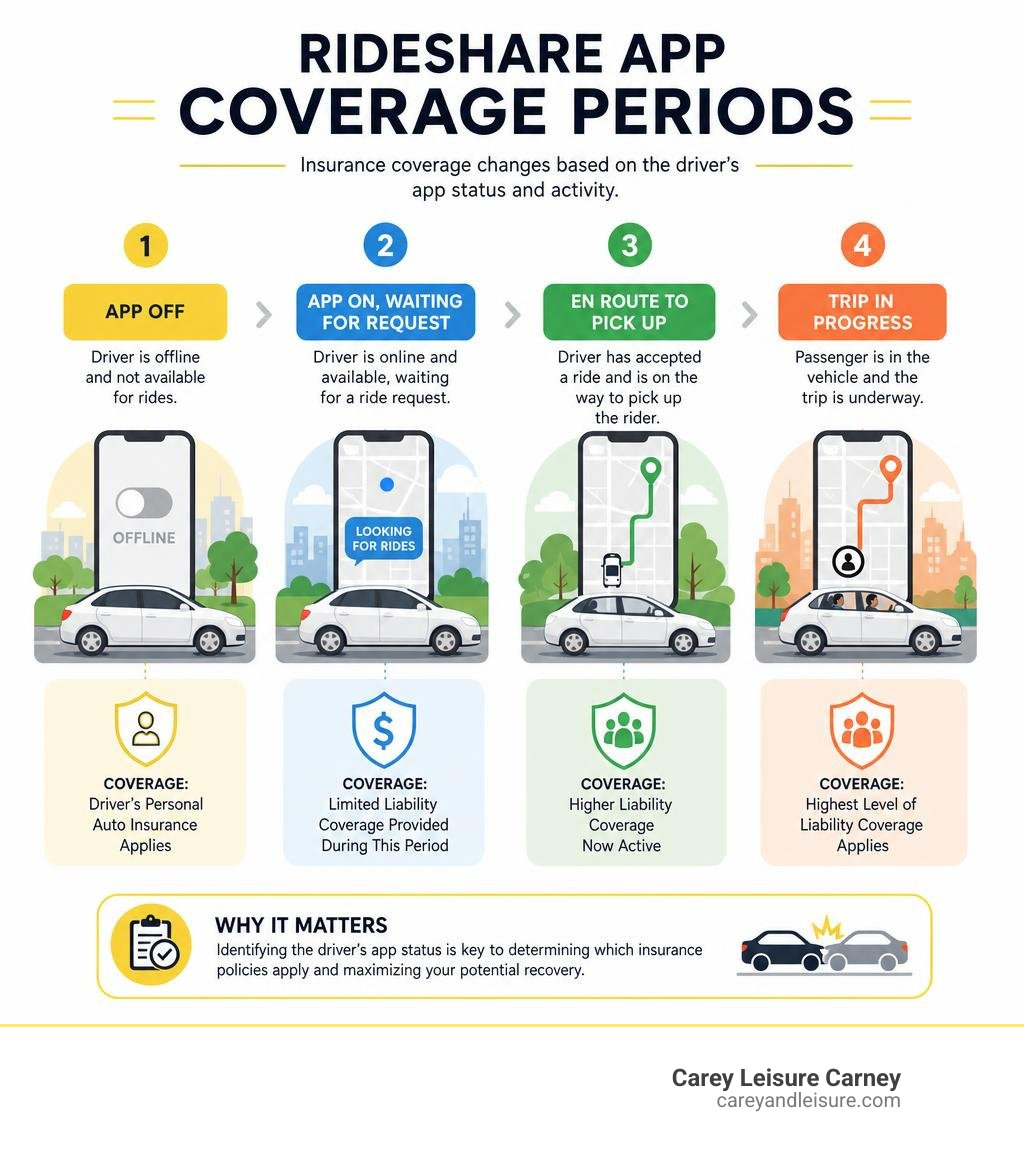
The primary factor determining which insurance policy responds to a crash is the driver’s exact app status at the precise second impact occurred. Transportation network regulations establish clear coverage tiers based on operational phases:
| Coverage Phase | Driver App Status | Primary Applicable Insurance Coverage |
|---|---|---|
| Period 0 | App is completely turned off | Driver’s personal auto insurance only. TNC provides zero coverage. |
| Period 1 | App is on; driver is waiting for a ride request match | Limited commercial contingency coverage ($50k bodily injury per person / $100k per accident / $25k property damage). |
| Period 2 | Ride accepted; driver is actively en route to pick up the passenger | Full commercial policy applies (up to $1,000,000 in third-party liability coverage). |
| Period 3 | Passenger is inside the vehicle until trip completion in app | Full commercial policy active ($1,000,000 liability + uninsured/underinsured motorist coverage). |
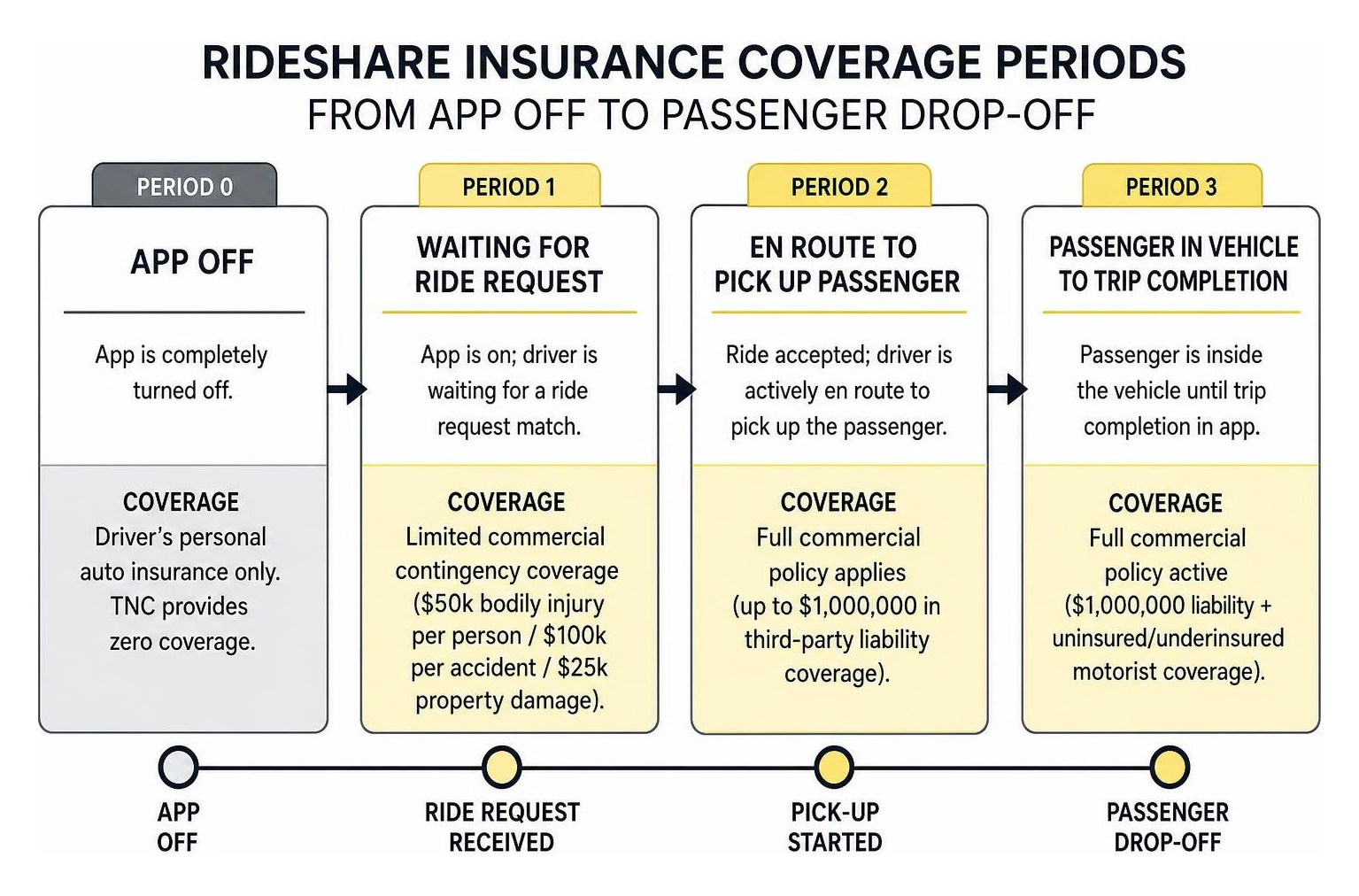
If a driver causes an accident while their app is completely closed, their personal auto insurer handles the claim. However, personal policies often contain “commercial use exclusions” that deny coverage if the driver was secretly using the car for profit. Navigating this multi-policy landscape requires precise verification of digital logs.
Multi-Party Fault and Corporate Legal Tactics
When an accident happens, multiple parties may share varying degrees of fault. A collision might involve the rideshare driver speeding, another motorist running a red light, or even hazardous roadway maintenance. Corporate insurance adjusters frequently use finger-pointing strategies to drag out claims, hoping injured victims grow desperate enough to accept lowball payouts.
Unraveling these defense strategies requires a comprehensive investigation into negligence. In our guide on The Blame Game Unpacking Negligence in Rideshare Accidents, we break down how corporate claims representatives attempt to shift fault away from commercial policies onto third-party drivers or the victims themselves.
What to Look for When Evaluating Legal Representation
Selecting the right legal team to handle an Uber or Lyft claim can make a significant difference in your recovery. You should seek an advocate who understands the nuances of digital forensics, corporate defense maneuvers, and courtroom litigation.
Key Qualifications of a Top-Tier Rideshare Accident Attorney
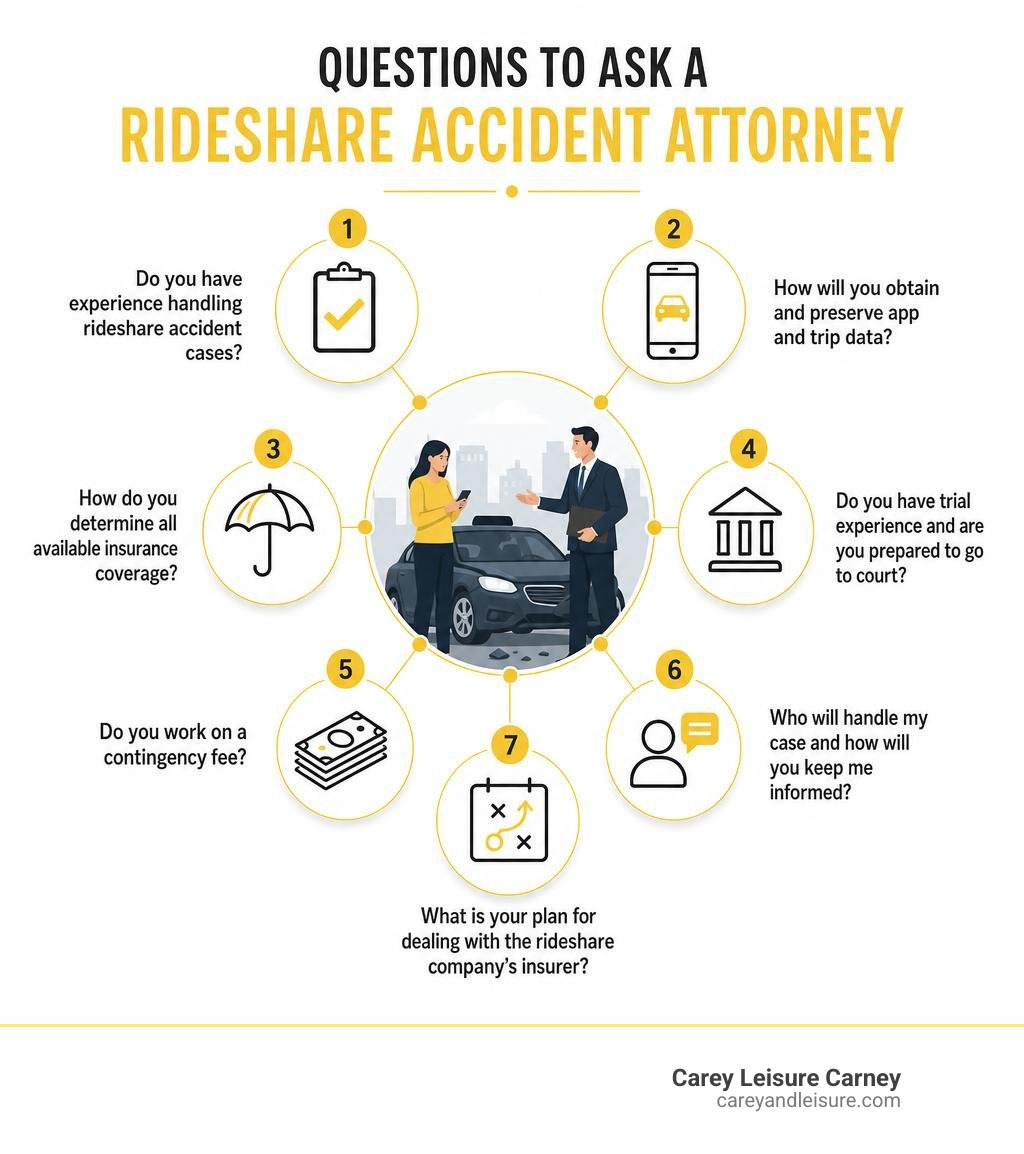
Not all personal injury practices maintain the trial resources necessary to challenge large insurance carriers. When evaluating representation across Pinellas, Pasco, and Hillsborough counties, look for specific markers of dedication and ability:
- Board Certification in Civil Trial Law: In Florida, only a small fraction of practicing attorneys earn board certification—a credential recognizing specialized trial competence and professionalism.
- Decades of Combined Experience: Established firms with seasoned litigators understand how to counter aggressive insurer tactics.
- Direct Attorney Access: You deserve to communicate directly with your legal counsel rather than being passed around support staff.
- Contingency Fee Representation: Your legal team should operate on a contingency basis, meaning you pay no upfront fees and owe nothing unless financial recovery is secured.
To better evaluate prospective firms, consult our Crash Course What to Look for in an Uber or Lyft Accident Lawyer as well as our practical overview on Don’t Get Taken for a Ride How to Pick the Best Rideshare Accident Lawyer.
Investigating Crashes and Preserving Digital Evidence
Unlike standard car crashes where evidence is limited to physical scene damage and witness statements, rideshare cases involve an abundance of digital records. Preserving this information requires prompt formal action before companies overwrite or delete internal server logs.
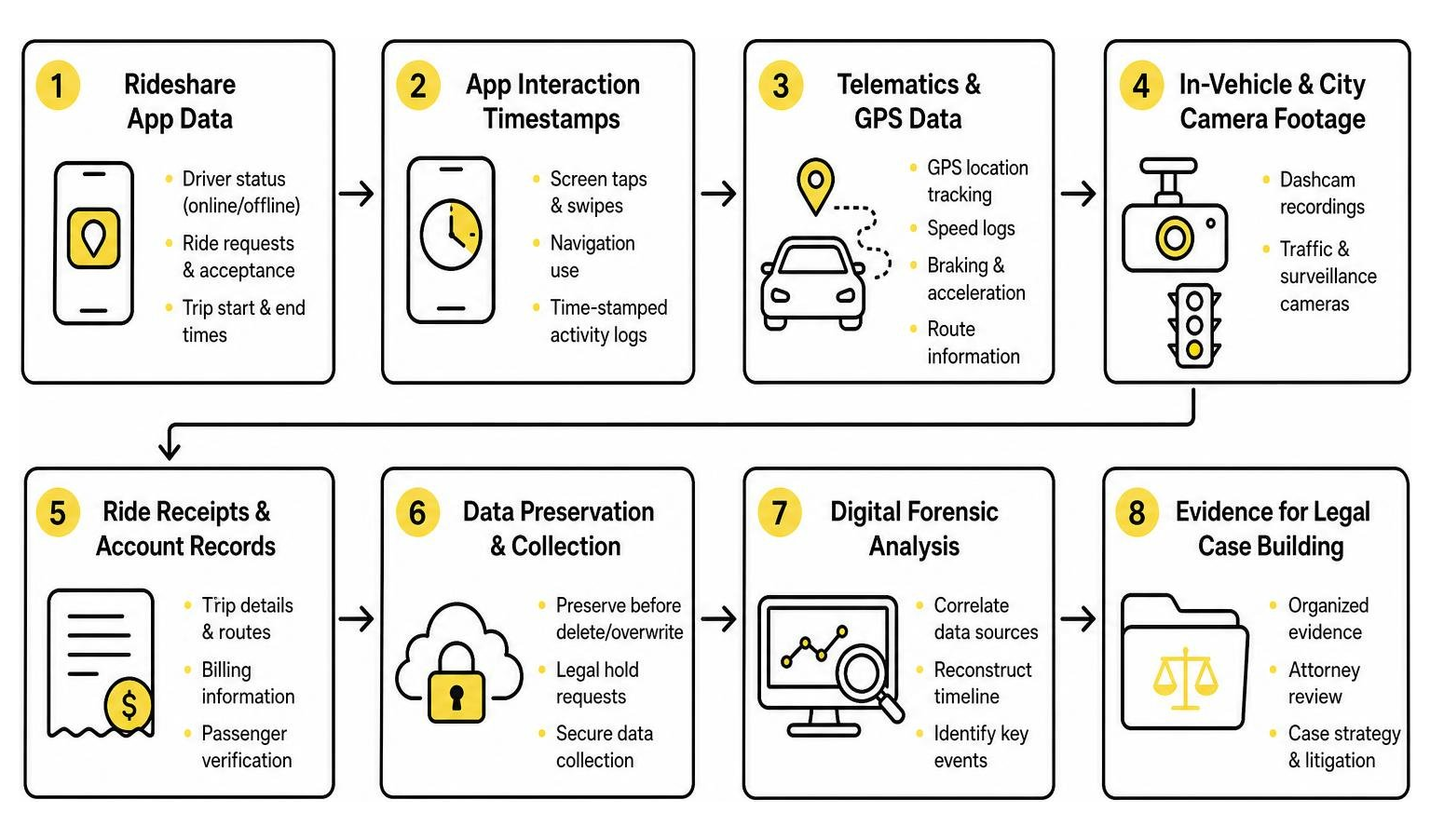
Critical evidence we work to secure includes:
- GPS Telematics & Speed Logs: Real-time tracking data demonstrating driver speed, sudden braking, and route deviations immediately preceding impact.
- App Interaction Timestamps: Records indicating whether the driver was interacting with their phone screen, accepting incoming ride pings, or browsing navigation routes while moving.
- Dashcam and City Camera Footage: Internal rideshare dashcam recordings and local traffic surveillance.
- Electronic Ride Receipts: Passenger account records confirming trip initiation, accepted routes, and billing details.
Essential Steps and Recoverable Damages After a Crash
Suffering an injury in a rideshare wreck can leave you facing mounting medical expenses and missed time from work. Understanding what financial compensation is recoverable helps set clear expectations throughout the settlement process. Depending on the details of the crash, recoverable damages may include past and future medical bills, physical therapy, lost earnings, reduced earning capacity, vehicle repair costs, and compensation for physical pain, mental anguish, and diminished quality of life.
Victims seeking fair financial compensation can learn more about how value is established by reading our detailed breakdown of the Uber Accident Settlement process along with our Lyft Car Accident Settlement Ultimate Guide.
Immediate Actions to Protect Your Claim
The actions you take immediately following a collision play a pivotal role in protecting your physical well-being and legal rights:
- Call 911 Immediately: Ensure law enforcement and emergency medical technicians respond. A formal police report is essential.
- Seek Immediate Medical Evaluation: Even if your injuries seem mild, adrenaline can mask severe soft-tissue or head trauma. Visit an emergency room or urgent care clinic right away.
- Document the Entire Scene: Photograph vehicle damage, license plates, road conditions, traffic signals, and any visible physical injuries.
- Report the Incident Within the App: Log the crash through the Uber or Lyft rider application to generate an official internal timestamp.
- Decline Recorded Statements to Insurers: Do not provide recorded statements to third-party insurance adjusters without consulting an attorney.
For step-by-step guidance tailored to local drivers and passengers, see our guide on What to Do If Your Uber Gets Into an Accident in Florida and explore our complete overview of Your Legal Journey What to Do After a Rideshare Accident.
When to Hire a Rideshare Accident Attorney for Minor or Major Injuries
Even collisions that initially appear minor can turn into contested legal disputes. Whiplash, herniated discs, and concussions often take days or weeks to fully manifest. Furthermore, when multiple vehicles are involved in communities like Wesley Chapel, New Port Richey, or Spring Hill, insurance carriers routinely dispute coverage priority. Retaining counsel early ensures your medical documentation aligns with your claim and prevents insurers from undervaluing your damages.
Frequently Asked Questions About Rideshare Accident Claims
How long do I have to file a claim after an Uber or Lyft accident in Florida?
In Florida, general personal injury negligence claims must be filed within the statutory deadline established under state law (typically two years from the crash date for modern negligence matters). Missing this deadline forfeits your right to seek compensation in court. Contacting legal counsel promptly ensures that crucial electronic ride data and witness statements are preserved before they are lost.
Can I recover compensation if I was partially at fault for the crash?
Under Florida’s modified comparative fault rules, an injured party can recover damages as long as their share of responsibility is not greater than 50%. If you are determined to be partially at fault, your total financial recovery is reduced in proportion to your percentage of fault. For example, if you are awarded $100,000 but found 20% at fault, you would receive $80,000. Injured passengers are rarely found at fault for a collision.
Who pays for my medical bills and damages after a collision?
Florida operates under a no-fault auto insurance framework. If you own a registered vehicle in Florida, your own Personal Injury Protection (PIP) coverage pays the initial portion of your medical bills and lost wages up to your policy limit, regardless of fault. Once your injuries exceed standard thresholds or your PIP coverage is exhausted, you can pursue compensation through the rideshare platform’s commercial policy (up to $1 million when carrying a passenger) or the at-fault driver’s third-party liability insurance.
Conclusion
Recovering from a serious car crash is difficult enough without having to navigate layered commercial insurance policies, complex app statuses, and corporate defense tactics alone. At Carey Leisure Carney, our board-certified trial attorneys bring over 100 years of combined legal experience to personal injury advocacy across Clearwater, St Petersburg, Largo, New Port Richey, Spring Hill, Trinity, and Wesley Chapel. We provide direct attorney access, clear communication, and trial-ready preparation for every case.
If you or a loved one was hurt in an Uber or Lyft wreck, learn how our dedicated legal team can protect your rights by visiting our Auto Accident Attorney Rideshare Accident Attorney service page today.