

Understanding the Legal Baseline: How Florida No Fault Insurance Operates
Florida operates under a pure no-fault insurance system designed to ensure that anyone injured in a motor vehicle collision receives prompt medical treatment without waiting for insurers to fight over who caused the crash. The statutory foundation governing these rules is codified under the Florida Motor Vehicle No-Fault Law under Chapter 627.
Under this framework, your primary avenue for initial medical reimbursement is your own auto insurance policy, regardless of whether you were rear-ended at a red light in Clearwater or sideswiped in St. Petersburg. For an accessible breakdown of how these rules function on everyday commutes, review our guide to understanding how Florida no-fault car accidents work.
The no-fault framework offers distinct trade-offs:
- Pros: It delivers rapid, first-party reimbursement for medical bills and lost wages without the necessity of proving third-party liability first.
- Cons: It restricts your immediate right to sue the at-fault driver for non-economic damages like pain and suffering unless your injuries satisfy a specific legal threshold, and the statutory coverage limit has remained fixed at $10,000 for decades despite rising healthcare expenses.
Minimum Financial Responsibility and State Mandates
Every motor vehicle registered in Florida must comply with strict financial responsibility laws. Under the Florida financial responsibility statute, drivers must carry minimum policy coverages:
- $10,000 in Personal Injury Protection (PIP)
- $10,000 in Property Damage Liability (PDL)
While bodily injury liability is not universally mandatory for all registered vehicle owners, Florida operates on a standard 10/20/10 financial responsibility framework ($10,000 bodily injury per person, $20,000 bodily injury per accident, and $10,000 property damage per accident) if you cause an accident resulting in injury or are convicted of certain offenses.
Florida requires continuous coverage. Even if your vehicle sits inoperable in your driveway in New Port Richey or Largo, you must maintain active coverage unless you surrender your license plate. Non-residents who maintain a vehicle in Florida for more than 90 cumulative days within a calendar year must also comply with these insurance mandates.
Failure to maintain active coverage carries severe penalties:
- Suspension of your driver’s license and vehicle registration.
- Administrative reinstatement fees ranging from $150 up to $500 for repeat violations.
- Personal financial liability for all damages resulting from an accident.
Comparing PIP, MedPay, and Bodily Injury Liability
Navigating the various insurance layers after an accident can be confusing. Each coverage type serves a distinct role in resolving crash-related damages:
| Coverage Type | Primary Function | Fault Required? | Pays To |
|---|---|---|---|
| Personal Injury Protection (PIP) | Covers emergency care, treatment, and lost income | No (First-Party) | Policyholder, resident relatives, and covered passengers |
| Medical Payments (MedPay) | Supplemental coverage filling PIP deductibles and the 20% co-pay | No (First-Party) | Policyholder and vehicle occupants |
| Bodily Injury Liability (BIL) | Covers serious injuries, long-term losses, and pain/suffering caused to others | Yes (Third-Party) | The injured victim harmed by the policyholder |
PIP acts as the primary payer for your medical bills. MedPay functions as an optional supplement to cover the 20% copay that PIP leaves behind. Bodily Injury Liability protects your personal assets if you injure someone else and they bring a third-party claim against you.
Breaking Down Personal Injury Protection (PIP) Benefits and Deadlines
PIP is the core mechanism of the Florida no-fault structure. It attaches to individuals rather than solely to vehicles, covering you, resident relatives in your household, and certain passengers who lack their own auto insurance policies. Detailed parameters are outlined in our guide on understanding what is covered under PIP.

Core Benefits Mandated by Florida No Fault Insurance
The statutory $10,000 PIP limit covers specific categories of losses:
- 80% of Reasonable Medical Expenses: Includes ambulance transport, emergency room visits, surgery, diagnostic imaging, and physical therapy, provided treatment is received through licensed physicians, hospitals, or accredited medical providers.
- 60% of Lost Wages: Reimburses a portion of your gross income if your treating physician restricts you from working during your recovery.
- 100% of Replacement Household Services: Covers ordinary domestic tasks you cannot perform due to your injuries, such as childcare, cooking, and home maintenance.
- $5,000 Death Benefit: Paid to the estate or surviving family members in fatal collisions, provided in addition to medical and disability benefits.
If a medical professional does not diagnose an Emergency Medical Condition (EMC), your accessible PIP medical benefit is restricted to a statutory cap of $2,500.
The Critical 14-Day Medical Rule
Under Florida law, you must seek initial medical care from a licensed healthcare provider within 14 days of the crash.
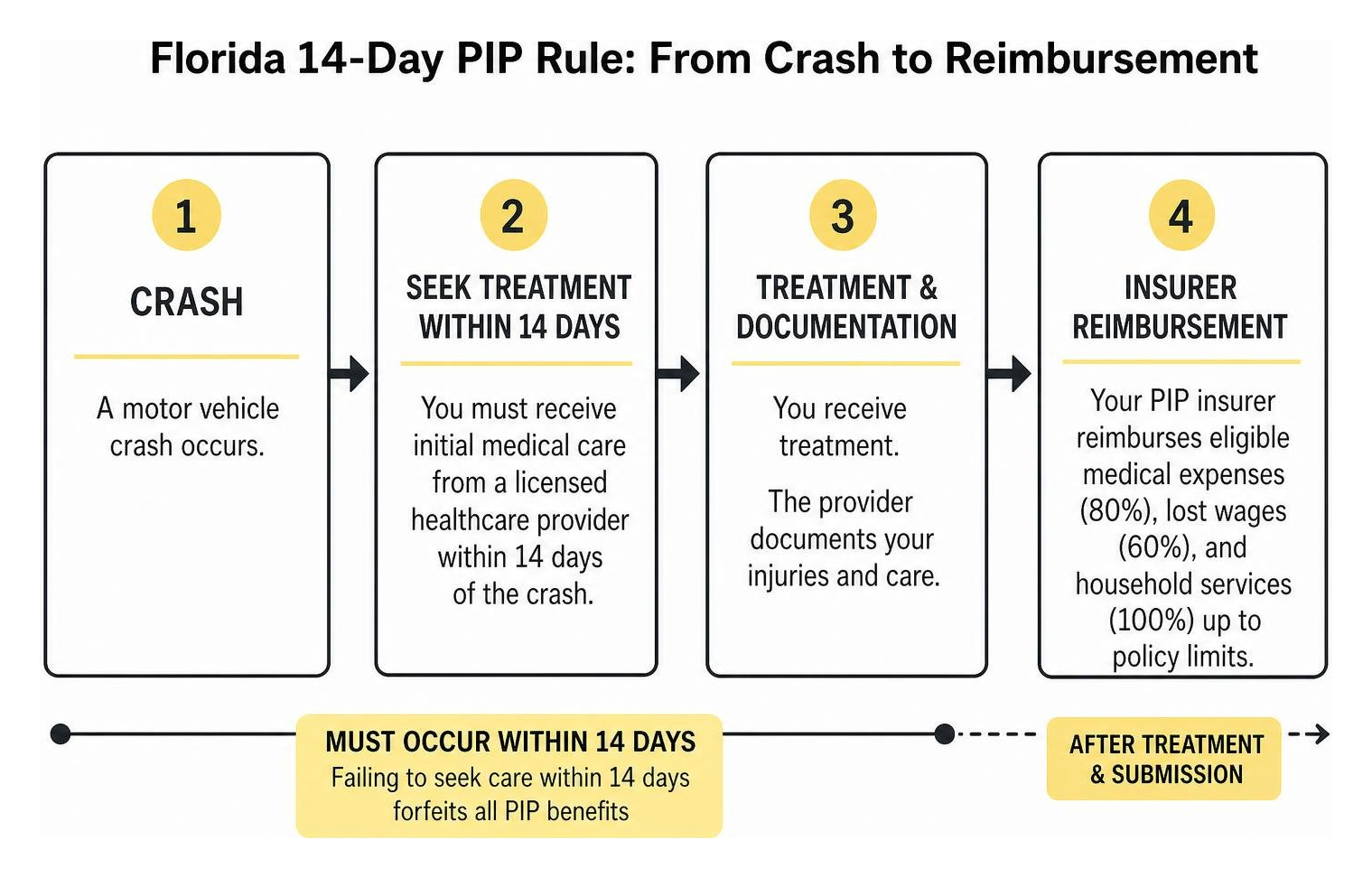
Failing to receive medical attention within this strict two-week window completely forfeits your right to collect any PIP benefits under your policy. When setting up your coverage, evaluating your PIP deductible options is crucial, as choosing a high deductible ($500 to $1,000) means paying that amount out-of-pocket before your 80% coverage begins.
Stepping Outside No-Fault: When Can You Sue the At-Fault Driver?
Because PIP caps out at $10,000 and pays only 80% of medical bills, a major crash in Spring Hill, Trinity, or Wesley Chapel can exhaust your coverage immediately. In these situations, knowing when to hire an accident lawyer after a crash is vital to ensure your rights are preserved.
Meeting the Serious Injury Threshold Under Florida No Fault Insurance
To file a third-party claim or lawsuit against the negligent driver for non-economic damages (pain, suffering, mental anguish, and loss of enjoyment of life), your injury must satisfy the statutory “serious injury threshold”:
- Significant and permanent loss of an important bodily function.
- Permanent injury within a reasonable degree of medical probability.
- Significant and permanent scarring or disfigurement.
- Death.
Our comprehensive overview on navigating severe injuries beyond no-fault limits illustrates how medical records, objective imaging, and physician testimony establish these legal criteria.
Legislative History and Proposed PIP Repeal Debates
For years, lawmakers have debated reforming or repealing Florida’s no-fault system. The Florida Legislature passed Senate Bill 54 to replace PIP with mandatory Bodily Injury Liability coverage, but the bill was ultimately vetoed over concerns about premium spikes for lower-income drivers.
Statutes such as Florida Statute 627.7407 application reflect ongoing policy discussions surrounding tort reform, bad-faith claim guidelines, and medical provider fee schedules. For now, the no-fault PIP structure remains the governing law across Florida.
Coverage Gaps: Protecting Yourself Against Uninsured Motorists
Florida regularly ranks among the states with the highest percentage of uninsured and underinsured motorists. If a careless driver causes significant bodily harm but carries only the minimum required $10,000 in property damage liability—or no insurance at all—your PIP coverage will leave substantial unpaid medical bills.
To protect yourself, we strongly recommend purchasing Uninsured/Underinsured Motorist (UM/UIM) coverage. Review our guide on understanding uninsured vs underinsured motorist coverage to see how this protection acts as your financial shield.
Essential Steps If Hit by an Uninsured Motorist
If you are involved in a collision with an uninsured or hit-and-run driver, take these immediate actions:
- Call Law Enforcement: Ensure a formal crash report is generated at the scene.
- Gather Evidence: Photograph vehicle positions, license plates, visible injuries, and roadway conditions.
- Seek Medical Care Within 14 Days: Protect your statutory PIP rights immediately.
- Notify Your Insurer Promptly: Report the crash without giving a recorded statement before speaking with counsel.
- Review UM Policy Types: Determine whether you have stacked or non-stacked Florida UM coverage protection.
- Consult Experienced Counsel: Learn your options for managing claims when a crash involves an uninsured motorist.
Frequently Asked Questions About Florida Auto Insurance Rules
Do I still need PIP insurance if I have private health insurance?
Yes. Florida law requires all owners of motor vehicles registered in the state to maintain PIP, regardless of their health insurance coverage. PIP serves as the primary payer for auto accident medical care, meaning health insurers often deny initial claims until PIP limits are exhausted. Review our overview of Florida PIP requirements for details.
What happens if I am not at fault but do not have insurance in Florida?
Driving without the mandatory PIP and PDL coverage violates Florida law. Even if another party caused the crash, you face driver’s license suspension, registration revocation, and administrative reinstatement fines up to $500. Read more about handling accidents when driving without insurance.
How long do I have to file a lawsuit against an at-fault driver in Florida?
For standard auto negligence claims arising from motor vehicle collisions, Florida’s statute of limitations generally gives you two years from the crash date to file a lawsuit. Failing to file within this statutory window permanently bars your claim. Preserving evidence, witness accounts, and medical documentation immediately is crucial.
Conclusion
Understanding Florida’s no-fault insurance system is essential to protecting your physical health and financial stability after a collision. While PIP provides immediate baseline relief for medical bills and lost income, it rarely covers the full scope of damages caused by a severe accident.
At Carey Leisure Carney, our board-certified trial attorneys bring over 100 years of combined legal experience to every case. We provide direct attorney access and personalized representation to clients throughout Clearwater, Largo, New Port Richey, Spring Hill, St. Petersburg, Trinity, and Wesley Chapel. If you or a family member has suffered injuries in an auto crash, consult our Florida no-fault insurance legal team for a free case evaluation to pursue the maximum compensation you deserve.