

PIP deductible Florida: Smart 2025 Guide
What is a PIP Deductible in Florida?
PIP deductible Florida refers to the amount you must pay out-of-pocket before your Personal Injury Protection insurance begins covering your medical expenses and lost wages after a car accident. Here’s what you need to know:
Key Facts About Florida PIP Deductibles:
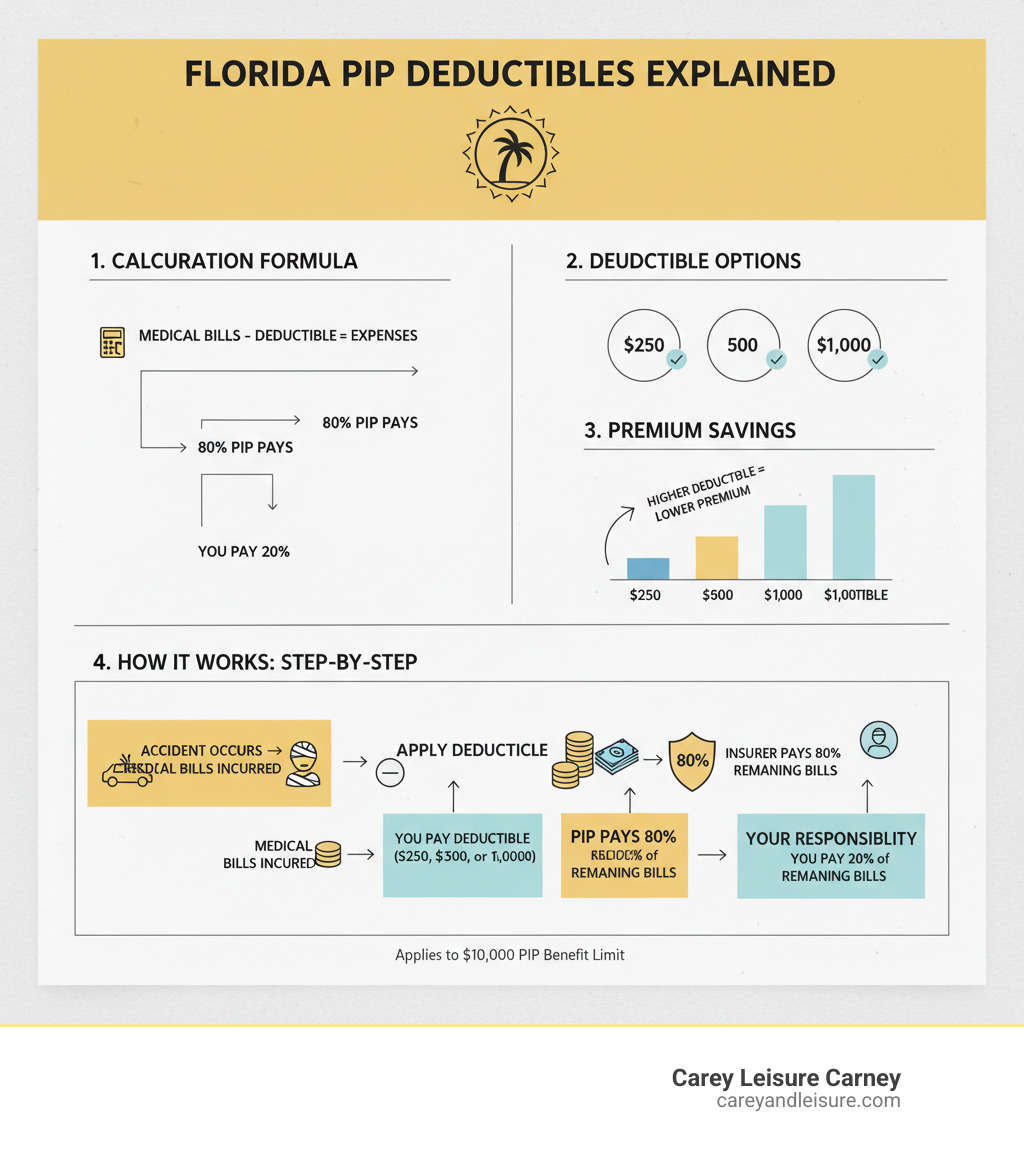
- Florida insurers must offer deductible options of $250, $500, and $1,000
- You pay the deductible amount before PIP covers 80% of remaining medical bills
- Higher deductibles lower your premium but increase your accident costs
- The deductible applies to the full $10,000 PIP benefit limit
- You may be able to recover your deductible from the at-fault driver
Florida operates under a no-fault insurance system, making PIP coverage mandatory for all drivers. When you’re injured in an accident, your own insurance pays first – regardless of who caused the crash. But there’s a catch: if you’ve elected a deductible to save money on premiums, you’ll need to pay that amount before your coverage kicks in.
The math is straightforward but often overlooked. With a $500 deductible and $5,000 in medical expenses, your PIP insurance covers $3,600 after you’ve paid your $500 deductible. That leaves you responsible for $900 – money many accident victims don’t have readily available during an already stressful time.
As Thomas W. Carey, a board-certified civil trial lawyer who has handled roughly 40,000 injury matters across Florida, I’ve seen countless clients struggle with PIP deductible Florida decisions that seemed minor when purchasing insurance but became major financial burdens after accidents. My experience guiding families through Florida’s complex no-fault system has shown me how these seemingly small policy choices can significantly impact your recovery and financial stability.
How Your PIP Deductible Works: A Practical Breakdown
Picture this: you’re cruising down I-275 on a sunny Tuesday morning when suddenly another driver runs a red light and crashes into your car. Your head is spinning, your neck hurts, and you’re wondering what happens next. This is exactly when understanding your PIP deductible Florida becomes incredibly important.
Florida’s no-fault insurance system means your own PIP insurance steps up first to cover your medical expenses and lost wages – regardless of who caused the accident. It’s designed to get you medical care quickly without waiting months for insurance companies to argue about fault.
But here’s the catch: you have just 14 days to seek medical treatment after your accident. Miss this window, and your PIP benefits could disappear entirely. Think of it as a ticking clock that starts the moment your accident happens.
Once you’ve gotten medical care within that critical two-week period, your deductible kicks in. You’ll need to pay this amount out of your own pocket before your PIP insurance pays a single penny. It’s like having to buy the first round of drinks before your friends start splitting the tab.
After you’ve paid your deductible, your PIP coverage picks up 80% of your remaining medical expenses. This leaves you responsible for the other 20% – what insurance folks call your co-insurance. Both your deductible and this 20% co-insurance eat into your total $10,000 PIP benefit limit, which can add up faster than you might expect.
Common PIP Deductible Amounts in Florida
Florida law requires every insurance company to offer you three specific deductible choices when you buy or renew your policy. These aren’t optional extras – they’re mandated by Florida Statutes § 627.739.
Your PIP deductible Florida options are $250, $500, or $1,000. Some insurers might offer higher amounts, but these three are what you’ll see most often.
Choosing the right deductible means taking an honest look at your finances. Can you comfortably write a $1,000 check right after an accident when you’re already dealing with car repairs, missed work, and medical appointments? If that thought makes you nervous, a lower deductible might be worth the extra premium cost.
Calculating Your Payout: A Real-World Example
Let’s walk through exactly how your deductible affects your actual payout with a real example.
Say you’re in an accident and rack up $5,000 in medical bills for emergency room visits, X-rays, and physical therapy. You were smart and sought treatment within 14 days, so your PIP benefits are intact. You chose a $1,000 deductible to save money on premiums.
Here’s the math: First, your $1,000 deductible comes off the top, leaving $4,000. Your PIP insurance then pays 80% of that remaining $4,000, which equals $3,200.
Your total out-of-pocket cost? You’ll pay your $1,000 deductible plus 20% of the remaining $4,000 (that’s $800), for a total of $1,800. Even though you had $5,000 in medical bills and $10,000 in PIP coverage, you’re still on the hook for nearly $2,000.
This example shows why understanding your coverage matters so much. That deductible you chose to save $20 a month on premiums could cost you hundreds or thousands when you actually need your insurance. For more details about how these limits work in practice, check out our guide on PIP Coverage Limits.
The Financial Trade-Off: Premiums vs. Out-of-Pocket Costs
Let’s be honest – nobody likes paying more than they have to for insurance. When you’re shopping for car insurance in Florida, it’s tempting to bump up that deductible to shave a few dollars off your monthly premium. But here’s the thing: choosing your PIP deductible Florida amount is like playing a financial balancing game where the stakes are your wallet and your peace of mind.
The math is simple enough. Insurance companies love higher deductibles because you’re essentially saying, “I’ll take on more risk, so you don’t have to.” In return, they reward you with lower premiums. It sounds like a win-win, right? Well, not always.
Here’s what those premium savings actually look like:
| Deductible Amount | Average Annual Premium Savings (Approx.) |
|---|---|
| $250 | Minimal (often negligible) |
| $500 | $20.00 |
| $1,000 | $80.00 |
These are average savings and can vary based on your insurer, driving record, location, and other factors.
Take a moment to really look at those numbers. A $1,000 deductible might save you about $80 per year – that’s less than $7 a month. But if you’re in an accident tomorrow, you’re immediately responsible for that full $1,000 before your PIP coverage even kicks in. Suddenly, that $7 monthly savings doesn’t seem quite as appealing, does it?
This is what we call being “penny wise and pound foolish.” You save a small amount upfront but potentially face a much larger financial burden when you’re already dealing with the stress and potential injuries from an accident. Medical bills don’t wait for your next paycheck, and Florida’s 14-day rule means you need to seek treatment quickly to maintain your PIP benefits.
How a Higher PIP Deductible in Florida Affects Your Premium
The relationship between your deductible and premium is straightforward – higher deductible equals lower premium. But the actual dollar amounts might surprise you. We’re not talking about hundreds of dollars in savings here.
Choosing a $500 deductible typically saves you around $20 annually compared to a $250 deductible. Jump to a $1,000 deductible, and your annual savings might reach $80. While every dollar counts, especially with Florida’s notoriously high insurance rates, these modest savings need to be weighed against your financial reality.
Before you automatically choose the highest deductible for the lowest premium, ask yourself some tough questions. Do you have $1,000 sitting in your checking account right now? Could you comfortably write that check tomorrow without scrambling to pay rent or buy groceries? If the answer is no, then saving $80 a year isn’t worth the potential financial stress.
Your risk tolerance plays a huge role here too. Some people are comfortable taking on more financial risk for premium savings. Others prefer the security of knowing they won’t face a large unexpected expense after an accident. Neither approach is wrong – it’s about what works for your specific situation.
The danger of being underinsured is real. We’ve seen clients who thought they were being smart by choosing high deductibles, only to find they couldn’t afford their out-of-pocket costs when they needed treatment most. This can delay necessary medical care or create medical debt – neither of which is worth the minimal premium savings.
Understanding how Florida’s no-fault system works is crucial for making informed coverage decisions. Your PIP insurance is designed to be your immediate safety net after an accident, regardless of fault. If your deductible creates a barrier to accessing that safety net, you’re defeating the purpose of having coverage in the first place. For a deeper understanding of how this system protects you, check out our guide on No-Fault Insurance Florida.
Legal Angles: Can You Recover Your PIP Deductible in Florida?
Here’s the question that keeps many accident victims up at night: “Can I get my deductible money back from the person who caused this mess?” The short answer is usually yes, but like most things involving Florida law, there’s more to the story.
The good news is that you can often recover your PIP deductible from the at-fault driver, but it wasn’t always this clear-cut. Back in 2003, Florida made a significant change to the law that opened the door for deductible recovery. They removed language from Florida Statute 627.739(1) that previously made it much harder to get your money back.
To recover your PIP deductible Florida, you’ll typically need to file a claim against the at-fault driver’s Bodily Injury (BI) liability coverage. Think of BI coverage as the safety net that pays for injuries the policyholder causes to others. It’s separate from their PIP coverage and designed to handle damages beyond what your own PIP insurance covers.
When we talk about what you can recover, lawyers divide damages into two buckets. Economic damages are the bills you can actually count – your medical expenses, lost wages, and yes, that deductible you had to pay. Non-economic damages cover things like pain and suffering, which are harder to put a price tag on.
Here’s where Florida gets a bit tricky. For non-economic damages like pain and suffering, you generally need to meet what’s called a permanent injury threshold. This means your injuries must be serious – think permanent disability, significant scarring, or loss of bodily function. But here’s the key point: your deductible falls under economic damages, which means you can often pursue it regardless of whether your injuries meet that permanent threshold.
Florida’s no-fault system was designed to keep minor fender-benders out of the courtroom, but it doesn’t slam the door on legitimate claims. When injuries are severe or costs pile up beyond what PIP covers, the legal system provides a path forward. For more context on how this all fits together, you can learn more about Florida’s no-fault system.
Suing the At-Fault Driver for Your Deductible
When someone else’s careless driving lands you in the hospital, fairness says they should pay for the mess they created – including your PIP deductible Florida. Thanks to that 2003 change in Florida law, the path to recovery became much clearer.
But getting your money back isn’t as simple as sending a bill in the mail. You’ll need to prove that the other driver was actually at fault, which means gathering evidence like police reports, witness statements, and sometimes even accident reconstruction experts. It’s detective work mixed with legal strategy.
The other big hurdle is something lawyers call collectibility – basically, does the at-fault driver have the means to pay? Most of the time, this comes down to their Bodily Injury liability coverage. If they have adequate insurance, you’re in good shape. But here’s a sobering reality: Florida has one of the highest rates of uninsured drivers in the country.
When you’re dealing with an uninsured driver, recovery becomes much more complicated. You might have to turn to your own Uninsured Motorist coverage or explore other options. If you find yourself in this frustrating situation, our guide on Car Accident No Insurance, Not at Fault Florida can help you understand your options.
A personal injury lawsuit can be your avenue to recover not just your deductible, but all the economic damages the accident caused. In cases involving permanent injuries, Florida law can even prevent the at-fault driver from reducing what they owe you by the amount of your PIP benefits. This legal principle has been reinforced in court cases and can make a significant difference in your final recovery.
Exceptions and Special Circumstances
While your PIP deductible Florida generally applies across the board, there are some important exceptions and special situations that can change the game entirely.
First, let’s talk about who actually has to pay the deductible. As the named insured on your policy, you get to choose whether your elected deductible applies just to you, or to you and your dependent relatives living in your household. But here’s the key point: you cannot make other people covered under your policy – like a friend riding in your car – subject to your chosen deductible. So if your passenger gets hurt, they might get their PIP benefits without any deductible at all.
There are also specific circumstances where your deductible might be waived entirely. Accidents involving drunk drivers can trigger special protections under Florida law. If a drunk driver injures you, you may not have to meet your deductible or pay the usual 20% co-insurance for related medical treatment.
This protection often comes through the Florida Crime Victim Compensation Act, which recognizes that drunk driving isn’t just negligence – it’s a crime. This act can step in to cover expenses that would otherwise fall on your shoulders, including deductible amounts and co-payments. It’s designed to ensure that crime victims don’t bear the financial burden of someone else’s criminal behavior.
Some insurance policies also include special endorsements or provisions that might waive deductibles under certain conditions, though these are relatively rare for PIP coverage. The bottom line is that every situation is unique, and what seems like a straightforward deductible application might have exceptions that could save you money.
These exceptions don’t happen automatically – they often require someone who knows the system to identify them and make sure they’re properly applied. That’s where having experienced legal guidance can make all the difference in your financial recovery.
Frequently Asked Questions About Florida PIP Deductibles
Let’s tackle some of the most common questions we hear about PIP deductible Florida from our clients. These are the real-world concerns that come up when people are trying to understand their coverage or dealing with the aftermath of an accident.
What is the difference between a PIP deductible and a collision deductible?
This question comes up all the time, and honestly, it’s no wonder people get confused! Both involve paying money out of your pocket, but they’re as different as apples and oranges.
Your PIP deductible is all about you and your passengers’ injuries. It kicks in when someone gets hurt in an accident, covering medical expenses, lost wages, and other injury-related costs. The beauty of PIP is that it doesn’t matter who caused the accident – your coverage is there for you regardless.
Your collision deductible, on the other hand, is all about your car’s damage. When your vehicle gets dinged, dented, or totaled after hitting another car or object, that’s when your collision coverage steps in to help with repairs or replacement costs.
Here’s the important part: these are completely separate claims that live in different sections of your auto insurance policy. If you’re unlucky enough to get injured and have your car damaged in the same accident, both deductibles would apply independently. So you might pay a $500 collision deductible to fix your car and a $1,000 PIP deductible before your injury coverage starts. It’s like having two different insurance policies working at the same time.
For a deeper dive into how vehicle coverage works, our guide on Collision vs. Comprehensive Coverage Explained breaks it all down.
Does the PIP deductible in Florida apply to lost wages?
Yes, and this catches a lot of people off guard. Your PIP deductible Florida doesn’t just apply to your medical bills – it applies to everything your PIP coverage pays for, including lost wages.
Here’s how Florida law works: your deductible gets applied to 100% of all your PIP expenses and losses combined. Think of it like one big pot of money that includes both your medical bills and your lost income.
Let’s say you have a $1,000 deductible, $3,000 in medical bills, and $2,000 in lost wages. Your deductible comes out of that combined $5,000 total first. After you’ve paid your $1,000 deductible, PIP typically covers 80% of your medical expenses and 60% of your lost gross income from the remaining amount.
The lost wage calculation is based on what you earned during the 13 weeks before your accident, and it’s all subject to that $10,000 overall PIP limit. This is why that deductible choice matters so much – it’s reducing the pool of money available before any of the percentage calculations even start.
Do I still need PIP coverage if I have good health insurance?
Absolutely, and here’s why this question comes up so often: people think good health insurance means they can skip PIP or choose minimal coverage. But in Florida, PIP coverage is mandatory – it’s not optional, no matter how great your health insurance might be.
Even with fantastic health insurance, PIP serves a completely different role in your financial protection. Your PIP coverage is designed to be the primary payer for accident-related injuries. This means it steps up first, often without the co-pays, deductibles, and prior authorization hassles that come with health insurance.
Your health insurance typically won’t even look at accident-related medical bills until your PIP benefits are used up or denied. It’s like having a specialized first responder that’s trained specifically for car accident injuries.
But here’s what makes PIP really unique: it covers things your health insurance never will. We’re talking about 60% of your lost wages, essential services like childcare or housekeeping if you’re laid up, and even death benefits for your family. Health insurance is fantastic for treating your injuries, but it won’t help pay your rent when you can’t work.
The two coverages work together through what’s called coordination of benefits. PIP handles the immediate aftermath of your accident, and once those benefits are exhausted, your health insurance can step in as secondary coverage. It’s like having a tag team working for your recovery – but PIP always goes first in Florida.
Expert Guidance on Your Florida PIP Policy

Let’s be honest – figuring out your PIP deductible Florida choices can feel like trying to read hieroglyphics while riding a roller coaster. But here’s the thing: these decisions matter more than you might think, especially when you’re dealing with the aftermath of an accident.
After handling roughly 40,000 injury cases across Florida, I’ve seen too many families make what seemed like smart money-saving choices that turned into financial nightmares when they needed their insurance most. The mistake I see repeatedly? Choosing a high deductible just to save $20 or $80 a year on premiums, then facing a $1,000 out-of-pocket bill when they’re already stressed about injuries and missed work.
Your PIP deductible Florida isn’t just a number on your policy – it’s your immediate financial responsibility when life throws you a curveball. You’re paying this amount before your PIP coverage even kicks in to pay 80% of your remaining medical bills. That $1,000 deductible might save you less than $7 a month in premiums, but it becomes a very real expense the moment you’re in an accident.
Here’s what really matters: adequate coverage isn’t just about having insurance – it’s about having insurance you can actually use when you need it. If you can’t afford your deductible, your coverage becomes almost meaningless in those crucial first days after an accident.
At Carey Leisure Carney, our Board-Certified attorneys understand these complexities because we’ve guided thousands of Floridians through them. We offer personalized service and direct attorney access because navigating Florida’s no-fault system shouldn’t feel like solving a puzzle alone. When you’re hurt and overwhelmed, you deserve clear answers from experienced professionals who genuinely care about your recovery.
Making the Right Choice and What to Do After an Accident
Choosing the right PIP deductible Florida isn’t about finding the “perfect” answer – it’s about making a decision that fits your real-world financial situation. Think about it this way: can you write a check for your deductible tomorrow without causing serious financial stress? If the answer is no, a lower deductible is probably worth the extra few dollars each month.
Review your policy annually because life changes, and your insurance should change with it. Maybe you got a raise and can now handle a higher deductible, or perhaps you’re facing tighter finances and need the security of lower out-of-pocket costs. Understanding all your coverage options goes beyond just meeting Florida’s minimum requirements – it’s about protecting your family’s financial stability.
If an accident does happen, remember these critical steps: seek prompt medical attention within 14 days to preserve your PIP benefits, and document everything carefully. Keep records of all medical treatments, bills, conversations with insurance companies, and any lost wages. This documentation becomes invaluable if you need to pursue recovery from the at-fault driver.
Here’s something many people don’t realize: you can often recover your PIP deductible and other out-of-pocket costs from the at-fault driver’s insurance. But navigating these complex claims while you’re trying to heal isn’t something you should tackle alone.
That’s where experienced legal guidance makes all the difference. Our team offers free consultations to help you understand your rights and options after an accident. We can assess whether you have a viable claim against the at-fault driver, help you steer insurance company tactics, and ensure you’re not leaving money on the table during your recovery.
Don’t let confusion about deductibles or pressure from insurance companies add to your stress when you’re already dealing with injuries. Florida’s insurance laws are constantly evolving – you can learn about recent changes in our article on New PIP Florida Law Changes – and having knowledgeable advocates on your side can make the difference between a full recovery and ongoing financial hardship.