
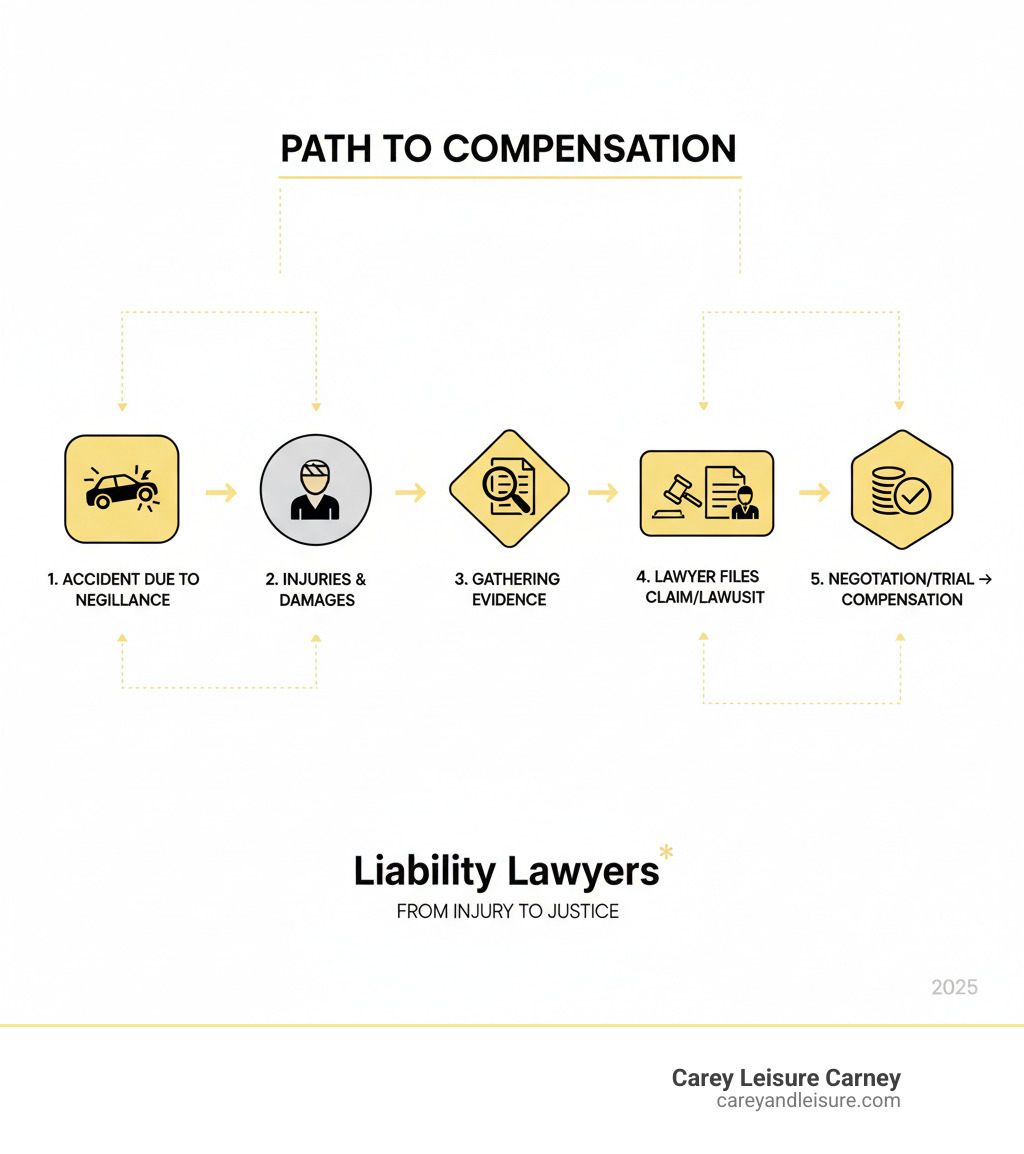
Liability Lawyers: Expert Justice 2025
Understanding Legal Responsibility: When Someone’s Actions Cause Your Harm
Liability lawyers represent people injured by someone else’s negligence, recklessness, or wrongful actions. These attorneys specialize in civil law, holding the responsible party accountable for the victim’s losses.
What liability lawyers do:
- Investigate accidents and gather evidence to prove fault
- Negotiate with insurance companies on your behalf
- File lawsuits when fair settlements cannot be reached
- Represent clients in premises liability, product liability, car accidents, and medical malpractice cases
- Work on contingency – you pay nothing unless they win your case
Common types of liability cases:
- Slip and fall accidents
- Defective products that cause injury
- Car and truck accidents
- Medical and professional negligence
- Dog bites and animal attacks
After an accident that wasn’t your fault, you may face mounting medical bills and lost income. The path to justice involves proving that another party had a legal duty to keep you safe, failed in that duty, and directly caused your harm.
The legal system holds people and businesses accountable when their actions—or inaction—cause harm. This principle of legal responsibility is the foundation of civil liability law, allowing injured parties to recover compensation for medical bills, lost wages, and pain and suffering.
I’m Thomas W. Carey, a board-certified civil trial lawyer. Since 1988, I have guided over 40,000 injury matters across Florida, including complex liability lawyers cases involving medical malpractice, car accidents, and premises liability. Understanding your rights and working with qualified legal counsel is the key to receiving the compensation you deserve.
The Foundations of Liability Law: Civil vs. Criminal
Legal liability means being responsible for the consequences of your actions or inactions. When liability lawyers take on a case, they argue that one party’s conduct caused harm to another, and the responsible party must make it right. This principle of accountability is what keeps society functioning fairly.
What is Civil Liability and Why is it Important?
Civil liability is the foundation of personal injury law. It’s the legal framework that allows an injured person to seek compensation when someone else’s carelessness causes them harm, whether from a car crash, a slip and fall, or a defective product.
This system serves two key purposes. First, it provides monetary compensation to help victims cover medical bills, lost wages, and pain and suffering. Second, it acts as a deterrent, encouraging people and businesses to act responsibly to avoid financial consequences.
Without civil liability, victims would bear the costs of someone else’s mistakes. The system ensures that the party at fault is held responsible.
Civil vs. Criminal Liability: Understanding the Difference
An incident can lead to both civil liability and criminal liability, which are separate legal processes with different goals.
Criminal liability involves offenses against society. The state prosecutes these cases to punish wrongdoers. The burden of proof is high: “beyond a reasonable doubt.”
Civil liability focuses on compensating the injured party. The burden of proof is lower: “preponderance of the evidence,” meaning it’s more likely than not that the defendant is responsible.
For example, a drunk driver may face criminal charges from the state while also facing a civil lawsuit from the person they injured.
| Feature | Civil Liability | Criminal Liability |
|---|---|---|
| Purpose | Compensate injured party | Punish offender, deter crime |
| Parties | Individual/entity (plaintiff) vs. Individual/entity (defendant) | State (prosecution) vs. Individual (defendant) |
| Outcome | Monetary damages, injunctions | Fines, imprisonment, probation |
| Burden of Proof | Preponderance of the evidence (more likely than not) | Beyond a reasonable doubt (almost certain) |
| Examples | Personal injury, contract disputes, property damage | Theft, assault, murder, drunk driving |
This dual system addresses both society’s need for justice and the victim’s need for financial recovery. Understanding the legal definition of liability is the first step. For injury victims, civil liability is the key to rebuilding their lives.
Types of Cases Handled by Liability Lawyers
When you’re hurt because of someone else’s actions, liability lawyers step in to hold the responsible parties accountable. The cases we handle generally fall into three main categories: negligence-based claims (failure to use reasonable care), intentional torts (deliberate harmful acts), and strict liability cases (responsibility regardless of fault, often for defective products or dangerous activities).

Premises Liability
Property owners must keep their premises reasonably safe for visitors. When they fail to fix or warn about hazards and someone gets hurt, they can be held responsible. Common cases include:
- Slip and fall accidents from wet floors, uneven surfaces, or poor lighting.
- Negligent security cases where inadequate safety measures lead to injury.
- Dog bites, for which Florida law holds owners strictly liable.
- Other incidents like swimming pool accidents or collapsed structures.
If you’ve been injured on someone else’s property, understanding what is premises liability is the first step to a valid claim.
Product Liability
Product liability law holds manufacturers, distributors, and sellers accountable for injuries caused by dangerous or defective products. Cases typically involve:
- Design defects: The product’s design is inherently unsafe.
- Manufacturing defects: An error during production makes a specific product dangerous.
- Failure to warn: The product lacks adequate instructions or warnings about non-obvious dangers.
Examples range from defective car parts and faulty medical devices to unsafe toys. As an example of state-specific laws, you can review product liability in Texas.
Professional Liability (Malpractice)
When licensed professionals like doctors, lawyers, or accountants fail to meet the accepted standard of care for their profession, it’s called malpractice. This negligence can cause serious harm.
- Medical malpractice includes misdiagnosis, surgical errors, and medication mistakes. Our medical malpractice attorneys handle these complex cases.
- Legal malpractice can occur when an attorney’s negligence, like missing a deadline, harms a client’s case.
- Accountant negligence can result in major financial losses for a client.
Understanding the difference between intentional misconduct and gross negligence can be critical in these claims.
Other Common Liability Areas
Liability lawyers also handle many other injury cases:
- Car and truck accidents are among the most common, caused by negligent drivers who are speeding, texting, or impaired. Our drunk driving accident attorneys fight to hold these drivers accountable.
- Wrongful death claims allow surviving family members to seek compensation after a loved one is killed by someone’s negligence.
- Defamation (libel or slander) involves false statements that harm a person’s reputation.
Establishing Fault: The Core of a Liability Claim
At the heart of every liability case is one question: who is legally at fault? Liability lawyers investigate accidents and gather evidence to prove who should be held accountable.

Proving responsibility isn’t always simple. It requires careful legal analysis and solid evidence. In every case, the plaintiff’s burden means the injured person must prove that the defendant’s actions led to their injuries.
The Four Elements of Negligence
Most liability claims are based on negligence—the failure to act with reasonable care. To win, we must prove four essential elements:
- Duty of Care: The defendant had a legal responsibility to act safely toward the plaintiff. For example, drivers have a duty to follow traffic laws, and property owners have a duty to keep their premises safe.
- Breach of Duty: The defendant failed to meet their responsibility. This is measured against what a “reasonable person” would do. A driver who texts while driving has breached their duty. Understanding the difference between intentional misconduct and gross negligence helps clarify the severity of a breach of duty.
- Causation: The defendant’s breach directly caused the plaintiff’s injuries. We must show that “but for” the defendant’s actions, the injury would not have occurred.
- Damages: The plaintiff suffered actual harm, such as physical injuries or financial losses. Without real damages, there is no case for compensation.
All four elements must be proven for a negligence claim to succeed.
Understanding Strict Liability
In some situations, the law uses strict liability, which holds a party responsible for harm even if they weren’t negligent. No proof of negligence is needed; we only need to prove that the defendant’s activity or product caused the injury.
Strict liability typically applies to:
- Inherently dangerous activities: Using explosives, transporting hazardous materials, or keeping wild animals. Those who engage in these activities accept full responsibility for any resulting harm.
- Defective products: Manufacturers are strictly liable for injuries caused by products with design flaws, manufacturing defects, or inadequate warnings.
- Animal attacks: In Florida, dog owners are strictly liable for injuries their pet causes, even if the dog had no prior history of aggression.
Strict liability simplifies the legal burden for victims of certain types of harm. For more information, you can review this Legal Liability FAQ.
From Claim to Compensation: Navigating the Legal Process with Liability Lawyers
Getting from a valid claim to fair compensation is a complex journey. Dealing with insurance adjusters, legal procedures, and paperwork while trying to heal is overwhelming. This is where experienced liability lawyers become essential, as they steer the process for you.

Insurance companies aim to minimize payouts. Without skilled legal representation, you are at a significant disadvantage against their teams of adjusters and lawyers.
The Role of a Liability Lawyer in Your Case
Your liability lawyer acts as your advocate, handling every aspect of your case so you can focus on recovery. Key responsibilities include:
- Investigation and Evidence Gathering: We conduct a thorough investigation to uncover all relevant evidence, from accident reports and medical records to expert witness testimony. How attorneys use investigations for your personal injury claim shows how deep this process goes.
- Negotiation with Insurers: We level the playing field with insurance adjusters, using our knowledge of case values and negotiation strategies to fight for maximum compensation.
- Litigation: If an insurance company refuses a fair settlement, we are prepared to file a lawsuit and take your case to trial. Understanding the litigation process can help you know what to expect.
- Client Representation: We provide personalized service and keep you informed every step of the way. You will have direct access to your attorney.
Recoverable Damages in a Successful Claim
Compensation, or damages, is intended to restore you to the financial position you were in before the accident. Damages fall into several categories:
- Economic Damages: These are tangible losses with a clear dollar value, including medical bills (past and future), lost wages, reduced earning capacity, and property damage.
- Non-Economic Damages: These compensate for non-financial suffering. This includes pain and suffering (physical and emotional distress), and loss of enjoyment of life. Our guide on compensation for pain and suffering in Florida explains how these are calculated.
- Punitive Damages: In rare cases of extreme misconduct, these may be awarded to punish the wrongdoer and deter similar behavior.
How State Laws Affect Your Case
Where your accident happened matters. State laws on filing deadlines and shared fault can dramatically affect your case.
- Statute of Limitations: This is a critical deadline for filing a lawsuit. In Florida, you generally have two years for most personal injury claims. Missing this deadline means losing your right to sue.
- Comparative Negligence: Florida uses a pure comparative fault system. This means you can recover damages even if you are partially at fault for your accident; your compensation is simply reduced by your percentage of fault. Our guide on comparative negligence explains this in detail.
These nuances show why a local lawyer who knows your state’s laws is crucial.
When to Hire and What to Look for in a Lawyer
Knowing when to hire a lawyer is key. You should always seek legal advice for cases involving severe injuries, disputed fault, or bad faith insurance tactics.
When choosing a lawyer, look for:
- Specialization and Board Certification: You want an expert in personal injury law. Board certification is the highest level of recognition for an attorney’s expertise. Our attorneys are board-certified, a distinction held by only 2% of Florida lawyers.
- Direct Attorney Access: Ensure you can speak directly with your lawyer, not just a case manager.
- Contingency Fee: Reputable liability lawyers work on a contingency basis, meaning you pay no fees unless they win your case. This ensures everyone has access to justice. Learn more about how much it costs to hire a personal injury attorney.
Frequently Asked Questions about Liability Claims
When you’re dealing with an injury, you’re bound to have questions. Here are answers to some of the most common concerns we hear from clients in Florida.
How long do I have to file a liability claim in Florida?
Florida has strict deadlines, called statutes of limitations, for filing lawsuits. Missing this deadline means you lose your right to sue, no matter how strong your case is. The general deadlines are:
- Personal Injury: Two years from the date of the accident.
- Wrongful Death: Two years from the date of death.
- Medical Malpractice: Two years from the date the malpractice was finded (or should have been), but no more than four years from the date the incident occurred, with few exceptions.
Because these deadlines are absolute, it is critical to contact liability lawyers as soon as possible after an injury to protect your legal options.
What if I am partially at fault for my own injuries?
No, you can still recover compensation. Florida uses a “pure comparative negligence” rule. This means that even if you are partially responsible, you can still receive damages, but your award will be reduced by your percentage of fault.
For example, if your total damages are $100,000 but you are found to be 20% at fault, you can still recover $80,000. An experienced lawyer can investigate the accident to accurately determine fault. Our comparative negligence guide explains this in more detail.
Don’t assume you have no case if you think you were partially at fault. Let an attorney evaluate the facts.
How much does it cost to hire a liability lawyer?
Hiring a personal injury lawyer should not add to your financial burden. Reputable liability lawyers work on a contingency fee basis, which means:
- You pay no upfront fees. No retainers or hourly charges.
- We only get paid if we win your case. Our fee is a pre-agreed percentage of the money we recover for you through a settlement or verdict.
- If we don’t win, you owe us no attorney fees.
We typically advance case-related expenses, like court filing fees or expert witness costs, which are reimbursed from the final award. This system ensures that everyone has access to quality legal representation. For more details, see our guide on how much it costs to hire a personal injury attorney.
Get the Justice You Deserve
When you’ve been hurt by someone else’s negligence, the legal system can be intimidating, but you don’t have to face it alone. This guide has shown how liability lawyers establish fault and steer the legal process to secure the compensation you need to rebuild your life.
Understanding your rights is the first step. Whether you were injured in a car crash, by a defective product, or on unsafe property, the law provides a path to justice. Experienced legal guidance is essential for dealing with insurance companies and meeting critical deadlines.
At Carey Leisure Carney, our team has over 100 years of combined experience helping injury victims. Our board-certified attorneys are among the top 2% in Florida, but what truly sets us apart is our commitment to personalized service. You will have direct access to your attorney, who will treat you with the respect and attention you deserve.
We serve clients in Clearwater, Largo, St. Petersburg, and throughout Florida. We know every case is personal, and we are here to fight for you. Because we work on a contingency fee basis, you pay nothing unless we win your case.
Don’t let someone else’s carelessness dictate your future. Contact our premises liability attorneys for a free consultation and let us help you move forward with confidence.