
Why You Need a Pedestrian Injury Attorney After a Close Encounter
When a Walk Turns Dangerous: What You Need to Know About a Pedestrian Injury Attorney
A pedestrian injury attorney helps people who were hit by a vehicle while walking – protecting their legal rights and fighting for fair compensation.
Here’s what you need to know right away:
- You have the right to sue the driver who hit you, even if you were partly at fault
- Florida law allows you to recover damages as long as you are 50% or less at fault
- You can claim medical bills, lost wages, and pain and suffering
- There are strict deadlines to file – waiting too long can cost you your case
- Insurance companies will try to minimize your payout – an attorney levels the playing field
The numbers are alarming. In 2022 alone, 7,522 pedestrians were killed in U.S. traffic crashes – the highest total in over 40 years. The National Highway Traffic Safety Administration continues to emphasize pedestrian safety as a critical traffic issue nationwide. In Florida, more than 5,000 people have been killed while walking over the last decade. And pedestrian deaths nationwide rose a staggering 77% between 2010 and 2021.
When a vehicle hits a person on foot, the results are almost always devastating. There are no airbags. No crumple zones. No seatbelts. The human body absorbs the full force of the impact – and the injuries reflect that reality.
If you or someone you love has been hurt in a pedestrian accident in the Tampa Bay area, you are likely overwhelmed – dealing with pain, mounting medical bills, missed work, and a confusing legal process. You don’t have to face that alone.
I’m Thomas W. Carey, founding partner of Carey Leisure Carney and a board-certified civil trial lawyer who has guided roughly 40,000 injury matters across Florida since 1988, including countless pedestrian injury attorney cases. After personally experiencing the devastating impact of a negligent driver – losing my wife Joni to a drunk driver – I have dedicated my career to fighting for victims who deserve justice.
Pedestrian injury attorney terms made easy:
Understanding Florida Pedestrian Laws and Right-of-Way Rules
Walking down the sun-soaked streets of Clearwater, Largo, or St. Petersburg should be a relaxing experience. However, navigating traffic as a pedestrian requires a clear understanding of Florida’s specific traffic regulations. Drivers often assume they always have the right-of-way, but Florida law tells a very different story.
Under Florida law, drivers must yield to pedestrians who are lawfully crossing within a marked or unmarked crosswalk. However, pedestrians also have a duty to obey traffic signals and use sidewalks where they are provided. If a sidewalk is not available, walkers must travel along the shoulder of the road facing traffic. When these rules are ignored by either party, collisions occur.
In March 2023, Florida passed House Bill (HB) 837, which fundamentally transformed how personal injury and pedestrian accident claims are handled. Prior to this law, Florida followed a “pure comparative negligence” system. This meant that even if you were 90% at fault for an accident, you could still recover 10% of your damages.
Today, Florida operates under a modified comparative negligence system with a strict 50% bar. If you are found to be more than 50% at fault for your pedestrian accident, you are legally barred from recovering any compensation from the other party. This makes securing an experienced pedestrian injury attorney more critical than ever. Insurance adjusters will work tirelessly to shift the blame onto you, arguing that you were jaywalking, distracted by your phone, or wearing dark clothing at night, just to push your fault percentage over that 50% threshold.
For a deeper dive into these rules, you can read our Florida Pedestrian Laws Complete Guide. Understanding how these statutes apply to your specific situation is key to protecting your rights.
Comparing Florida’s Comparative Negligence Systems
| Feature | Old Law (Pure Comparative Negligence) | New Law (Modified Comparative Negligence – HB 837) |
|---|---|---|
| Recovery Threshold | You could recover damages even if you were 99% at fault. | You are barred from recovery if you are more than 50% at fault. |
| Impact on Claims | Encouraged settlements since some recovery was always possible. | Insurance companies fight aggressively to assign 51%+ fault to the pedestrian. |
| Pedestrian Duty | Shared fault reduced the payout proportionally. | Shared fault above 50% completely destroys the claim. |
How a Pedestrian Injury Attorney Proves Driver Negligence
To secure a successful settlement or verdict, we must establish that the driver was negligent. This requires proving four essential legal elements:
- Duty of Care: Every motorist has a legal obligation to operate their vehicle safely and remain vigilant for pedestrians.
- Breach of Duty: The driver failed to meet this standard (e.g., by texting, speeding, or failing to yield at a crosswalk).
- Causation: This breach of duty directly caused the collision.
- Damages: You suffered actual physical, emotional, or financial harm as a result.
Proving these elements is rarely straightforward. Drivers routinely claim that the pedestrian “stepped out of nowhere.” To counter these assertions, we utilize advanced accident reconstruction techniques. By analyzing skid marks, vehicle damage, event data recorders (the vehicle’s “black box”), and traffic camera footage, reconstruction experts can recreate the physics of the crash to prove exactly how fast the driver was traveling and when they applied the brakes.
If you were struck while walking in Pinellas County, working with local experts who understand the layout of local roads is invaluable. For more on how we build these cases, see our guide on Pedestrian Accident Fault: The Role of Experts in Your Case.
Common Causes and Catastrophic Injuries in Pedestrian Collisions
Pedestrian accidents rarely happen without a driver making a critical error. In our decades of legal practice across Clearwater, Largo, St. Petersburg, and New Port Richey, we have identified several recurring causes of these collisions:
- Distracted Driving: Drivers looking at smartphones, adjusting GPS units, or talking to passengers instead of watching the road.
- Speeding: High speeds reduce a driver’s reaction time and dramatically increase the force of impact.
- Driving Under the Influence: Alcohol and drugs impair a driver’s judgment, coordination, and visual tracking.
- Failing to Yield: Motorists turning right on red or rushing through intersections without checking crosswalks.
- Poor Roadway Visibility: Inadequate street lighting or faded crosswalk markings that make pedestrians difficult to spot.
Because pedestrians lack any physical protection, the physical consequences of being struck by a multi-ton vehicle are catastrophic. Common injuries we see in these cases include:
- Traumatic Brain Injuries (TBIs): Ranging from concussions to permanent cognitive impairment caused by the head striking the windshield or pavement.
- Spinal Cord Damage: Resulting in partial or complete paralysis (paraplegia or quadriplegia).
- Fractures and Orthopedic Trauma: Shattered pelvises, broken legs, and collarbone fractures that often require multiple reconstructive surgeries.
- Internal Organ Damage: Ruptured spleens, punctured lungs, and internal bleeding that require emergency life-saving interventions.
If you are dealing with these life-altering injuries, you can learn more about your recovery options in our detailed article on Florida Pedestrian Accident.
[Typical Pedestrian Impact Sequence]
Vehicle Bumper Strikes Lower Extremities -> Hood / Windshield Secondary Impact -> Ground / Pavement Final Impact
When to Contact a Pedestrian Injury Attorney After a Hit-and-Run
A hit-and-run accident is one of the most stressful situations an injured pedestrian can experience. When a driver flees the scene, you may worry about who will pay for your emergency medical care and ongoing rehabilitation.
First, stay calm: you still have legal options. In Florida, if the driver cannot be identified, or if they are identified but carry no insurance (or carry policy limits that fail to cover your bills), we can look to your own auto insurance policy. If you own a vehicle or live with a relative who does, your Uninsured/Underinsured Motorist (UM) coverage can step in to pay for your damages just as the at-fault driver’s liability insurance would have.
Additionally, time is of the essence. While Florida’s statute of limitations for personal injury lawsuits was cut from four years to two years under HB 837, hit-and-run investigations require immediate action to preserve fleeting evidence, such as nearby security camera footage or witnesses who saw the fleeing vehicle.
To understand the critical actions required in these scenarios, review the Steps to Take After Being a Pedestrian Accident Victim.
Why You Should Hire a Pedestrian Injury Attorney

Many injured pedestrians believe they can handle their claims directly with the insurance company. This is a dangerous mistake. Insurance adjusters are trained professionals whose primary goal is to settle your claim for as little money as possible. They may call you shortly after the accident, acting sympathetic, and offer a quick settlement.
Do not fall for this tactic. Once you sign a release and accept a settlement, your case is closed forever. If you later discover that you need a spinal fusion surgery or that your traumatic brain injury prevents you from returning to work, you cannot ask for more money.
An experienced pedestrian injury attorney acts as your shield. We handle all communications with the insurance companies, gather and organize your medical records, calculate your future medical needs, and build a compelling case that forces the insurer to take you seriously. We know their tactics, and we know how to counter them.
For a comprehensive explanation of how an attorney protects your interests during this challenging time, read Navigating the Aftermath: Pedestrian Accident Attorneys Explain Your Rights.
Maximizing Your Compensation and Damages
When we represent an injured pedestrian, we pursue every dollar of compensation available under Florida law. This includes economic and non-economic damages:
- Past and Future Medical Expenses: From the initial ambulance ride and emergency room care to future surgeries, physical therapy, and home modifications.
- Lost Wages and Loss of Earning Capacity: Compensation for the time you missed at work, as well as the long-term impact if your injuries prevent you from earning the same income you did before the crash.
- Pain and Suffering: Compensation for the physical pain, emotional distress, loss of enjoyment of life, and mental anguish caused by the trauma.
To understand how a case transitions from initial medical treatment to a finalized financial recovery, check out our guide From Sidewalk to Settlement: Navigating Your Pedestrian Injury Claim.
Frequently Asked Questions About Pedestrian Accidents
What should I do immediately after being hit by a car?
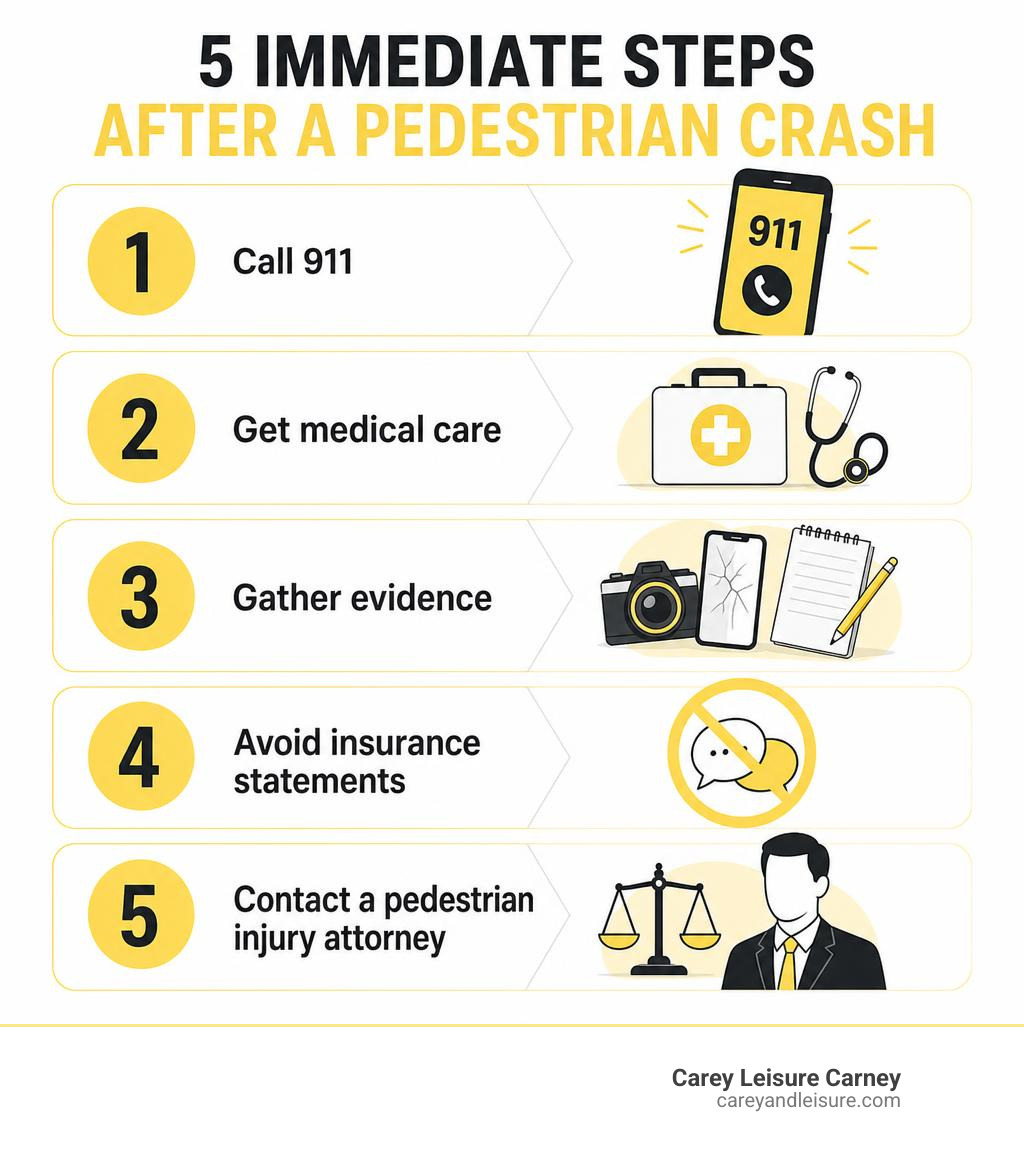
Your immediate actions in the minutes and hours following a collision can significantly impact your physical recovery and your legal claim:
- Call 911: Ensure law enforcement and emergency medical personnel are dispatched to the scene. The police officer will write an official accident report, which is a vital piece of evidence.
- Seek Immediate Medical Attention: Even if you believe your injuries are minor, go to the emergency room or an urgent care clinic. Adrenaline can mask severe internal injuries, and a delay in care will be used by the insurance company to argue that your injuries were not caused by the crash.
- Document the Scene: If you are physically able, take photos of the vehicle that hit you, your visible injuries, the surrounding crosswalks, traffic signs, and any skid marks.
- Gather Witness Information: Collect names and phone numbers of anyone who saw the accident.
- Contact an Attorney: Speak to us before giving any recorded statements to insurance adjusters.
For a step-by-step breakdown of how to navigate these chaotic moments locally, read How to Handle a Clearwater Auto or Pedestrian Crash.
How does Florida’s no-fault insurance affect my pedestrian claim?
Florida is a “no-fault” auto insurance state. This means that if you are injured in a traffic accident, your own Personal Injury Protection (PIP) insurance is primary.
- If you own a vehicle and carry PIP, your own policy will pay 80% of your necessary medical expenses and 60% of your lost wages, up to a limit of $10,000, regardless of who caused the accident.
- If you do not own a vehicle but live with a relative who does, you are covered under their PIP policy.
- If you do not have access to PIP through your own household, the PIP policy of the driver who hit you will cover your initial medical bills.
Because PIP only covers up to $10,000 (and only pays a portion of your bills), you will likely have significant out-of-pocket costs and unpaid medical liens. We can help you file a third-party liability claim against the negligent driver’s bodily injury liability insurance to recover the remaining 20% of your medical bills, the remaining 40% of your lost wages, and all of your non-economic damages like pain and suffering.
For more details on navigating these complex insurance structures, see What to Expect: A Guide to Pedestrian Accident Claims and Settlements.
What is the deadline to file a pedestrian injury lawsuit in Florida?
Under Florida’s modified statutes (HB 837), the statute of limitations for filing a personal injury lawsuit based on negligence is two years from the date of the accident. If you fail to file a lawsuit in court before this two-year window closes, you lose your right to hold the negligent party accountable forever.
While two years may sound like a long time, building a robust case takes months of preparation, expert consultation, and medical documentation. Waiting until the last minute can severely jeopardize your recovery.
To ensure you do not miss any critical legal deadlines, read Don’t Walk Away: Secure Your Pedestrian Accident Lawyer Near You.
Conclusion
A sudden pedestrian accident can change the course of your life in an instant. But you do not have to carry the heavy burden of medical bills, lost income, and legal disputes on your own.
At Carey Leisure Carney, we have spent decades standing up for injured walkers, joggers, and families throughout Clearwater, Largo, St. Petersburg, New Port Richey, Spring Hill, Trinity, and Wesley Chapel. As a firm, our unique strength lies in our credentials: we are home to Board-Certified civil trial attorneys—a distinction held by less than 2% of lawyers in Florida. With over 100 years of combined legal experience, we do not pass your file to investigators or paralegals; we provide direct attorney access and personalized, compassionate representation from start to finish.
We operate on a contingency fee basis, meaning you pay absolutely nothing upfront, and we only collect a fee if we successfully recover compensation for you. Let us handle the insurance companies while you focus on healing.
For a deeper understanding of your legal rights, read our Pedestrian Accident Attorney Ultimate Guide or contact our dedicated Auto Accident Attorney / Pedestrian Accident Attorney team today to schedule your free, no-obligation case evaluation.