
I don’t have any specified local SEO locations for this law firm.
What You Need to Know About a Settlement After a Car Accident
Reaching a fair settlement after a car accident is one of the most important steps you can take to protect your financial future — and most people have no idea where to start.
Quick answer: How does a car accident settlement work?
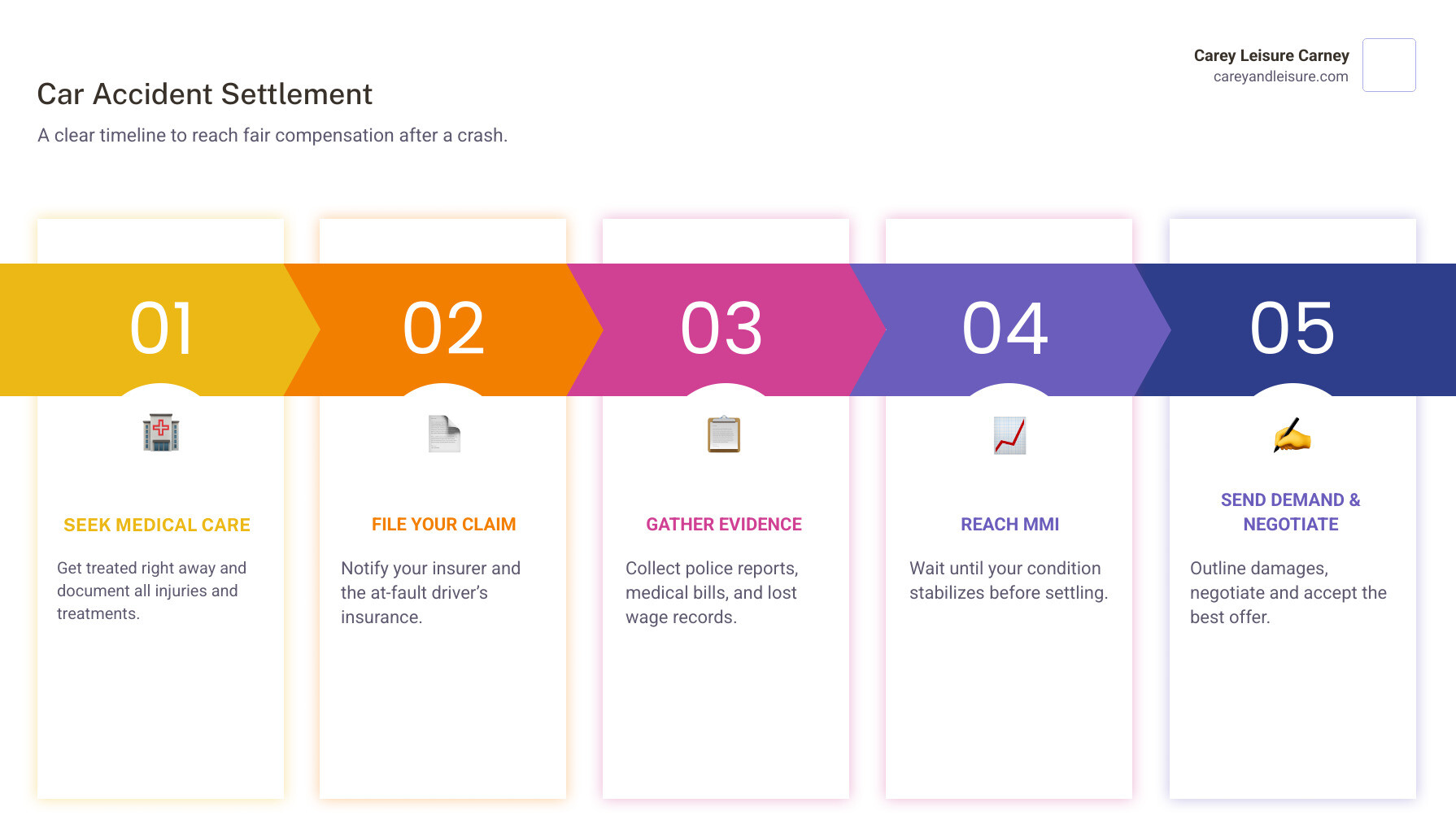
| Step | What Happens |
|---|---|
| 1. Seek medical care | Get treated right away; document everything |
| 2. File your claim | Notify your insurer and the at-fault driver’s insurer |
| 3. Gather evidence | Police reports, medical bills, lost wage records |
| 4. Reach MMI | Wait until your condition stabilizes before settling |
| 5. Send a demand letter | Outline all damages and your requested amount |
| 6. Negotiate | Expect back-and-forth with the insurance company |
| 7. Accept or file suit | Sign a release — or take the case to court |
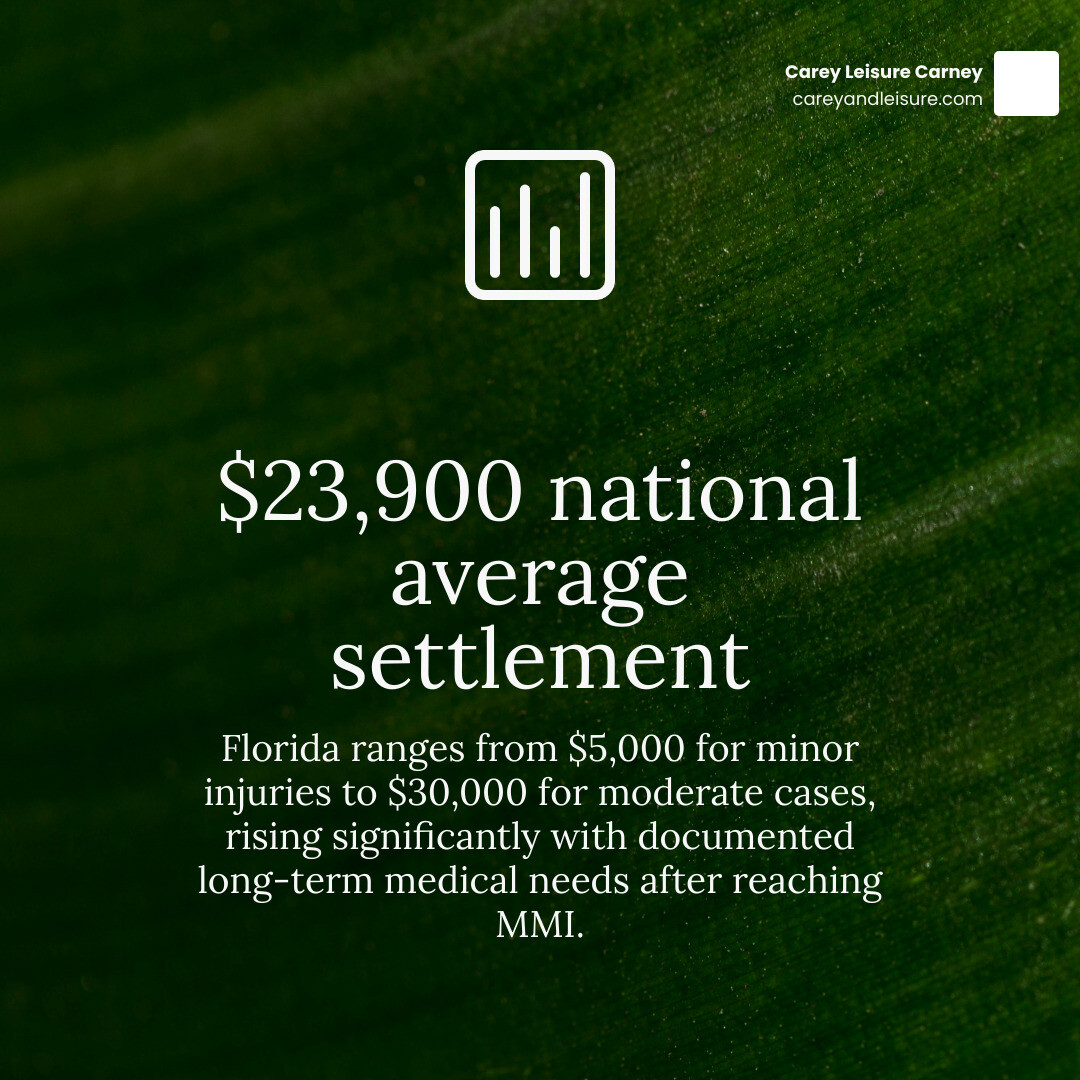
Nearly 95% of personal injury cases resolve through settlement, never reaching a courtroom. The national average settlement is around $23,900, but amounts vary widely — from under $10,000 for minor injuries to well over $100,000 for serious trauma. Once you sign a release, your case is closed for good, which is why every decision along the way matters.
I’m Thomas W. Carey, founding partner of Carey Leisure Carney and a board-certified civil trial lawyer with over 35 years guiding Florida injury victims through the settlement after car accident process. Across roughly 40,000 injury matters, I’ve seen how the right preparation — and the right legal team — can mean the difference between a lowball payout and the full compensation you deserve.
Simple settlement after car accident word guide:
- Auto accident legal help
- compensation after accident
- compensation for pain and suffering after a car accident
What is the Average Settlement After a Car Accident?
When clients walk into our offices in Clearwater or New Port Richey, the first question is almost always: “How much is my case worth?” It’s a fair question. You have medical bills piling up and a car that looks like an accordion.
As of May 2026, the national average for a settlement after a car accident hovers around $23,900. However, averages can be misleading. In Florida, we typically see a range between $5,000 and $30,000 for standard claims. If you suffered a minor “fender bender” with soft-tissue injuries like whiplash, your settlement might stay under $10,000. On the other hand, if you’re dealing with broken bones or surgical trauma, that number can easily climb into the six or seven-figure range.
Data from thousands of cases shows that the median settlement for a soft-tissue back injury is approximately $18,000, while disc injuries (like a herniated disc) jump to a median of $64,000. Why the big difference? It comes down to the permanence and objective proof of the injury.
To see how these numbers play out in real life, check out our Personal Injury Settlement Examples. Understanding these benchmarks helps manage expectations, but remember: your case is unique. You can get a deeper dive into the math behind these numbers in our guide: What Is My Personal Injury Case Worth?

Factors Affecting Florida Payouts
In Florida, and specifically in the Tampa Bay area, several local factors influence your final check.
- Injury Severity: This is the heavy hitter. A permanent injury that requires ongoing care will always command a higher settlement than a “resolved” injury.
- Clearwater Medical Costs: The cost of treatment at local facilities like Morton Plant Hospital or St. Joseph’s affects your economic damages.
- Insurance Policy Limits: You can’t get blood from a stone. If the at-fault driver only has the state-minimum $10,000 in bodily injury liability (if they have it at all), your settlement might be capped by that policy unless you have Uninsured Motorist (UM) coverage.
- Clarity of Liability: If the other guy was 100% at fault (like a rear-end collision on US-19), your case is much stronger than a “he-said, she-said” intersection accident.
For more strategies on navigating these factors, read about How to Get the Most Compensation from a Car Accident Settlement in Florida.
Key Factors That Influence Your Claim Value
Every settlement after a car accident is a puzzle made of several pieces. If one piece is missing or broken, the whole value drops.
- Liability: In Florida, we use a modified comparative negligence system. If you are found partially at fault, your check is reduced by that percentage. If you are more than 50% at fault, you get nothing.
- Insurance Coverage: We look at every available policy — yours, the other driver’s, and sometimes even the vehicle owner’s or an employer’s policy if they were on the clock.
- Financial Loss: This includes every penny you’ve lost or will lose. We’re talking about hospital bills, physical therapy, and the wages you lost while you were stuck on the couch recovering.
You can learn more about the types of Compensation After Accident available to you, or see our specific tips on How to Get the Most Compensation from a Car Accident Settlement in Florida.
Calculating a Fair Settlement After a Car Accident
Insurance adjusters use software like “Colossus” to value claims, but we use real-world math. We break damages into two categories:
1. Economic Damages (The “Hard” Costs) These are easy to calculate because they have a receipt.
- Past and future medical bills.
- Lost wages and loss of earning capacity.
- Property damage (your car).
2. Non-Economic Damages (The “Human” Costs) This is where things get tricky. How do you put a price on not being able to pick up your toddler or the constant burning pain in your neck?
- The Multiplier Method: We take your total economic damages and multiply them by a number (usually 1.5 to 5) based on how bad the injury is. A 1.5 multiplier might apply to a sprained wrist, while a 5 multiplier is reserved for life-altering injuries.
- The Per Diem Method: This assigns a daily dollar value to your pain from the day of the crash until you reach maximum recovery.
For a detailed look at this, see our article on Pain and Suffering After a Car Accident: Your Guide to Fair Compensation.
Impact of Maximum Medical Improvement (MMI)
You should almost never settle your case until you reach Maximum Medical Improvement (MMI). MMI is the point where a doctor says, “You’re as good as you’re going to get.”
If you settle while you’re still in physical therapy, and then find out six months later that you need a $50,000 spinal fusion surgery, you can’t go back for more money. The insurance company will simply point to the release you signed and say, “Sorry, Charlie.” Waiting for MMI ensures we can accurately project your future medical needs and long-term disability.
If you’re dealing with chronic issues, our guide on Navigating Back Pain Compensation After a Car Accident: A Comprehensive Guide explains why MMI is so critical for spinal injuries.
Navigating Florida’s No-Fault Laws and PIP
Florida is one of the few “no-fault” states left in the country. This doesn’t mean no one is at fault for the crash; it means your own insurance pays for your initial medical bills regardless of who caused the accident.
Personal Injury Protection (PIP) is mandatory in Florida. It typically covers:
- 80% of your medical bills.
- 60% of your lost wages.
- Up to a $10,000 limit.
The 14-Day Rule: This is the most important deadline you’ve never heard of. In Florida, you must seek medical treatment within 14 days of the accident to use your PIP benefits. If you wait 15 days, you could lose that $10,000 in coverage entirely. Even if you think you just have a “little headache,” go to a doctor in Clearwater, Largo, or Spring Hill to get checked out.
For more on how PIP fits into your total case value, see What Is My Personal Injury Case Worth?
Comparative Negligence in 2026
In March 2023, Florida passed HB 837, which significantly changed how a settlement after a car accident is calculated. We now follow a modified comparative fault rule under Florida Stat. § 768.81.
If you are 20% at fault for an accident (maybe you were speeding slightly when someone pulled out in front of you), your total compensation is reduced by 20%. However — and this is a big “however” — if you are found to be more than 50% at fault, you are barred from recovering any damages from the other party. This makes proving liability more important than ever.
The Timeline: From Crash to Compensation
A common myth is that you’ll have a check in your hand two weeks after the crash. In reality, a quality settlement after a car accident takes time.
- The Investigation (Weeks 1-4): We gather police reports, dashcam footage, and witness statements.
- Treatment and MMI (Months 1-6+): You focus on getting better. We focus on collecting every single medical record.
- The Demand Package: Once you reach MMI, we send a comprehensive “demand letter” to the insurance company. This is essentially a 20-page document (often backed by AI-organized medical chronologies) that tells your story and demands a specific amount.
- Negotiation (1-3 Months): The “back-and-forth.” They offer low; we stay high. We go through several rounds until we reach a number that actually covers your needs.
- Finalization: If we agree, you sign a release and get your funds (usually within 2-6 weeks). If not, we file a lawsuit.
You can see how this timeline varies in our Personal Injury Settlement Examples.

Maximizing Your Settlement After a Car Accident
To get the highest possible settlement after a car accident, you need to be proactive.
- Document Everything: Keep a “symptom journal.” If the pain in your neck kept you from sleeping on Tuesday, write it down. If you couldn’t go to your grandson’s birthday party in St. Pete, write it down.
- Avoid Recorded Statements: The other driver’s insurance adjuster is not your friend. They are trained to get you to say things like “I’m feeling okay today,” which they will later use to argue you weren’t really hurt.
- Hiring Board-Certified Counsel: Statistics from the Insurance Research Council show that represented claimants receive settlements averaging 3.5 times higher than those who go it alone. At Carey Leisure Carney, our attorneys are Board-Certified — a distinction held by less than 2% of Florida lawyers.
Don’t forget the property side of things, either. Check out The Ultimate Guide to Winning Your Vehicle Damage Claim to ensure your car is handled correctly.
Common Mistakes That Reduce Your Payout
We’ve seen many people accidentally sabotage their own settlement after a car accident. Here are the “don’ts”:
- Accepting the First Offer: The first offer is almost always a “lowball.” It’s designed to see if you’re desperate enough to take pennies on the dollar.
- Settling Before MMI: As mentioned, once you sign that release, it’s over. Don’t settle until you know the full extent of your future medical needs.
- Social Media Posts: Insurance adjusters will check your Facebook and Instagram. If you claim you have a debilitating back injury but post a photo of yourself dancing at a wedding in Trinity, your settlement value will plummet.
- Ignoring Doctor’s Orders: If you skip physical therapy appointments, the insurance company will argue that you must not be that hurt.
If your vehicle was destroyed in the process, make sure you know your rights by reading What If My Car Is a Total Loss? and Compensation for Diminished Car Value After Accident Florida.
Frequently Asked Questions about Car Accident Settlements
How long does a settlement take in Florida?
A straightforward case with minor injuries might settle in 3 to 6 months. However, if you have serious injuries or we have to file a lawsuit to get the insurance company to be fair, it can take 12 to 24 months. The most important factor is how long it takes you to reach Maximum Medical Improvement.
What if the at-fault driver is uninsured?
This is a huge problem in Florida, where many drivers carry the bare minimum (which doesn’t include bodily injury liability). If the at-fault driver is uninsured, we look to your own Uninsured/Underinsured Motorist (UM) coverage. This is the most important insurance you can buy in Florida because it steps into the shoes of the person who hit you.
Can I reopen my case after signing a release?
No. A “Release of All Claims” is a binding legal contract. Once you sign it and accept the money, you forever waive your right to sue that person or their insurance company for that specific accident. This is why we insist on waiting for MMI.
Conclusion
Navigating a settlement after a car accident in Florida is a marathon, not a sprint. From the 14-day PIP rule to the complexities of modified comparative negligence, the deck is often stacked against the individual.
At Carey Leisure Carney, we believe you shouldn’t have to face billion-dollar insurance companies alone. With over 100 years of combined experience and Board-Certified expertise, we provide the “big firm” results with the “small firm” personalized service you deserve. When you call us, you get direct access to your attorney — not just a paralegal or an automated system.
Whether you are in Clearwater, St. Petersburg, New Port Richey, or Spring Hill, we are here to help you maximize your recovery and get your life back on track.
If you’ve been injured and want to know what your case is truly worth, Contact a Clearwater Personal Injury Attorney at Carey Leisure Carney today for a free consultation. We don’t get paid unless you do.