Claiming Compensation: A Step-by-Step Guide to Fatal Accident Claims
When You Lose Someone: What a Fatal Accident Claim Means for Your Family
A fatal accident claim is a legal action that allows surviving family members to seek financial compensation when a loved one dies due to someone else’s negligence or wrongful act.
Here’s what you need to know right away:
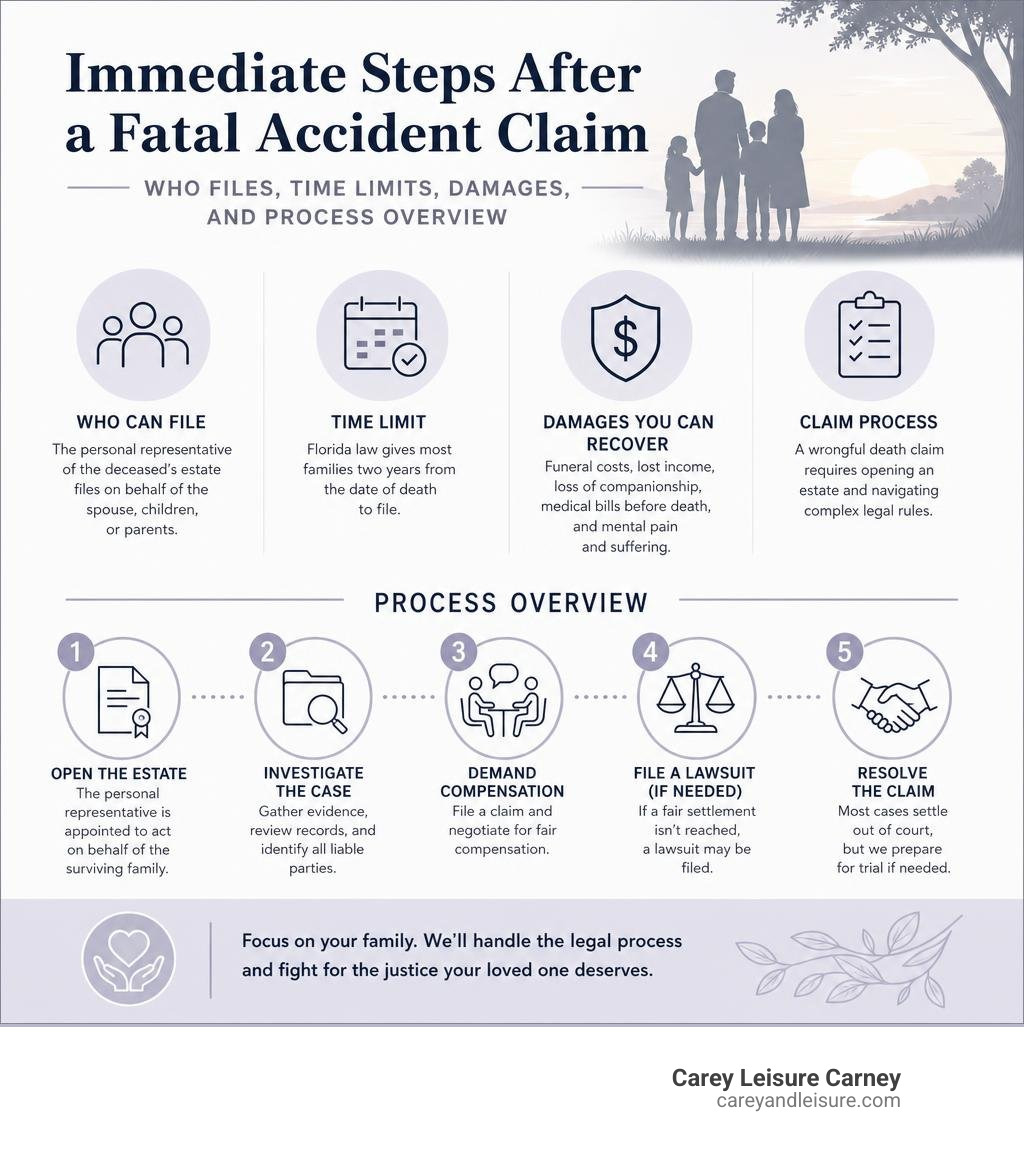
- Who can file: In Florida, the personal representative of the deceased’s estate files on behalf of the spouse, children, or parents
- What you can recover: Funeral costs, lost income, loss of companionship, medical bills before death, and mental pain and suffering
- Time limit: Florida law gives most families two years from the date of death to file
- Do you need an attorney? Yes — a wrongful death claim requires opening an estate and navigating complex legal rules
- Will you go to court? Most claims settle out of court, but a board-certified trial attorney strengthens your position either way
Losing someone you love is devastating enough. Then come the medical bills, the lost income, the funeral expenses — and a legal system that can feel overwhelming when you’re already grieving. No compensation can undo what happened. But holding the responsible party accountable can provide financial stability and a measure of justice for your family.
I’m Thomas W. Carey, founding partner of Carey Leisure Carney and a board-certified civil trial lawyer with decades of experience handling fatal accident claims across Florida — including the wrongful death of my own wife, Joni, who was killed by a drunk driver. That personal experience drives everything I do for families who come to us in their darkest moments.
Explore more about fatal accident claim:
Understanding the Legal Framework of a Fatal Accident Claim
When a sudden tragedy strikes, the legal system is probably the last thing on your mind. However, understanding how a fatal accident claim works is essential to protecting your family’s future. At its core, this claim is built on the concept of negligence.
To secure compensation, we must establish four key legal elements:
- Duty of Care: The responsible party owed your loved one a legal duty to act reasonably (for example, a motorist must follow traffic laws, and a property owner must maintain safe premises).
- Breach of Duty: They failed in that duty (e.g., speeding, driving under the influence, or leaving a hazard unfixed).
- Causation: This specific failure directly caused the fatal accident.
- Damages: The death resulted in real financial and emotional losses for the surviving family.
Understanding these concepts is the first step in navigating The Grim Reality A Guide to Fatal Accidents and Their Aftermath.

Wrongful Death vs. Survival Actions in Florida
Under Florida law, a fatal accident triggers two distinct types of legal remedies: a wrongful death action and a survival action. While they sound similar, they serve entirely different purposes.
- Wrongful Death Action: This focuses on the losses suffered by the surviving family members because their loved one is gone. It covers emotional pain and suffering, loss of companionship, and the loss of financial support the deceased would have provided.
- Survival Action: This focuses on the losses suffered by the deceased person from the moment of the injury until their death. If your loved one survived for a period of time before passing away, the estate can recover compensation for their pre-death pain and suffering, medical bills, and lost earnings during that window.
For a deeper dive into how Florida handles these sensitive cases, take a look at our Wrongful Death Lawyer Florida Complete Guide.
International Frameworks: The Fatal Accidents Act 1976 and Law Reform Act 1934
If you have family ties abroad or if the accident involved international jurisdictions, you might encounter different statutory frameworks. In the United Kingdom, for example, fatal injury cases are split between two pieces of legislation:
- The Law Reform (Miscellaneous Provisions) Act 1934: This allows the deceased’s estate to carry on a claim for the pain, suffering, and financial losses incurred by the deceased before they died.
- The Fatal Accidents Act 1976: This allows the deceased’s dependants to claim for their own losses, such as loss of financial dependency and funeral expenses.
While the terminology and specific statutory limits differ from Florida’s wrongful death statutes, the core purpose remains identical: providing financial security to those left behind. For more details on UK payouts and statutory structures, you can read about Fatal Accident Compensation Payouts (2026): Who Can Claim and How Much? .
Who Can File and What Compensation is Available?
The rules governing who can file a fatal accident claim and what types of compensation are available depend heavily on where the claim is filed. The table below highlights the key differences between the Florida wrongful death framework and the UK statutory system.
| Feature | Florida Wrongful Death Law | UK Fatal Accidents Act 1976 |
|---|---|---|
| Who Files the Claim? | The Personal Representative of the Estate | The Executor/Administrator or the Dependants |
| Primary Beneficiaries | Spouse, children, parents, and dependent relatives | Spouse, civil partner, cohabitee (2+ years), children, parents, siblings |
| Statutory Bereavement Award | None (Emotional damages are evaluated case-by-case and are uncapped) | Fixed at £15,120 (for eligible relationships) |
| Financial Dependency | Based on lost services, support, and future estate accumulations | Calculated via the apportionment principle (66% to 75% of income) |
| Standard Time Limit | Two years from the date of death | Three years from the date of death |
No matter which system applies to your situation, pursuing Fatal Accident Claims is about securing the financial support your family needs to survive and heal.
Eligible Claimants in Florida and Abroad
In Florida, a wrongful death lawsuit must be brought by the personal representative of the deceased’s estate. This representative acts on behalf of all eligible survivors. Eligible survivors include:
- The surviving spouse.
- Minor children (and adult children if there is no surviving spouse).
- Parents of the deceased.
- Any blood relatives or adoptive siblings who were partly or wholly dependent on the deceased for support or services.
Abroad, the list of qualifying dependants under the Fatal Accidents Act 1976 is slightly broader and explicitly includes cohabiting partners (who must have lived together for at least two years prior to the death), siblings, aunts, uncles, and cousins.
If you are trying to determine who has the legal standing to file in your specific area, searching for Accidental Death Lawyers Near Me can connect you with local legal professionals who can clarify your rights.
Calculating Financial Dependency and the Bereavement Award in a Fatal Accident Claim
Calculating financial dependency is one of the most complex parts of a fatal accident claim.
In the UK, courts often use a standardized apportionment principle to determine how much income went toward the family:
- For couples without children: It is generally assumed the deceased spent 33% of their income on themselves, leaving a 66% dependency for the surviving partner.
- For families with children: The personal expenditure deduction drops to 25%, meaning the family’s financial dependency is calculated at 75% of the deceased’s net income.
Additionally, the UK provides a fixed Statutory Bereavement Award (currently set at £15,120), which is paid to a surviving spouse, civil partner, or the parents of an unmarried minor.
In Florida, we do not use a fixed statutory bereavement award. Instead, our courts allow survivors to recover uncapped damages for mental pain and suffering, loss of companionship, and the loss of parental guidance. We also calculate financial dependency by evaluating the deceased’s specific earnings, career trajectory, retirement benefits, and the value of “services” they performed around the home (like childcare or property maintenance).
To understand how these calculations apply to a motor vehicle tragedy, read our guide on Fatality Car Accident Resulting in Death.
Step-by-Step Process of Pursuing a Fatal Accident Claim
Navigating a legal claim while dealing with intense grief is incredibly difficult. Knowing what to expect step-by-step can help demystify the process.

- Appoint a Personal Representative: In Florida, we must first open an estate in probate court to name a personal representative. This is the only person authorized to file the wrongful death lawsuit.
- Investigate and Gather Evidence: We collect police reports, medical files, witness accounts, and physical evidence from the accident scene.
- Identify Liable Parties and Insurance Coverage: We pinpoint who is responsible and find out what insurance policies are available to cover the losses. If you were involved in a motor vehicle accident, referencing resources like Involved in a Crash? – Florida Highway Safety and Motor Vehicles can help you understand the initial insurance reporting requirements.
- Value the Claim: We work with economic experts and forensic accountants to calculate the full lifetime value of lost wages, benefits, and household services.
- Negotiate a Settlement: We present our evidence to the insurance company and negotiate for a fair settlement.
- Filing a Lawsuit and Trial: If the insurer refuses to offer a fair settlement, we file a formal lawsuit and prepare to present your case to a jury.
Gathering Crucial Evidence and Establishing Liability
To build a rock-solid fatal accident claim, we must compile clear evidence that proves the other party was at fault. This evidence typically includes:
- Official Reports: Police crash reports, homicide investigation files, or occupational health and safety reports.
- Medical Documentation: Records detailing any medical treatment your loved one received before passing away, as well as autopsy or medical examiner reports.
- Eyewitness Statements: Accounts from people who saw the accident occur.
- Digital Evidence: CCTV footage, dashcam videos, black box data from vehicles, or cell phone records (to prove distracted driving).
- Financial Records: Tax returns, pay stubs, and employment contracts to verify the deceased’s income.
For help locating official documents, check out our resource on Uncovering the Truth Where to Find Fatality Reports.
Navigating Time Limits, Costs, and Court Proceedings
Time is of the essence when pursuing a claim. In Florida, the statute of limitations for most wrongful death claims is two years from the date of death. If you miss this deadline, you lose your right to seek justice. (By contrast, the UK limitation period is generally three years).
Many families worry about how they will pay for legal help. We handle fatal injury claims on a contingency fee basis (often referred to as “no win, no fee”). This means:
- You pay nothing upfront.
- We cover all the investigation and litigation costs.
- We only get paid if we successfully recover compensation for you.
Understanding the legal landscape surrounding these tragic events is crucial, as outlined in The Silent Epidemic Unpacking Fatal Traffic Accidents.
Frequently Asked Questions About Fatal Accident Claims
Losing a family member brings up many complex legal questions. Here are some of the most common questions we hear from grieving families. For more insights on specific accident types, you can read Tragedy on the Road Understanding Drunk Drivings Fatal Toll.
Can I claim compensation for a fatal accident that occurred abroad?
Yes, but these claims are highly complex. If a Florida resident is killed in an accident abroad, your ability to file a claim depends on several factors:
- Package Holidays: If the trip was booked as part of a package tour through a US-based or international operator, you may be able to sue the operator in local courts.
- Foreign Defendants: If you must sue a foreign individual or business, the case may need to be resolved under the laws of the country where the accident happened.
- Uninsured or Unknown Drivers: If the accident was a hit-and-run abroad, international motor insurance bureaus may have funds to compensate victims.
If you are dealing with a local hit-and-run tragedy, you can learn more about your options in our guide on Hit and Run Death.
Do I need a solicitor or attorney to make a claim?
Technically, you aren’t legally required to hire an attorney, but attempting to handle a fatal accident claim on your own is highly discouraged. Insurance companies are notorious for offering lowball settlements to grieving families who don’t have legal representation.
An experienced, board-certified attorney will:
- Handle all communication and negotiations with the insurance company.
- Accurately calculate the lifetime value of your financial losses.
- Ensure all probate court filings and estate requirements are handled correctly.
While you may find generic regional resources online, having direct access to a dedicated, board-certified trial specialist is what truly makes a difference.
To understand how an attorney protects your rights in catastrophic negligence cases, read Drunk Drivers Head on Collisions and Wrongful Death Your Legal Options.
Will our family have to go to court to settle?
The vast majority of fatal accident claims—over 90%—are settled out of court. This is usually done through negotiation or formal mediation, where both sides meet with a neutral third party to reach an agreement.
However, if the insurance company refuses to offer a fair settlement, your attorney must be fully prepared to take the case to trial. Working with a law firm that has extensive courtroom experience ensures that the insurance company takes your claim seriously from day one.
Conclusion
At Carey Leisure Carney, we understand that no amount of money can bring back your loved one. But we also know that financial stress shouldn’t be added to your grief. Our team of board-certified civil trial attorneys—a distinction held by less than 2% of lawyers in Florida—brings over 100 years of combined legal experience to your side.
We serve families throughout Florida, including Clearwater, Largo, New Port Richey, Spring Hill, St. Petersburg, Trinity, and Wesley Chapel. When you work with us, you get direct attorney access and the compassionate, personalized service your family deserves.
If you are ready to seek justice and secure your family’s financial future, contact a compassionate wrongful death attorney at Carey Leisure Carney today for a free, confidential consultation.