

The A to Z of Personal Injury Claims: A Comprehensive Guide
What You Need to Know Right Now About Filing a Personal Injury Claim
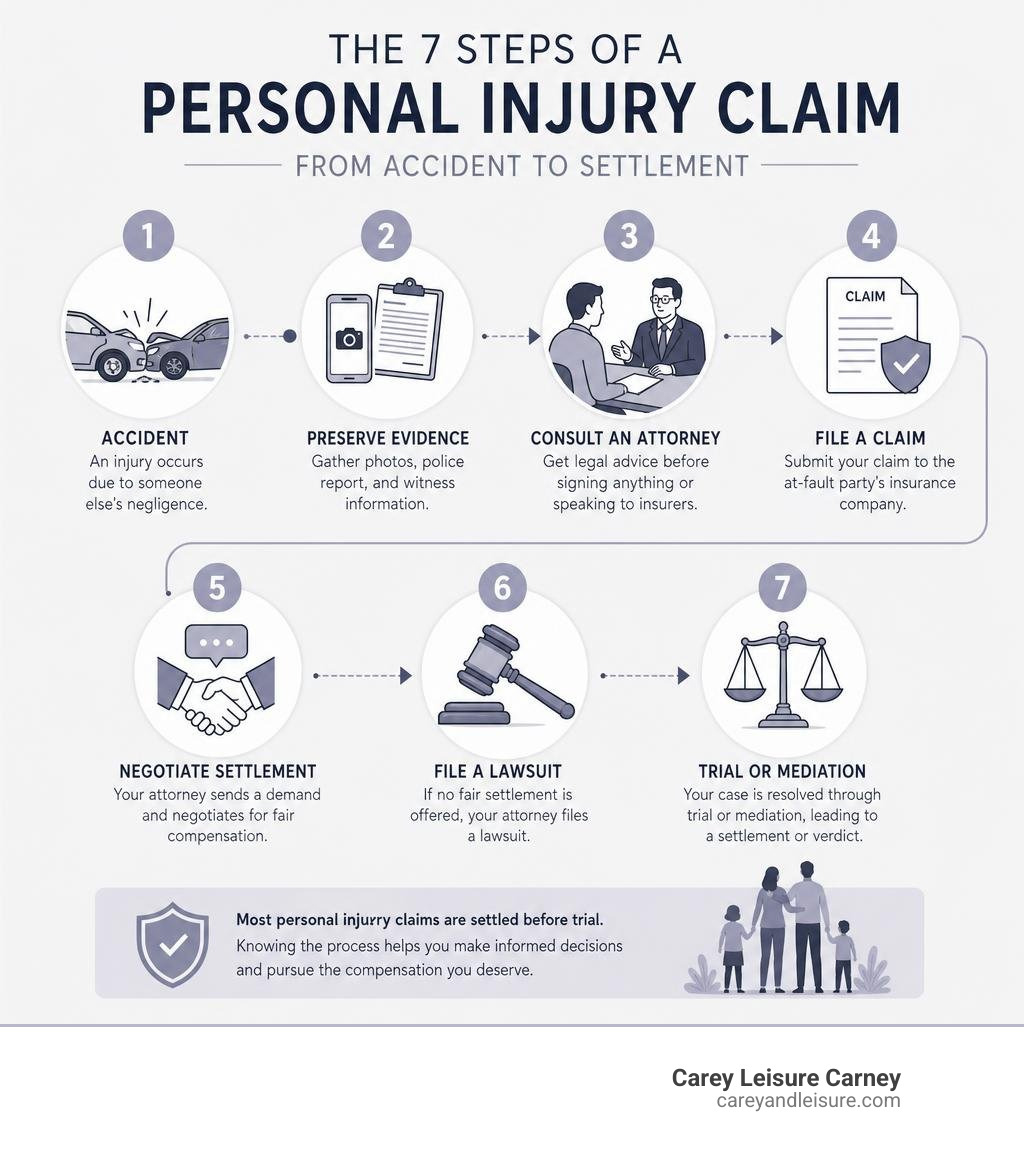
This personal injury claim guide is for anyone who has been hurt in an accident — or lost a loved one — because of someone else’s negligence. Here is a quick overview of how the process works:
The core steps of a personal injury claim:
- Seek medical care immediately after the accident
- Preserve evidence — photos, police reports, witness details
- Consult a personal injury attorney before signing anything
- File a claim with the at-fault party’s insurance company
- Negotiate a settlement through demand letters and negotiation
- File a lawsuit if a fair settlement cannot be reached
- Go to trial or mediate to resolve the case
Quick facts: Over 400,000 personal injury claims are filed every year in the U.S. Most settle before trial. Victims who hire an attorney recover 3 to 3.5 times more in compensation than those who go it alone.
Being hurt in an accident is overwhelming. Medical bills pile up. You may be missing work. And an insurance adjuster is already calling — trying to close your case fast and cheap. Knowing your legal rights is the first step toward getting fair compensation.
Every valid personal injury claim rests on four key elements: someone owed you a duty of care, they breached that duty, that breach caused your injury, and you suffered real damages as a result. If all four are present, you likely have grounds to file.
I’m Thomas W. Carey, founding partner of Carey Leisure Carney, a board-certified civil trial lawyer with over 35 years of experience guiding clients through every stage of the personal injury claim process — from car crashes and slip-and-fall cases to catastrophic injury and wrongful death. This guide draws on the same knowledge I’ve applied across roughly 40,000 injury matters to help you understand exactly what to do next.
Personal injury claim guide word roundup:
- Auto accident legal help
- compensation after accident
- compensation for pain and suffering after a car accident
What is a Personal Injury Claim and Do You Have Grounds to File?
At its core, a personal injury claim is a legal dispute resolved under tort law. When one person suffers physical or emotional harm because of another party’s negligent or intentional actions, the injured person (the plaintiff) can seek financial recovery from the responsible party (the defendant).
To establish viable legal grounds for a claim, you must prove that your situation satisfies the four pillars of negligence:
- Duty of Care: The defendant had a legal obligation to act with reasonable caution to prevent harm to others. For example, drivers in Clearwater have a duty to keep their eyes on the road and obey traffic signals.
- Breach of Duty: The defendant failed to uphold that duty. A driver texting behind the wheel or a store owner leaving a wet floor unmarked represents a clear breach.
- Causation: The defendant’s breach directly caused your bodily injury. It is not enough that they acted carelessly; their specific carelessness must be the direct catalyst for your accident.
- Damages: You suffered actual, measurable losses (medical bills, lost wages, pain and suffering) because of those injuries.
Without these four elements, you do not have a viable case. If you are unsure whether your accident meets these criteria, reviewing the fundamentals of Personal Injury Lawsuits can help clarify where you stand.
Common Types of Personal Injury Cases and Injuries
Personal injury claims arise from many different scenarios. In our decades of practicing law across Pinellas, Pasco, and Hernando counties, we have represented clients facing a wide range of accidents and injuries:
- Car Accidents: By far the most common driver of personal injury claims. Whether it is a rear-end collision on US-19 in Largo or a distracted driver on the Gandy Bridge, auto accidents make up over half of all injury filings nationwide.
- Slip and Falls: These fall under premises liability. If a property owner in St. Petersburg fails to repair a broken step or clean up a spill, they can be held liable for resulting fractures or head injuries.
- Commercial Vehicle Accidents: Collisions involving semi-trucks, delivery vans, or corporate vehicles often cause catastrophic damage. Because commercial policies are larger and multiple parties may be liable, it is vital to Understand commercial vehicle settlements before speaking with an insurer.
- Rideshare Accidents: Accidents involving Uber or Lyft vehicles add a layer of complexity regarding which insurance policy is active at the time of the crash.
The physical consequences of these accidents can range from soft-tissue damage like whiplash to life-altering traumatic brain injuries (TBIs) and spinal damage.

The Ultimate Personal Injury Claim Guide: Understanding Your Rights
Navigating the legal landscape requires a clear understanding of how fault and liability are determined. Every state has its own rules governing these concepts. For instance, if you look at the California Court Guide on Personal Injury, you will find a legal system built around pure comparative negligence.
Here in Florida, our laws are distinct. We operate under a modified comparative negligence system. This means your financial recovery is directly tied to your percentage of fault. If you are found partially responsible for the accident, your compensation is reduced by that exact percentage. However, if you are found to be more than 50% at fault, you are barred from recovering any damages at all.
Step-by-Step Personal Injury Claim Guide
To secure the compensation you deserve, you must follow a structured path. Missing a step can jeopardize your ability to recover damages.

- Seek Immediate Medical Treatment: Your health is the absolute priority. Even if you feel fine, adrenaline can mask severe injuries like internal bleeding or concussions. Establishing an official medical record right away is crucial for your case.
- Consult a Personal Injury Attorney: Before you speak to an insurance adjuster or sign any authorization forms, get professional legal advice.
- Investigation and Evidence Gathering: Your legal team will collect police reports, obtain surveillance footage, interview witnesses, and compile your medical records.
- Notice of Claim: We notify the negligent party and their insurance provider of our intent to seek damages.
- The Demand Letter: Once you reach Maximum Medical Improvement (MMI)—meaning your injuries have healed as much as they realistically will—we draft a comprehensive demand letter outlining your losses and proposing a settlement figure.
- Negotiation or Filing a Lawsuit: If the insurance company refuses to offer a fair settlement, we file a formal complaint in court, initiating the litigation phase.
- Discovery: Both sides exchange evidence, take depositions, and build their arguments.
- Mediation: A neutral third party helps both sides attempt to reach a settlement before going to court.
- Trial: If mediation fails, the case goes before a judge or jury to decide liability and compensation.
To visualize how these puzzle pieces fit together over time, you can Navigate the complete personal injury process to prepare for the road ahead.
Why You Need a Personal Injury Claim Guide for Complex Cases
Not every claim is straightforward. Certain variables introduce immense legal complexity:
- Pre-Existing Conditions: Insurance adjusters love to claim your current pain is merely a continuation of an old injury. A skilled attorney uses medical experts to prove how the recent accident aggravated your pre-existing condition.
- Claims Involving Minors: Children cannot legally file lawsuits or agree to settlements. Special court-approved guardianships and trust structures are required to protect a minor’s recovery.
- Government Entities: If you are injured by a city bus in Clearwater or on poorly maintained state property in Spring Hill, sovereign immunity laws apply. These claims involve incredibly short deadlines and strict notice requirements. For example, while Texas has its own rules under the Texas Tort Claims Act, Florida has its own strict guidelines under Florida Statute 768.28.
- International or Out-of-State Variances: If you are researching how claims are handled globally, you might find systems like the UK’s Official Injury Claim Service Guide, which uses online portals and fixed tariffs for minor whiplash claims. While interesting, these foreign models have no bearing on your Florida claim, which requires local, state-specific representation.
Proving Your Case: Evidence, Documentation, and Liability
You cannot win a personal injury claim on your word alone. You need clear, admissible evidence. The stronger your documentation, the more leverage you have during settlement negotiations.
Key pieces of evidence include:
- Official Reports: Police crash reports or business incident logs.
- Medical Records: Detailed diagnostics, treatment plans, and billing statements.
- Visual Proof: Photos and videos of the accident scene, vehicle damage, road hazards, and your physical injuries.
- Witness Statements: Unbiased accounts from people who saw the event occur.
- Surveillance Footage: Video from nearby traffic cameras, doorbell cameras, or business security systems.
To make sure you do not miss anything critical at the scene or in the days following your accident, check out our guide on How to document evidence for your claim.
Understanding Your Damages
When seeking recovery, your losses are categorized into economic and non-economic damages:
| Damage Type | What It Covers | Examples |
|---|---|---|
| Economic Damages | Tangible, measurable financial losses | Emergency room bills, future surgeries, physical therapy, lost wages, loss of earning capacity, property damage |
| Non-Economic Damages | Intangible, subjective losses | Pain and suffering, emotional distress, loss of enjoyment of life, loss of consortium |
Damages, Compensation, and Statutes of Limitations
Calculating the true value of your claim is one of the most important roles of a personal injury lawyer. We look at your immediate bills, but we also calculate your future needs—such as ongoing medical care or the long-term impact on your career. If you are wondering what your specific injuries might be worth, you can read more about how these calculations work by asking: What is my personal injury case worth?
Beyond compensatory damages (economic and non-economic), courts occasionally award punitive damages. These are not meant to compensate you, but rather to punish the defendant for intentional misconduct or gross negligence (such as drunk driving) and to deter others from acting similarly.
Time is Not on Your Side: Statutes of Limitations
Every state limits the amount of time you have to file a lawsuit after an accident. If you miss this window, you lose your right to seek compensation forever.
- Florida: Under Florida Statute 95.11, the deadline for most personal injury lawsuits based on negligence is two years from the date of the accident. (Note: This was shortened from four years due to major tort reform legislation).
- Texas: For comparison, the Texas statute of limitations is also two years under Texas Civ. Prac. & Rem. Code §16.003.
Because these deadlines are strict and preparing a solid lawsuit takes time, you should never delay in consulting an attorney.
Settlement Negotiations, Mediation, and Going to Trial
The vast majority of personal injury claims are resolved before they ever see the inside of a courtroom. The process begins when your attorney sends a formal demand letter to the insurance company.
Once the insurer receives the demand, they will assign an adjuster to the case. The adjuster’s job is to protect the insurance company’s bottom line. They will likely return with a lowball counteroffer, kicking off a series of negotiations.
If negotiations stall, we file a lawsuit. This forces the insurance company to take the claim seriously and adhere to a court-mandated schedule. During the litigation phase, both parties will often participate in mediation—an informal, confidential meeting where a certified mediator helps us find common ground.
If mediation fails, we go to trial. This is where having a Board-Certified civil trial attorney makes all the difference. We present your case to a jury, using expert witnesses and visual evidence to fight for a favorable verdict.
To see what successful outcomes look like in practice, you can explore some of our past Personal Injury Settlement Examples.
Frequently Asked Questions About Personal Injury Claims
What is the statute of limitations for a personal injury claim in Florida?
In Florida, the filing deadline for a personal injury lawsuit based on negligence is two years from the date of the injury. If you are filing a wrongful death claim, the deadline is also two years from the date of your loved one’s passing. Given the current June 2026 legal landscape, these strict two-year limits apply to all recent accidents, making early legal consultation essential.
Can I still recover damages if I was partially at fault for the accident?
Yes, but with limits. Florida follows a modified comparative negligence rule with a 51% bar. You can recover compensation as long as you are 50% or less at fault for the accident. Your final payout will be reduced by your percentage of fault. However, if you are found to be 51% or more at fault, you cannot recover any money from the other party.
How long does it take to resolve a personal injury lawsuit?
There is no single timeline. A straightforward car accident claim with clear liability might settle in a matter of months. However, complex cases involving severe injuries, disputable liability, or large commercial entities can take a year or more to resolve, especially if the case must go to trial.
Conclusion
When you are recovering from an accident, you should be focusing on your health—not arguing with insurance adjusters or worrying about legal deadlines.
At Carey Leisure Carney, we have spent over three decades fighting for injury victims in Clearwater, Largo, New Port Richey, Spring Hill, St. Petersburg, Trinity, and Wesley Chapel. Our attorneys are Board-Certified in civil trial law—a distinction held by less than 2% of Florida lawyers. We do not pass our clients off to paralegals or case managers; when you work with us, you get direct attorney access and personalized, compassionate representation.
We operate on a contingency fee basis. This means we charge no upfront fees, and you pay us nothing unless we win your case.
If you are ready to take the next step, let us help you:
- Read our guide on How to win your lawsuit without losing your mind
- Discover how we protect your rights and Unlock your claim with expert legal help
- Learn more about our risk-free approach with Our No Win No Fee promise
Contact a Clearwater personal injury attorney today for a free, no-obligation consultation, and let our family fight for yours.