No ID, No Piña Colada: Navigating Florida Alcohol ID Laws
Florida Alcohol ID Laws: The Basics
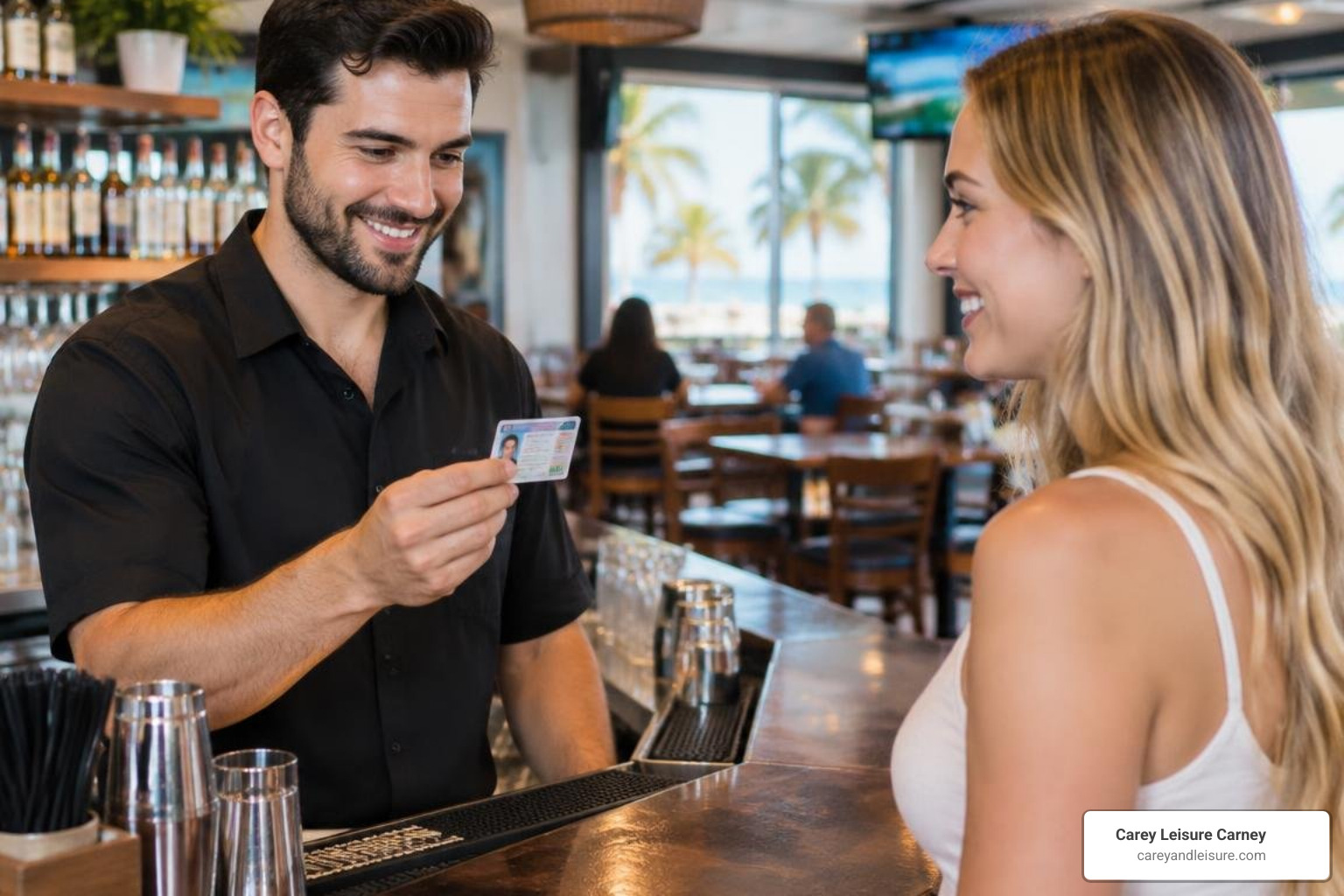
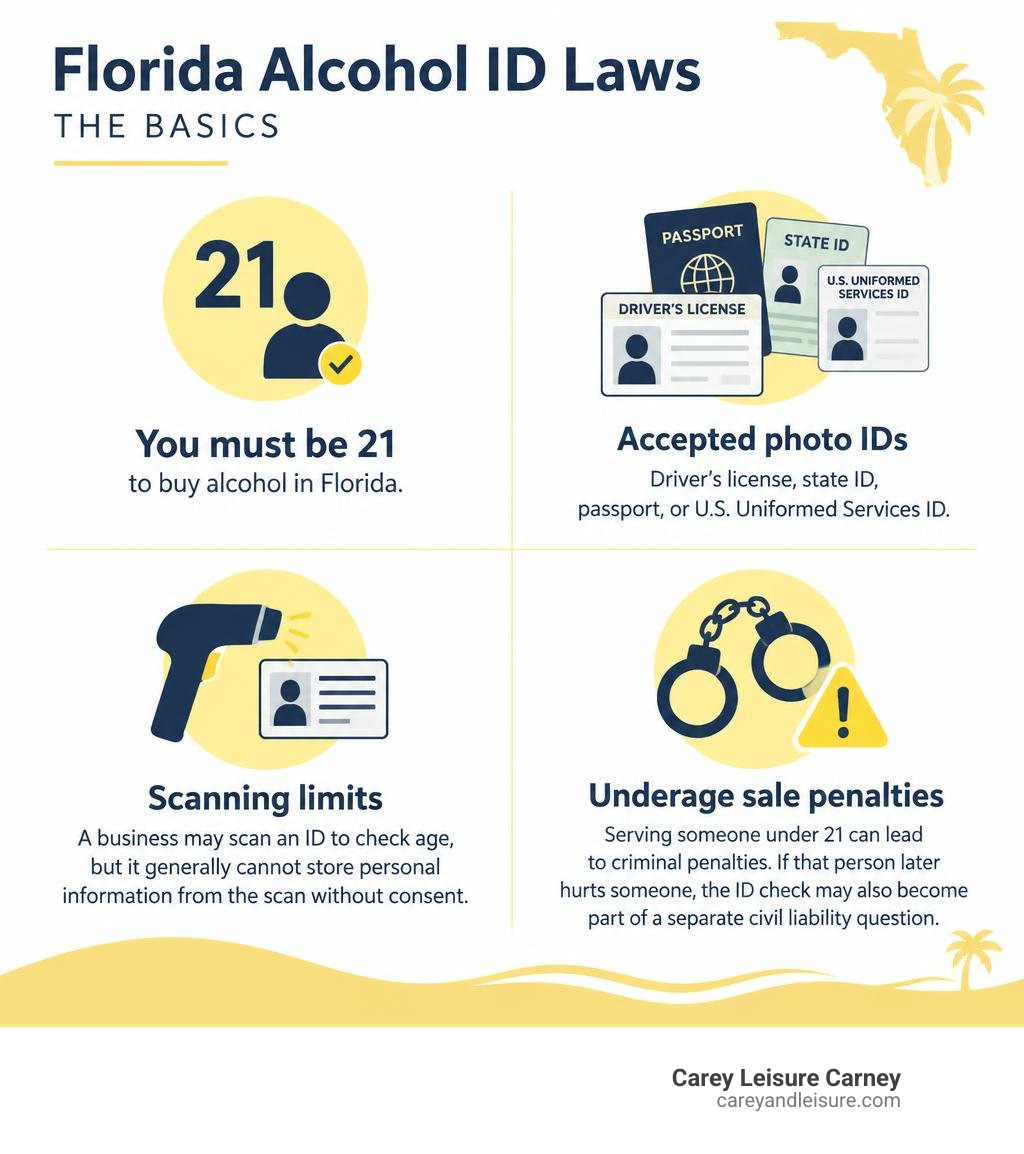
You must be 21 to buy alcohol in Florida. Sellers should check a patron’s photo ID, such as a driver’s license, state ID, passport, or U.S. Uniformed Services ID, and make sure the photo matches the person. A business may scan an ID to check age, but it generally cannot store personal information from the scan without consent.
Serving someone under 21 can lead to criminal penalties. If that person later hurts someone, the ID check may also become part of a separate civil liability question.
I’m Thomas W. Carey, founder of Carey Leisure Carney and a civil trial lawyer who has handled DUI injury cases and worked with anti-drunk-driving groups. That experience shapes how I explain Florida alcohol ID laws: start with the rules, then look closely at what happened when someone was harmed.
Easy florida alcohol id laws glossary:
Understanding Florida Alcohol ID Laws and Legal Verification
Under Florida Statute 562.11, selling, giving, or serving alcoholic beverages to anyone under 21 years of age is strictly illegal across the state. Whether you are running a beachfront bar in Clearwater or grabbing dinner in St. Petersburg, the legal drinking age remains an absolute threshold.
When an employee or establishment sells alcohol to an underage patron, the state treats the first offense as a second-degree misdemeanor. Under Florida sentencing guidelines, that can bring up to 60 days in jail and a $500 fine. If a second violation happens within one year of the first, the charge steps up to a first-degree misdemeanor, which carries penalties of up to one year in jail and a $1,000 fine.
Beyond criminal charges against individual servers, licensed businesses face administrative fines, license suspensions, and revocations from the Florida Department of Business and Professional Regulation (DBPR). For an everyday breakdown of these baseline rules, review our practical legal guide to Florida drinking rules.
Acceptable Forms of Identification Under Florida Alcohol ID Laws
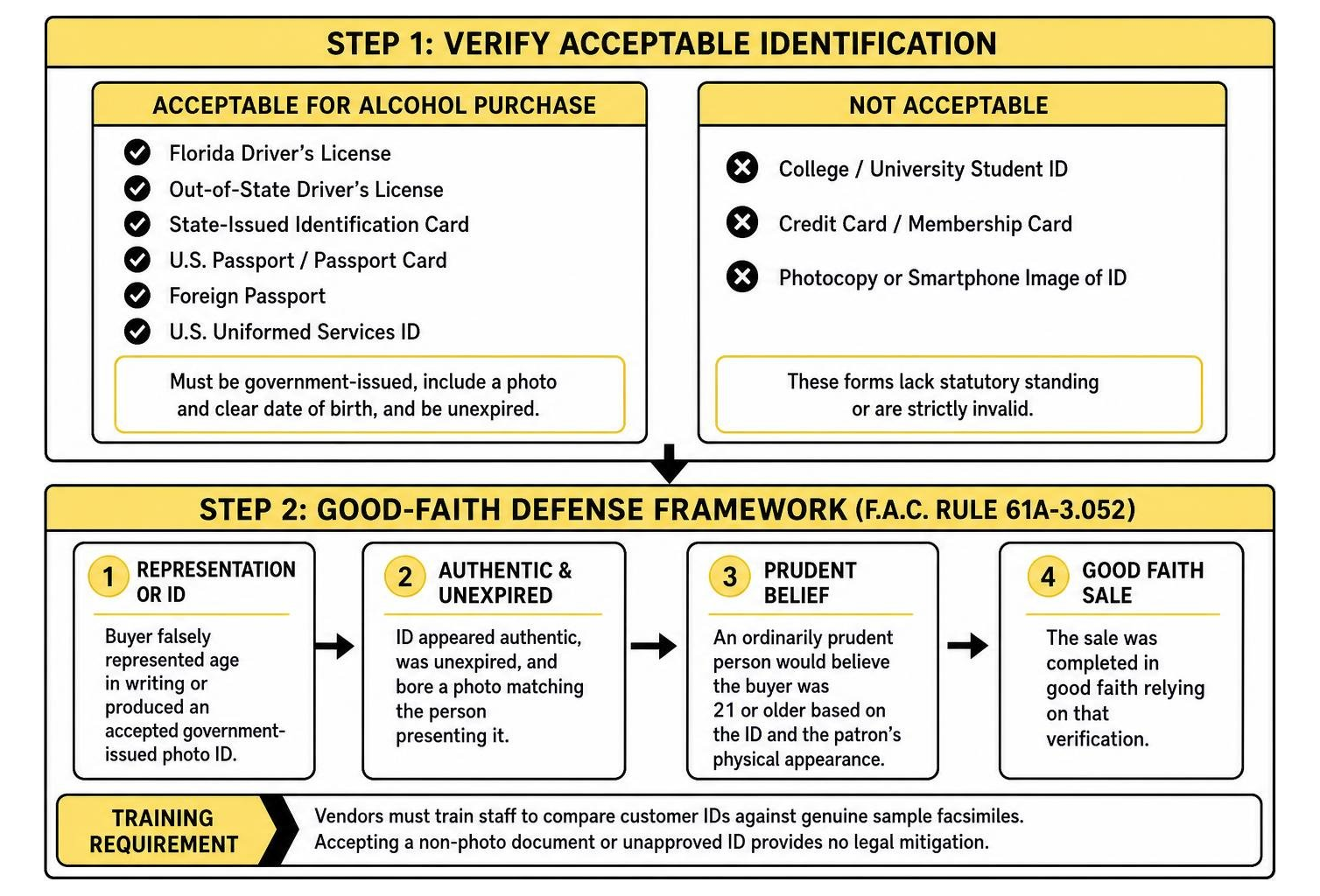
Florida sets clear, firm boundaries on what documents prove legal age for alcohol sales. Not every piece of plastic with a birthdate passes muster. State law requires government-issued identification that includes a photograph and clear date of birth.
Under state verification standards and Florida Statute 322.051, standard identification documents issued to adults over 15 generally expire on their eighth birthday following issuance, while minor IDs expire after four years. Servers must check these expiration dates carefully.
| Identification Type | Valid for Alcohol Purchase? | Requirements & Notes |
|---|---|---|
| Florida Driver’s License | Yes | Must be unexpired and feature a clear photograph. |
| Out-of-State Driver’s License | Yes | Must be government-issued, current, and photo-bearing. |
| State-Issued Identification Card | Yes | Issued by Florida DHSMV or another state authority with photo. |
| U.S. Passport / Passport Card | Yes | Must be valid and issued by the U.S. Department of State. |
| Foreign Passport | Yes | Must be unexpired with photo and birthdate. |
| U.S. Uniformed Services ID | Yes | Must show active duty, reserve, retired, or dependent status. |
| College / University Student ID | No | Lacks statutory standing for age verification under state law. |
| Credit Card / Membership Card | No | Unacceptable regardless of photo or name match. |
| Photocopy or Smartphone Image of ID | No | Digital photos or physical copies are strictly invalid. |
The Good-Faith Defense and F.A.C. Rule 61A-3.052
What happens if an underage patron uses a sophisticated counterfeit ID to purchase a drink? Florida law provides an affirmative defense for vendors, but only if they meet rigid statutory criteria.
Under Florida Administrative Code Rule 61A-3.052, a licensee or employee charged with an administrative violation can assert a defense if:
- The buyer falsely represented their age in writing or produced an accepted government-issued photo ID.
- The ID appeared authentic, was unexpired, and bore a photo matching the person presenting it.
- An ordinarily prudent person inspecting the ID and the patron’s physical appearance would believe the buyer was 21 or older.
- The sale was completed in good faith relying on that verification.
Rule 61A-3.052 also makes it clear that vendors must train their staff to compare customer identification against genuine sample facsimiles. If a clerk accepts a non-photo document or an unapproved form of ID, administrative bodies will not accept it as legal mitigation.
ID Scanning Regulations and Privacy Protections in Florida
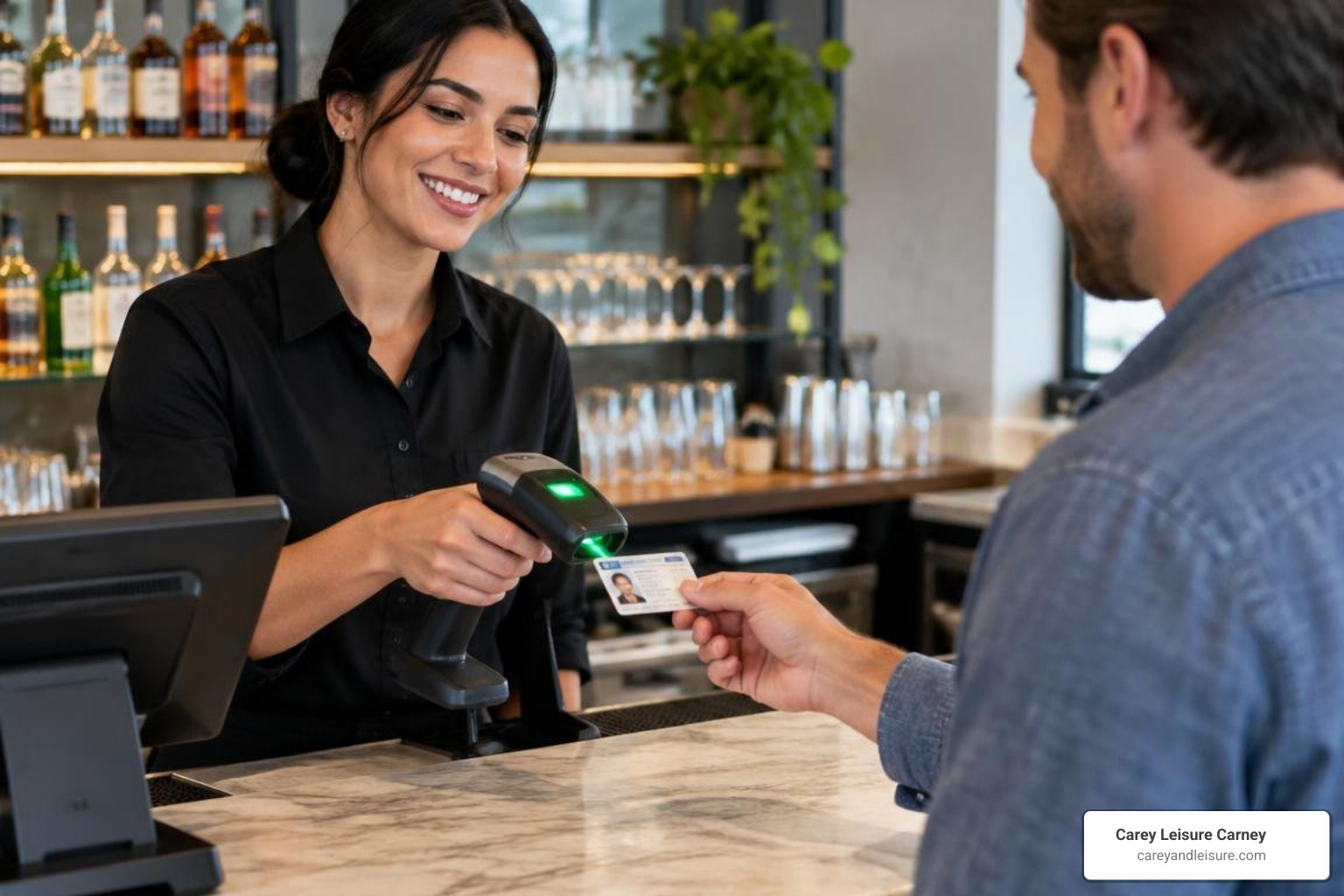
Modern hospitality venues in Largo and Wesley Chapel often rely on digital scanners at door entrances and cash registers. When a vendor fails to screen patrons properly, the liability when a minor is served alcohol can extend far beyond simple administrative citations into serious civil claims.
Electronic Verification and Scanning Under Florida Alcohol ID Laws
Florida Statute 322.143 permits businesses to scan the magnetic strip or barcode of a driver’s license or identification card to verify age for purchasing age-restricted products like alcohol and tobacco.
However, technology is not an absolute shield. Barcode readers verify the encoded data on the document’s back, but they cannot tell you whether a 19-year-old borrowed their 22-year-old sibling’s genuine license. For that reason, digital scanning tools must accompany physical document inspection, surface feature checks, and visual comparison of the customer’s face against the photo.
Data Storage Restrictions and Patron Privacy
While Florida allows businesses to swipe or scan an ID for age checks, it places strict limits on what happens to that data under Florida Statute 322.143.
- No Retaining Personal Identifying Information: A business cannot compile, store, sell, or share a customer’s name, residential address, driver’s license number, or exact date of birth obtained from an ID scan.
- Allowed Scan Outcomes: Venues may record non-identifying transaction data, such as confirming that a scan occurred, the date and time, and whether the age check passed.
- Consent Exceptions: A business may only retain personal data if the customer gives clear, affirmative consent after receiving written disclosure explaining exactly what data is collected and why.
Venues that run electronic scanners must configure their hardware to discard personal identifiers immediately after displaying the age verification result.
Underage Possession, Misrepresentation, and Key Statutory Exceptions
Under Florida Statute 562.111, it is unlawful for any person under the age of 21 to have alcoholic beverages in their possession.
A first-time underage possession charge is a second-degree misdemeanor, carrying fines and possible court supervision. A second offense elevates to a first-degree misdemeanor. In addition to criminal penalties, Florida courts routinely suspend the driver’s license of any minor convicted of illegal alcohol possession or attempting to buy alcohol with a fake ID.
The Christopher Fugate Act and Under-21 Employment
Florida Statute 562.11 includes provisions often referred to as the Christopher Fugate Act. These rules regulate situations where licensees employ workers who are under 21 years old.
While Florida allows employees aged 18 and older to work in licensed establishments—such as waiting tables, handling unopened containers in grocery stores, or clearing glasses—underage workers cannot consume alcoholic beverages on the premises. If a licensee serves, provides, or allows an underage employee to consume alcohol on duty or on the licensed property, the offense is charged as a first-degree misdemeanor.
Postsecondary Educational Tasting Exemptions

Florida law carves out a narrow, strictly regulated exception for postsecondary students enrolled in accredited culinary arts, hospitality, or fermentation programs.
Under Florida Statute 562.111, students who are at least 18 years old may taste—but not ingest or consume—alcoholic beverages as part of an official curriculum requirement. The course must be offered by an accredited public or private postsecondary institution, and all tastings must occur under the direct supervision of an instructor who is at least 21 years old. The alcohol must remain in the control of the instructional staff, and students are required to discard or spit the product rather than drink it.
Open Container Violations and Alcohol Liability in Florida
Open container rules work hand in hand with age verification laws to maintain safety across Florida communities. Under Florida Statute 316.1936, having an unsealed or open alcoholic container in a motor vehicle is prohibited for both drivers and passengers.
Drivers face moving traffic infractions with points assessed against their driving record, while passengers face non-moving civil penalties. However, Florida allows a specific exception: patrons dining at licensed restaurants may transport a partially consumed, properly resealed bottle of wine off-site, provided the bottle is securely placed in a locked trunk or locked glove compartment away from vehicle occupants.
Local municipalities in places like New Port Richey, Spring Hill, and Trinity enforce their own municipal open container ordinances on public sidewalks, beaches, and parks. Unlawful alcohol service and open consumption frequently intersect with Florida open container regulations and civil liability for bars serving intoxicated patrons.
Frequently Asked Questions About Florida Alcohol ID Laws
Can a Florida business save customer data after scanning an ID?
No. Under Florida Statute 322.143, businesses are prohibited from storing, selling, or sharing personal information retrieved from an ID scan unless the customer provides explicit, informed consent. Establishments may only retain the transaction timestamp and pass/fail verification result.
What is the penalty for serving alcohol to a minor in Florida?
Serving alcohol to an underage individual is a second-degree misdemeanor punishable by up to 60 days in jail and a $500 fine. A second violation within one year becomes a first-degree misdemeanor, carrying up to one year in jail, alongside severe administrative license suspensions from state regulators.
Are students allowed to taste alcohol in Florida culinary classes?
Yes, but only under specific statutory guidelines. Students must be at least 18 years old, enrolled in an accredited postsecondary program, and supervised by an instructor aged 21 or older. The curriculum permits tasting for sensory evaluation without swallowing.
Conclusion
Understanding state alcohol identification statutes protects business owners, service workers, and patrons across Florida. From recognizing valid photo credentials to complying with data privacy and employee restrictions, following the law keeps local communities safe from preventable harm.
If you or a loved one has suffered injuries in an alcohol-related incident or drunk driving crash, our team at Carey Leisure Carney is here to help. Based in Clearwater and serving clients across Largo, New Port Richey, Spring Hill, St. Petersburg, Trinity, and Wesley Chapel, our Board-Certified trial lawyers bring over 100 years of combined experience to every case. Explore our comprehensive guide to Florida alcohol laws or reach out to our team today for a free consultation.