
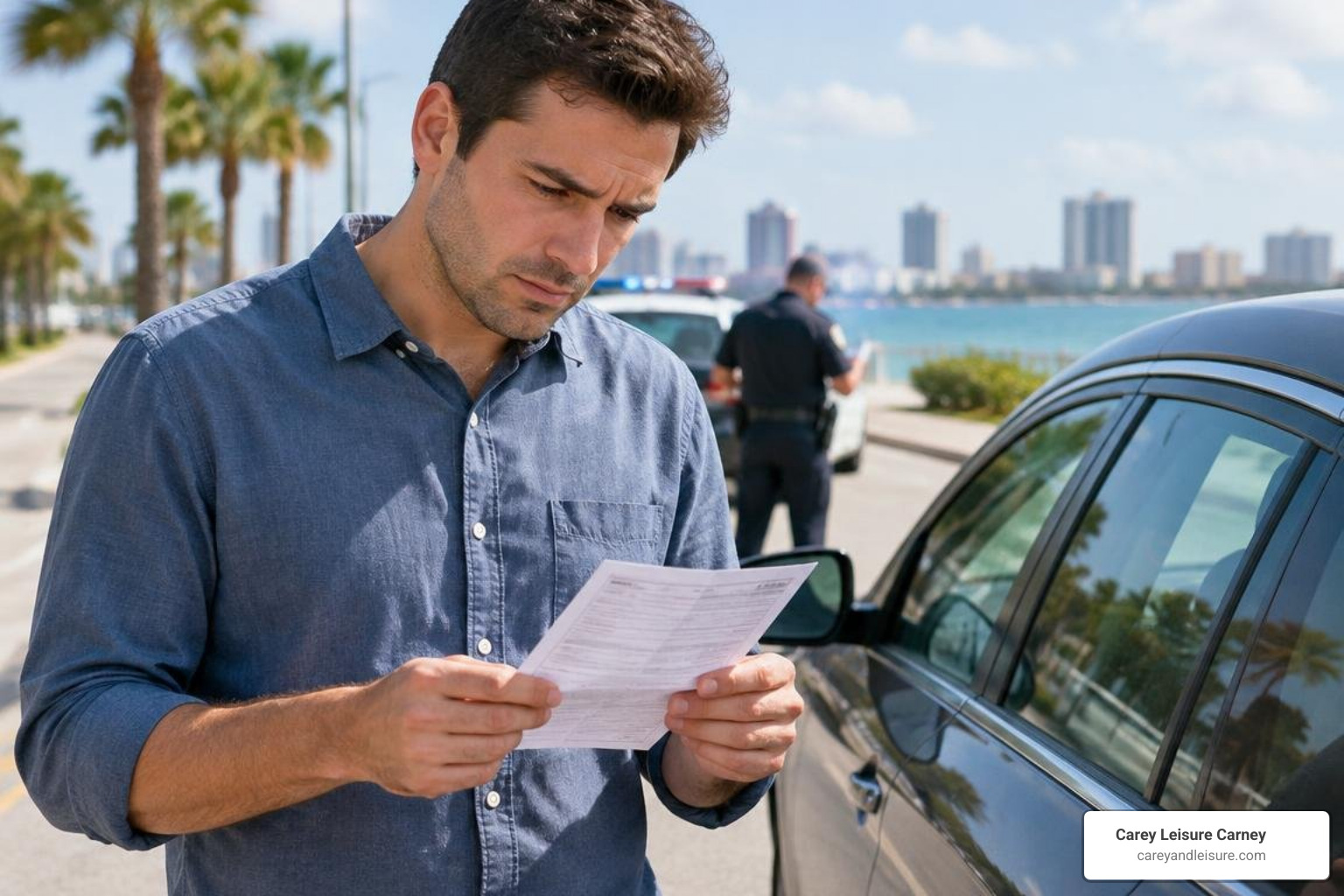
Find the Right Drunk Driving Lawyer Near You
If you’re searching for drunk driving lawyers near me after an arrest in Clearwater, look for a Florida criminal-defense attorney who regularly handles DUI cases in Pinellas County. Check their Florida Bar standing, ask about similar cases and fees, and act quickly: you generally have 10 days after receiving a suspension notice to request a formal review of your driving privileges.
If a drunk driver injured you, you need a different kind of help. A personal-injury lawyer can pursue compensation for your losses; that claim is separate from the driver’s criminal case.
I’m Thomas W. Carey, founding partner of Carey Leisure Carney and a board-certified civil trial lawyer whose wife was killed by a drunk driver. When people search for drunk driving lawyers near me, I want them to find the right help: our Clearwater firm represents people injured by drunk drivers, not drivers facing DUI charges.
Drunk driving lawyers near me vocab to learn:
How to find drunk driving lawyers near me in Clearwater, Florida
A DUI arrest feels like your whole life is on pause. The good news is that you don’t need to find a perfect lawyer in one panicked evening. You need a qualified one, and a short, calm search will get you there.
Local experience matters more than many people expect. A lawyer who works in the Pinellas County courts regularly knows how local prosecutors approach plea offers, how judges handle motions, and how arresting officers tend to testify. That kind of familiarity is hard to learn from a website.

How to search for drunk driving lawyers near me in Clearwater
Start with a few simple filters:
- Florida Bar standing. Confirm the attorney is licensed and in good standing, and look at any disciplinary history on The Florida Bar’s website. A very minor issue in the past may not matter. A serious one is a red flag.
- DUI case experience. Ask how many DUI cases they handle each year and whether they’ve handled cases like yours, such as a first offense, a refusal, a drug-related charge, or a crash with injuries.
- Local court familiarity. Look for someone who regularly appears in Clearwater and Pinellas County courtrooms.
- Specialized credentials. The National College for DUI Defense attorney directory lets you search by city, state, or ZIP code. That a listing alone doesn’t prove special competence. Board certification in DUI defense is the stronger signal, so verify any claims yourself.
Former prosecutors can be a real asset. They often understand how the other side builds a case, and that insight can help in negotiations.
Questions to ask drunk driving lawyers near me
Most DUI lawyers offer a free or low-cost first meeting. Meet with two or three if you can, and bring a list. Good questions include:
- Have you handled cases like mine, and how did they turn out?
- What range of outcomes is realistic here, and why?
- Do you take cases to trial, or do you mostly negotiate pleas?
- How are your fees structured (hourly or flat), and how much is the retainer? Is any unused portion refundable?
- Who will actually work on my case, and how often will you update me?
- Have you faced any bar discipline?
Listen to how they answer. A strong lawyer explains things in plain language and is honest about risks. Be wary of anyone who guarantees a result, since no ethical attorney can. Reviews can help too, but vague ones that are either furious or glowing without details deserve a grain of salt. For more on this process, see guidance on vetting and consulting DUI attorneys.
Compare private counsel and a public defender
If you can’t afford a lawyer, you have a constitutional right to one. A judge can appoint a public defender if you qualify as indigent. Public defenders are hardworking, but they often carry heavy caseloads. A private attorney may have more time to dig into your evidence.
| Factor | Private DUI attorney | Public defender |
|---|---|---|
| Eligibility | Anyone who can pay | Must qualify as indigent |
| Choosing your lawyer | You pick | Court assigns |
| Caseload | Usually smaller | Often very large |
| Cost | Retainer or flat/hourly fee | Low or no cost, based on eligibility |
| Time for investigation | Typically more flexibility | Often limited by resources |
If money is tight, ask private lawyers about payment plans before you rule them out.
What to do immediately after a Florida DUI arrest
The first hours matter. Here’s a simple game plan:
- Stay calm and be polite. Arguing never helps.
- Identify yourself. Provide your license, registration, and insurance, then politely decline to discuss your drinking or where you were going. You can say you’d like to speak with a lawyer.
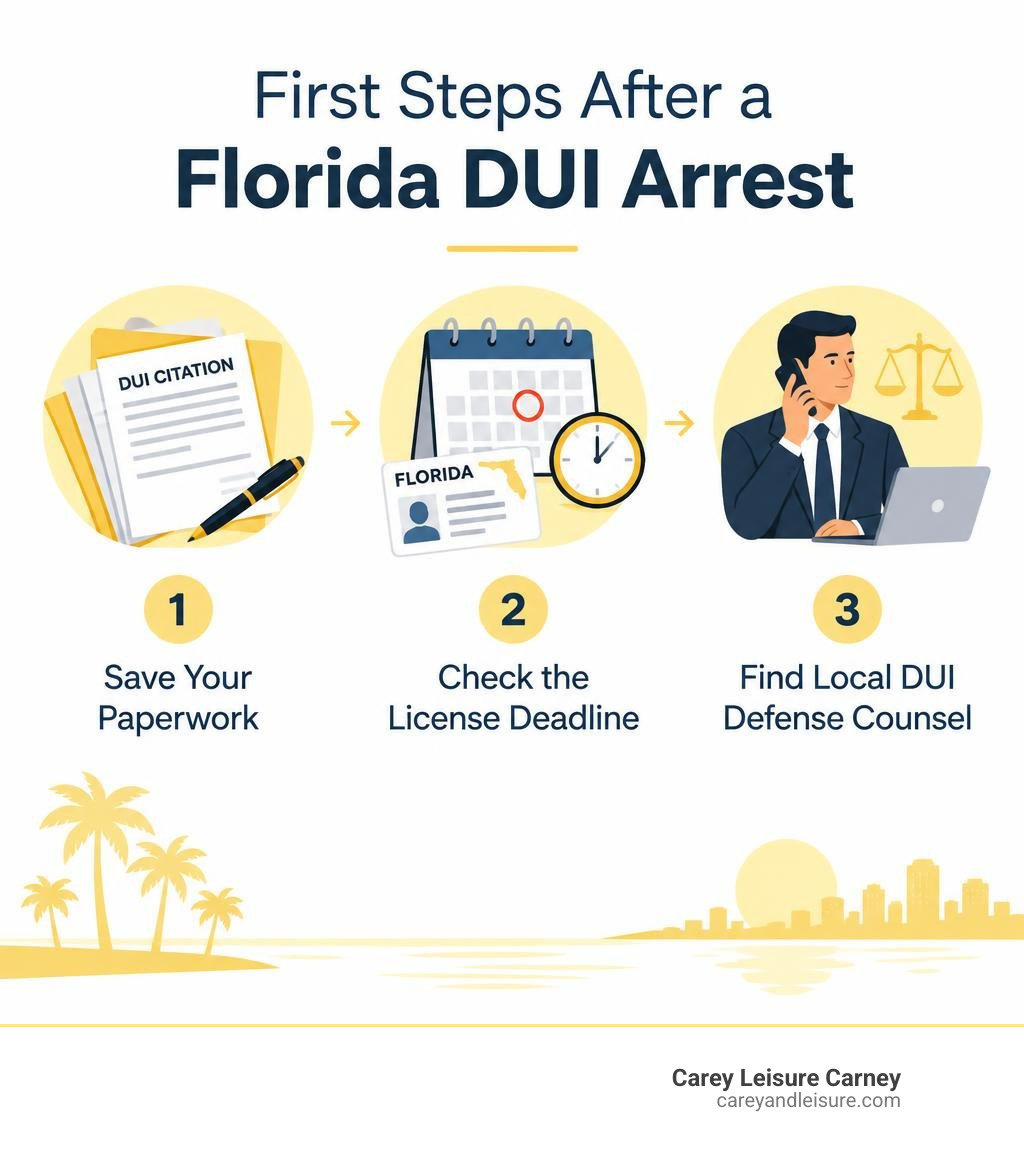
- Save every piece of paper. That includes the citation, the notice of suspension, bond paperwork, and property receipts.
- Write down what you remember. Note where you were, what you ate and drank and when, how the stop unfolded, what tests were given, and what the road and weather were like. Memory fades fast.
- Call a DUI defense attorney within a day or so.
- Mark your license deadline. In Florida, the clock for challenging your administrative suspension is short, about 10 days. The Florida Highway Safety and Motor Vehicles overview of DUI administrative suspension explains how it works.
Protect your driving privileges
A Florida DUI usually starts two separate proceedings, and people often confuse them.
- The administrative case is about your license. If you blow over the limit or refuse testing, the arresting officer typically takes your license and issues a temporary permit. You can request a formal review hearing within the short deadline to challenge the suspension.
- The criminal case is about guilt, fines, jail, and probation. It moves on its own timeline in court.
You can win one and lose the other. Missing the license deadline can mean automatic suspension even if your criminal case later goes well. Depending on your situation, you may be eligible for restricted driving privileges, so ask your attorney. Refusing a breath or blood test brings its own suspension, which we cover in the FAQ below.
Understand Florida DUI terms and penalties
Florida uses the term DUI. Other states use DWI, OWI, or OUI, and they all describe essentially the same thing: operating a vehicle while impaired by alcohol, drugs, or both. In Florida, you can face a charge at a blood alcohol level of 0.08 percent or higher, and lower limits apply to commercial drivers (0.04) and drivers under 21 (0.02). You can also be charged below those numbers if officers believe you were impaired. Prescription medication counts too, even if you take it legally.
Penalties grow with each offense and can include:
- Fines and court costs
- Jail time
- Probation and community service
- Driver’s license suspension or revocation
- DUI school and substance evaluation
- An ignition interlock device
- Vehicle impoundment
The ripple effects go beyond the courtroom. A CDL holder can lose their livelihood. Some professional licenses and jobs require disclosure. Insurance rates can jump, and an SR-22 filing may be required. One estimate puts the total cost of a first DUI conviction, with fines, fees, and insurance, at more than $10,000. Meanwhile, roughly 1.02 million DUI arrests happen in the U.S. every year, so you’re far from alone.
Separate criminal defense from an injury claim
Here’s where we come in. A DUI defense lawyer protects the person accused. If you were hurt by a drunk driver, you have a different path: a civil claim against the driver, and sometimes others, for medical bills, lost income, and pain and suffering. The driver’s criminal case does not decide your compensation.
Our firm focuses on that second path. If this is your situation, our guides on drunk driving accident claims and legal options after being hit by a drunk driver walk you through what to expect.
How to evaluate a DUI lawyer and understand possible defenses
Once you’ve narrowed your list, look at how each lawyer thinks. The best ones can explain a plan, not just a price. Pay attention to:
- Case-specific experience: drug DUIs, crash cases, refusals, and commercial licenses each have their own wrinkles.
- Florida procedure: they should know both the license process and the criminal process cold.
- Credentials: Florida Bar standing, professional memberships, and any board certification.
- Realistic advice: honest odds beat big promises every time.
- A clear fee agreement: get it in writing, with what’s included and what isn’t.
Review test and stop evidence
A DUI case is built from pieces of evidence, and each piece can be tested. A good defense attorney will look at:
- The traffic stop. Did the officer have a lawful reason to pull you over? Without it, evidence may be thrown out.
- Probable cause for arrest. Did the officer’s observations support an arrest?
- Field sobriety tests. These are subjective, and results can be affected by nerves, footwear, uneven pavement, weather, lighting, medical conditions, or an officer who didn’t follow standard instructions. Many people are told they performed poorly even when they were fine.
- Breath tests. Machines need proper maintenance, calibration, and a trained operator, and a lawyer can request those records. Certain conditions, like acid reflux, can raise concerns about accuracy.
- Blood tests. The questions here are chain of custody, how the sample was drawn, stored, and handled, and the lab’s methods.
- Video evidence. Dash cam and body cam footage can show you walking, talking, and acting normally, which can undercut a number on a machine.
- Rising BAC. Alcohol takes time to absorb. Your level when you were driving could have been lower than when you were tested later.
Ask about reductions, dismissals, and case strategy
Many DUI cases are not as locked-in as they feel. One industry estimate suggests that 30 to 40 percent of cases are reduced or dismissed with experienced representation, but every case is different and nobody can promise your result. Ask your lawyer how they’d approach:
- Evidence review: getting video, records, and lab files before deciding anything.
- Suppression motions: asking the court to exclude evidence from an unlawful stop or arrest.
- Plea negotiation: sometimes a reduced charge is the smartest outcome, and sometimes it isn’t.
- Trial readiness: prosecutors notice when a lawyer is genuinely willing to go to trial.
- Diversion eligibility: some first-time situations may qualify for alternatives, depending on the facts and the charge.
Ask them, too, where the case is weak. A lawyer who can name the risks is more trustworthy than one who says it will be easy. For background on how Florida treats alcohol-related conduct, see our overview of Florida alcohol laws.
Frequently asked questions about finding a DUI lawyer
Here are quick answers to common questions about the Florida DUI process, local legal help, and your license. These are general explanations, not legal advice, so confirm details with a Florida DUI defense attorney.
What penalties can follow a first, second, or third DUI in Florida?
Penalties rise with prior offenses. Florida counts earlier convictions within certain lookback periods, so the dates of your prior cases matter a lot.
- First offense: typically a misdemeanor, with fines, possible jail, probation, community service, DUI school, and a license suspension or revocation. A very high BAC or a minor in the car can increase the penalties.
- Second offense: higher fines, longer possible jail time, a longer license revocation, and an ignition interlock device. A second offense soon after the first can carry mandatory jail time.
- Third offense: can become a felony, depending on how close your earlier convictions are, with possible prison exposure and a very long revocation.
Case-specific factors, like a crash, an injury, or a high BAC, can change everything. Your lawyer can tell you which category you actually fall into.
What happens if I refuse a breath or blood test, and how soon should I act?
Florida has an implied consent law: by driving, you agree to lawful testing after a DUI arrest. Refusing usually triggers an administrative license suspension, and a prior refusal can make a later one worse. Prosecutors may also mention the refusal in court. Even so, the refusal doesn’t end your case, and there may be ways to challenge it.
Timing is the key. You generally have about 10 days to request a formal review hearing, so talk to an attorney right away.
Can DUI test results or charges be challenged?
Yes. Attorneys commonly look at whether the stop was legal, whether the officer followed proper testing procedures, whether the breath machine’s records check out, how the blood sample was handled, and whether field sobriety tests were given correctly. Outcomes vary, and some cases do end in conviction. A thorough review tells you where you stand.
Conclusion
Facing a DUI is stressful, but you can take control with a few smart moves. Act promptly, especially on your license deadline. Compare a few qualified local attorneys instead of grabbing the first ad. Ask hard questions about experience, fees, and strategy. And remember that fighting a criminal charge and recovering from an injury are two very different jobs.
At Carey Leisure Carney, we’re a Clearwater personal injury firm, and our board-certified attorneys help people hurt in crashes caused by drunk drivers. We don’t defend DUI charges, but we’re glad to point you toward the right kind of help. If you want to understand how Florida treats alcohol-related conduct, our page on Florida alcohol laws and DUI-related information is a good next stop. And if a drunk driver hurt you or someone you love, reach out to us. We’ll be on your side.