
Top Rated DUI Defense Attorneys and How They Beat Strict Charges
How DUI Defense Attorneys Protect Your License and Future in Florida
After a Florida DUI arrest, act fast: request a DHSMV formal review hearing within 10 days, avoid discussing the facts of the case without legal advice, and preserve documents, video, and other evidence. Skilled dui defense attorneys handle both tracks of the case: the criminal charge in court and the separate administrative action that can suspend your driving privilege.
A strong defense may challenge the traffic stop, field sobriety exercises, breath-test procedures, blood testing, or whether police had lawful grounds for the arrest. The right approach depends on the evidence, but waiting can cost someone the chance to fight for their license.
I am Thomas W. Carey, founding partner of Carey Leisure Carney and a board-certified civil trial lawyer with decades of experience in Florida DUI-related injury and wrongful-death litigation. That work has shown me why people facing DUI allegations need informed DUI defense attorneys who understand the serious legal and personal stakes.
Understanding the Dual-Track Florida DUI System: Criminal Court vs. DHSMV

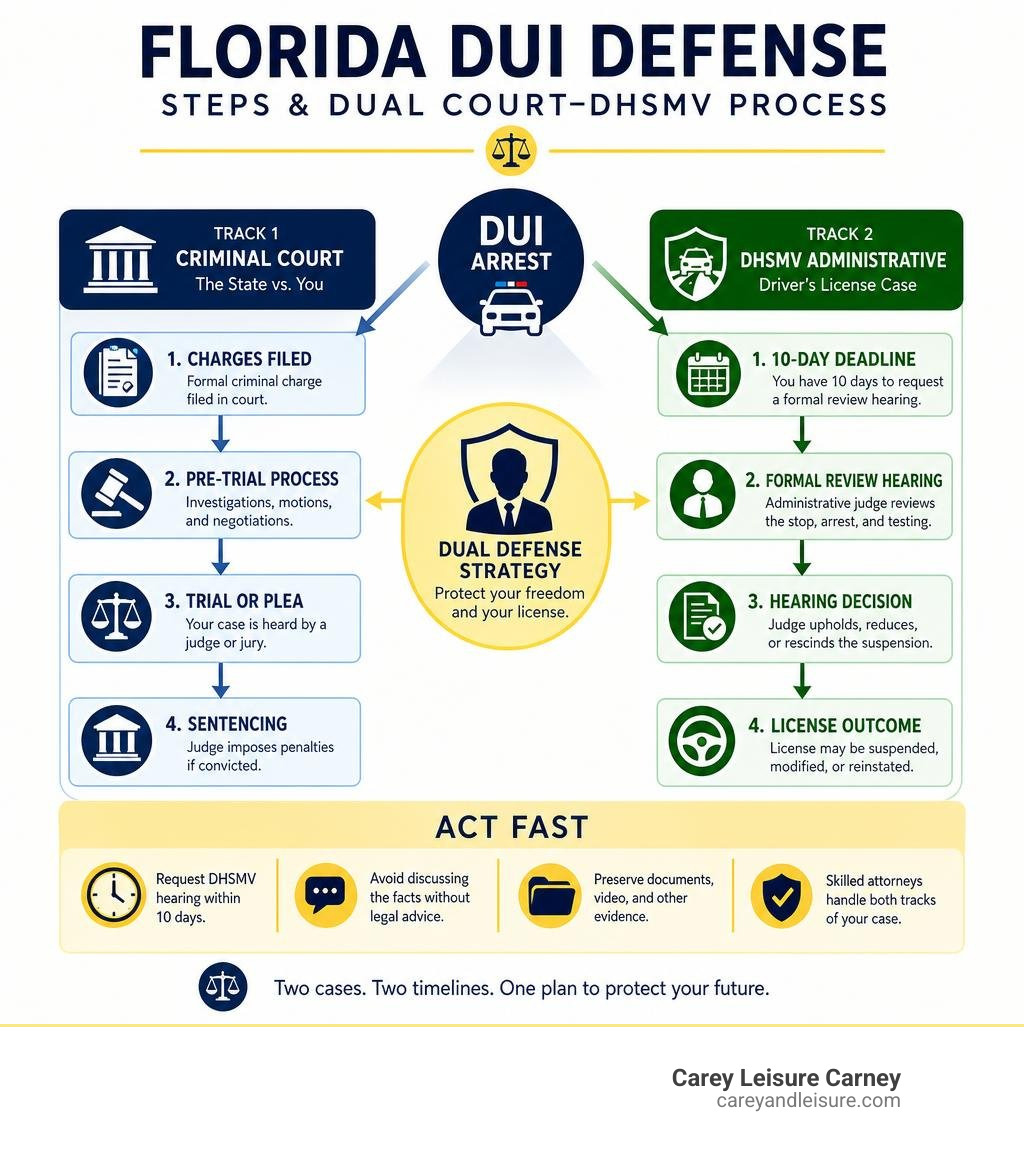
A drunk driving arrest in Pinellas County or Pasco County does not simply initiate a single legal case. Instead, it triggers two entirely separate legal proceedings running on independent timelines. The first track is the criminal prosecution handled by the State Attorney’s Office in county or circuit court, where judges impose statutory penalties like probation, fines, or jail time. The second track is an immediate administrative action governed by the Florida Department of Highway Safety and Motor Vehicles (DHSMV) Bureau of Administrative Reviews, which targets your driver’s license.
To properly navigate this complex landscape, it is helpful to understand duidwi what you need to know about impaired driving and how civil administrative suspensions interact with courtroom litigation. While the criminal court case determines guilt or innocence through formal arraignment, pre-trial motions, and potential jury trials, the DHSMV process moves rapidly toward an automatic suspension regardless of your criminal court outcome. Hardship license eligibility and temporary driving permits must be secured through the DHSMV early, or a driver faces complete loss of driving privileges before ever seeing a judge.
The 10-Day Rule and Saving Driving Privileges
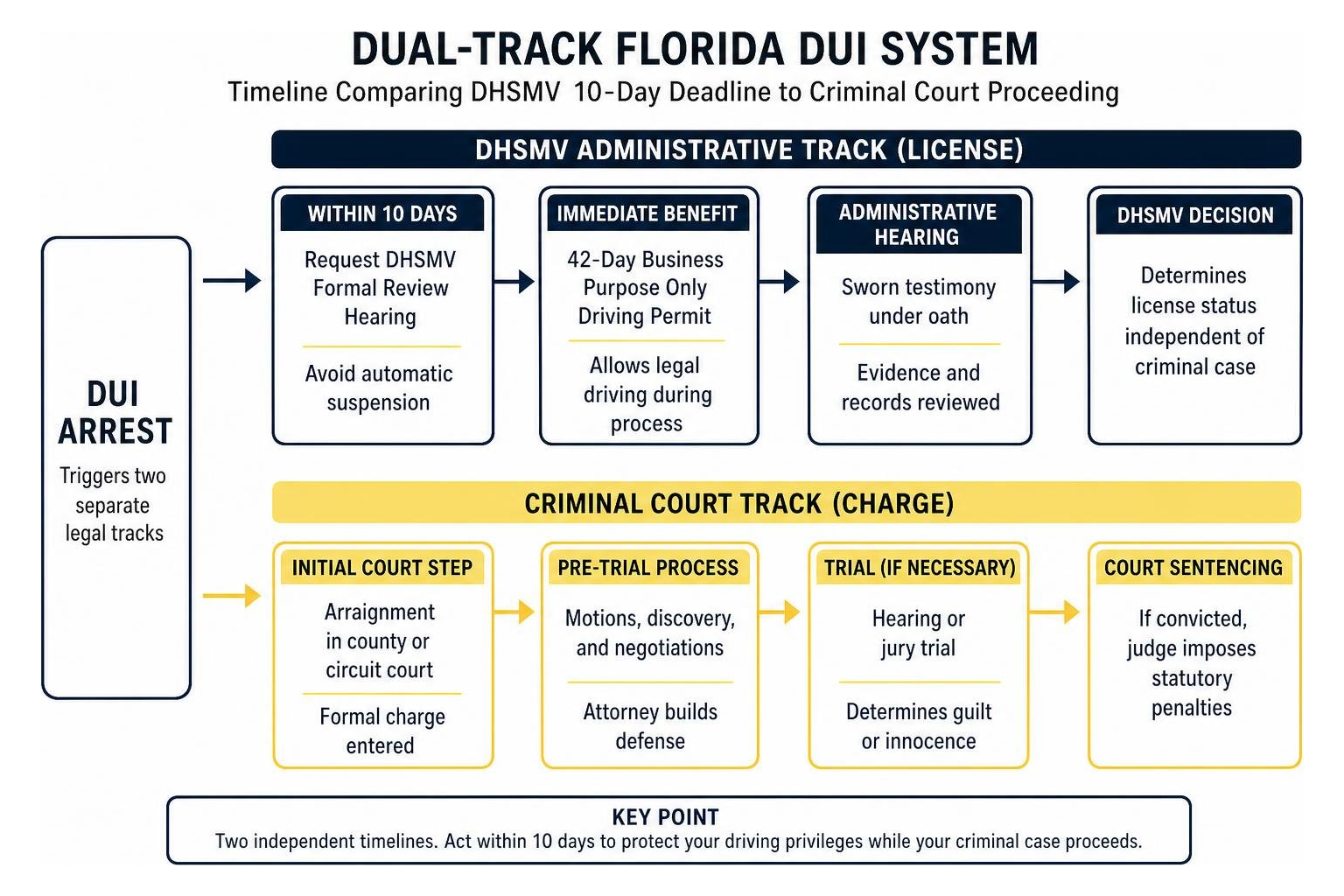
Under Florida law, a driver has exactly 10 calendar days from the date of arrest to challenge the administrative suspension of their license. If you fail to act within this narrow statutory window, your license is automatically suspended on day 11, leaving you unable to drive to work, school, or medical appointments.
By formally requesting a DHSMV Formal Review Hearing within these first 10 days, your attorney can secure an immediate 42-day business purpose driving permit (BPO). Beyond keeping you legally on the road, this administrative hearing serves as an invaluable discovery tool. Your lawyer can issue administrative subpoenas to force the arresting officers, breath technicians, and agency inspectors to provide sworn testimony under oath. This locks in law enforcement statements early, uncovers evidentiary flaws, and preserves crucial video and calibration logs long before criminal prosecutors finalize their formal discovery.
Florida DUI Penalties for First and Repeat Offenses
The statutory consequences of a DUI conviction in Florida escalate sharply based on prior offenses, blood alcohol concentration (BAC), and whether property damage or injuries occurred.
| Offense Level | Jail Time | Statutory Fines | License Revocation | Ignition Interlock Device (IID) |
|---|---|---|---|---|
| 1st Offense (BAC < 0.15) | Up to 6 months | $500 – $1,000 | 6 to 12 months | Discretionary (Up to 6 mos.) |
| 1st Offense (BAC ≥ 0.15 or Minor) | Up to 9 months | $1,000 – $2,000 | 6 to 12 months | Mandatory (Min. 6 months) |
| 2nd Offense (Within 5 Years) | Up to 9 mos. (10 days mandatory) | $1,000 – $2,000 | Mandatory 5 years | Mandatory (Min. 1 year) |
| 2nd Offense (Outside 5 Years) | Up to 9 months | $1,000 – $2,000 | 6 to 12 months | Mandatory (Min. 1 year) |
| 3rd Offense (Within 10 Years – Felony) | Up to 5 yrs (30 days mandatory) | $2,000 – $5,000 | Mandatory 10 years | Mandatory (Min. 2 years) |
| 3rd Offense (Outside 10 Years – Misdemeanor) | Up to 12 months | $2,000 – $5,000 | 6 to 12 months | Mandatory (Min. 2 years) |
| 4th or Subsequent Offense (Felony) | Up to 5 years | Min. $2,000 – $5,000 | Permanent Revocation | Mandatory (Min. 5 years) |
In addition to statutory fines and jail terms, first-time misdemeanor convictions require a minimum of 50 hours of community service (or a buyout where permitted), up to 12 months of reporting probation, mandatory completion of a certified DUI education course, a 10-day vehicle impoundment, and a psychosocial evaluation for substance abuse treatment.
Proven Strategies Used by Top DUI Defense Attorneys to Win Cases

A DUI charge is an accusation, not a final conviction. Seasoned legal counsel conducts a comprehensive investigation into every phase of the police encounter. The first line of defense rests on the Fourth Amendment of the U.S. Constitution.
Law enforcement officers cannot pull over a vehicle on a mere hunch. They must possess articulable reasonable suspicion that a traffic infraction or criminal activity occurred. If an officer stops a driver in Clearwater, Largo, or St. Petersburg solely for momentary tire contact with an inner lane line without erratic driving, defense counsel files a formal Motion to Suppress. If the court finds the initial stop unlawful, all subsequent evidence—including roadside statements, field sobriety tests, and chemical readings—is ruled inadmissible, which frequently leads to an outright dismissal of the case.
How DUI Defense Attorneys Challenge Chemical and Breath Tests
Florida law enforcement agencies rely primarily on the Intoxilyzer 8000 for evidential breath testing. However, these instruments are complex scientific tools prone to mechanical, electrical, and human errors.
Attorneys challenge breath tests by auditing technical compliance under Florida Administrative Code Rule 11D-8. For instance, the arresting officer must maintain strict, continuous observation of the arrestee for at least 20 minutes before testing to ensure no burping, vomiting, or regurgitation introduces residual mouth alcohol into the test chamber. Furthermore, breath machines operate on an assumed standard 2100:1 blood-to-breath partition ratio, which does not reflect natural human biological variation.
For blood tests, defense strategies focus on chain-of-custody gaps, improper tube storage temperature, expiration dates of anti-coagulant preservatives, and gas chromatography testing protocols to challenge whether microbial fermentation generated alcohol within the blood vial post-draw.
Dismantling Field Sobriety Exercises and Drug DUI Evidence
Standardized Field Sobriety Tests (SFSTs)—including the Horizontal Gaze Nystagmus (HGN), Walk-and-Turn, and One-Leg Stand—are designed by the National Highway Traffic Safety Administration (NHTSA) to detect clues of impairment. However, officers often administer and score these tests unfairly under adverse roadside conditions.
Roadside exercises are inherently stacked against the driver:
- Environmental Obstacles: Uneven asphalt, passing traffic wind gusts, poor nighttime lighting, and cruiser strobe lights corrupt balance and gaze tracking.
- Physical Limitations: Pre-existing knee, back, or inner ear injuries, advanced age, obesity, and improper footwear can cause physical instability unrelated to alcohol.
- Subjective Officer Scoring: Officers count natural human nervousness and minor balance adjustments as signs of intoxication while ignoring flawless instruction compliance.
In drug-related DUI allegations, officers often deploy Drug Recognition Experts (DREs). Defense attorneys challenge DRE evaluations by showing that routine urine tests only reveal inactive metabolites stored in fat cells for days or weeks (especially cannabis) rather than active, psychoactive molecules causing real-time driving impairment.
When DUI Defense Attorneys Recommend Pretrial Diversion Programs
When the physical and chemical evidence gathered by the state appears formidable, an experienced lawyer evaluates whether you qualify for specialized pretrial diversion programs. In Florida’s Sixth Judicial Circuit (serving Pinellas and Pasco counties, including Clearwater, New Port Richey, and Trinity), eligible first-time offenders may enter the DROP (DUI Rehabilitation and Education Program).
DROP is structured across specific tiers based on BAC and aggravating circumstances:
- Tier 1: Available for lower BAC readings with no accident involved. Upon successful completion of DUI school, community service, a victim impact panel, and an ignition interlock period, prosecutors amend the charge down to reckless driving with a withhold of adjudication.
- Tier 2: Designed for higher BAC levels or cases with refusals, imposing stricter community control conditions while still allowing the driver to avoid a formal DUI conviction.
Securing entry into a diversion program prevents the mandatory lifetime criminal record that accompanies a Florida DUI adjudication.
Chemical Test Refusal, Implied Consent, and Trenton’s Law
Under Florida’s Implied Consent Law (Florida Statute 316.1932), any person who accepts the privilege of operating a motor vehicle in the state is deemed to have given consent to submit to an approved chemical test of their breath or urine if lawfully arrested for DUI.
Drivers frequently face the difficult decision of whether to submit to roadside or station-house chemical testing:
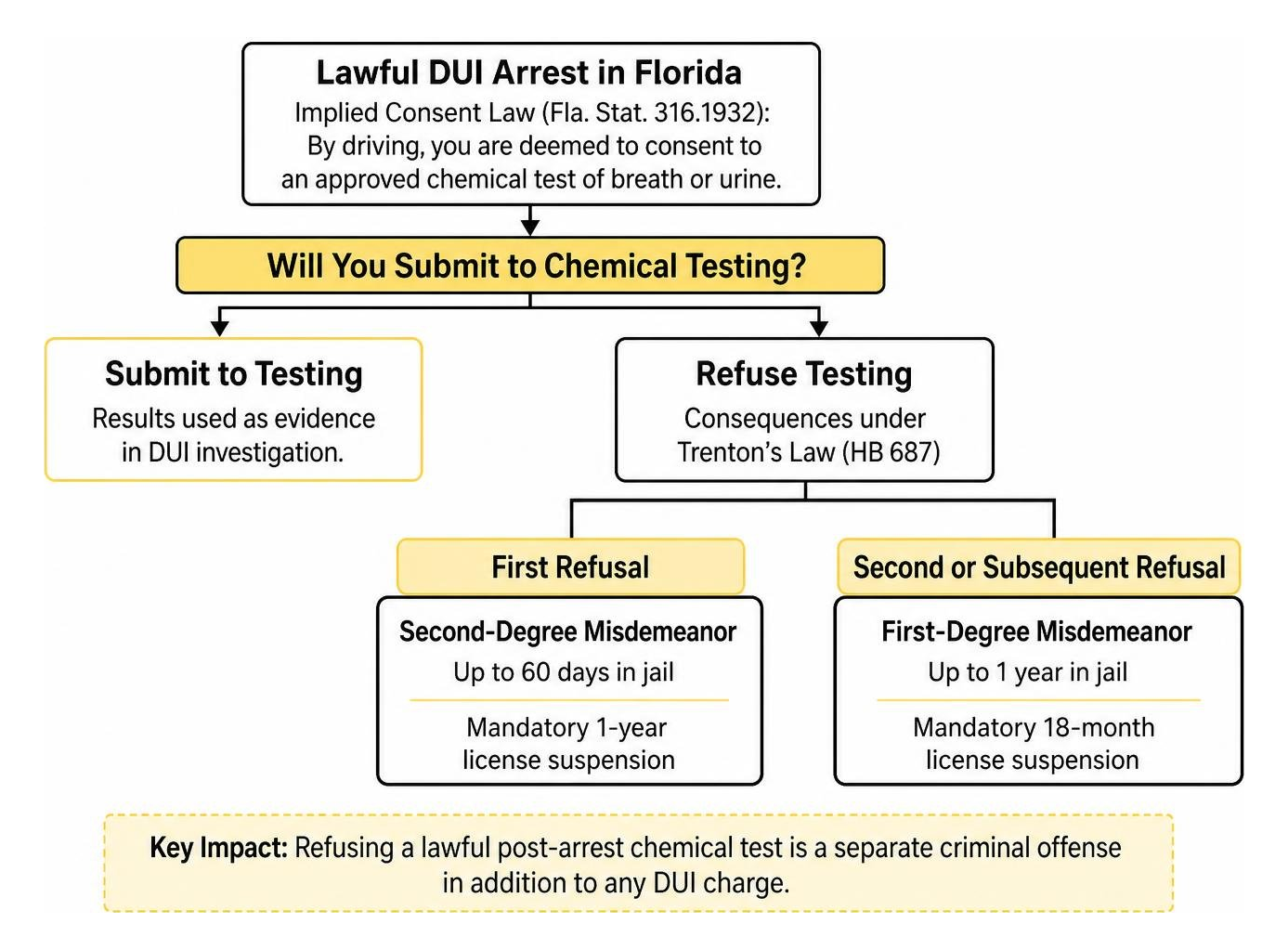
Under Florida’s Trenton’s Law (HB 687), the consequences of refusing chemical testing carry criminal penalties. While a first refusal previously triggered only an administrative license suspension, Trenton’s Law establishes that refusing a lawful post-arrest chemical test can be prosecuted as a standalone second-degree misdemeanor, punishable by up to 60 days in jail and a mandatory 1-year license suspension. A second or subsequent refusal escalates to a first-degree misdemeanor carrying up to one year in jail and an 18-month license suspension.
Board Certification and Forensic Credentials in Defense Counsel
DUI defense is an intricate intersection of criminal procedure, constitutional case law, and forensic science. When selecting legal representation, specialized credentials demonstrate a lawyer’s mastery over complex technical evidence.
Attorneys who hold membership in the National College for DUI Defense (NCDD) or maintain Board Certification from The Florida Bar and the American Bar Association have demonstrated substantive trial experience, ethical standing, and scientific education. Credentials such as Forensic Lawyer-Scientist designations signify hands-on laboratory training in headspace gas chromatography, mass spectrometry, and pharmacological drug metabolism. This scientific background allows counsel to cross-examine state toxicologists effectively and uncover lab flaws that standard general practitioners might overlook.
Frequently Asked Questions About DUI Defense
Can a Florida DUI conviction be expunged or sealed?
No. Under Florida Statute 316.656, judges are statutorily prohibited from withholding adjudication on a DUI conviction. This means that if you plead guilty, plead no contest, or are found guilty of DUI at trial, a formal adjudication of guilt is mandatory. Under state law, a DUI conviction remains on your permanent driving record for 75 years and can never be expunged or sealed.
The only way to keep your record clean is to have the charges dismissed, secure an acquittal at trial, or successfully negotiate a reduction to a non-DUI charge, such as reckless driving with a withhold of adjudication. Once reduced to reckless driving without a formal conviction, you may become eligible to have the record sealed and eventually expunged, provided you meet Florida’s statutory background qualifications.
What is the difference between an alcohol DUI and a drug DUI in Florida?
While alcohol DUIs rely on standardized per se limits (such as the 0.08 BAC threshold), Florida law recognizes no statutory “per se” limit for illicit or prescription drugs. In a drug DUI prosecution, the state must prove two separate elements: that the driver had a chemical or controlled substance in their body, and that the substance actually impaired their normal faculties.
Chemical urine tests cannot measure active real-time intoxication because they merely register inactive chemical metabolites that linger in the human body for days or weeks after use. Top defense strategies focus on attacking the 12-step DRE protocol, demonstrating that prescription medications were taken within therapeutic medical limits, and establishing alternative medical explanations for abnormal pupil dilation, fatigue, or balance issues.
What happens if I am involved in an accident during a DUI arrest?
When a traffic crash accompanies a DUI arrest, the legal exposure increases substantially in both the criminal and civil courts. Criminally, a DUI involving property damage or non-serious personal injury is elevated to a first-degree misdemeanor punishable by up to one year in jail. If the accident causes serious bodily injury to another person, the offense is charged as a third-degree felony carrying up to 5 years in Florida state prison, while fatal collisions result in DUI manslaughter charges carrying mandatory minimum prison terms.
From a civil perspective, impaired driving provides legal grounds for injured victims to pursue punitive damages under Florida Statute 768.736. In civil injury claims, navigating drunk driving punitive damages allows plaintiffs to seek financial penalties specifically aimed at punishing gross negligence and intentional misconduct. This exposes the driver to personal financial liability beyond standard auto insurance policy limits.
Conclusion
A DUI arrest across Tampa Bay—whether in Clearwater, Largo, St. Petersburg, New Port Richey, Spring Hill, Trinity, or Wesley Chapel—demands swift, strategic legal action within the first 10 days to preserve your driving privileges and protect your future. Understanding how procedural motions, chemical testing calibrations, and roadside exercise challenges dismantle the state’s case provides the best opportunity to avoid severe criminal penalties.
For over four decades, our team at Carey Leisure Carney has stood as dedicated advocates across the Tampa Bay area. As Board-Certified trial attorneys—a distinction earned by fewer than 2% of lawyers in Florida—we bring more than 100 years of combined courtroom experience to every legal issue we examine. Understanding the nuances of florida alcohol laws is vital for safeguarding your rights and ensuring every procedural defense is fully deployed.