

Don’t Get Whiplashed by the System: Making Your Injury Claim
What You Need to Know About Claiming Whiplash After a Car Accident
Claiming whiplash after a car accident is something thousands of Florida drivers face every year — and many don’t realize they have a right to compensation until it’s too late.
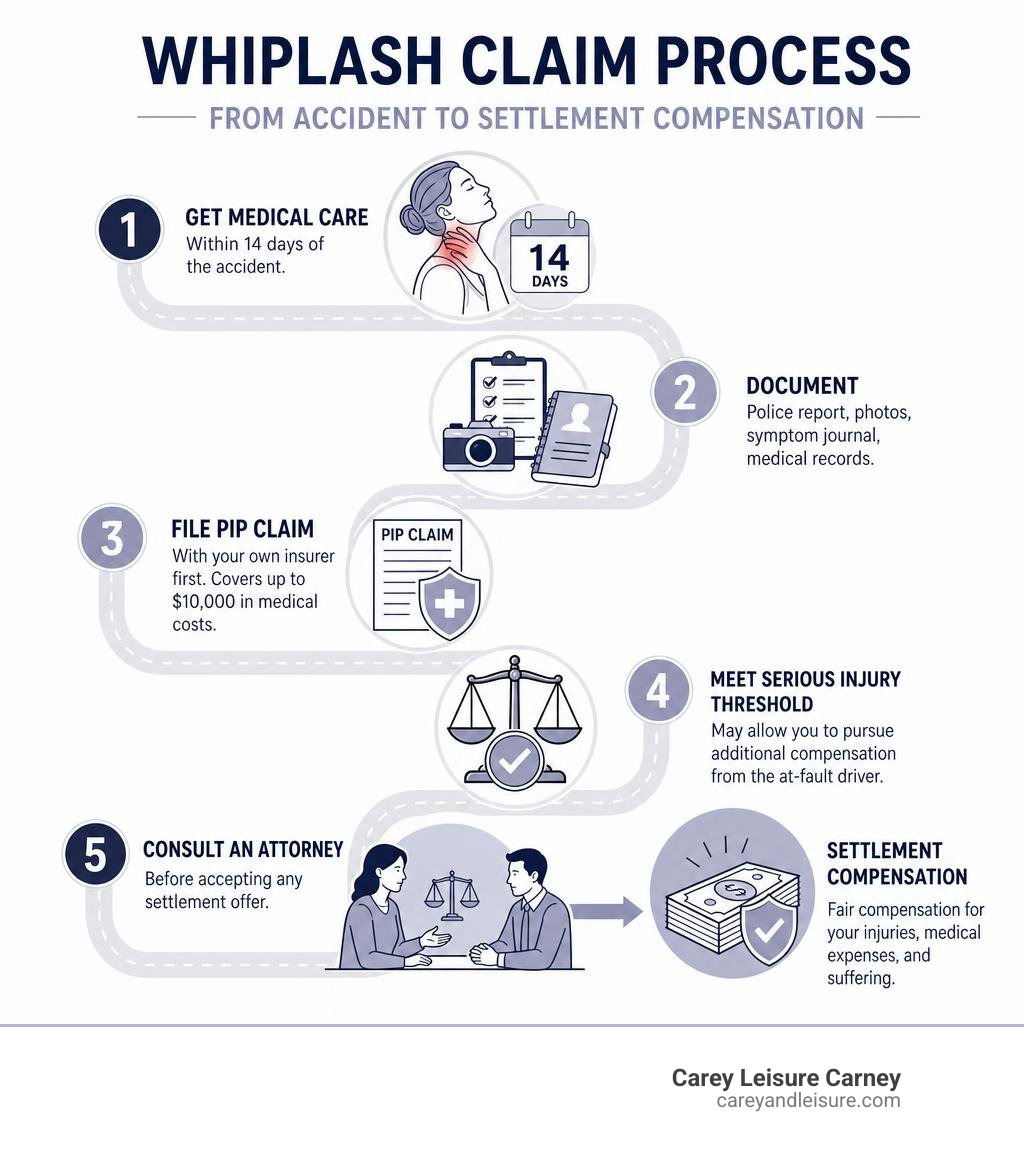
Here’s a quick overview of how the process works:
- Seek medical attention within 14 days of the accident to preserve your PIP insurance coverage
- Document everything — police report, photos, symptom journal, medical records
- File a PIP claim with your own insurer first (covers up to $10,000 in medical costs)
- Determine if your injury meets Florida’s serious injury threshold to pursue additional compensation from the at-fault driver
- Consult a personal injury attorney before accepting any settlement offer
Whiplash sounds minor. Insurance companies want you to believe it is. But the reality is that the average whiplash victim can still suffer significant pain more than eight years after the accident — and soft tissue injuries that don’t show up on X-rays are routinely undervalued or denied by insurers.
If you’re feeling neck pain, stiffness, or headaches after a crash — even days later — you may be dealing with whiplash. And you deserve fair compensation for it.
I’m Thomas W. Carey, founding partner of Carey Leisure Carney and a board-certified civil trial lawyer with over 35 years of experience guiding Florida injury victims through the process of claiming whiplash after a car accident. In that time, I’ve seen how quickly insurance companies move to minimize these claims — and how the right documentation and legal strategy can make all the difference.
Terms related to claiming whiplash after car accident:
- neck pain after car accident compensation
- compensation for pain and suffering after a car accident
- chronic pain after car accident compensation
What is Whiplash and How Does It Occur?
Whiplash is a non-medical term used to describe a range of neck injuries caused by sudden, rapid movement. When your car is struck, the force of the impact causes your head and neck to jerk violently forward and backward, or side to side. This whip-like motion stretches and tears the delicate muscles, tendons, and ligaments in your neck.

To understand how whiplash happens, we have to look at the physics of a car crash. In a typical rear-end collision, your vehicle is pushed forward. Your seat pushes your torso forward with it, but your head remains momentarily stationary. This causes your neck to hyperextend backward over the top of the seat.
As your body bounces back, your head is thrown violently forward (hyperflexion). This rapid acceleration-deceleration cycle happens in less than a blink of an eye, putting immense physical impact on your cervical spine.
Whiplash is classified as a soft tissue injury. Because it affects muscles and ligaments rather than bones, it is one of the most common types of car accident injuries we handle.
Many drivers mistakenly believe that if their vehicle didn’t sustain heavy damage, they couldn’t possibly be injured. However, biomechanical research shows that a minor impact can cause long-term damage. Whiplash can occur at impact speeds as low as 5 to 10 mph. When a car has a stiff bumper that doesn’t crumple, the force of the collision isn’t absorbed by the metal — it is transferred directly to the occupants inside.
Common Symptoms and Delayed Onset
The symptoms of whiplash can range from mild discomfort to severe, debilitating pain. The most common indicators include:
- Persistent neck pain and stiffness
- Loss of range of motion in the neck
- Headaches, typically starting at the base of the skull
- Tenderness or pain in the shoulders, upper back, or arms
- Tingling or numbness radiating down the arms
- Dizziness, fatigue, and blurred vision
- Difficulty concentrating or sleeping
One of the most dangerous aspects of whiplash is its delayed onset. Immediately after a car accident, your body is flooded with adrenaline and endorphins. This natural “fight or flight” response acts as a powerful temporary painkiller, masking the symptoms of physical trauma.
You might walk away from a crash in Clearwater or St. Petersburg feeling completely fine, only to wake up 24 to 72 hours later unable to turn your head. This delay is completely normal from a medical standpoint, but insurance adjusters frequently use it to claim that your injuries are either exaggerated or occurred after the accident.
Understanding the link between neck pain after a car accident and securing your compensation is crucial to protecting your health and your legal rights.
Step-by-Step Guide to Claiming Whiplash After Car Accident
Navigating the insurance system while recovering from a painful neck injury can feel overwhelming. To protect your health and build a strong foundation for your claim, you need to follow a structured, step-by-step process.

Following a clear path after a crash ensures you do not make mistakes that could invalidate your coverage. For a detailed breakdown of your immediate responsibilities under state law, read our guide on what to do after a car accident in Florida. Additionally, understanding the fundamentals of how to make a whiplash injury claim after a car accident will help you handle the insurance adjusters who may try to minimize your pain.
Seek Immediate Medical Attention
Your absolute first priority after any car accident is to see a medical professional. Under Florida law, you must seek medical treatment within 14 days of the accident to utilize your Personal Injury Protection (PIP) benefits. If you miss this strict window, your insurance company can deny your medical claims entirely.
When you go to the doctor, be explicit about every symptom you are experiencing, no matter how minor. A doctor will establish a formal medical record linking your neck pain directly to the crash.
Because soft tissue injuries do not show up on standard X-rays, your doctor may order advanced diagnostic imaging, such as an MRI or a CT scan, to rule out herniated discs or spinal cord damage.
Depending on your diagnosis, your treatment plan may include physical therapy, neck braces, prescription muscle relaxants, or specialized chiropractic care. Consistent medical records are the single most important piece of evidence when claiming whiplash after a car accident.
Document the Accident Scene and Your Injuries
To build a compelling case, you must gather and preserve as much evidence as possible. If you are physically able to do so at the scene, take the following steps:
- Call the Police: Always request an officer to write an official police report. This report is an objective record of the crash and often establishes fault.
- Take Photos and Videos: Capture images of the vehicle damage, the road conditions, any skid marks, and the overall layout of the scene. Also, take photos of any visible physical injuries, like bruising from a seatbelt.
- Gather Witness Statements: Get the names, phone numbers, and addresses of anyone who saw the accident occur.
- Keep a Symptom Journal: Write down your daily pain levels, your range of motion, and how the injury limits your daily activities (e.g., your ability to drive, work, or lift your children).
- Save Financial Receipts: Keep a meticulous file of all medical bills, pharmacy receipts, co-pays, and documentation of any lost wages from missed work.
Proving Your Injury and Calculating Compensation
Proving a whiplash injury is notoriously difficult because there are rarely broken bones or obvious external wounds. Insurance companies are highly skeptical of soft tissue claims, often labeling them as “minor” or implying that the victim is faking the pain. Overcoming this skepticism requires clear, undeniable proof.
To successfully secure damages, you must establish a direct link of causation between the negligent driver’s actions, the collision, and your resulting physical symptoms. Having trusted car accident legal advice in your corner can help you gather the necessary medical expert reports and crash reconstruction data to prove your case.
The Legal Process of Claiming Whiplash After Car Accident in Florida
Florida operates under a “no-fault” auto insurance system. This means that regardless of who caused the accident, your first line of financial recovery is your own PIP insurance. By law, Florida drivers must carry at least $10,000 in PIP coverage, which pays for 80% of necessary medical expenses and 60% of lost wages, provided you sought treatment within the 14-day window.
However, $10,000 can be exhausted in a single afternoon if you require emergency room care and advanced imaging. To step outside of the no-fault system and file a third-party claim or lawsuit against the at-fault driver for full economic and non-economic damages, your injury must meet Florida’s “serious injury threshold.”
Under Florida Statute § 627.737, a serious injury includes:
- Significant and permanent loss of an important bodily function
- Permanent injury within a reasonable degree of medical probability
- Significant and permanent scarring or disfigurement
- Death
Proving that a whiplash injury is permanent requires specialized medical testimony and consistent, long-term treatment records.
Common Challenges When Claiming Whiplash After Car Accident
Because whiplash relies heavily on subjective symptoms (like pain and stiffness), insurance companies will use every tool in their arsenal to deny or devalue your claim. Some of the most common challenges include:
- Pre-Existing Conditions: If you have ever had neck pain, degenerative disc disease, or a previous sports injury, the insurer will argue that your current pain is merely a pre-existing condition and not caused by the crash.
- Treatment Gaps: If you waited several weeks to see a doctor, or if you missed physical therapy appointments, the insurance adjuster will claim that your injuries cannot be that serious.
- Subjective Symptoms: Since soft tissue damage doesn’t always show up on standard imaging, insurers may claim there is no objective medical proof of your injury.
- Minor Vehicle Damage: They will argue that because your bumper only has a scratch, your body couldn’t have suffered trauma.
We know how to fight back against these tactics. For example, a pre-existing condition does not disqualify you; under Florida law, you are entitled to compensation if a crash aggravated a pre-existing injury.
Understanding how to document chronic pain after a car accident for compensation and navigating back pain compensation after a car accident are vital steps in overcoming these common insurance hurdles.
Understanding Whiplash Compensation and Settlement Values
If your injuries cross the serious injury threshold, you can pursue both economic and non-economic damages from the at-fault driver’s insurance.
| Compensation Category | Covered by Florida PIP (No-Fault) | Covered by Third-Party Claim / Lawsuit |
|---|---|---|
| Medical Expenses | 80% of necessary treatments (up to $10,000 limit) | 100% of past, current, and future medical bills |
| Lost Wages | 60% of lost income (up to PIP limit) | 100% of lost earnings and reduced earning capacity |
| Out-of-Pocket Costs | Not covered | 100% of prescriptions, medical devices, and travel to doctors |
| Pain and Suffering | Not covered | Full recovery for physical pain, mental anguish, and loss of enjoyment |
The average settlement payout for a moderate whiplash injury typically ranges between $12,000 and $30,000. However, severe cases involving herniated discs, nerve damage, or chronic pain can result in payouts exceeding $100,000 or even $200,000.
To maximize your recovery, you must document every aspect of how the injury has disrupted your life. Learn more about how to get the most compensation from a car accident settlement in Florida and explore our guide on compensation for pain and suffering in Florida.
Frequently Asked Questions about Whiplash Claims
Dealing with the aftermath of an accident brings up a lot of questions. Here are the answers to the most common questions our clients ask.
How long do I have to file a whiplash claim in Florida?
In Florida, the statute of limitations for filing a personal injury lawsuit is two years from the date of the car accident. If you do not file your lawsuit within this two-year window, you will lose your right to seek compensation forever.
Additionally, remember the 14-day rule for your PIP coverage: you must seek initial medical treatment within 14 days of the crash, or your own insurer will deny your PIP benefits.
Can I claim whiplash if the accident was minor?
Yes, absolutely. Many whiplash injuries occur in low-speed rear-end collisions at speeds of 5 to 10 mph. Modern vehicles are designed to minimize structural damage to the car, which means the physical force of the impact is transferred directly into your body, snapping your head and neck.
Even if your car has zero visible damage, the biomechanics of the crash can still cause severe soft tissue tears in your cervical spine.
Do I need a lawyer for a whiplash claim?
While you can technically handle a basic PIP claim on your own, having an experienced attorney is vital if you are suffering from ongoing pain or if your medical bills exceed $10,000.
Insurance adjusters are trained to settle soft tissue claims for as little money as possible. An attorney will calculate the true value of your claim, gather expert medical opinions, negotiate with the insurance company, and, if necessary, take your case to court to ensure you receive fair compensation.
Conclusion
Claiming whiplash after a car accident doesn’t have to be an uphill battle against a system designed to wear you down. When you are dealing with persistent neck pain, your focus should be on physical recovery, not fighting with insurance adjusters who want to dismiss your injury as a minor inconvenience.
At Carey Leisure Carney, we have spent over three decades defending the rights of injured Floridians. We are a family-owned personal injury law firm serving Clearwater, Largo, New Port Richey, Spring Hill, St. Petersburg, Trinity, and Wesley Chapel.
Our unique advantage is our expertise: our firm features Board-Certified civil trial attorneys — a distinction held by less than 2% of all lawyers in Florida. With more than 100 years of combined legal experience, we offer our clients direct attorney access and highly personalized, compassionate service. You will never be passed off to a case manager; you will work directly with the lawyers fighting for your recovery.
If you or a loved one is suffering from whiplash after a Florida car crash, do not let the insurance companies take advantage of you. Get help from a personal injury attorney at Carey Leisure Carney today. Contact us for a free, no-obligation consultation, and let us help you secure the compensation you deserve.