

How to Find Local Malpractice Attorneys in Clearwater
To compare local malpractice attorneys, start with a Florida Bar license check. Then ask each lawyer about medical malpractice cases like yours, who will handle your case, and how they use medical experts to review records. Confirm whether the first consultation is free, how fees and case costs work, and whether you can meet by video. Contact a lawyer promptly: Florida filing deadlines can limit your options.
I’m Thomas W. Carey, founding partner of Clearwater-based Carey Leisure Carney and a board-certified civil trial lawyer who has worked on medical malpractice cases. I know choosing among local malpractice attorneys can feel urgent and personal, so the checks below focus on experience, access, and clear answers.
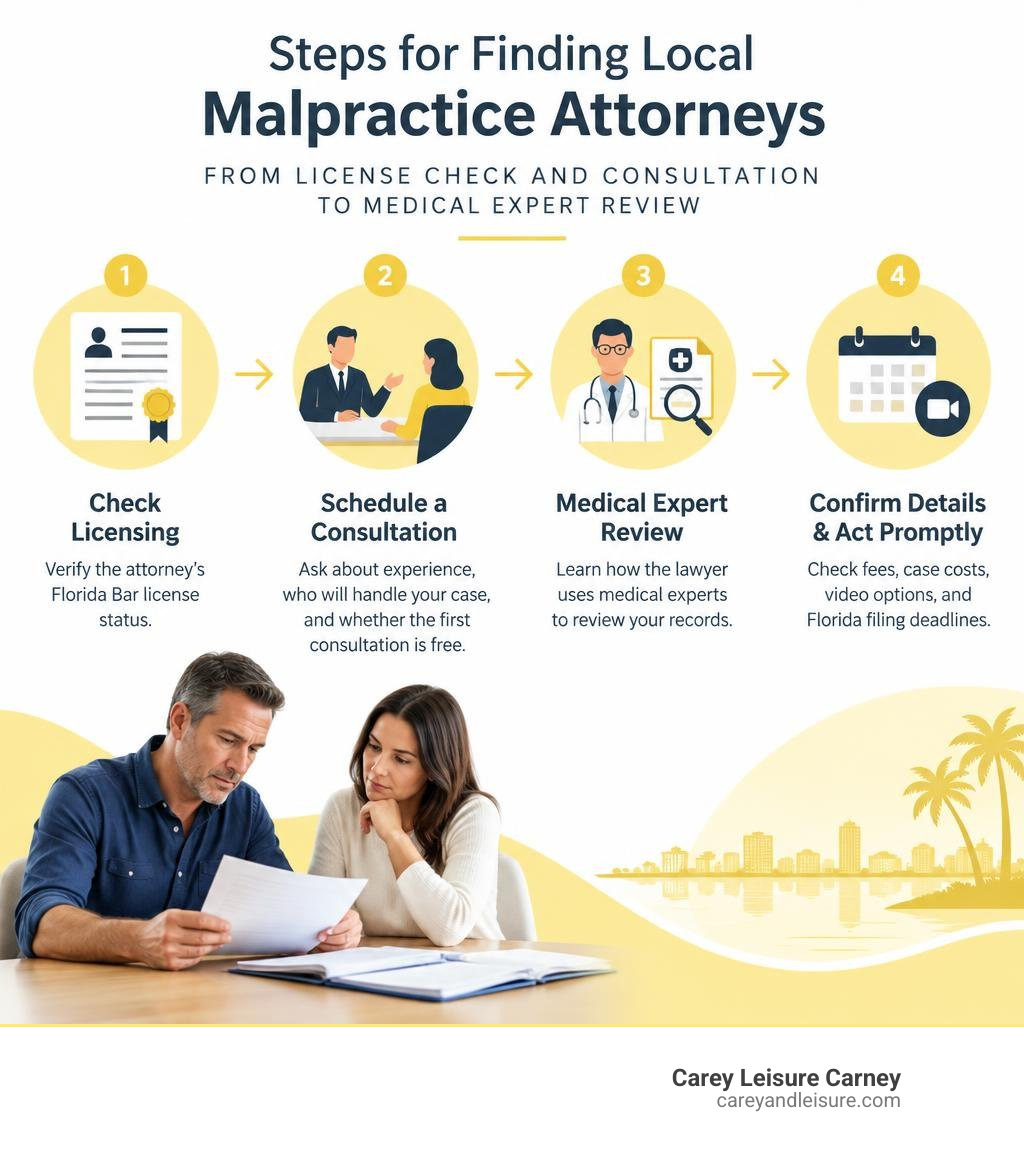
Key local malpractice attorneys vocabulary:
How to Compare Local Malpractice Attorneys in Clearwater, FL
Choosing a lawyer is a bit like choosing a surgeon: you want someone who does this work all the time, not someone who “dabbles.” Here is a practical checklist we suggest running every candidate through.
- Medical malpractice focus. Malpractice cases are not car-wreck cases with a stethoscope. Ask what share of the lawyer’s work is medical negligence.
- Case experience. Ask about cases like yours, whether that is a surgical error, a missed diagnosis, or a birth injury.
- Trial and settlement history. Insurers watch which lawyers are willing to go to trial. A lawyer with real courtroom experience negotiates from strength.
- Client reviews. Read reviews on independent sites, not only the firm’s own page.
- Professional recognition. Look for Board Certification, Super Lawyers, Martindale-Hubbell, and AVVO profiles, then confirm them yourself.
- Communication. Ask how often you will get updates and how quickly calls are returned.
- Lead-attorney involvement. Find out who actually handles your case day to day.
- Fees. Ask whether the firm works on contingency, meaning no attorney fee unless you recover money.
- Free consultation. You should not pay just to learn whether you have a case.
- Video consultation. If you are recovering at home or family lives far away, a video call can make the first meeting much easier.
If you want to browse before you call, you can find attorney listings by state or check local malpractice lawyer listings. Treat these as starting points for research, not endorsements. Listings show who exists, not who is right for your situation.
How to Vet Local Malpractice Attorneys
Start with the basics. Every lawyer you consider should be in good standing with The Florida Bar, and you can check that on the Bar’s public member search. Then look at medical negligence experience and whether results can be independently verified. A big number on a website means little if you cannot find a court record or news report behind it.
Next, check recognitions such as Super Lawyers, Martindale-Hubbell, and AVVO. They are useful signals, but they are not guarantees. Board Certification by The Florida Bar is a stricter benchmark, since it requires substantial trial experience, peer review, and an exam. Roughly the top 2% of Florida lawyers hold it. Then read client reviews for patterns: do people say the lawyer was reachable, honest, and clear?
You will also see a choice between a lawyer with a nearby office and one who covers a wider region. Neither is automatically better.
| Factor | Local-office attorney | Broader regional coverage |
|---|---|---|
| Meeting in person | Easy, often a short drive | May require travel or video |
| Familiarity with area courts and hospitals | Often strong | Varies |
| Convenience for family and hospital visits | High | Moderate |
| Resources for big, expert-heavy cases | Depends on the firm | Often larger teams |
| Video meetings | Ask the firm | Usually common |
For many Tampa Bay families, the sweet spot is a firm with a nearby office that also offers video meetings. You get the handshake and the flexibility.
Questions to Ask Local Malpractice Attorneys
Bring this list to your first call. A good lawyer will not mind a single question.
- What types of medical malpractice cases do you handle?
- Have you handled cases like mine, and how did they turn out?
- Who will manage my case, and will I speak with the lead attorney?
- How fast do you usually respond to calls and emails?
- Is the first consultation free?
- What is your contingency percentage, and does it change if the case goes to trial?
- Who pays litigation expenses (records, experts, filing fees) up front, and how are they repaid?
- Can we meet by video, including evenings or weekends?
Ask about expenses in particular. Expert reviews and records are real costs in malpractice cases, and you should know how they are handled before you sign anything.
What Cases May Qualify, and How Is a Claim Evaluated?

Medical malpractice happens when a healthcare provider’s care falls below accepted standards and that failure causes harm. Cases we commonly see discussed include:
- Birth injuries
- Surgical errors
- Misdiagnosis and delayed diagnosis
- Medication errors
- Anesthesia errors
- Emergency-room errors
- Hospital negligence
- Nursing-home negligence
A bad outcome alone is not malpractice. Medicine carries risk, and sometimes good care still ends badly. A claim generally needs four elements:
- Duty of care. The provider owed you a professional duty, usually through a doctor-patient relationship.
- Breach. The provider did not meet the accepted standard of care.
- Causation. That breach caused your injury.
- Damages. You suffered real losses, such as medical bills, lost income, or pain and suffering.
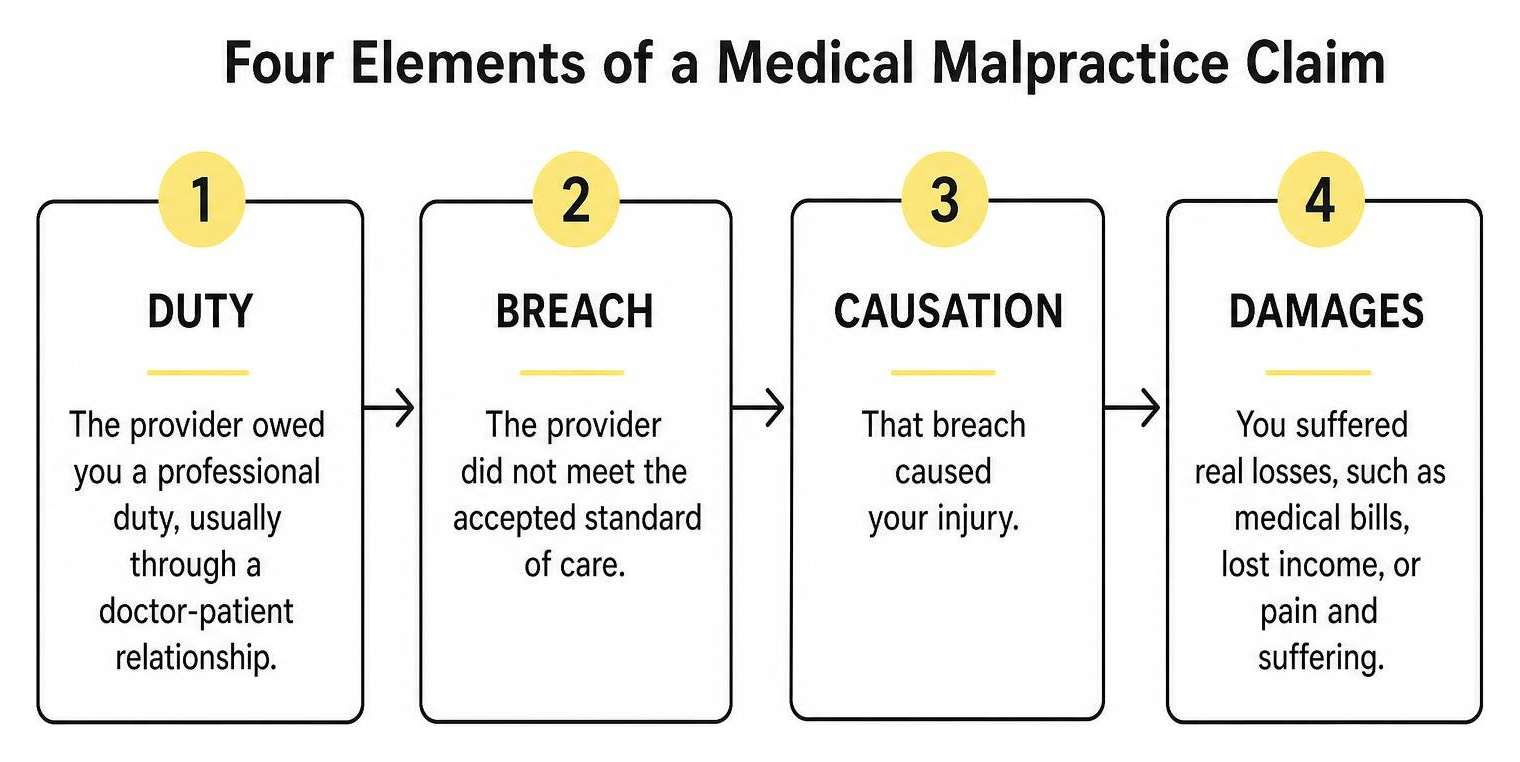
Here is how a claim is usually evaluated. First, a lawyer listens to your story and collects your medical records. Then independent medical experts, often doctors in the same specialty, review those records and tell us whether the care fell below the standard. If the experts support the claim, the case has merit. If not, an honest lawyer will tell you so, even though that is not what anyone hopes to hear.
You may hear a family say, “They told us it was just a complication.” That is common. Hospitals and doctors sometimes avoid detailed explanations, and patients can feel stonewalled, a pattern sometimes called a “conspiracy of silence.” An independent review can separate a true complication from an avoidable mistake. Also, keep your records and any bills, photos, and notes. Do not discard anything.
What Evidence and Experience Matter in a Malpractice Case?
Strong cases are built on paper and expert opinion. The most important pieces are:
- Medical records. Charts, imaging, lab results, nursing notes, and medication logs.
- A treatment timeline. What happened, when, and who was involved.
- Expert testimony. Experts explain the standard of care and how it was missed.
- Avoidable harm. Evidence that a reasonable provider would have prevented the injury.
- Documented losses. Bills, wage records, and proof of how life has changed.
Lawyer experience matters because these cases are expensive and technical. A lawyer who knows how to read records and question experts can spot problems early. Verdicts and settlements can be large in serious cases, but no ethical lawyer can guarantee an outcome.
One reported statistic puts the success rate of medical malpractice lawsuits at about 25%, with payouts often higher than in other kinds of suits. Read that with context. It reflects how demanding these cases are, and it is why careful screening matters. Good lawyers turn down weak cases, so the cases that move forward tend to be the well-supported ones.
Some situations deserve their own deep dive. If your injury began in a hospital ER, our guide on emergency-room errors explains common failures. If surgery or sedation was involved, read about anesthesia mistakes. And if a child was hurt during delivery, we cover birth-injury claims in Florida.
Florida Filing Deadlines, Fees, and Local Reach
Time is the one thing you cannot get back in a malpractice claim, so let’s talk deadlines.
In Florida, the general statute of limitations for medical malpractice is two years. Under the discovery rule, that clock usually starts when you knew, or reasonably should have known, about the injury and that it may have been caused by malpractice. There is also a statute of repose, a longer outside limit of four years from the incident, with narrow exceptions in cases involving fraud, concealment, or intentional misrepresentation. Other exceptions can apply, including for some claims involving children. Because these rules are technical, do not try to calculate your own deadline. Our guide on Florida medical-malpractice filing deadlines walks through them in more detail.
Florida also has a pre-suit process. Before filing a lawsuit, a claimant generally must investigate the claim, provide notice to the provider, and support the claim with a verified written medical expert opinion. A formal notice period follows, during which the parties can exchange information and explore resolution. You can read the law itself in Chapter 766, Section 106 of the 2026 Florida Statutes. All of this takes time, which is another reason to call early. Preserve your records, avoid posting about the case on social media, and act promptly.
Fees and Expenses
Most medical malpractice lawyers work on contingency. That means you pay no attorney fee unless there is a recovery, if your agreement says so. Ask for the agreement in writing and look at three things: the fee percentage, how case expenses are handled, and whether those expenses come out before or after the fee is calculated. Expenses can include expert reviews, records, depositions, and filing costs. A trustworthy firm explains all of this before you sign, not after.
Local Reach Around Tampa Bay
Being close matters when you need to drop off records, meet in person, or bring a family member along. We are based in Clearwater and serve families across the area. If you are near one of these communities, these pages give you more local detail:
- Medical-malpractice attorney in Clearwater
- Medical-malpractice attorney in St. Petersburg
- Medical-malpractice attorney in Largo
We also work with clients in Trinity, Wesley Chapel, Spring Hill, and New Port Richey. Because Florida malpractice law is statewide, the same filing rules apply no matter which of these communities you call home.
Frequently Asked Questions About Local Malpractice Attorneys
Below are the questions we hear most. In short: Florida claim deadlines are strict, fee agreements should be explained in writing, consultations can often be done in person or remotely, and a good lawyer will be clear about how your case will be evaluated and who will be available to you.
Do Local Malpractice Attorneys Offer Free Consultations or Video Meetings?
Many do. A free initial consultation lets you explain what happened and learn whether the case is worth investigating, with no pressure to hire anyone. Video consultations are also increasingly common, which helps if you are recovering, caring for a loved one, or have relatives out of town who want to join. Ask whether evening or weekend calls are possible, and whether family members can join. Since policies differ from firm to firm, confirm the details directly before you schedule.
How Do I Know Whether a Medical Error Is Malpractice?
You usually cannot tell from the outside, and that is okay. Ask yourself a few questions. Did the provider do something a reasonably careful provider would not have done, or fail to do something they should have? Was the injury avoidable? Did the mistake actually cause the harm? A “complication” can be a known risk that happened despite proper care, or it can be a label placed on a preventable error. Only a review of the records by qualified medical experts can answer that. A case-specific evaluation is the right next step.
Will the Lead Attorney Personally Handle My Case?
This is one of the best questions you can ask, and the answer should be clear. In many firms, a senior lawyer signs the agreement while associates or case managers do most of the work. Support staff are valuable, but you deserve to know who is making the decisions and how to reach that person. Ask who the lead counsel is, what role associates will play, how often you will receive updates, and how to contact the attorney directly. At our firm, direct attorney access and personal service are core to how we work.
Conclusion
Finding the right lawyer after a medical error is a big decision, and you do not have to make it alone or in a rush. Compare experience, ask hard questions, check credentials, and watch the Florida deadlines.
Carey Leisure Carney is a Clearwater-based personal injury firm with Board-Certified attorneys, direct attorney access, and personalized service. We are happy to talk through whether your situation is a good fit for our firm and, if it is not, point you toward your next step. Explore our medical-malpractice resources and consultation options, and reach out soon for a prompt legal review. The sooner someone looks at your records, the more options you may have.