
Stop the Slip by Securing Loose Commercial Floor Mats Today
Loose Floor Mats Can Cause Serious Falls
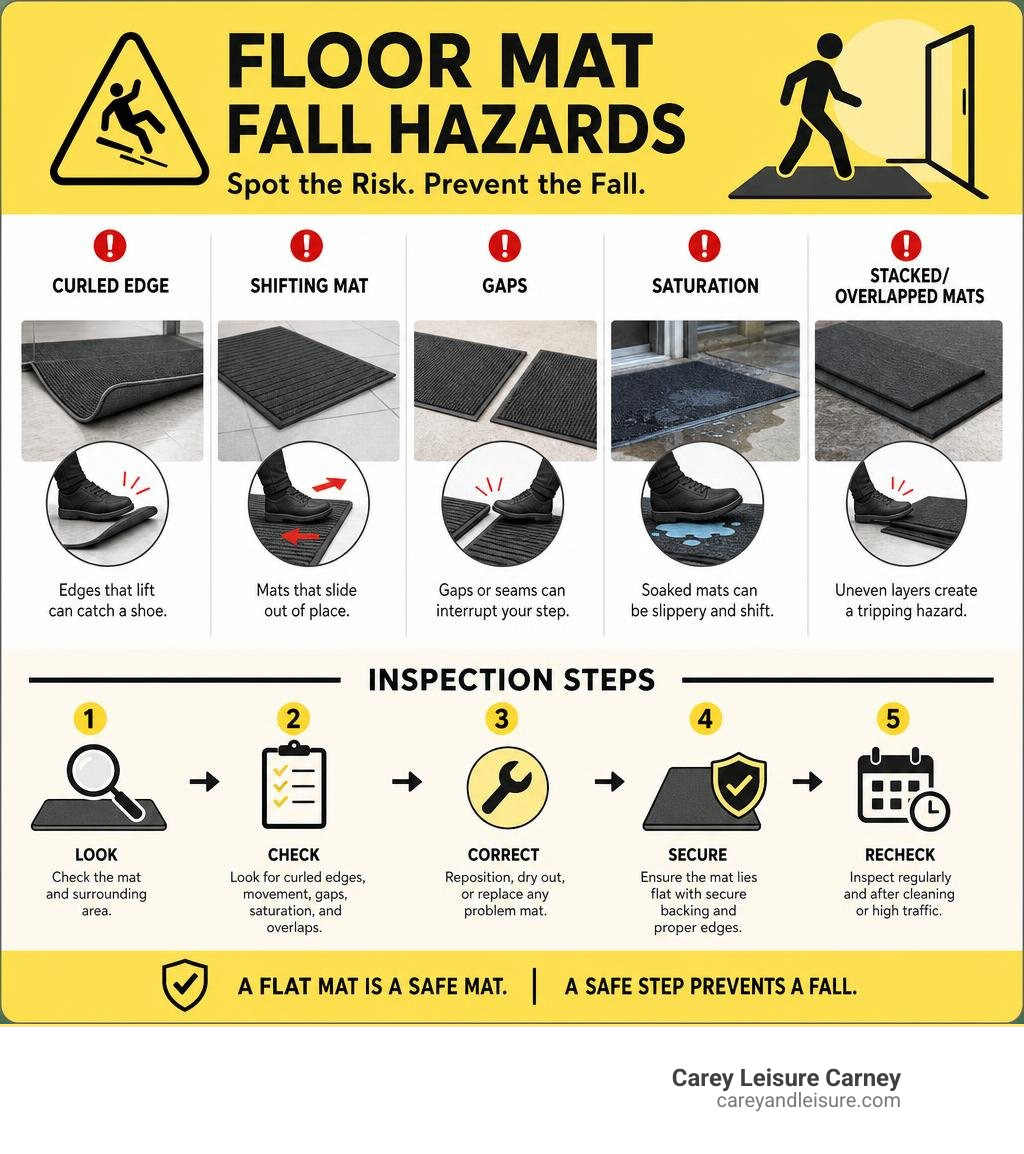
A floor mat trip hazard exists when a mat curls, bunches, slides, overlaps another mat, or becomes soaked and unstable. Check commercial mats often, remove any damaged mat at once, and replace it with a properly sized mat that lies flat, has secure backing, and uses beveled edges where needed.
A mat may be placed to prevent a slip, yet poor placement or wear can turn it into a new danger. Raised corners can catch a shoe. Gaps between pieced-together mats can interrupt a walking path. Stacked mats create an uneven surface that can cause a person to stumble or roll an ankle.
Falls send more than 8 million people to U.S. emergency rooms each year. In workplaces, slips, trips, and falls remain among the most common injuries. For a customer, worker, or visitor, a sudden fall can mean fractures, head injuries, medical bills, missed work, and a long recovery.
I am Thomas W. Carey, a founding partner at Carey Leisure Carney and a Board-Certified Civil Trial Lawyer who has handled or overseen thousands of Florida injury matters. My work with premises cases has shown how a preventable floor mat trip hazard can have life-changing consequences when a property owner fails to find and correct it.
Floor mat trip hazard glossary:
Identifying the Most Dangerous Floor Mat Trip Hazard Types
Commercial and industrial facilities rely heavily on floor mats to keep entrances clean and provide ergonomic support. However, when these safety tools degrade from heavy foot traffic, cart wheels, and harsh cleaning chemicals, they quickly become hazardous.
The primary cause of mat-related falls is unexpected elevation changes along pedestrian paths. Walking requires subconscious muscle memory; when a person’s foot encounters an unanticipated lip, ridge, or sliding surface, the body cannot adjust in time. Recognizing the specific ways mats fail is the first step toward maintaining a safe property.
Curling Borders and the “Bacon Effect” Floor Mat Trip Hazard
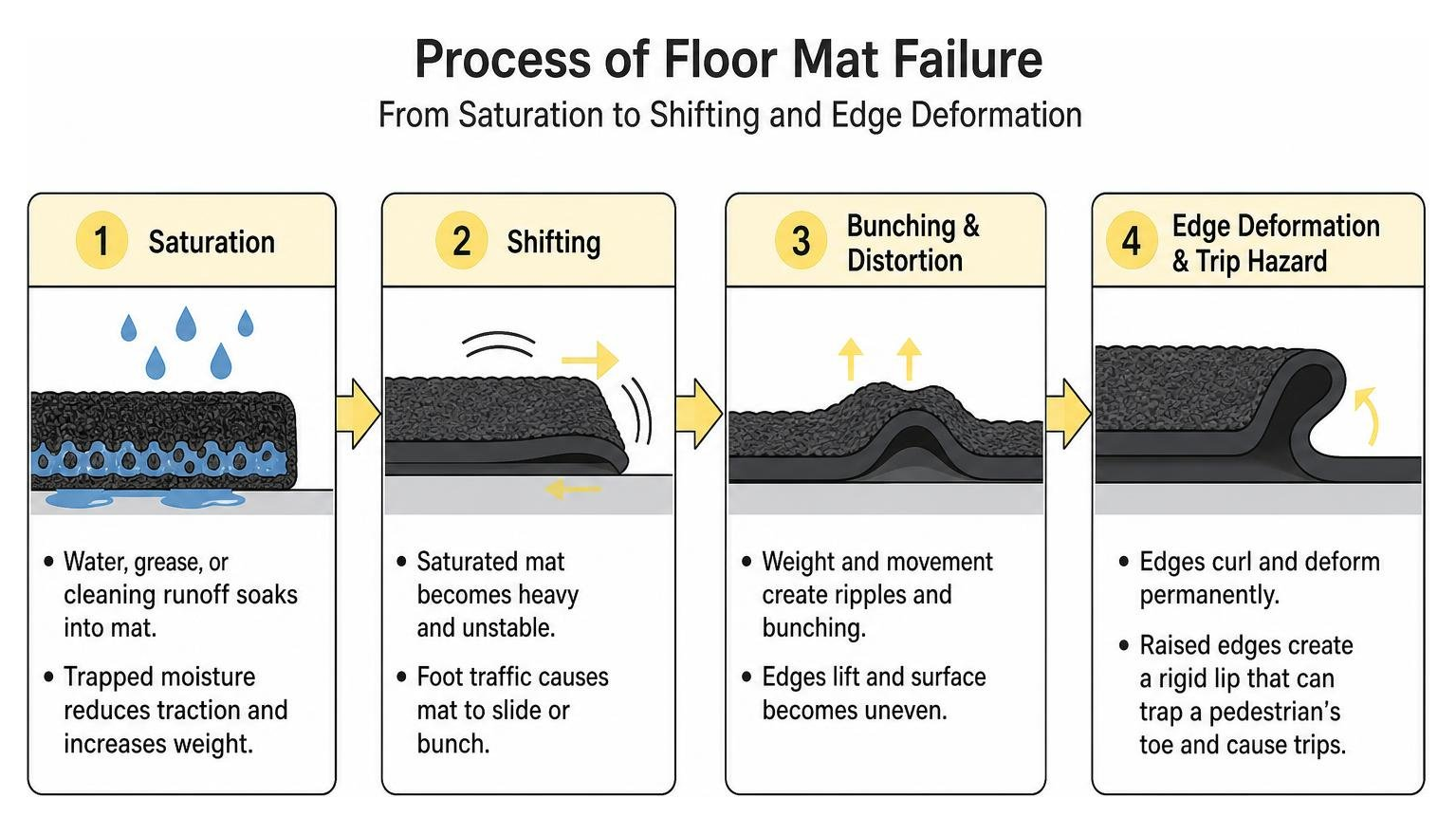
One of the most frequent defects observed in commercial walkways is edge curling, often referred to in facility safety audits as the “bacon effect.” Over time, foot traffic, floor wash chemicals, temperature fluctuations, and exposure to industrial oils cause rubber and vinyl borders to warp and lift upward.
When a mat border curls up by even a fraction of an inch, it creates a rigid lip capable of trapping a pedestrian’s toe during normal stride swing. Key physical warning signs that a mat must be removed include:
- Wavy or ripple-like distortion along outer edges
- Corners lifting permanently off the floor substrate
- Cracking, chipping, or tearing around the perimeter border
- Delamination where the top carpet layer separates from the rubber backing
- Permanent creases caused by improper rolling during storage
Stacked Mats and Postural Instability
In many workspaces, employees layer several mats on top of one another in an attempt to add extra cushioning. Over 40% of safety leaders report discovering stacked mats during routine audits.
While the intention may be added comfort, stacking creates significant safety hazards. Layering mismatched mats creates an unstable, spongy platform that forces feet, ankles, and legs to make continuous micro-adjustments—similar to the muscle strain of walking in high heels. According to the National Safety Council, musculoskeletal disorders (MSDs) affect 25% of the world’s population, and the U.S. Department of Labor notes MSDs are a leading cause of lost work time. Stacking mats increases the risk of rolled ankles, sudden loss of balance, and severe tripping accidents.
Pieced-Together Mats and Gapping Seams
Facilities often attempt to cover large or irregularly shaped work areas by pushing multiple rectangular mats together. This practice creates an unsafe walking surface.
Individual mats inevitably shift under foot traffic, creating variable gaps, overlapping edges, and raised transitions. When workers step across these seams, shoes can catch in the voids or slide as loose sections shift across smooth concrete. Installing continuous, custom-sized matting or interlocking modular systems with locked transition ramps eliminates these dangerous seams.
Environmental Saturation as a Hidden Floor Mat Trip Hazard
A mat saturated with water, grease, or cleaning runoff presents a severe dual risk:
- Hydroplaning and Sliding: Moisture trapped beneath non-porous backing destroys traction against polished tile or sealed concrete, turning the entire mat into a sliding hazard.
- Surface Slipperiness and Weight Bunching: When open-cell or porous fibers become completely soaked, they lose the ability to capture new moisture, allowing puddles to form on top while the mat bunches under foot pressure.
Deploying properly maintained entryway matting and replacing saturated mats during heavy weather events ensures floors remain dry and pedestrian pathways stay secure.
OSHA Standards and Safety Guidelines for Commercial Floor Mats
Workplace safety regulations and industry engineering standards establish clear specifications for floor coverings to minimize walking-working surface risks. Under OSHA standard 29 CFR 1910.22, employers must maintain walking-working surfaces in a clean, orderly, and sanitary condition, keeping walking zones dry and free of hazards like protruding objects or loose coverings.
National standards, including ANSI/NFSI B101.6 (Standard Guide for Commercial Entrance Matting) and ASTM F1637 (Standard Practice for Safe Walking Surfaces), outline specific geometric and traction requirements:
- 1/4-Inch Threshold: Mats with an overall thickness exceeding 1/4 inch (0.25 in) must incorporate beveled edges.
- 1:2 Bevel Slope: Perimeter bevel transitions must maintain a slope no steeper than 1:2 to ensure smooth travel for footwear, wheelchairs, and carts.
- Visual Contrast: Mat borders should visually contrast with the surrounding floor to alert pedestrians to the surface transition.
- Backing Traction: Backing materials must meet high-traction testing standards to prevent migration across polished stone, tile, or sealed concrete.
| Feature / Metric | Compliant Floor Mat | Non-Compliant / Defective Mat |
|---|---|---|
| Edge Profile | Beveled ramp with max 1:2 slope | Square, vertical, or hand-cut edge > 1/4″ |
| Border Condition | Lies completely flat against floor | Curled, lifted, or cracked (“bacon effect”) |
| Backing Type | NFSI-certified slip-resistant rubber | Smooth plastic, worn backing, unanchored foam |
| Arrangement | Single continuous custom piece | Stacked layers or loose overlapping pieces |
| Moisture State | Dry, clean, high-traction pile | Saturated, pooling liquid, hydroplaning base |
Legal Consequences and Commercial Property Owner Liability
Under Florida premises liability law, commercial property owners, landlords, and business operators owe a legal duty to invitees to maintain premises in a reasonably safe condition. Installing floor mats does not satisfy this legal obligation if the mats themselves are allowed to deteriorate into active tripping hazards.
Duty of Care and Constructive Notice in Florida
To understand how liability applies, one must understand what is premises liability. Commercial owners have an active obligation to regularly inspect their premises, identify dangerous conditions, and either repair them promptly or provide adequate warnings.
Under Florida Statute 768.0755, when an injured person slips or trips on a transitory substance or hazardous condition on commercial property, they must demonstrate that the business had actual or constructive knowledge of the dangerous condition and failed to take reasonable steps to remedy it. Constructive notice can be proven by showing:
- The dangerous condition existed for such a length of time that the business, exercising ordinary care, should have known about it.
- The condition occurred with regularity and was therefore foreseeable.
A business that fails to maintain written, time-stamped inspection logs cannot easily argue it exercised reasonable care when a curled, bunched, or shifting mat causes an injury. Victims in Tampa Bay often consult a premises liability attorney st petersburg fl to review maintenance records and hold negligent establishments accountable.
Common Injuries and Financial Damages in Premises Claims
Trips caused by curled or bunched mats differ mechanically from slips. While a slip typically causes a backward fall, a trip catches the leading foot and drives the body forward. This forward momentum frequently results in:
- Traumatic brain injuries (TBIs) and facial trauma from direct ground impact
- Complex wrist, arm, and elbow fractures caused by bracing against the fall
- Rotator cuff tears and shoulder dislocations
- Meniscus and knee ligament tears
- Hip fractures and spinal disc herniations
Understanding what to do after a slip and fall accident is essential for protecting your health and your legal rights. Medical treatment costs, rehabilitation expenses, lost earnings, and non-economic damages can escalate quickly. While a compliant commercial mat costs between $30 and $150 annually to maintain, a single premises liability settlement or verdict can range from $50,000 to over $250,000 depending on injury severity. If you were hurt on commercial property, consulting a dedicated slip and fall attorney clearwater fl ensures the full extent of your damages is pursued.
Proactive Mat Maintenance and Fall Prevention Protocols
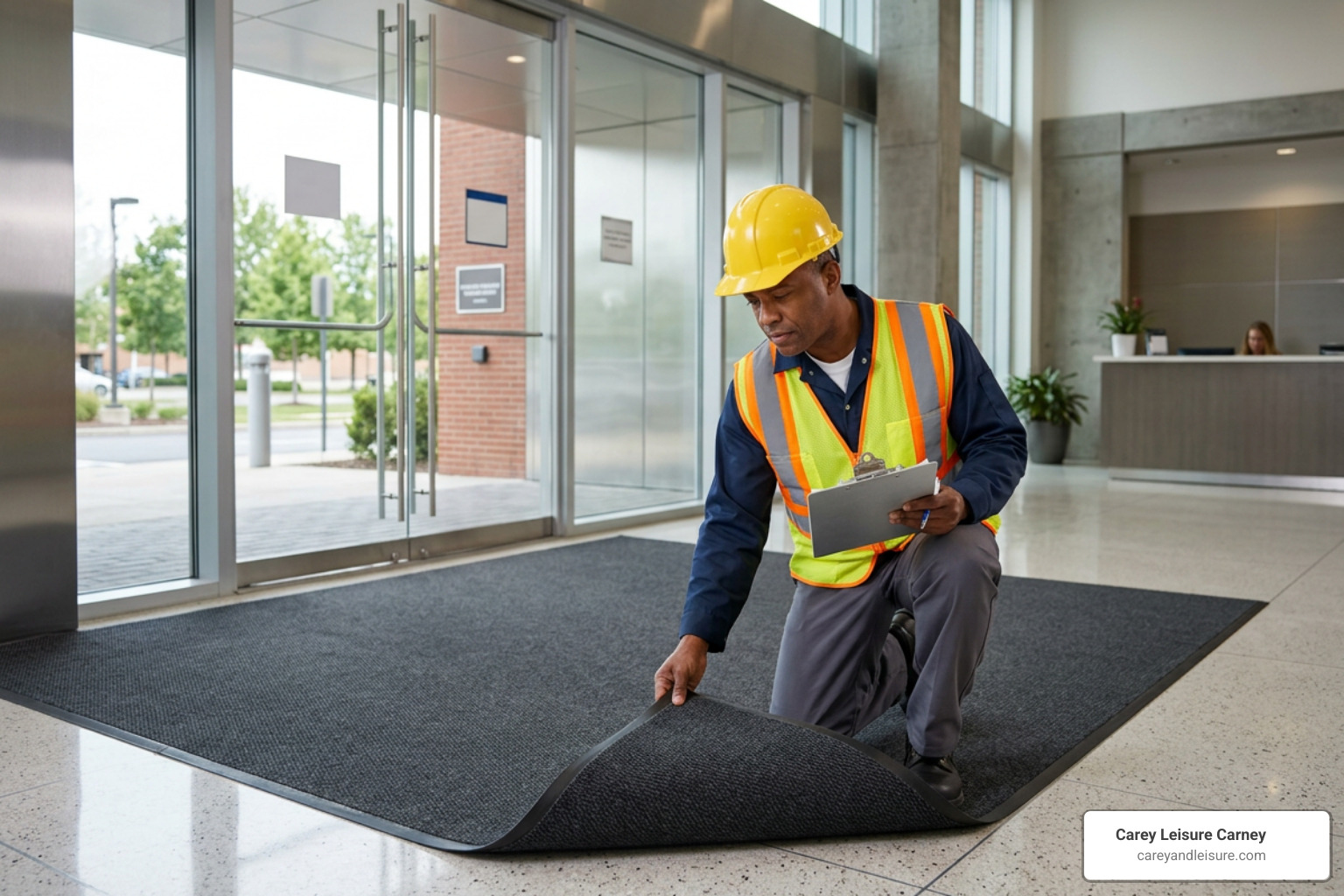
Preventing mat accidents requires an active, structured maintenance program rather than passive installation. Facility managers across commercial and industrial properties can minimize risk by following proven protocols:
- Conduct 5-Minute Daily Audits: Walk entrance paths, service counters, and transition areas before peak foot traffic to verify all mats lie flat, are aligned with door thresholds, and have intact bevels.
- Establish High-Traffic Inspection Cycles: During rain events or in busy retail environments, check mats every two hours for moisture saturation, shifting, or bunching.
- Match Backings to Floor Substrates: Use heavy-duty, 90-mil rubber backing or stay-put adhesive grips on smooth surfaces like terrazzo, polished concrete, and tile.
- Implement Clear Safety Signage: When temporary hazard conditions arise during repairs, adhere to visual warning placement standards by positioning high-visibility signs at eye level ahead of walking path transitions.
- Train Custodial and Floor Staff: Educate workers on the risks of stacking mats or rolling them tightly for storage. Empower employees to discard damaged floor coverings immediately.
- Document All Walkway Maintenance: Maintain accurate, time-stamped digital logs of cleaning, drying, and inspection cycles to demonstrate ongoing compliance with safety standards.
Understanding what to do after a trip and fall accident caused by a building or design defect helps injured individuals evaluate whether improper facility maintenance contributed to their fall.
Frequently Asked Questions About Commercial Floor Mat Safety
Can a business be held liable for an injury caused by a safety floor mat?
Yes. Business owners often assume that placing a mat shields them from liability because their intent was to prevent slips. However, if that mat is allowed to curl, slide, bunch, or become saturated, the business has introduced an active tripping hazard. When a property owner fails to inspect and maintain floor coverings, they can be held liable under Florida law for resulting injuries. For a complete overview of legal duties, review our premises liability attorney complete guide.
How often should high-traffic commercial floor mats be inspected and replaced?
In high-volume commercial environments such as retail stores, restaurants, and medical centers, mats should be visually inspected every two hours during operating hours. Mats showing edge curling, backing tears, or compression should be removed immediately. Depending on traffic volume, quality commercial mats typically require replacement every 12 to 24 months.
What evidence is required to prove a floor mat negligence claim?
Preserving evidence quickly is vital in premises liability claims. Essential evidence includes:
- High-resolution photographs or video showing the exact mat condition, curled edges, or lack of secure backing immediately following the incident
- Preservation of commercial security camera footage capturing the fall
- Business incident reports and employee witness statements
- Written maintenance and inspection logs (or evidence showing inspections were neglected)
- Medical records detailing physical injuries
Victims seeking legal guidance can work with an experienced slip and fall attorney new port richey fl to preserve critical evidence before property owners alter the scene.
Conclusion
Commercial floor mats are intended to protect pedestrians, but neglected, warped, or improperly placed mats create severe walking hazards. Property owners have a continuous legal duty to maintain their walking surfaces in a safe condition. When safety inspections are ignored, innocent patrons and workers suffer painful, costly injuries.
At Carey Leisure Carney, our Board-Certified trial attorneys bring over 100 years of combined legal experience to personal injury and premises liability claims across Florida. We provide direct attorney access and personalized representation to ensure our clients recover the full compensation they deserve.
If you or a loved one suffered an injury caused by a hazardous, poorly maintained floor mat in Clearwater, Largo, New Port Richey, Spring Hill, St Petersburg, Trinity, or Wesley Chapel, contact our team today for a free consultation regarding your Florida premises liability claim.