

The Lyft Accident Payout: A Guide to Understanding Your Rights
Why Understanding Lyft Accident Compensation Matters
Lyft accident compensation can be complicated. Knowing your rights is the first step to recovering what you deserve after a rideshare crash, where victims often face mounting medical bills, lost wages, and uncertainty about who will pay.
Quick Answer: What You Can Recover from a Lyft Accident
- Medical expenses (current and future treatment)
- Lost wages and diminished earning capacity
- Pain and suffering (physical and emotional)
- Property damage to your vehicle
- Settlement ranges from $10,000 for minor injuries to over $1 million for catastrophic cases
Coverage depends on the driver’s app status:
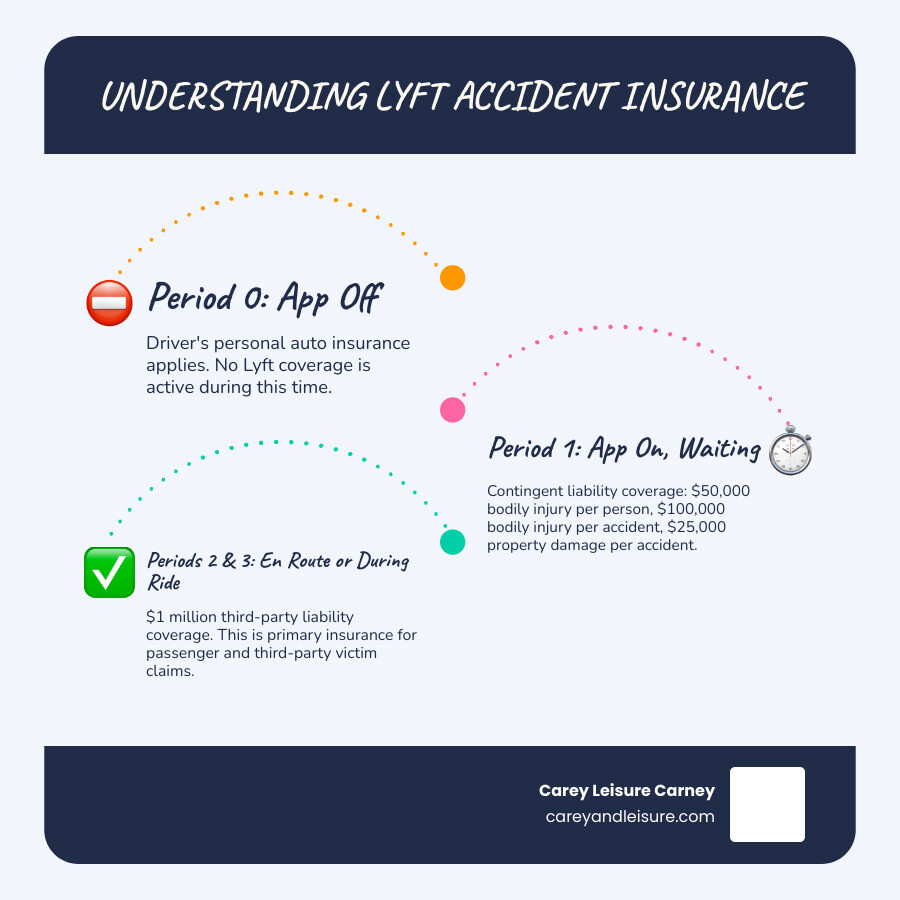
- App Off → Driver’s personal insurance only
- App On, Waiting → Limited Lyft coverage ($50,000/$100,000/$25,000)
- En Route or During Ride → Full $1 million Lyft policy
Rideshare services have transformed travel but also introduced new legal challenges. Research shows Uber and Lyft’s arrival led to a 3% increase in car accident fatalities overall. After a crash, the key questions are which insurance policy applies and how much you can recover, not just who was at fault.
The answer depends on injury severity, the driver’s app status, and who caused the collision. Insurers often try to minimize payouts by disputing coverage or offering quick, low settlements before victims understand their full damages.
Your compensation might include:
- Emergency room visits, surgery, and rehabilitation
- Weeks or months of lost income
- Long-term medical care for permanent injuries
- Compensation for chronic pain or disability
- Property damage to your vehicle
Florida’s no-fault insurance system adds complexity. Your Personal Injury Protection (PIP) covers initial medical bills regardless of fault. However, serious injuries allow you to pursue full compensation from the at-fault party, bringing Lyft’s substantial insurance policies into play.
I’m Thomas W. Carey, a board-certified civil trial lawyer who has handled thousands of personal injury cases across Florida, including complex rideshare accident claims involving Lyft accident compensation. My experience navigating rideshare insurance policies and Florida law has helped injured clients secure the full recovery they deserve.
Important Lyft accident compensation terms:
How Lyft’s Complex Insurance Coverage Works
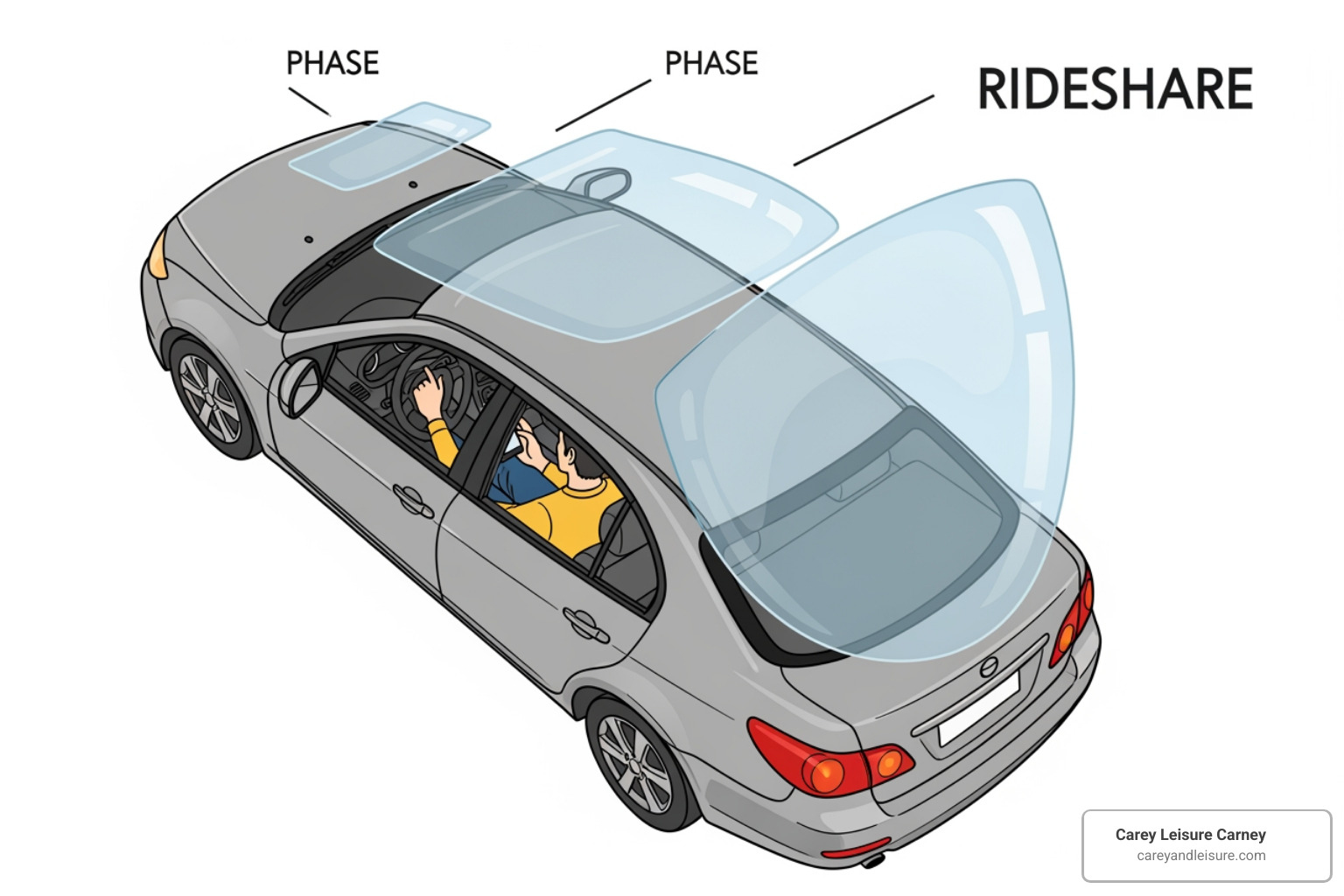
Understanding who pays after a Lyft accident is the most complex part of seeking Lyft accident compensation. Unlike traditional car accidents, a Lyft crash involves a multi-layered insurance structure dependent on the driver’s “app status” at the moment of collision. It’s not just about who caused the crash, but when they caused it relative to their rideshare duties.
Lyft’s insurance applicability and limits fluctuate based on the driver’s status: offline, waiting for a request, or on a ride. This confuses victims, making it hard to know which insurer to pursue for damages.
Period 0: App is Off
When a Lyft driver’s app is off and they are not logged into the Lyft platform, Lyft’s commercial insurance provides no coverage. In this scenario, the driver is a private citizen operating their personal vehicle. Any accident during this period is covered solely by the driver’s personal auto insurance policy.
This is like any other car accident on Florida roads. Florida law requires drivers to have $10,000 in Personal Injury Protection (PIP) and $10,000 in Property Damage Liability (PDL). Your own Personal Injury Protection (PIP) Insurance 101 – Part 2 would also cover your initial medical expenses. However, if the at-fault driver’s personal insurance is insufficient or they are uninsured, recovering full compensation can be challenging. This is where options like your own uninsured/underinsured motorist (UM/UIM) coverage become vital. If you’re asking, “What happens if an uninsured driver hits you?”, we can help you steer those waters.
Period 1: App is On, Waiting for a Request
This is where things get more complicated. When a Lyft driver has their app on and is waiting for a ride request, Lyft provides a limited contingent liability policy. This policy acts as secondary coverage, meaning the driver’s personal insurance is expected to pay first. If it denies coverage or is insufficient, Lyft’s policy may step in.
In Florida, during this “Period 1” phase, the state’s transportation network company (TNC) statute requires liability coverage of:
- $50,000 per person for bodily injury
- $100,000 per accident for bodily injury
- $25,000 per accident for property damage
These limits are much lower than when a passenger is in the vehicle. If you have serious injuries, these limits might not cover all your damages. Insurers often dispute which period the driver was in to limit their payout, which is why having an attorney who understands Lyft’s insurance policy details is essential.
Periods 2 & 3: En Route to Pick Up or During a Ride
These are the periods where Lyft’s most substantial insurance coverage applies. Once a Lyft driver accepts a ride request and is either en route to pick up a passenger (Period 2) or has a passenger in the vehicle (Period 3), Lyft’s commercial insurance policy becomes primary.
During these phases, Lyft typically provides:
- $1 million in third-party liability coverage for bodily injury and property damage.
This $1 million policy is a significant safeguard for passengers and other third parties (like drivers of other vehicles, pedestrians, or cyclists) injured due to the Lyft driver’s negligence. This robust coverage is designed to cover passenger injuries and third-party claims, offering a much higher ceiling for Lyft accident compensation. This policy is primary, meaning it should pay out before the driver’s personal insurance. Navigating these complex insurance layers requires expertise, and our team is well-versed in handling claims under these policies.
| Lyft Driver App Status | Insurance Coverage | Limits (Bodily Injury/Property Damage) |
|---|---|---|
| App Off (Period 0) | Driver’s Personal Auto Insurance | Varies by individual policy |
| App On, Waiting (Period 1) | Lyft’s Contingent Liability | $50k per person / $100k per accident / $25k property damage |
| En Route/During Ride (Periods 2 & 3) | Lyft’s Primary Commercial Policy | $1 million liability |
Key Factors That Determine Your Lyft Accident Compensation
When you’ve been in a Lyft accident, you’ll likely wonder, “What is my personal injury case worth?” There’s no single answer. The value of your Lyft accident compensation depends on many unique factors. Our job is to evaluate every detail to ensure you receive the full compensation you deserve.

These factors fall into two categories: economic damages (tangible financial losses) and non-economic damages (intangible losses like pain and suffering).
Severity of Injuries and Medical Expenses
The nature and severity of your injuries are the most significant drivers of your settlement amount. More severe injuries lead to higher medical expenses and a greater impact on your life, increasing the potential for substantial Lyft accident compensation.
- Minor Injuries: Cases with minor injuries like whiplash or sprains, requiring limited medical treatment, typically settle for $10,000 to $50,000.
- Moderate Injuries: Moderate injuries like fractures, concussions, or herniated discs requiring surgery or extended therapy often result in settlements from $50,000 to $200,000. For instance, a rear-end collision leading to herniated discs requiring epidural injections or surgery could settle for $65,000 to $110,000.
- Severe Injuries: Catastrophic injuries like Spinal Cord Injuries or a Traumatic Brain Injury Attorney can lead to settlements from $200,000 to over $1 million, especially in cases involving permanent disability or Fatal Accident Claims. The most common settlement range for serious Lyft accidents is $300,000 to $1 million. If you or a loved one have suffered such devastating harm, our Catastrophic Injury Attorney team is ready to fight for your future.
Medical expenses are not just about what you’ve already paid. We also consider future medical care, including ongoing treatments, medications, physical therapy, and potential surgeries, as well as rehabilitation costs. Documenting these costs thoroughly is crucial.
Lost Wages and Pain and Suffering
Beyond medical costs, a Lyft accident can severely impact your ability to earn a living and enjoy life.
- Lost Wages and Diminished Earning Capacity: If your injuries prevent you from working, you can claim compensation for lost income—both past and future. If your injuries result in a permanent disability that limits your job performance or forces you into a lower-paying role, we can seek compensation for diminished earning capacity.
- Pain and Suffering: This covers non-economic damages, including physical pain, emotional distress, and loss of enjoyment of life. While harder to quantify, these damages are a real part of your suffering. Insurance companies often use a “multiplier method,” multiplying your economic damages by a number between 1.5 and 5, depending on the severity of your injuries. Our team ensures your pain and suffering are never underestimated.
Determining Liability and Fault in Florida
Florida’s modified comparative negligence rule is critical for your Lyft accident compensation. Your compensation is reduced by your percentage of fault. For instance, if you are 20% at fault for a $100,000 award, you receive $80,000. However, if you are 51% or more at fault, you cannot recover any damages under Florida law.
Determining liability in a Lyft accident can be complex. Was it the Lyft driver’s negligence, another driver’s fault, or a combination? We carefully investigate every detail, including:
- Police Reports: These provide an official account of the accident.
- Witness Statements: Eyewitness accounts can corroborate your version of events.
- Dashcam Footage/Surveillance: Video can be invaluable in establishing fault.
- Lyft App Data: This can confirm the driver’s app status, which is crucial for insurance coverage.
Knowing “How to tell who is at fault in a car accident” is our specialty. We gather all necessary evidence to build a strong case for liability for our clients in Clearwater, Largo, New Port Richey, Spring Hill, St Petersburg, Trinity, and Wesley Chapel.
Potential Settlement Ranges for Lyft Accidents
There is no “average” settlement for a Lyft accident, as every case is unique. The figures below are ranges based on past cases. Your actual Lyft accident compensation depends on your specific circumstances, injuries, and legal representation. Think of it as a spectrum of possibilities, not a fixed price. For more general information, visit our page on Compensation after accident.
Minor Injury Settlements: $10,000 – $50,000
These settlements typically involve injuries that, while painful, do not result in long-term impairment or extensive medical intervention.
- Common Injuries: Whiplash, bruises, mild sprains, and minor soft tissue damage.
- Medical Treatment: Usually includes emergency room visits, a few doctor appointments, and possibly a short course of physical therapy.
- Impact: Limited time off work, minimal disruption to daily life.
- Examples: A rear-end collision causing minor soft tissue damage might settle between $6,000 and $25,000.
Moderate Injury Settlements: $50,000 – $200,000
This range applies to more serious injuries that require more intensive medical care, potentially including specialist consultations or surgical procedures.
- Common Injuries: Fractures, concussions, herniated discs, or significant soft tissue damage.
- Medical Treatment: May involve orthopedic care, neurological evaluations, surgery, and extended physical therapy.
- Impact: Moderate time off work, some limitations on activities, potential for ongoing pain.
- Examples: Cases with herniated discs requiring epidural injections or surgery often settle between $65,000 and $110,000. Intersection collisions frequently exceed $100,000 if fractures or internal injuries occur.
Severe Injury Settlements: $200,000 – $1 Million+
These are cases involving catastrophic injuries that lead to permanent impairment, long-term care needs, or wrongful death. Such cases can have multi-million dollar payouts.
- Common Injuries: Spinal Cord Injuries, traumatic brain injuries (TBIs), severe burns, amputations, or permanent disabilities.
- Medical Treatment: Extensive and ongoing medical care, multiple surgeries, lifelong rehabilitation, and adaptive equipment.
- Impact: Significant or permanent loss of earning capacity, profound impact on quality of life, and severe pain and suffering.
- Examples: The most severe Lyft accidents resulting in traumatic brain injuries, spinal cord damage, or Fatal Accident Claims frequently settle between $200,000 and over $1 million. The most common settlement range for serious Lyft accidents falls between $300,000 and $1 million.
The Claims Process: Steps to Take After a Lyft Accident
Being in a Lyft accident is jarring and complex. Knowing the right steps to take immediately and throughout the claims process can significantly impact your ability to secure fair Lyft accident compensation. We guide our clients in Clearwater, St. Petersburg, and across Florida on what to do.
Immediate Actions at the Scene
Your safety is the top priority. Follow these steps if you’re in a Lyft accident:
- Call 911: Report the accident to the police. A police report is critical documentation for your claim.
- Seek Medical Attention: See a doctor as soon as possible, even if you feel fine. Some injuries don’t manifest symptoms for hours or days. This creates a medical record linking your injuries to the accident.
- Exchange Information: Get contact and insurance details from all drivers involved.
- Take Photos and Videos: Document the scene, including vehicle damage, road conditions, and any visible injuries.
- Get Witness Contacts: If anyone saw the accident, get their names and phone numbers.
These immediate actions are crucial. For more detailed guidance, refer to our guide on “What to do after a car accident Florida.”
The Claims Process for Lyft Accident Compensation
Once immediate needs are addressed, the formal claims process begins.
- Report to Lyft: Use the app or website to report the accident to Lyft. Be factual and concise.
- Notify Your Own Insurer: Inform your personal auto insurance company, even if you weren’t at fault. Your PIP coverage will likely be the first to cover medical bills.
- Do Not Give a Recorded Statement: Insurance adjusters may contact you quickly. Do not give a recorded statement or sign any documents without consulting an attorney. Anything you say can be used against you.
- Preserve Evidence: Keep all medical records, bills, receipts for accident-related expenses, and records of lost wages.
“The role of insurance companies in a car accident” is often to minimize payouts. They may dispute liability, downplay your injuries, or offer a quick, low settlement.
Why You Need an Experienced Attorney
This is where our firm shines. Navigating a Lyft accident’s aftermath is difficult, especially when dealing with complex insurance policies.
- Navigating Insurance Complexities: We understand the nuances of when each policy (Lyft’s primary, contingent, or the driver’s personal) applies and how to compel the correct insurer to provide coverage.
- Calculating Total Damages: We carefully calculate all your economic and non-economic damages, including future medical expenses and a fair valuation for your pain and suffering.
- Negotiating with Adjusters: Insurance companies are notorious for lowball settlements. Our attorneys are skilled negotiators who will fight aggressively on your behalf, countering tactics designed to minimize your Lyft accident compensation. Research shows that professionally represented rideshare accident claims settle for 3.5 times more than unrepresented claims, on average.
- Filing a Lawsuit: If negotiations don’t yield a fair settlement, we are prepared to take your case to court.
For these reasons, having “Car Accident Attorneys a Must” is not an exaggeration. We level the playing field and work tirelessly to maximize your recovery.
Frequently Asked Questions about Lyft Accident Payouts
Clients in Clearwater, New Port Richey, and our other service areas often ask similar questions about Lyft accidents. Here are answers to provide clarity on Lyft accident compensation.
How long does a Lyft accident settlement take?
A Lyft accident settlement timeline varies from months to years, depending on:
- Case Complexity: Accidents with multiple vehicles, disputed liability, or complex medical issues take longer.
- Injury Severity: For severe injuries, we often wait until you reach Maximum Medical Improvement (MMI) to accurately assess long-term damages.
- Negotiation Period: Reaching a fair settlement with insurers can involve extensive negotiations.
- Litigation Timeline: If a lawsuit is filed, the court process can add months or years to the timeline.
Our goal is to achieve the best outcome efficiently, but never at the expense of securing the full compensation you deserve.
Can I sue Lyft directly for an accident?
Suing Lyft directly is challenging because its drivers are independent contractors, not employees. This distinction helps Lyft argue it is not directly liable for a driver’s negligence.
However, direct claims against Lyft might be pursued for:
- Negligent Hiring or Retention: If Lyft failed to conduct proper background checks or ignored a driver’s unsafe history.
- Failure to Maintain a Safe Platform: If an app malfunction contributed to the accident.
In most cases, claims for Lyft accident compensation are made against the at-fault driver’s insurance and/or Lyft’s commercial insurance policy. Our legal team can determine the most effective strategy for your case.
What if the at-fault driver was in another vehicle?
If another driver caused the accident, your claim primarily targets their auto insurance, similar to a standard car accident claim.
However, Lyft’s insurance can still play a crucial role:
- Third-Party Claim: We would pursue a claim against the at-fault driver’s liability insurance for your damages.
- Lyft’s Uninsured/Underinsured Motorist (UM/UIM) Coverage: If the at-fault driver’s insurance is insufficient or they are uninsured, Lyft’s commercial policy typically includes significant UM/UIM coverage (often up to $1 million) that can cover the shortfall.
Understanding Uninsured vs. Underinsured Motorist Coverage Explained is key, and we help our clients steer these options to ensure they receive maximum compensation.
How Carey Leisure Carney Can Maximize Your Settlement
At Carey Leisure Carney, we understand that a Lyft accident can turn your life upside down. Our mission is to alleviate the legal burden so you can focus on what truly matters: your recovery. Based in Clearwater, Florida, and serving clients across Largo, New Port Richey, Spring Hill, St. Petersburg, Trinity, and Wesley Chapel, we bring unparalleled expertise to your Lyft accident compensation claim.
What sets us apart?
- Board-Certified Expertise: Our attorneys are Board-Certified in Civil Trial Law, a distinction held by only 2% of Florida lawyers. This means we possess a superior level of knowledge, skill, and experience in the courtroom, ensuring your case is handled with the highest level of competence. With over 100 years of combined experience, we have a deep understanding of Florida’s complex personal injury laws and rideshare insurance regulations.
- Direct Attorney Access: We believe in personalized service. When you work with us, you get direct access to your attorney. We are here to answer your questions, explain complex legal concepts in simple terms, and keep you informed every step of the way.
- Navigating Complex Insurance: The multi-layered insurance policies of Lyft, combined with Florida’s no-fault system, create a challenging landscape. We excel at identifying all potential sources of recovery, including Lyft’s commercial policies, the driver’s personal insurance, and any other applicable coverages, to maximize your compensation.
- Fighting for Fair Compensation: Insurance companies are not on your side. They will try to minimize your payout. We stand firm against these tactics, carefully documenting your damages, building a robust case, and aggressively negotiating for the full and fair settlement you deserve. If negotiations fail, we are ready and able to take your case to trial.
- Free Consultation: We offer a free, no-obligation consultation to discuss your Lyft accident case. This allows us to understand your situation, explain your legal options, and outline how we can help, all at no cost to you.
Don’t let the complexities of a Lyft accident claim overwhelm you. Let our experienced team fight for your rights and secure the compensation you need to move forward. Contact a Rideshare Accident Attorney at Carey Leisure Carney today.