

How to Win Your Personal Injury Lawsuit Without Losing Your Mind
What Are Your Real Chances of Winning a Personal Injury Lawsuit?
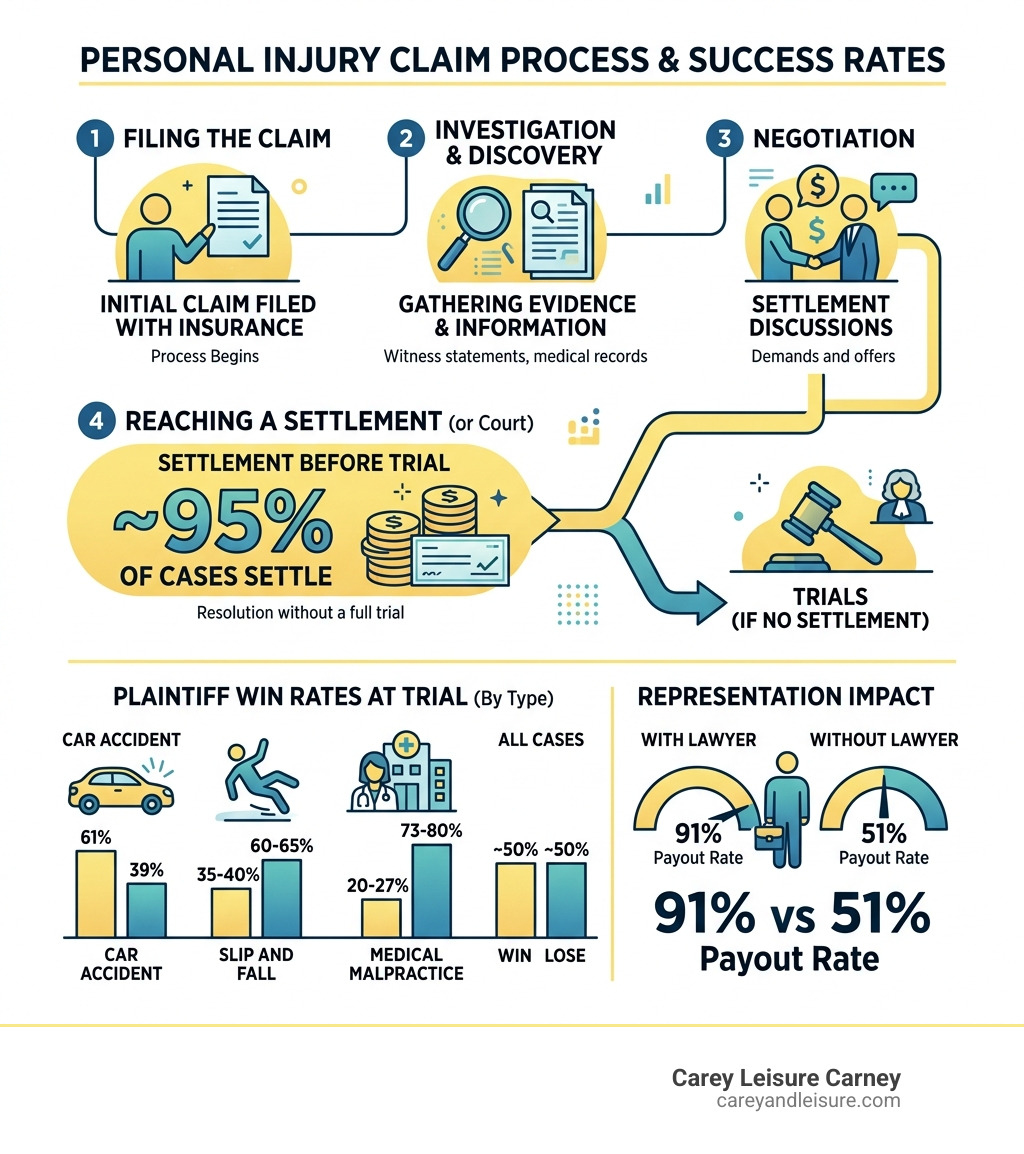
The chances of winning a personal injury lawsuit are better than most people expect — here’s a quick breakdown:
| Scenario | Success Rate |
|---|---|
| Cases that settle before trial | ~95% |
| Plaintiffs who win at trial | ~50% |
| Car accident cases at trial | ~61% |
| Medical malpractice cases at trial | ~20-27% |
| Slip and fall cases at trial | ~35-40% |
| Cases with a lawyer vs. without | 91% vs. 51% payout rate |
The short version: most personal injury cases resolve in the injured person’s favor — but the amount you recover and how smoothly the process goes depends heavily on your specific situation.
If you’ve been hurt in an accident in Florida, you’re likely dealing with mounting medical bills, lost income, and a legal system that feels overwhelming. That’s normal. And you’re not alone in wondering whether pursuing a claim is even worth it.
Here’s what the data actually shows: roughly 95% of personal injury cases settle before ever reaching a courtroom, according to the U.S. Department of Justice. That means a full trial is the exception, not the rule. But “settling” isn’t the same as “losing” — a well-negotiated settlement can fully cover your medical costs, lost wages, and pain and suffering.
What separates a strong outcome from a weak one comes down to a handful of factors: the quality of your evidence, how fault is assigned, the severity of your injuries, and — critically — whether you have experienced legal representation fighting for you.
I’m Thomas W. Carey, founding partner of Carey Leisure Carney and a board-certified civil trial lawyer with over 35 years of experience guiding clients through the full spectrum of personal injury claims across Florida — and I’ve seen how the right preparation dramatically shifts the chances of winning a personal injury lawsuit in your favor. In this guide, I’ll walk you through exactly what drives case outcomes, what Florida law means for your claim, and what you can do right now to protect your rights.
Easy chances of winning a personal injury lawsuit glossary:
Defining Success: What Are the Real Chances of Winning a Personal Injury Lawsuit?

When we talk about “winning,” many people picture a dramatic Hollywood scene where a jury foreperson reads a verdict for millions of dollars. In reality, winning a personal injury case usually means reaching a settlement agreement that fairly compensates you for your losses.
Statistically, the vast majority of personal injury lawsuits never see the inside of a courtroom. Data from the U.S. Department of Justice (DOJ) and the National Center for State Courts (NCSC) consistently shows that approximately 95% of cases settle before trial. Understanding these lawsuit basics is the first step toward lowering your stress levels. A settlement is a guaranteed “win” — it provides immediate funds and eliminates the risk of walking away with nothing.
The Reality of Courtroom Victories
While settlements are common, some cases do proceed to trial. If your case is among the 4-5% that reach a jury, the chances of winning a personal injury lawsuit at trial hover around 50%.
Trials are inherently risky. Juries are composed of human beings with their own biases, and their decisions can be unpredictable. This is why the litigation process is often viewed as a high-stakes chess match. If a defendant offers a settlement that covers your needs, taking the “sure thing” is often the wiser move than gambling on a 50/50 jury split.
Why Most Cases Settle Out of Court
Insurance companies and defendants generally prefer settlements for three main reasons:
- Risk Mitigation: They don’t want to risk a massive jury award that exceeds their policy limits.
- Cost Efficiency: Trials are expensive. Legal fees, expert witness costs, and court fees can easily reach $50,000 to $100,000 or more.
- Privacy: Settlements are usually private, whereas trial records are public.
During the the litigation process: depositions and discovery phases, both sides get a clear look at the other’s “cards.” If the evidence is overwhelmingly in your favor, the insurance company will likely increase their offer to avoid a public defeat.
The Anatomy of a Strong Case: Evidence and Liability
To improve your chances of winning a personal injury lawsuit, you must meet the “burden of proof.” In civil cases, this is known as the preponderance of the evidence. This doesn’t mean proving your case “beyond a reasonable doubt” like in a murder trial; it simply means proving that your version of events is more likely than not (at least 51% likely).
Whether you are dealing with a standard accident or a case involving gross negligence law complete guide, the quality of your documentation is the engine that drives your compensation after accident.
How Evidence Impacts the Chances of Winning a Personal Injury Lawsuit
Evidence turns “he-said, she-said” into an undeniable fact. For example, a case supported only by your personal testimony might have a 50% chance of settling. However, if you add CCTV footage of the crash, that probability can jump to 90%.
| Type of Evidence | Impact on Success Odds |
|---|---|
| CCTV/Dashcam Footage | Extremely High – Hard to dispute visual proof |
| Third-Party Witness Statements | High – Neutral parties carry weight with juries |
| Comprehensive Medical Records | High – Links injuries directly to the event |
| Police Reports | Moderate – Provides an official narrative |
| Expert Testimony | Moderate to High – Necessary for complex medical/tech issues |
Proving Fault and Causation
To win, we must prove four key elements of negligence:
- Duty of Care: The defendant owed you a duty to act reasonably (e.g., a driver must follow traffic laws).
- Breach of Duty: They failed that duty (e.g., they ran a red light).
- Causation: Their failure directly caused your injury.
- Damages: You suffered actual losses (medical bills, pain, etc.).
If you’re wondering what is my personal injury case worth?, the answer depends on how clearly we can link the defendant’s breach to your specific injuries.
Navigating Florida’s Legal Landscape and Success Odds
Florida has unique laws that directly impact your chances of winning a personal injury lawsuit. One of the most significant is the modified comparative negligence rule.
As of 2023, Florida follows a “51% bar” rule. This means you can recover compensation as long as you are not more than 50% at fault for the accident. If you are found to be 20% at fault, your total award is reduced by 20%. However, if you are 51% at fault, you get nothing. This makes understanding comparative negligence vital when calculating how to get the most compensation from a car accident settlement in Florida.
Florida’s Serious Injury Threshold
Because Florida is a “no-fault” state for car accidents, your own Personal Injury Protection (PIP) insurance covers the first $10,000 of your medical bills regardless of who caused the crash. To sue the other driver for “pain and suffering” (non-economic damages), you must meet the “serious injury threshold.” This typically requires proving a permanent injury, significant scarring, or loss of a bodily function. Reviewing personal injury settlement examples can help you see how these thresholds are met in real-world scenarios.
Improving Your Chances of Winning a Personal Injury Lawsuit Through Expert Representation
The single most controllable factor in your case success is your choice of attorney. According to the Insurance Research Council, injury victims who hire a lawyer recover 3.5 times more compensation on average than those who represent themselves.
At Carey Leisure Carney, we provide something most firms don’t: direct access to Board-Certified civil trial lawyers. Only 2% of Florida attorneys hold this certification. When insurance adjusters see a Board-Certified lawyer on the letterhead, they know the chances of winning a personal injury lawsuit against us at trial are slim, which often forces them to offer higher settlements early on. This is a primary reason why you need a personal injury lawyer and why you should use your trusted advocate: a guide to selecting a personal injury lawyer to vet your counsel.
Common Pitfalls That Sabotage Your Success Odds
Even a “slam dunk” case can be ruined by simple mistakes. One of the biggest traps today is social media. If you claim a debilitating back injury but post a photo of yourself at a Clearwater beach BBQ the next weekend, the insurance company will find it and use it to destroy your credibility.
Another common issue is “gaps in treatment.” If you wait three weeks to see a doctor after an accident, the insurer will argue that you weren’t actually hurt or that something else caused the injury in the intervening time. If your claim is initially rejected, don’t take no for an answer: navigating denied claims with legal counsel to get back on track.
Dealing with Insurance Company Tactics
Insurance adjusters are not your friends. Their job is to protect their company’s bottom line. Common tactics include:
- The Lowball: Offering a quick, small check before you know the full extent of your injuries.
- Recorded Statements: Asking “innocent” questions designed to get you to admit fault.
- Delays: Dragging out the process to make you desperate for any amount of money.
If you feel you are being treated unfairly, you may need bad faith insurance lawyers near me to hold the insurer accountable.
The Impact of the Statute of Limitations
In Florida, you generally have two years from the date of the accident to file a personal injury lawsuit. While two years sounds like a long time, evidence disappears quickly. Skid marks fade, witnesses move away, and surveillance footage is often erased within 72 hours. The sooner you file, the better your chances of winning a personal injury lawsuit.
Frequently Asked Questions About Lawsuit Success Rates
What is the average success rate for car accident lawsuits?
Car accident claims have one of the highest success rates, with plaintiffs winning approximately 61% of cases that go to trial. This is often because liability is easier to prove through police reports, traffic laws, and vehicle damage patterns. Rear-end collisions, in particular, almost always favor the driver who was hit.
Can I still win my case if I was partially at fault?
Yes! As long as you are 50% at fault or less, you can still recover damages in Florida. If you are awarded $100,000 but were 25% at fault for speeding, you would still receive $75,000. Our job is to minimize your assigned fault to maximize your payout.
How long does it typically take to resolve a personal injury case?
Most cases resolve within 6 to 18 months. The timeline depends heavily on your “Maximum Medical Improvement” (MMI). We cannot settle your case until we know the full cost of your future medical needs. Rushing a settlement usually means leaving money on the table.
Conclusion
Navigating the legal system in Clearwater, St. Petersburg, or New Port Richey doesn’t have to be a nightmare. While the chances of winning a personal injury lawsuit are statistically in your favor, the margin for error is thin.
At Carey Leisure Carney, we combine over a century of experience with the personalized touch of a family-run firm. You won’t be passed off to a paralegal; you will have direct access to the board-certified experts who are actually handling your case. Whether you are in Largo, Trinity, or Wesley Chapel, we are ready to fight for the compensation you deserve.
Don’t let an insurance company dictate your future. Contact an experienced auto accident attorney at Carey Leisure Carney today for a free consultation, and let us help you win your case without losing your mind.