
Your Rights on the Road: An Attorney’s Guide for Rideshare Drivers
Why Rideshare Drivers Need Legal Guidance
An attorney for uber drivers helps with accidents, deactivation disputes, wage claims, and complex insurance issues stemming from your independent contractor status. Here’s when you need one:
- After an accident: To handle multi-layered insurance claims, determine liability, and secure full compensation for injuries and lost income.
- Account deactivation: To appeal wrongful termination, challenge policy violations, or fight unfair rating-based removal.
- Wage and expense disputes: To recover unpaid earnings, tips, or reimbursement for vehicle costs.
- Arbitration requirements: To represent you against corporate legal teams in mandatory arbitration proceedings.
- Insurance claim denials: To negotiate with billion-dollar insurers who aggressively defend rideshare cases.
The gig economy’s growth has created serious legal challenges. Rideshare drivers face unique risks compared to traditional employees. As independent contractors, Uber and Lyft often avoid liability. You’re also on the road more, increasing your accident risk; one study found traffic fatalities rose 3% annually with the advent of ridesharing.
After an accident, you’re caught between multiple insurance policies. Coverage shifts based on your app status. A crash during a ride could trigger Uber’s $1 million policy, but the same crash while waiting for a request might only provide $50,000 in coverage—or leave a gap where no policy pays.
Account deactivation can end your income overnight for anything from low ratings to unproven claims, and the appeals process favors the platform. Wage disputes are also complex, as contractors lack minimum wage or overtime guarantees.
The legal landscape is constantly evolving. While some states push for employee reclassification, most still treat you as a contractor. Arbitration clauses in your agreement mean you can’t sue in court and must face the company in private arbitration, where they have the advantage.
I’m Thomas W. Carey, a board-certified civil trial lawyer with over 35 years of experience handling complex injury cases across Florida. As an attorney for uber drivers, I’ve seen how rideshare accidents and disputes demand specialized legal knowledge to protect drivers’ rights and secure the compensation they deserve.
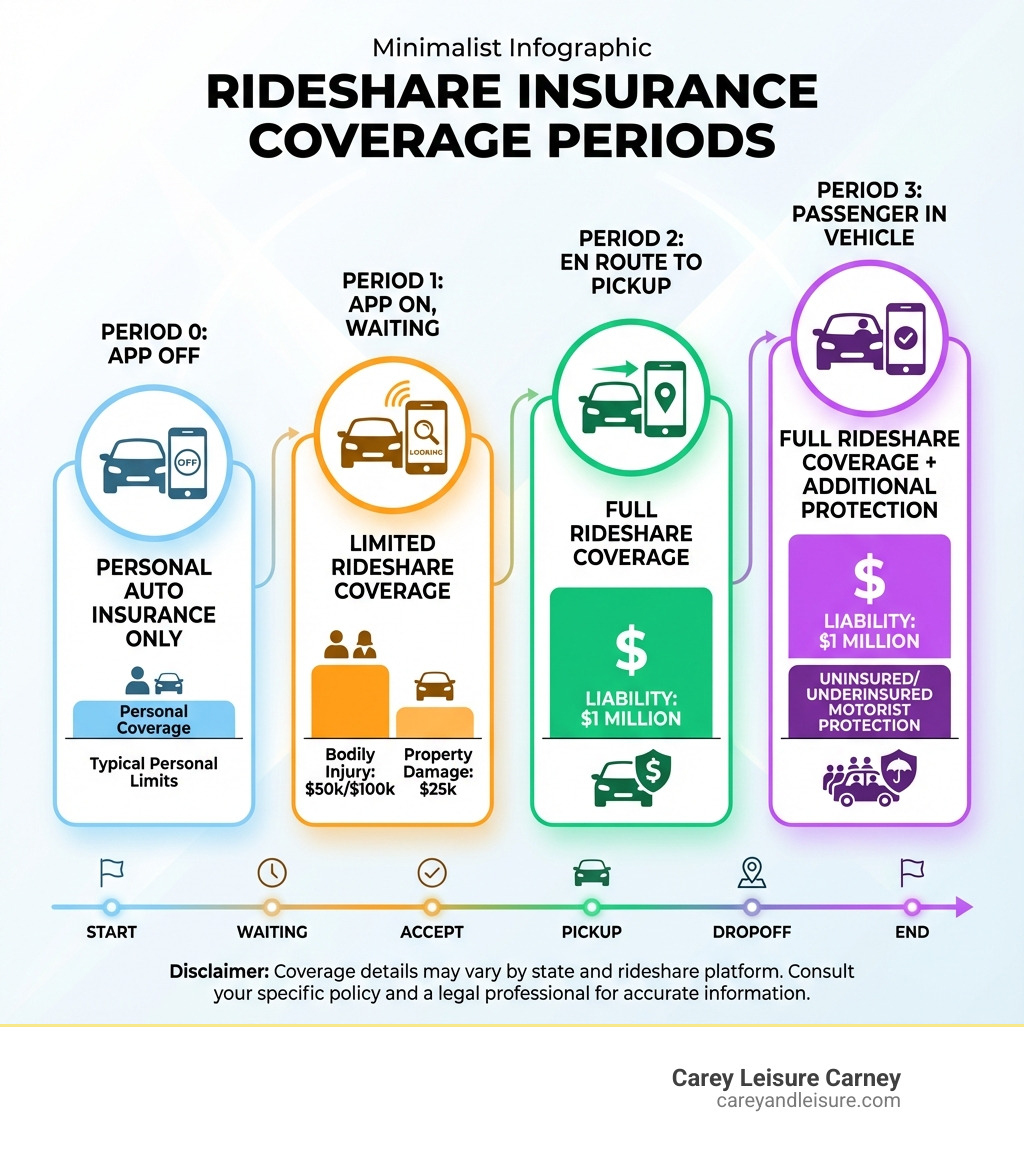
Infographic: Rideshare Insurance Coverage Periods – Period 0 (App Off): Personal auto insurance only. Period 1 (App On, Waiting for Request): Limited rideshare coverage – $50,000 per person/$100,000 per accident bodily injury, $25,000 property damage. Period 2 (En Route to Pickup): Full rideshare coverage – $1 million liability. Period 3 (Passenger in Vehicle): Full rideshare coverage – $1 million liability plus uninsured/underinsured motorist protection.
Navigating an Accident: Insurance, Liability, and Your First Steps

A car accident is stressful, but for Florida rideshare drivers, it’s a labyrinth of insurance and liability questions. Uber and Lyft classify drivers as independent contractors, a critical distinction that impacts whose insurance covers damages and when.
Florida’s mix of a fault-based system for accident liability and a no-fault system for Personal Injury Protection (PIP) is already complex. For rideshare drivers, it becomes even more intricate.
Understanding liability and coverage depends on the “period” of the ride—your app status at the moment of the crash.
Understanding Rideshare Insurance: What’s Covered and When?
Uber and Lyft provide supplemental insurance policies, but coverage amounts vary based on your app status. Florida’s HB221 outlines specific insurance requirements for ridesharing services.
Here’s a breakdown of the four crucial periods:
- Period 0 (App Off): If your app is off, rideshare insurance provides no coverage. Your personal auto policy is responsible, but it may have an exclusion for commercial use, which is why many drivers get specialized rideshare insurance.
- Period 1 (App On, Waiting for Request): When you’re logged in and waiting for a request, a lower tier of company coverage kicks in, as required by Florida law:
- Primary automobile liability coverage of at least $50,000 for bodily injury per person.
- $100,000 for total bodily injury per incident.
- $25,000 for property damage per incident.
- PIP and uninsured/underinsured motorist (UM/UIM) coverage as required by Florida law. You can find more detailed information on Uber’s insurance policy details and Lyft’s insurance policy details.
- Period 2 (En Route to Pickup): Once you accept a request and are en route to the passenger, the highest tier of coverage is active:
- Up to $1 million in primary liability coverage for death, bodily injury, and property damage per accident.
- PIP and uninsured/underinsured motorist (UM/UIM) coverage as required by Florida law.
- Period 3 (With Passenger): With a passenger in your vehicle, you have the same robust coverage as Period 2:
- Up to $1 million in primary liability coverage for death, bodily injury, and property damage per accident.
- PIP and uninsured/underinsured motorist (UM/UIM) coverage as required by Florida law.
Uninsured/Underinsured Motorist (UM/UIM) coverage is particularly important. It protects you if you’re hit by a driver with no insurance or not enough to cover your damages. Uber and Lyft provide significant UM/UIM coverage during Periods 2 and 3. However, navigating these claims can be incredibly complex. Understanding the nuances of Uninsured vs underinsured motorist coverage explained is crucial.
An attorney for uber drivers is essential to steer these policies, negotiate with insurers, and ensure you receive maximum compensation.
Immediate Steps to Take After a Rideshare Accident
After an accident, prioritize safety and secure the scene. Take these crucial steps:
- Call 911: Report the accident to get police and medical services to the scene. A police report is vital for your insurance claim.
- Report in-app: Use the app’s emergency feature to report the accident to Uber or Lyft. Take screenshots of your app showing your active status (Period 1, 2, or 3).
- Document the scene: Take photos and videos of vehicle damage, license plates, road conditions, and any visible injuries.
- Exchange information: Collect contact and insurance information from all involved drivers.
- Seek immediate medical care: Get checked by a doctor, even if you feel fine. Some injuries don’t manifest for hours or days.
- Avoid admitting fault: Do not apologize or make statements that could be interpreted as admitting fault. Stick to the facts.
- Collect witness contacts: Get names and phone numbers from any witnesses.
- Contact an attorney for uber drivers: Before speaking with insurance adjusters, contact us. They aim to minimize payouts; we protect your rights.
For more detailed guidance, refer to our guide: What to do after a car accident in Florida.
Common Causes and Injuries in Rideshare Crashes
Rideshare drivers are on the road more, increasing their accident risk. One study highlighted a 3% increase in traffic accidents linked to the industry’s rise.
Common causes of rideshare accidents include:
- Distracted driving: Using a phone for navigation or ride requests while driving is dangerous. Impaired driving statistics show the severe risks involved.
- Speeding to meet demand: The pressure to complete rides quickly can lead to aggressive driving.
- Driver fatigue: Long hours on the road can impair judgment and reaction times.
- Unsafe pickups/drop-offs: Stopping in hazardous locations can create dangers.
The types of injuries sustained in rideshare accidents can range from minor to catastrophic:
- Whiplash and soft tissue injuries.
- Spinal cord injuries: Can lead to paralysis or long-term disability.
- Traumatic brain injuries (TBI): Ranging from concussions to severe brain damage.
- Fractures and broken bones.
- Lacerations and contusions.
- Internal organ injuries.
- Fatalities.
- Psychological trauma: Including Post-Traumatic Stress Disorder (PTSD), anxiety, and depression.
The Independent Contractor Dilemma: How Your Classification Affects Your Rights
Classifying drivers as independent contractors is foundational to the gig economy. While offering flexibility, it shields companies like Uber and Lyft from employer responsibilities, a classification that has been a legal battleground for years as it denies drivers essential protections.
These multi-billion dollar companies use this classification to avoid costs like minimum wage, overtime, and benefits. We find this approach unjust, as the public increasingly expects taxi-like accountability from these services.
The legal fight over driver classification has been fierce. Landmark cases, including a monumental $26 million verdict against a taxi company, have demonstrated that with skilled legal representation, the independent contractor defense can be challenged and defeated.
Key Risks of Being an Independent Contractor
As an independent contractor in Florida, you face significant risks:
- No overtime pay or minimum wage guarantee: Your earnings are tied to fares, without an hourly safety net.
- Bearing all expenses: You are responsible for gas, vehicle maintenance, insurance, and other operational costs.
- No employer-provided benefits: This means no health insurance, retirement plans, or paid time off.
- No workers’ compensation: If injured on the job, you typically don’t qualify for workers’ compensation. This leaves personal injury lawsuits as a primary recourse, a process requiring an experienced attorney for uber drivers.
- Self-employment taxes: You’re responsible for both employer and employee portions of Social Security and Medicare taxes.
These burdens underscore why legal advocates continue to fight for better conditions. For more on your options when injured, explore Filing Personal Injury Lawsuits.
The “ABC Test” and the Fight for Employee Status
The “ABC Test” is a legal standard used in states like California to determine worker classification. While Florida doesn’t use this test, its influence is critical for the future of the gig economy nationwide.
The ABC Test presumes a worker is an employee unless the company proves all three of the following conditions:
- (A) The worker is free from the control and direction of the hiring entity in connection with the performance of the work.
- (B) The worker performs work that is outside the usual course of the hiring entity’s business.
- (C) The worker is customarily engaged in an independently established trade, occupation, or business of the same nature as the work performed.
If a company fails even one criterion, the worker is an employee. A California Supreme Court ruling making the test retroactive sent shockwaves through the gig economy, leading to major legal battles.
The implications of reclassification are enormous for rideshare companies, as it would mean providing minimum wage, overtime, and benefits, significantly increasing their costs. This ongoing legal struggle, championed by tireless advocates, continues to shape the future of work. For drivers, this fight is about securing fundamental labor rights, and an attorney for uber drivers can help you understand how these evolving standards might affect you.
When to Hire an Attorney for Uber Drivers
As a rideshare driver, you steer a complex legal landscape where challenges from accidents to deactivations can be overwhelming. An attorney for uber drivers is an indispensable ally. Uber and Lyft are multi-billion dollar companies with vast legal teams protecting their interests, not yours. Facing them alone is a significant disadvantage.
An experienced attorney makes all the difference in accident claims, deactivation fights, or wage disputes. We help you steer mandatory arbitration, file claims correctly, and negotiate with powerful insurers who aim to minimize payouts.
The Role of an Attorney in Accident Claims
If you’ve been in an accident while driving for Uber or Lyft in Florida, an attorney for uber drivers plays several critical roles:
- Investigating the crash: We gather evidence like police reports, witness statements, and medical records to establish fault and damages.
- Gathering evidence: We review app data and ride logs to prove your status at the time of the crash, which is crucial for insurance coverage.
- Calculating total damages: We assess all damages, including medical bills, lost wages, future needs, and pain and suffering. An attorney for uber drivers can determine “What is my personal injury case worth?”
- Negotiating with multiple insurers: We manage complex negotiations between your personal policy, the at-fault driver’s insurance, and rideshare policies to prevent coverage gaps.
- Fighting lowball settlement offers: Insurers often try to settle for less than your case is worth. We aggressively advocate for a fair settlement that covers all your losses.
- Proving liability: In Florida’s fault-based system, proving who caused the accident is paramount. We build a strong case to hold the responsible parties accountable.
- Court representation: While many cases settle, we are prepared to take your case to court if a fair agreement cannot be reached.
How an attorney for Uber drivers can help with Deactivation and Disputes
Wrongful deactivation can instantly cut off your income. If you believe you’ve been unfairly deactivated for reasons like low ratings or false allegations, an attorney for uber drivers can be your strongest advocate:
- Reviewing the deactivation notice: We help you understand the specific, often complex, reasons for your deactivation.
- Drafting a compelling appeal: We help prepare a detailed appeal with evidence to challenge the decision.
- Navigating internal reviews: We guide you through the company’s opaque appeal process to ensure deadlines and procedures are met.
- Considering legal action: If appeals fail, we explore legal options like arbitration or court action.
Uber cannot retaliate against you for bringing a legal claim against it. To learn more about selecting the right legal partner, check out our guide on Hiring a law firm what you need to know.
Why an attorney for Uber drivers is crucial for navigating arbitration
Your driver agreement forces most claims against Uber or Lyft into arbitration, a private dispute resolution process where they have a significant advantage.
An experienced attorney for uber drivers is crucial for this process because:
- Understanding the arbitration clause: We explain its implications for your case.
- Filing an arbitration demand: We ensure this formal legal document is filed correctly and effectively states your claims.
- Evidence findy: We manage the evidence exchange process to build your case.
- Representation against corporate lawyers: You need strong representation to counter the company’s experienced legal team.
- Negotiating a binding settlement: We negotiate for a favorable outcome before or during the binding arbitration hearing.
Securing Fair Compensation: What You Can Claim
After an accident or wrongful deactivation, securing fair compensation is paramount. As an attorney for uber drivers, we work to get you every dollar you’re entitled to. Claims fall into two categories: economic and non-economic damages.
| Category | At-Fault Driver Accident | Not-At-Fault Driver Accident |
|---|---|---|
| Economic Damages | – Medical bills (past & future) | – Medical bills (past & future) |
| – Lost wages (past & future) | – Lost wages (past & future) | |
| – Property damage (vehicle repair/replacement) | – Property damage (vehicle repair/replacement) | |
| – Diminished earning capacity | – Diminished earning capacity | |
| – Out-of-pocket expenses (e.g., rental car, medication) | – Out-of-pocket expenses (e.g., rental car, medication) | |
| Non-Economic Damages | – Pain and suffering | – Pain and suffering |
| – Emotional distress | – Emotional distress | |
| – Mental anguish | – Mental anguish | |
| – Loss of enjoyment of life | – Loss of enjoyment of life | |
| – Disfigurement/scarring | – Disfigurement/scarring | |
| – Loss of consortium (for spouse) | – Loss of consortium (for spouse) | |
| Punitive Damages | – In rare cases, if conduct was grossly negligent or intentional (e.g., DUI). These are meant to punish the at-fault party and deter similar behavior. | – In rare cases, if conduct was grossly negligent or intentional (e.g., DUI). These are meant to punish the at-fault party and deter similar behavior. |
| Wrongful Death | – If the accident results in death, surviving family members can pursue damages for funeral expenses, lost financial support, and emotional suffering. | – If the accident results in death, surviving family members can pursue damages for funeral expenses, lost financial support, and emotional suffering. |
| Deactivation Cases | – Lost income from deactivation | – Lost income from deactivation |
| – Emotional distress | – Emotional distress | |
| – Costs associated with finding alternative employment | – Costs associated with finding alternative employment |
Table: Potential Compensation in Rideshare Accident and Deactivation Cases
For a deeper dive into financial recovery after an incident, visit our page on Compensation after accident.
Calculating Economic Damages
Economic damages are quantifiable financial losses from the incident. They are easier to calculate but require thorough documentation.
- Past and future medical bills: Covers ER visits, surgery, physical therapy, and long-term care.
- Lost income: We calculate past and future lost earnings if you cannot drive due to injury or deactivation.
- Diminished earning capacity: Compensation for a permanent reduction in your ability to earn a living.
- Vehicle repair or replacement: Fair compensation for damage to or total loss of your vehicle.
- Out-of-pocket expenses: Covers rental cars, transportation to medical appointments, and medications.
Understanding Non-Economic Damages
Non-economic damages cover non-monetary losses that impact your quality of life and are harder to quantify.
- Pain and suffering: Compensation for physical discomfort and emotional distress from your injuries.
- Emotional distress: Covers anxiety, depression, and other psychological impacts.
- Post-Traumatic Stress Disorder (PTSD): A severe accident can result in lasting psychological effects.
- Loss of enjoyment of life: Damages for being unable to participate in hobbies and activities you once enjoyed.
- Disfigurement or scarring: Compensation for the distress caused by permanent physical changes.
In Florida, there are specific considerations for calculating pain and suffering. To learn more, read our guide on Compensation for pain and suffering in Florida.
Frequently Asked Questions about Legal Help for Rideshare Drivers
Can I sue Uber or Lyft directly if I’m in an accident?
Suing Uber or Lyft directly is difficult because you are an independent contractor, a status companies use to avoid liability. Claims are typically filed first against the at-fault driver’s insurance, then your personal policy, and finally the rideshare company’s policy if applicable.
A direct lawsuit may be possible if the company was negligent, for example, by failing to conduct a proper background check. Their screening processes have been criticized as inadequate. We believe they should be held to a higher safety standard. An experienced attorney for uber drivers can assess your case to find the best legal strategy.
What if the other driver is uninsured or flees the scene (hit-and-run)?
Uninsured/Underinsured Motorist (UM/UIM) coverage is vital in this scenario. If the at-fault driver is uninsured, underinsured, or flees the scene (hit-and-run), your UM/UIM coverage can pay for your damages.
How UM/UIM applies depends on your ride period at the time of the crash. You would first turn to your personal UM/UIM policy, then potentially the rideshare company’s policy, which offers significant coverage during active rides (Periods 2 and 3). A skilled attorney for uber drivers is required to steer these complex claims. Learn more about What happens if an uninsured driver hits you.
How much does it cost to hire a lawyer for my rideshare case?
We, like most personal injury attorneys, work on a contingency fee basis. This means you pay no upfront fees. Our fee is a percentage of the compensation we recover for you. If we don’t win, you owe us nothing. This allows any driver to access high-quality legal representation against powerful companies. You can learn more by reading How much does it cost to hire a personal injury attorney.
Protecting Your Rights and Your Future
As a Florida Uber or Lyft driver, you face a challenging legal environment. The complexities of insurance, contractor status, and accident risks make protecting your rights critical. You are an entrepreneur facing unique legal problems.
At Carey Leisure Carney, we understand this landscape. Our Board-Certified attorneys—in the top 2% in Florida—have over 100 years of combined experience in complex auto accident and personal injury claims. We offer direct attorney access and personalized service, so you’re never just a case number.
Whether you’ve been in an accident in Clearwater, Largo, New Port Richey, Spring Hill, St. Petersburg, Trinity, or Wesley Chapel, we are here to provide the professional guidance you need. Don’t let the corporate might of rideshare companies or the aggressive tactics of insurance adjusters intimidate you. We will tirelessly advocate on your behalf to secure the compensation and justice you deserve.
Contact us for a free, no-obligation consultation to discuss your case with an experienced rideshare accident attorney. Let us help you protect your rights and your future on the road.