
When Your Ride Goes Wrong: Why You Need a Rideshare Lawyer
When a Rideshare Ride Turns Into a Legal Nightmare
If you need an uber crash lawyer, here is what you need to know right away:
- Uber accidents are not the same as regular car crashes — multiple insurance policies may apply
- The coverage available depends on what the driver was doing in the app at the moment of the crash
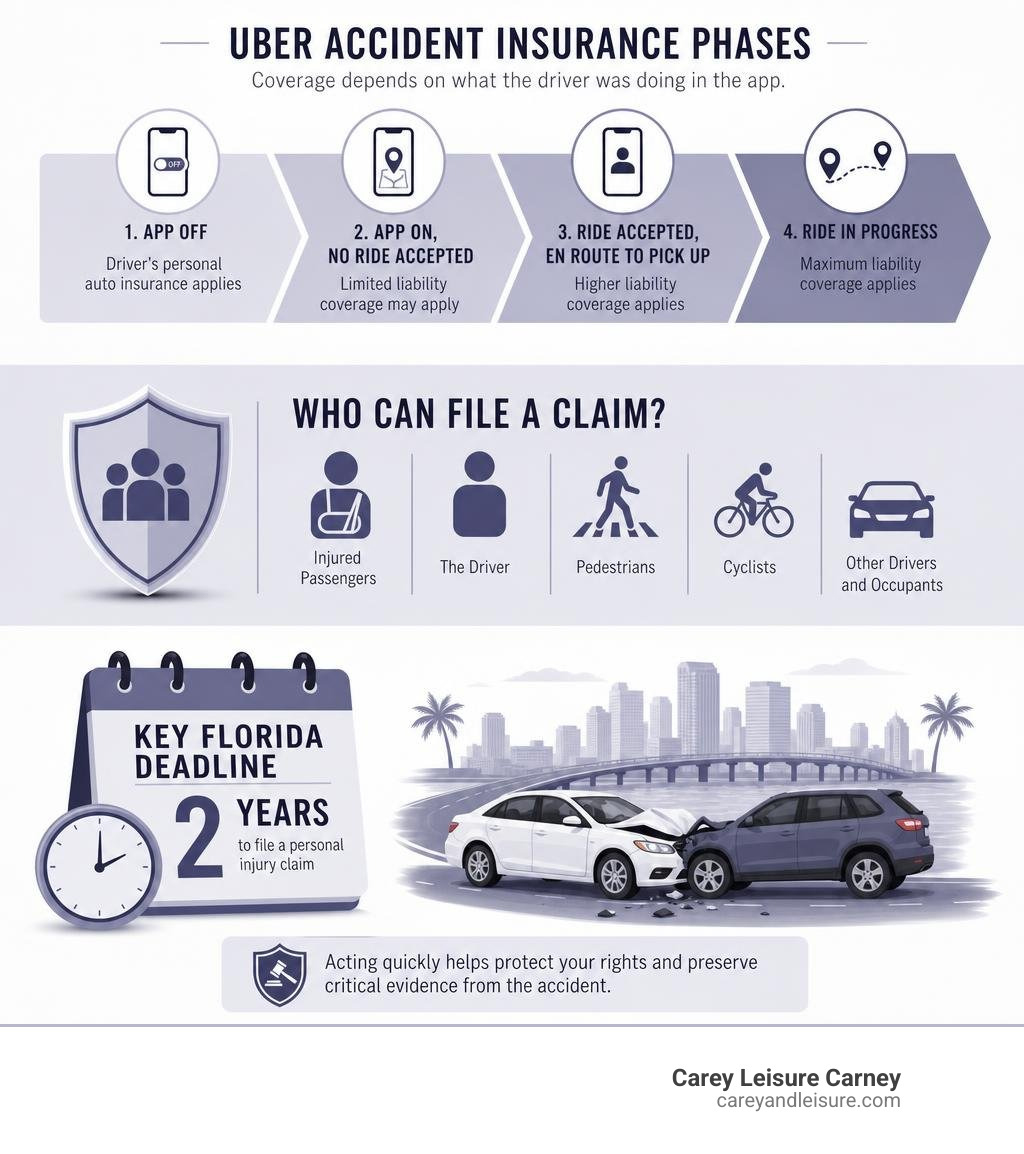
- Florida gives you two years from the date of the accident to file a personal injury claim
- You can seek compensation for medical bills, lost wages, and pain and suffering
- A specialized rideshare attorney can identify the correct insurance tier and preserve critical digital evidence before it disappears
Every year, millions of Floridians rely on Uber to get around — to work, to the airport, to a night out. Most rides end without incident. But when something goes wrong on a Florida road, the aftermath can feel overwhelming fast.
Unlike a standard two-car crash, an Uber accident can involve your own auto insurance, the driver’s personal policy, and Uber’s commercial coverage — all at the same time. Figuring out which policy applies, and getting any of them to pay fairly, is where things get complicated quickly.
According to Uber’s own U.S. Safety Report, there were 58 fatalities in car accidents involving Uber drivers in 2018 alone. Behind every one of those numbers is a family left trying to navigate a confusing claims process while dealing with injuries, lost income, and mounting bills.
Florida’s roads — and Florida’s rideshare laws — add another layer of complexity that most general car accident attorneys simply are not equipped to handle.
I’m Thomas W. Carey, founding partner of Carey Leisure Carney and a board-certified civil trial lawyer with over 35 years of experience handling serious injury cases across Florida, including complex uber crash lawyer matters in Pinellas County and throughout the Tampa Bay area. In the sections below, I’ll walk you through exactly how these claims work and what you need to do to protect yourself.
Common uber crash lawyer vocab:
How Rideshare Accidents Differ from Standard Car Wrecks
When you get into a typical fender bender on US-19 in Clearwater or near Gandy Boulevard in St. Petersburg, the legal path is relatively straightforward. You exchange insurance information with the other driver, file a claim under Florida’s no-fault system, and if your injuries are severe, pursue the at-fault driver’s bodily injury liability coverage.
An Uber crash completely upends this traditional model. The primary complicating factor is how rideshare companies structure their relationships with drivers. Uber drivers are legally classified as independent contractors rather than employees. Under traditional legal doctrines, an employer can be held “vicariously liable” for the negligent actions of an employee while they are on the clock. Because Uber drivers are independent contractors, Uber’s corporate entity uses this classification as a legal shield to avoid direct liability for crashes.
To address the massive coverage gaps this structure created, Florida passed Florida Statute § 627.748 (often referred to as the “rideshare law”). This statute mandates specific, tiered insurance coverage that rideshare companies must maintain. However, getting access to these policies is not automatic. The applicable coverage shifts in real-time based on the driver’s activity within the app.
Because multiple insurance companies are almost always involved, they will quickly begin pointing fingers at one another. The driver’s personal insurance company will deny the claim because the driver was using their vehicle for commercial purposes (a standard exclusion in personal auto policies). Meanwhile, Uber’s commercial insurer may argue the driver wasn’t actively on a trip, attempting to push the liability back onto the driver’s personal carrier. For a deeper look at these corporate maneuvers, you can learn more about rideshare legal challenges.
Who Can File a Claim After an Uber Crash?
Rideshare accidents leave a wide path of disruption. Depending on your role in the collision, your path to financial recovery will look slightly different:
- Rideshare Passengers: If you were riding in the back of an Uber when a crash occurred, you are in a strong legal position. You had zero control over the vehicle and bear absolutely no fault for the accident. You are generally covered by Uber’s $1 million commercial policy, regardless of whether your Uber driver or another motorist caused the wreck.
- Third-Party Drivers and Passengers: If you were driving your own vehicle in Largo or Wesley Chapel and were struck by an Uber driver, you can file a claim. Your ability to tap into Uber’s commercial policy depends entirely on whether the Uber driver was logged into the app and what phase of a ride they were in.
- Pedestrians and Cyclists: If you were walking near downtown St. Petersburg or riding your bike in Clearwater Beach and were hit by a rideshare vehicle, your injuries are likely catastrophic. You can file a claim against the rideshare company’s commercial insurance if the driver was online at the time of the crash.
- Uber Drivers Themselves: If you are an Uber driver who was hit by an underinsured or uninsured motorist while you had an active passenger, you can access Uber’s uninsured/underinsured motorist (UM/UIM) coverage to pay for your medical bills and lost wages.
For a comprehensive breakdown of how these different roles affect your legal strategy, read our rideshare accident lawyer complete guide.
Florida’s No-Fault Insurance and Rideshare Claims
Florida is one of a handful of “no-fault” insurance states. This means that regardless of who caused the accident, your first line of defense for medical expenses is your own Personal Injury Protection (PIP) coverage. Under Florida law, standard PIP covers 80% of necessary medical expenses and 60% of lost wages, up to a limit of $10,000.
If your injuries are serious, you can step outside of the no-fault system and file a lawsuit directly against the at-fault parties. To do this in Florida, your injuries must meet the “severe injury threshold,” which includes:
- Significant and permanent loss of an important bodily function
- Permanent injury within a reasonable degree of medical probability
- Significant and permanent scarring or disfigurement
- Death
When your injuries clear this threshold, you are no longer capped by the $10,000 PIP limit. You can pursue full compensation for all of your medical bills, future rehabilitative care, lost earning capacity, and pain and suffering.
Understanding Uber’s Insurance Coverage Tiers in Florida
The defining characteristic of an Uber accident claim is the tiered insurance system. The amount of insurance money available to cover your medical expenses and vehicle damage is determined entirely by the driver’s “app status” at the exact millisecond of the impact.
| Driver App Status | Applicable Insurance Policy | Bodily Injury Coverage Limits | Property Damage Limits |
|---|---|---|---|
| Phase 1: Offline / App Closed | Driver’s Personal Auto Insurance | Driver’s personal policy limits (Min: $10k PIP / $10k PDL in FL) | Driver’s personal policy limits |
| Phase 2: Online / Waiting for Request | Uber’s Contingent Liability Policy | $50,000 per person / $100,000 per accident | $25,000 per accident |
| Phase 3: Trip Accepted to Drop-off | Uber’s Commercial Policy | $1,000,000 total liability | Included in $1,000,000 limit |
Navigating these shifts in coverage can be incredibly confusing, which is why having an experienced uber crash lawyer on your side is critical. To understand how these tiers interact with other rideshare platforms, check out our uber car accident attorneys complete guide.
Phase 1: App Closed (Offline)
When an Uber driver has the app completely shut down and is using their car for personal errands—such as driving to a grocery store in New Port Richey or picking up their kids from school in Spring Hill—they are legally treated as an ordinary motorist.
If they cause an accident during this time, Uber’s commercial insurance provides zero coverage. You must file a claim against the driver’s personal auto insurance policy.
The major risk here is that Florida does not require drivers to carry bodily injury liability insurance to register a vehicle. If the off-duty driver only carries the bare minimum Florida-mandated coverage ($10,000 in PIP and $10,000 in property damage liability), you may find yourself facing massive medical bills with very little insurance money available. In these situations, we look to see if you have uninsured/underinsured motorist coverage on your own personal policy to help cover the difference.
Phase 2: App Open, Waiting for a Request
This is the gray area of rideshare insurance, and it is where many of the most bitterly contested insurance disputes occur. In Phase 2, the driver has opened the Uber app and is actively waiting to accept a ride request, but has not yet matched with a passenger. They might be slowly cruising through downtown St. Petersburg or parked in a lot in Trinity waiting for a “surge.”
Because the driver is technically using the vehicle for commercial profit, their personal auto insurer will almost certainly deny coverage if an accident occurs. To prevent these drivers from being completely uninsured, Florida law requires Uber to provide contingent liability coverage during Phase 2. This coverage includes:
- $50,000 in bodily injury liability per person
- $100,000 in bodily injury liability per accident
- $25,000 in property damage liability
While this is far better than nothing, these limits can quickly be exhausted if a crash causes severe, multi-vehicle injuries. Proving that a driver was in Phase 2 requires securing digital logs from Uber to show they were logged into the network when the crash occurred.
Phase 3: Ride Accepted to Passenger Drop-Off
The moment an Uber driver taps their screen to accept a ride request—even if they are miles away from the pickup location in Largo or Wesley Chapel—they enter Phase 3. This phase remains active while the driver is en route to pick up the passenger, while the passenger is in the vehicle, and until the passenger safely exits the car at their final destination.
During Phase 3, Uber’s massive $1 million commercial liability policy is triggered. This primary commercial policy covers:
- Third-party bodily injury and property damage up to $1 million
- Uninsured/underinsured motorist (UM/UIM) coverage up to $1 million (in certain scenarios)
If you are a passenger in an active Uber and are injured in a crash, this is the policy that will cover your damages. However, do not expect Uber’s insurance carrier to simply hand over a million-dollar check. They employ teams of high-powered adjusters and defense lawyers whose sole job is to minimize payouts. For guidance on how to navigate this specific tier, see our guide on selecting the right uber accident attorney.
Why You Need a Specialized Uber Crash Lawyer
Many people assume that any personal injury lawyer who handles car accidents can easily manage an Uber claim. This is a costly misconception. Specialized rideshare claims require an understanding of federal transportation regulations, state-specific rideshare statutes, and the technical mechanisms of mobile app data extraction.
Insurance companies are businesses, and they maximize their profits by paying out as little as possible on claims. In rideshare cases, they use highly coordinated tactics to delay, devalue, or outright deny valid claims.
One common tactic is raising a “material misrepresentation” defense. If an Uber driver did not explicitly disclose to their personal auto insurer that they were using their vehicle for ridesharing, the insurer may void the policy entirely. This leaves the crash victim trapped in a legal battle between the personal insurer and Uber’s commercial carrier, with both companies claiming they are not responsible.
At Carey Leisure Carney, we don’t let insurance companies play these games. We have spent decades building a reputation as aggressive litigators. Insurance companies track which law firms actually file lawsuits and go to trial, and which ones simply accept the highest phone offer. Because we prepare every single case as if it is heading to a jury, insurers treat our clients with the respect they deserve.
How an Uber Crash Lawyer Proves Negligence
To win a personal injury lawsuit in Florida, you must establish the four elements of negligence:
- Duty of Care: The driver owed you a legal duty to operate their vehicle safely.
- Breach of Duty: The driver breached that duty by acting carelessly (e.g., speeding, texting, running a red light).
- Causation: The driver’s breach directly caused the collision.
- Damages: You suffered actual physical and financial harm as a result.
In an Uber crash, proving when the breach occurred is just as important as proving how it occurred. We must establish the exact insurance phase at the moment of impact.
To do this, we immediately issue formal preservation of evidence letters to Uber’s corporate legal department. This legal demand prevents Uber from deleting or overwriting the digital evidence associated with the crash. We then obtain:
- The driver’s electronic trip logs and GPS tracking data
- App status history showing when the driver logged on and off
- Mobile phone records to check for distracted driving or active texting
- In-car dashcam footage and local traffic camera recordings
By cross-referencing GPS timestamps with physical police reports, we can indisputably establish which insurance tier applies to your case.
Recoverable Damages in a Florida Rideshare Case
If you have been injured in an Uber accident, your life may have been turned upside down. We help you pursue full compensation for both your economic and non-economic losses, including:
- Medical Expenses: All emergency room visits, surgeries, hospital stays, doctor appointments, physical therapy, and future medical care.
- Lost Wages: The income you lost because you were physically unable to work after the accident.
- Loss of Earning Capacity: If your injuries result in a permanent disability that prevents you from returning to your career, we calculate your lifetime lost earnings.
- Pain and Suffering: Compensation for the physical pain, mental anguish, loss of enjoyment of life, and emotional distress caused by the crash.
- Punitive Damages: In rare cases where the driver’s behavior was exceptionally reckless (such as driving under the influence of drugs or alcohol), Florida allows you to seek punitive damages.
Under Florida law, punitive damages are generally capped at $500,000 or three times the total amount of your economic and non-economic damages, whichever is greater. To learn more about what your potential recovery might look like, read our detailed post on the mechanics of an uber accident settlement.
Steps to Take Immediately After a Florida Rideshare Accident
The steps you take in the minutes and days following an Uber crash can make or break your personal injury claim. Here is what you need to do to protect your health and your legal rights:
- Seek Medical Attention Immediately: Your health is the absolute priority. Call 911 or have someone take you to the nearest emergency room—such as Morton Plant Hospital in Clearwater or St. Anthony’s Hospital in St. Petersburg. Even if you feel fine, the rush of adrenaline can mask severe internal injuries, brain trauma, or spinal damage. Gaps in medical care are the number one weapon insurance adjusters use to devalue claims.
- Call Law Enforcement: Ensure a police officer responds to the scene to document the crash and write an official report. The police report provides an objective, third-party account of the accident, details road conditions, and notes any traffic citations issued.
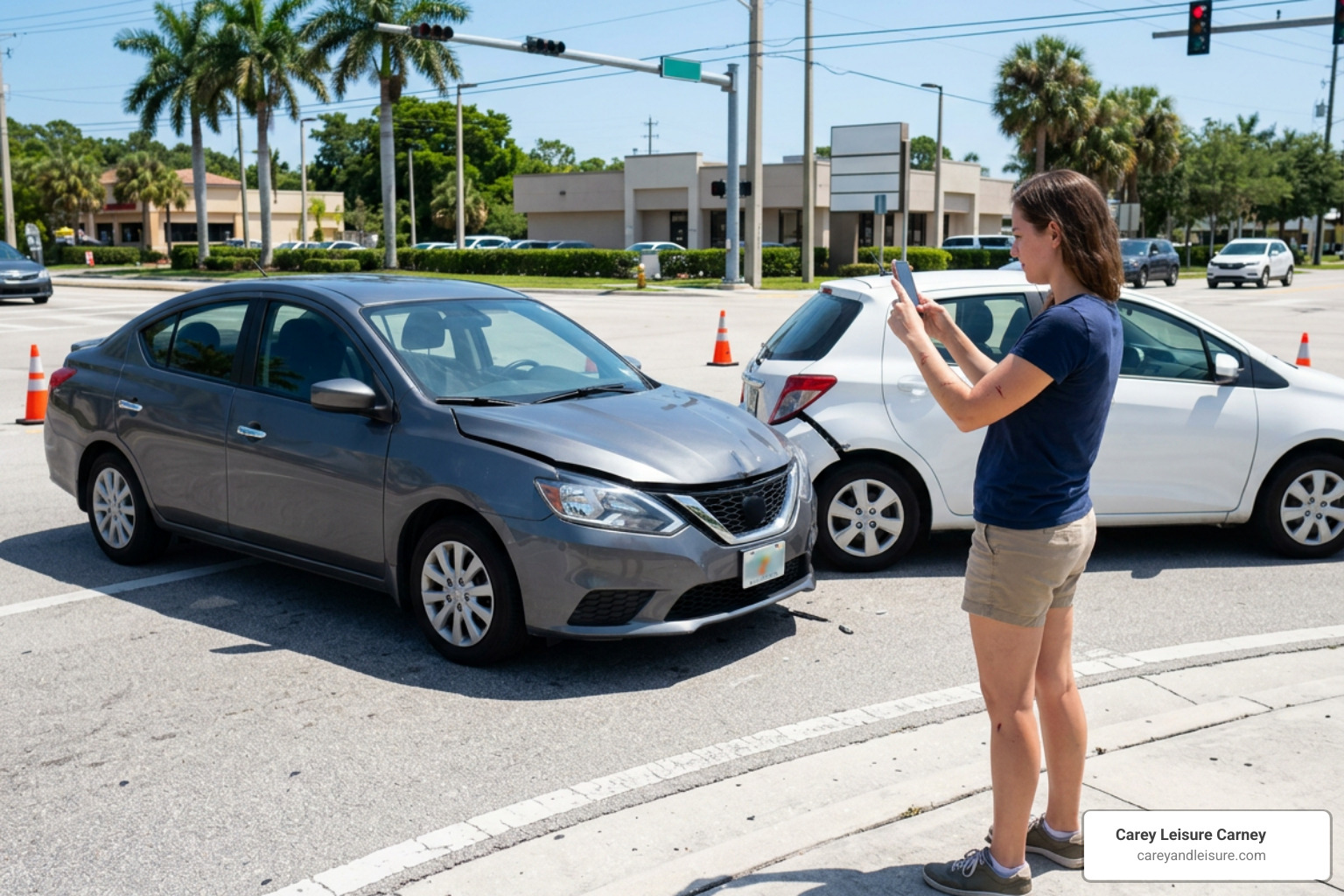
- Collect Scene Evidence: If you are physically able, use your phone to take extensive photos and videos of the scene. Document vehicle damage, license plates, skid marks, traffic signs, and your own visible injuries.
- Screenshot the Ride Details: If you were a passenger, take immediate screenshots of your Uber app showing the driver’s name, vehicle details, trip route, and receipt. This is vital digital evidence that links Uber to the crash.
- Gather Witness Information: Get the names, phone numbers, and brief statements of any bystanders who saw the collision occur.
For a step-by-step roadmap on navigating the legal system after your initial medical treatment, see our guide on navigating your uber accident lawsuit.
When to Contact an Uber Crash Lawyer
You should contact a specialized attorney as soon as possible after your accident. In Florida, the statute of limitations for personal injury claims is two years from the date of the crash. If you do not file a lawsuit within this two-year window, you lose your legal right to seek compensation forever.
While two years may seem like a long time, building a strong case takes months. Physical evidence can be cleared from roadways within hours, surveillance footage is often overwritten within days, and witnesses’ memories fade quickly. The sooner we can get to work investigating your crash, securing electronic app data, and managing the insurance companies, the stronger your case will be. For more information on why early action is vital, read about getting the legal help you deserve.
Common Mistakes That Can Ruin Your Claim
When you are recovering from a serious injury, it is easy to make simple mistakes that can destroy your legal claim. Be sure to avoid these common insurance traps:
- Giving a Recorded Statement: Shortly after the crash, an insurance adjuster from Uber’s carrier will likely call you. They will sound friendly and sympathetic, but their goal is to get you to say something on a recorded line that downplays your injuries or suggests you were at fault. Never give a recorded statement without your lawyer present.
- Accepting a Quick Settlement: Insurance companies often offer a fast, lowball settlement check within weeks of the crash. They want you to sign a liability release before you realize the true, long-term cost of your injuries. Once you sign that release, you can never ask for more money.
- Posting on Social Media: Do not post photos, status updates, or comments about the accident or your physical activities on platforms like Facebook or Instagram. Defense attorneys actively monitor these accounts, looking for any photo they can use to argue that your injuries are not as severe as you claim.
- Skipping Doctor Appointments: If you miss physical therapy sessions or skip follow-up medical appointments, the insurance company will argue that you have made a full recovery or that you are failing to mitigate your damages.
Frequently Asked Questions About Rideshare Accidents
Can I sue Uber directly after an accident?
Generally, no. Because Uber classifies its drivers as independent contractors, the law shields the corporate entity from direct liability under normal circumstances. Your primary path to recovery is filing a claim against the commercial insurance policies that Uber is legally required to provide.
However, there are rare exceptions where we can file a direct lawsuit against Uber. These include cases of negligent hiring or screening, where Uber allowed a driver onto the platform who had a history of reckless driving or criminal behavior, or cases involving app design defects that distract drivers while they are behind the wheel.
What if the other driver was at fault for the crash?
If you were an Uber passenger and another motorist caused the collision, that third-party driver is liable for your injuries. However, many Florida motorists carry very little insurance or drive completely uninsured.
If the at-fault driver’s policy is insufficient to cover your medical expenses, we can tap into Uber’s uninsured/underinsured motorist (UM/UIM) coverage. During Phase 3, Uber provides up to $1 million in UM/UIM coverage to protect passengers when third-party drivers cause a crash and cannot pay for the damages. To learn more about how this coverage works, read our guide on understanding rideshare payouts.
How much does it cost to hire a rideshare accident attorney?
At Carey Leisure Carney, we represent clients on a contingency fee basis. This means there are absolutely no upfront costs, no hourly fees, and you do not pay us a single penny unless we win your case and recover money for you.
We offer a completely free, no-obligation case evaluation where we will sit down with you, review the details of your accident, and explain your legal options. If we take your case, our fees are paid as a percentage of the final settlement or court verdict we secure on your behalf. To learn more about how this fee structure protects you, see our ultimate rideshare settlement guide.
Conclusion: Trust Carey Leisure Carney to Fight for You
An Uber accident can disrupt your life in an instant, leaving you to deal with physical pain, emotional trauma, and financial stress. You do not have to fight corporate insurance giants and their teams of lawyers on your own.
At Carey Leisure Carney, we do things differently. We are a family-founded firm of dedicated trial attorneys based in Clearwater, Florida, serving clients across Pinellas, Pasco, and Hernando counties—including Largo, New Port Richey, Spring Hill, St. Petersburg, Trinity, and Wesley Chapel.
Our unique advantage is our deep expertise. Our partners are Board-Certified in Civil Trial Law by the Florida Bar—a distinction held by less than 2% of all attorneys in the state. This means we are recognized legal experts who know how to present a case to a jury and win. With over 100 years of combined legal experience, we have successfully recovered millions of dollars for injury victims just like you.
We do not pass our clients off to paralegals or case managers. When you hire us, you get direct attorney access and personalized, compassionate representation from start to finish. We take your recovery personally, and we will stand by your side every step of the way.
If you or a loved one has been injured in a rideshare crash, do not wait for evidence to disappear or deadlines to pass. Contact us today to secure the dedicated legal representation you deserve.
Protect your rights with an experienced auto accident attorney/rideshare accident attorney