

Patience Pays: Navigating the Wait for Your Accident Compensation
When Will You Actually Get Paid After a Car Accident?
How long does compensation take after a car accident is one of the first questions injured people ask — and the honest answer is: it depends. Here is a quick breakdown:
| Scenario | Typical Timeline |
|---|---|
| Minor injury, clear fault, cooperative insurer | 3 to 6 months |
| Moderate injuries requiring extended treatment | 6 to 12 months |
| Severe injuries or disputed liability | 12 to 24 months |
| Catastrophic injuries or litigation required | 2 to 4+ years |
| Check arrival after signing the settlement release | 2 to 6 weeks |
The national average across all car accident cases is roughly 15 months from the date of the crash to the final check in hand. But your case could resolve much faster — or take longer — depending on factors like injury severity, who is at fault, and how your insurance company behaves.
The bills, meanwhile, do not wait. Medical expenses pile up. Your paycheck may have stopped. And an insurance adjuster is probably already calling with an offer that sounds reasonable but may be far less than what you are owed. That financial pressure is real, and it is exactly why understanding the timeline before you make any decisions matters so much.
I am Thomas W. Carey, founding partner of Carey Leisure Carney and a board-certified civil trial lawyer who has guided approximately 40,000 injury matters across Florida since 1988 — and how long does compensation take after a car accident is a question I have answered for clients throughout Clearwater and the Tampa Bay area for decades. In this guide, I will walk you through every phase of the process so you know exactly what to expect and how to protect your recovery.
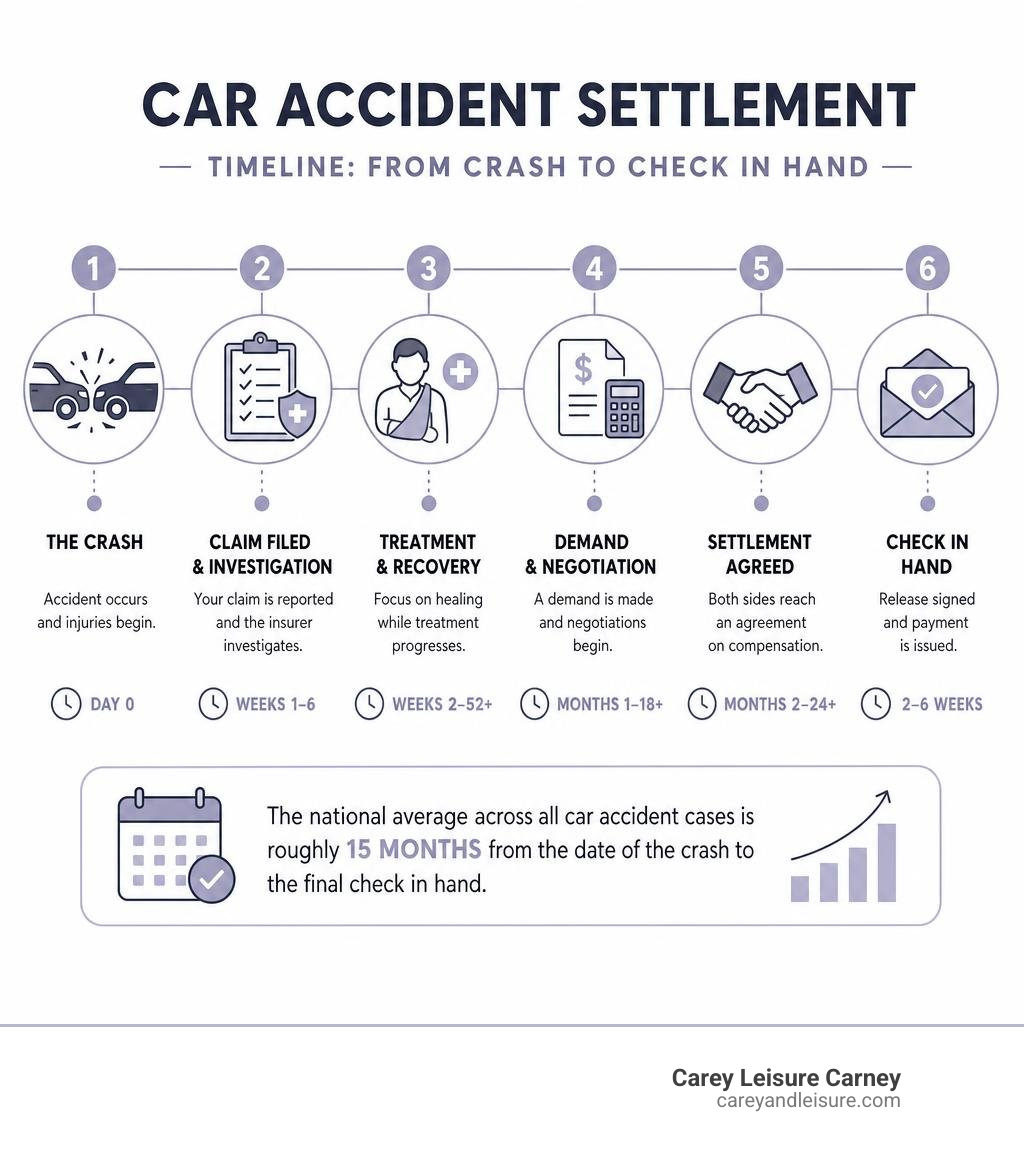
Common how long does compensation take after a car accident vocab:
How Long Does Compensation Take After a Car Accident?
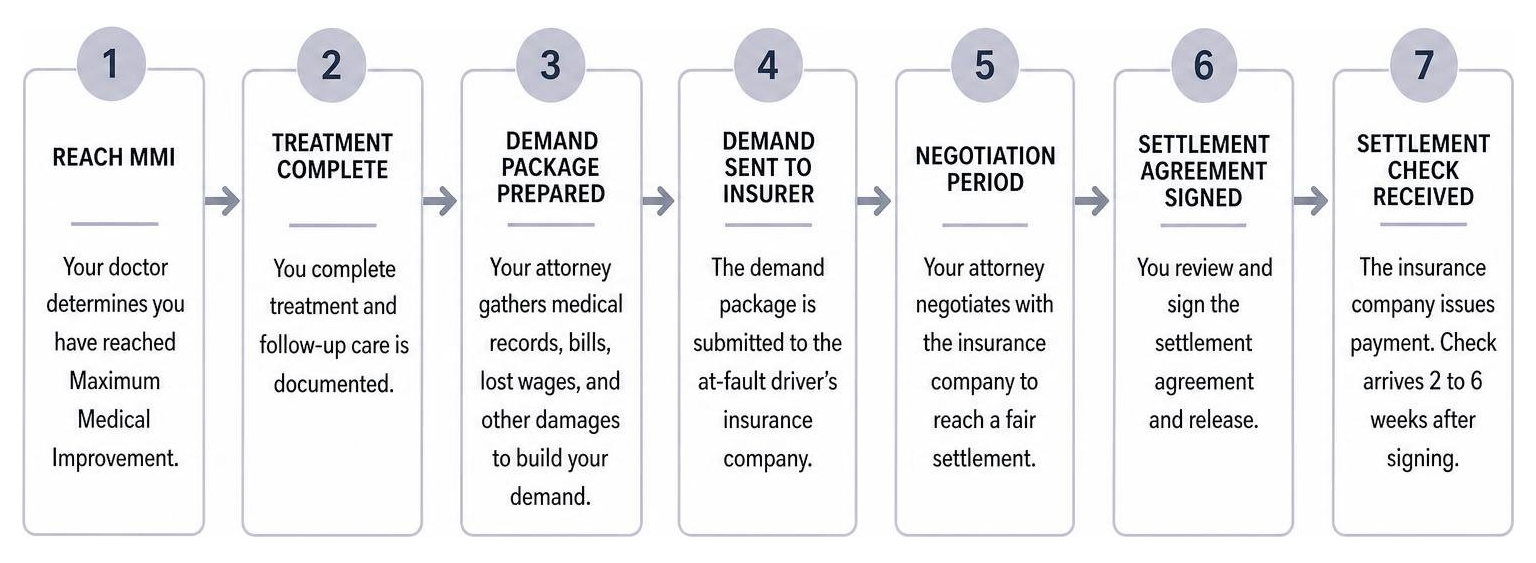
To understand how long does compensation take after a car accident, we first have to look at the legal framework governing auto insurance in Florida. Florida is a “no-fault” auto insurance state. This means that regardless of who caused the crash on US-19 or Gulf-to-Bay Boulevard, your first stop for medical coverage is your own Personal Injury Protection (PIP) insurance policy.
Under Florida’s strict PIP laws, you must seek medical attention within 14 days of the accident, or you forfeit your PIP benefits entirely. PIP covers up to 80% of necessary medical expenses and 60% of lost earnings, capped at a maximum of $10,000.
Because PIP is first-party coverage, these claims are processed relatively quickly. Your medical bills are typically paid directly to your doctors within a matter of weeks. However, if your injuries are severe, permanent, or your medical bills quickly exceed that $10,000 threshold, you must step outside of the no-fault system.
To recover the remaining 20% of your medical bills, your full lost wages, and non-economic damages like pain and suffering, you must file a third-party claim against the at-fault driver’s bodily injury liability insurance. This is where the timeline shifts from weeks to months — or even years.
According to the FindLaw Guide on Settle Timelines, the timeline for third-party claims is dictated by the complexity of the accident, the clarity of fault, and the extent of your injuries. When navigating these third-party waters, our guide on Navigating Florida Car Accident Claims outlines the critical initial steps you must take to prevent the insurance company from dragging out your claim indefinitely.
The Timeline for Minor vs. Major Injury Claims
The severity of your physical injuries is the single largest factor in determining how long does compensation take after a car accident.
For minor injuries — such as soft tissue strains, mild whiplash, or bruising where you recover fully within a few weeks — the claim can often be resolved in 3 to 6 months. There are fewer medical records to collect, the financial stakes are lower, and the insurance company is generally more willing to settle quickly to close their books.
Major injuries, however, completely rewrite the schedule. If you suffer a bone fracture, a traumatic brain injury (TBI), or a spinal cord injury requiring surgery, your claim will take much longer — often 12 to 18+ months.
Why does this happen?
- High Financial Stakes: If your damages are valued in the hundreds of thousands of dollars, insurance companies will deploy every resource to find a reason to deny or minimize your claim. They will audit your medical records, investigate your personal life, and delay negotiations.
- Treatment Duration: We cannot accurately value a major injury claim until we know the full extent of your medical bills and future care needs.
While the SetCalc State Settlement Averages indicate that Florida’s average car accident settlement hovers around $77,000, this number blends minor fender-benders with catastrophic crashes. To get a realistic picture of your specific situation, you can read our deep dive into Understanding Personal Injury Value to see how medical treatment paths directly shape the ultimate value of your recovery.
Why Maximum Medical Improvement (MMI) Dictates the Calendar
We always advise our clients: never settle your injury claim until you reach Maximum Medical Improvement (MMI).
MMI is a formal medical status declared by your treating physician. It means your injuries have healed and stabilized to the point where further medical treatment is not expected to improve your condition. You may be 100% healed, or you may be left with a permanent impairment, but your medical path is now clear and predictable.
If you rush to settle with the insurance company before reaching MMI, you make a massive financial gamble. Once you sign a settlement release, your case is closed forever. If you discover six months from now that you need a $100,000 spinal fusion surgery, you cannot go back and ask the insurance company for more money. You will be personally responsible for those bills.
Waiting for MMI ensures we can calculate every dollar of your past, present, and future medical costs. This is why we emphasize knowing How Long to See a Doctor and maintaining consistent medical treatment without any gaps. If you skip physical therapy appointments, the insurance adjuster will claim you are healed or that you are failing to mitigate your damages, further delaying your payout.
Key Factors That Delay Your Car Accident Settlement

Even when you are patient and follow your medical plan, several roadblocks can stall your compensation. Insurance companies are profit-driven corporations. They do not make money by paying claims quickly; they make money by holding onto their cash as long as possible.
Here are the most common factors that delay car accident settlements:
- Disputed Liability: If the at-fault driver or their insurer claims you caused the accident, negotiations will stall while both sides gather evidence.
- Insurance Delay Tactics: Adjusters may “stonewall” by failing to return phone calls, requesting duplicate documentation, or changing the adjuster assigned to your file mid-case.
- Algorithmic Claims Software: Many major insurers use automated software programs (like Colossus) to evaluate claims. These programs assign rigid point values to medical codes, often ignoring the human element of pain and suffering, which forces your attorney to fight harder for a fair valuation.
- Multiple Parties Involved: Multi-car pileups in Clearwater or Largo mean multiple insurance policies, multiple attorneys, and a complex web of cross-claims that take months to untangle.
Understanding The Role of Insurance Companies in this process helps you see that these delays are rarely accidental — they are calculated strategies designed to wear you down until you accept a lowball offer.
Proving Liability and Comparative Fault in Florida
In March 2023, Florida overhauled its negligence laws under House Bill 837, moving the state from a “pure” comparative fault system to a modified comparative fault system with a 50% bar.
Under this current law, if you are found to be more than 50% at fault for the accident, you are completely barred from recovering any compensation from the other party. If you are 50% or less at fault, you can still recover damages, but your final payout is reduced by your exact percentage of fault. For example, if your case is worth $100,000 but you are found 20% at fault for speeding through an intersection in St. Petersburg, your settlement check will be reduced to $80,000.
Because of this 50% threshold, insurance companies now fight tooth and nail to push your percentage of fault over that 50% line. They will scour the crash scene, review traffic camera footage, and analyze event data recorders (black boxes) to pin the blame on you.
To counter this, we must conduct an immediate, thorough investigation. Gathering witness statements, preserving dashcam footage, and securing the police report are critical. If you are wondering what steps to take immediately following a collision to protect your claim, read our guide on What to Do After a Not-At-Fault Accident.
How Long Does Compensation Take After a Car Accident with Commercial Vehicles?
If you were hit by a commercial semi-truck, a delivery van, or a corporate fleet vehicle, the timeline for your settlement will be significantly longer than a standard passenger car accident. It is not uncommon for commercial vehicle claims to take 1 to 2+ years to resolve.
Commercial accidents are incredibly complex for several reasons:
- Multiple Defendants: Liability may rest not only with the truck driver but also with the trucking company, the cargo loader, or the maintenance contractor.
- Federal Regulations: Commercial carriers are governed by strict Federal Motor Carrier Safety Administration (FMCSA) rules. Investigating whether the driver violated hours-of-service logs or if the truck had a history of mechanical failures requires auditing thousands of pages of corporate records.
- High Policy Limits: Commercial policies often carry limits of $1 million or more. Because the financial stakes are so high, corporate defense lawyers will litigate aggressively to protect their bottom line.
Resolving these claims requires specialized knowledge and expert witnesses, such as accident reconstructionists or mechanical engineers. For a deeper look into how these complex investigations work, consult our Legal Advice for Car Accidents resource.
The Post-Settlement Phase: From Signed Release to Check in Hand

Let’s fast forward: your attorney has negotiated a fair settlement, and you have verbally agreed to the amount. You might think you will walk out of the office with a check that afternoon. Unfortunately, there is still an administrative process that takes between 2 to 6 weeks before the funds are actually in your hands.
This post-settlement phase follows a strict legal and administrative sequence:
Florida Statutes require insurance companies to pay a settled claim within 20 days of a written agreement. Once the insurance company issues the check, they mail it to our law firm. By law, personal injury attorneys cannot hand this check directly to you. We must deposit the gross settlement check into a specialized, audited escrow account known as an Interest on Lawyers’ Trust Account (IOLTA).
We must wait for the bank to fully clear the funds (usually 3 to 5 business days) before we can begin distributing the money. To understand how this fits into the broader legal journey, check out our step-by-step breakdown of the From Crash to Cash Process, and for more details on the check delivery phase, refer to the SetCalc Settlement Check Timeline.
How Long Does Compensation Take After a Car Accident to Clear Liens?
The biggest bottleneck in the post-settlement phase is resolving medical liens and subrogation claims.
If your health insurance company, Medicare, Medicaid, or a hospital paid for your medical treatment after the crash, they have a legal right to be reimbursed from your personal injury settlement. These entities will place a “lien” on your recovery.
We cannot distribute your settlement funds until every single lien is officially resolved. If we pay you before clearing these liens, our firm and you can be held legally and financially liable.
Negotiating these liens actually works to your advantage. As your attorneys, we do not just accept the lien amounts at face value. We aggressively negotiate with health insurance companies and government agencies to reduce what you owe them. Every dollar we shave off your medical liens is a dollar that goes directly into your pocket.
However, dealing with government bureaucracies takes time. For example, getting an initial response for a Medicare conditional-payment request typically takes 60 to 90 days. If you want to learn more about how we fight to minimize these deductions and maximize your recovery, read our guide on Maximizing Your Florida Settlement.
Deductions Taken from Your Gross Settlement Check
Before you receive your final net check, several standard deductions must be taken from the gross settlement amount. When we sit down with you to finalize your case, we will provide an itemized, written settlement statement showing exactly where every penny went.
Here is a comparison of what a typical settlement deduction structure looks like:
| Deduction Type | Description | Typical Percentage / Cost |
|---|---|---|
| Attorney Contingency Fee | The fee for our legal services (only paid if we win). | 33.3% (pre-lawsuit) to 40% (if a lawsuit is filed) |
| Case Expenses & Costs | Reimbursement for out-of-pocket costs incurred to build your case (medical records, filing fees, court reporters, expert witnesses). | Varies ($500 for simple cases; $10,000+ if expert testimony is required) |
| Outstanding Medical Bills | Unpaid balances owed directly to your doctors, chiropractors, or physical therapists. | Varies based on your treatment path |
| Medical Liens / Subrogation | Reimbursement owed to health insurance, Medicare, or Medicaid. | Negotiated down by your attorney |
| Your Net Recovery | The final cash amount paid directly to you. | Typically 40% to 60% of the gross settlement |
Frequently Asked Questions about Car Accident Timelines
What is the statute of limitations for a car accident lawsuit in Florida?
In March 2023, Florida House Bill 837 slashed the statute of limitations for negligence claims — including car accidents — from four years down to two (2) years from the date of the crash.
This means if you do not file a formal lawsuit in court within two years of your accident, you lose your right to seek compensation forever. While two years might sound like a long time, building a robust, evidence-backed personal injury case takes months of preparation. It is vital to consult an attorney early to ensure no deadlines are missed. You can read more about these strict time limits in our Guide to Accident Statute of Limitations.
Can I speed up the process of getting my settlement check?
Yes, you can take active steps to keep your case moving forward:
- Seek Immediate Medical Care: Go to the ER or urgent care immediately after the crash to establish a clean medical record.
- Maintain Consistent Treatment: Attend every physical therapy and doctor appointment. Gaps in care give insurance adjusters an excuse to delay your claim.
- Organize Your Documents: Keep copies of your receipts, police reports, and wage loss statements in one place.
- Stay Off Social Media: Insurance adjusters monitor your accounts. A single photo of you smiling at a backyard BBQ in Clearwater Beach can be used to argue you aren’t actually injured.
- Hire a Lawyer Early: The sooner we get to work, the faster we can preserve evidence and apply pressure to the insurer.
For those considering handling their own property damage or minor claims, our Settling Your Own Claim Guide offers practical advice on managing the process efficiently.
What happens if the insurance company takes longer than the allowed time?
Under Florida law, insurance companies have a duty of good faith to investigate and settle claims promptly. Generally, insurers have 30 days to investigate your auto claim and make a determination.
If an insurance company acts in bad faith — by intentionally delaying payments, failing to conduct a proper investigation, or offering unreasonably low settlements without explanation — we can file a bad faith lawsuit against them. This can force the insurer to pay damages far exceeding the original policy limits. If you are facing a stalling or unresponsive insurer, read our advice on Handling Denied Claims.
Conclusion
Waiting for your car accident compensation can be incredibly frustrating, especially when bills are piling up and you are trying to recover physically. But as we always tell our clients throughout Clearwater, Largo, St. Petersburg, and the surrounding Tampa Bay communities: patience pays. Rushing into a quick settlement only benefits the insurance company.
At Carey Leisure Carney, we have spent over three decades fighting to ensure our clients receive the full, fair compensation they deserve. Our firm features Board-Certified civil trial attorneys — a distinction held by less than 2% of Florida lawyers. We combine over 100 years of collective experience with a commitment to personalized service, meaning you will always have direct access to your attorney, not just a case manager.
If you or a loved one has been injured in a car accident in Clearwater, Spring Hill, Wesley Chapel, or anywhere in the Tampa Bay area, do not navigate this stressful wait alone. Contact a Clearwater Personal Injury Attorney at Carey Leisure Carney today for a free, no-obligation consultation, and let us handle the insurance companies while you focus on healing.