

The Price of Pain: How Much Compensation Can You Expect After a Car Accident?
What to Expect When Asking How Much Compensation After a Car Accident
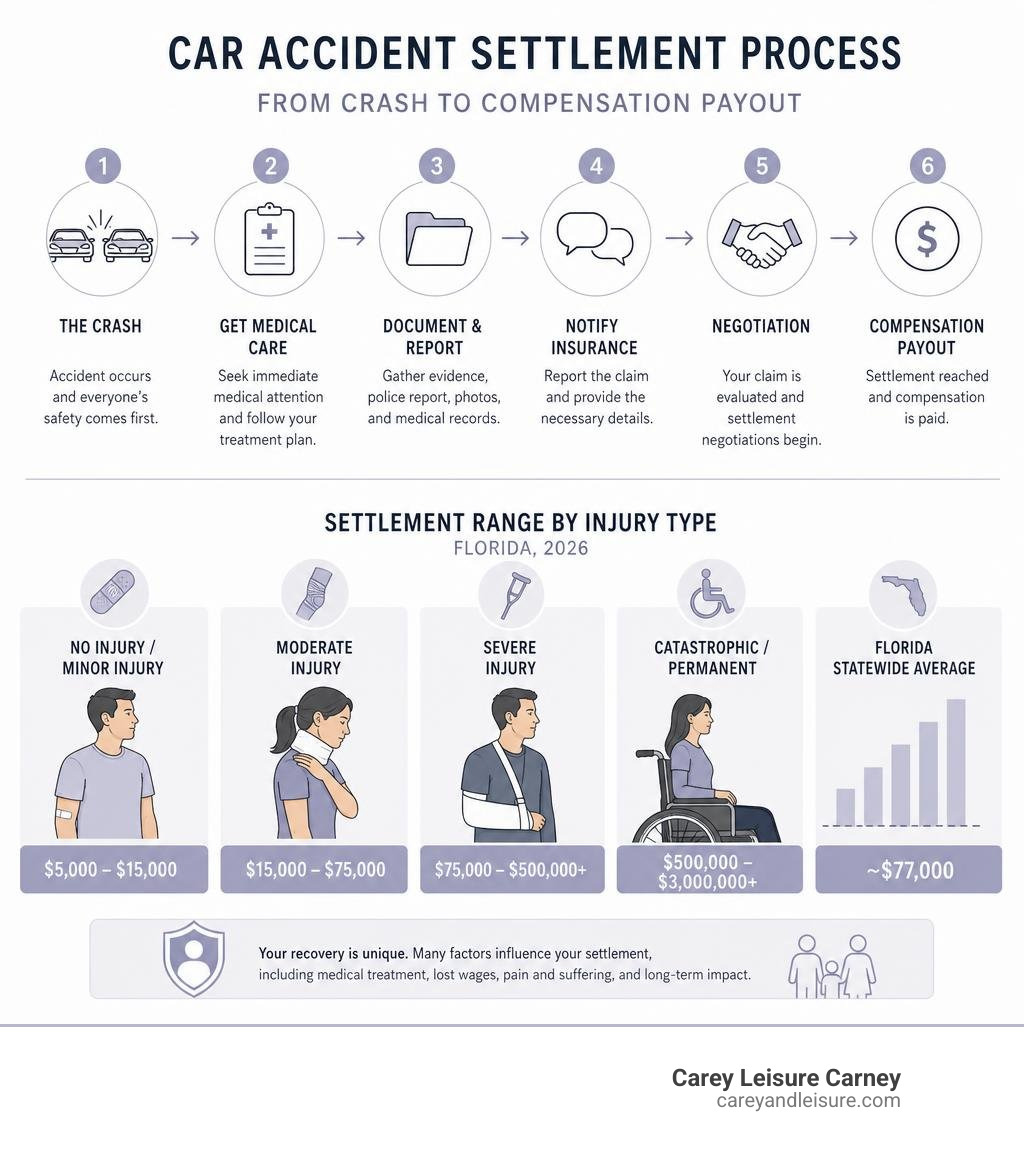
Understanding how much compensation after a car accident you can receive depends on several factors — but here’s a quick snapshot to set your expectations:
| Injury Severity | Typical Settlement Range (Florida, 2026) |
|---|---|
| No injury / minor injury | $5,000 – $15,000 |
| Moderate injury | $15,000 – $75,000 |
| Severe injury | $75,000 – $500,000+ |
| Catastrophic / permanent | $500,000 – $3,000,000+ |
| Florida statewide average | ~$77,000 |
Note: Every case is different. These ranges reflect general trends, not guarantees.
The numbers above can feel abstract when you’re dealing with mounting medical bills, missed paychecks, and an insurance adjuster who seems more interested in closing your claim than covering your costs. The reality is that what you receive and what you deserve are often two very different numbers — especially without the right guidance.
Florida’s no-fault insurance system, shared fault rules, and strict injury thresholds all shape what you can actually recover. Knowing how these pieces fit together is the first step toward protecting your financial future.
I’m Thomas W. Carey, founding partner of Carey Leisure Carney and a board-certified civil trial lawyer with nearly four decades of experience helping Florida accident victims understand how much compensation after a car accident they are truly owed. Having personally witnessed the devastating impact a serious crash can have on a family, I’ve dedicated my career to making sure injured people are never left to navigate this process alone.
How much compensation after car accident vocab explained:
- Auto accident legal help
- compensation for pain and suffering after a car accident
- compensation for ptsd after car accident
Understanding the National and Florida Averages for Car Accident Settlements
When you start researching how much compensation after a car accident you might recover, you will likely encounter various national statistics. Across the United States in 2026, the national average bodily injury settlement sits at approximately $30,416. However, looking strictly at national averages can be incredibly misleading.
In Florida, our statewide average is significantly higher, hovering around $77,000. Why is there such a massive gap? Florida’s unique insurance landscape, high density of traffic in metro areas like Tampa and St. Petersburg, and rising medical costs all drive up the average value of local claims.
Furthermore, averages are heavily skewed by outliers. A few multi-million-dollar catastrophic injury verdicts pull the mathematical average up, while thousands of minor “fender-bender” claims settle for much smaller amounts. If you are trying to gauge where your specific situation fits, we recommend reading our detailed guide on What Is My Personal Injury Case Worth? to understand how individual variables shape your ultimate payout.
How Much Compensation After Car Accident Claims Are Filed in Florida?
The financial recovery you can expect is directly tied to the severity of your injuries. In Florida, these generally fall into three distinct bands:
- Minor Injuries ($5,000 – $15,000): These typically involve soft-tissue damage, minor whiplash, or bruising that resolves within a few weeks of chiropractic care or physical therapy. There are rarely permanent lifestyle changes or long-term treatment requirements.
- Moderate Injuries ($15,000 – $75,000): These cases often feature broken bones, herniated discs, or moderate concussions. Victims may require specialized medical procedures, injections, or extended rehabilitation, resulting in notable lost wages and a longer recovery window.
- Severe and Catastrophic Injuries ($75,000 – $500,000+): These life-altering situations involve traumatic brain injuries (TBIs), spinal cord damage, complex fractures requiring multiple surgeries, or permanent loss of bodily functions.
If you are dealing with moderate to severe injuries, securing experienced Clearwater legal representation is vital. Insurance companies are businesses first, and they will look for any opportunity to minimize their payouts. Having an advocate on your side ensures your medical needs are fully documented and fought for.
Key Factors That Determine How Much Compensation After Car Accident Events You Receive
No two crashes are identical. Even if two people suffer the exact same injury, their final compensation packages can look entirely different. The total value of your claim relies heavily on several core factors:
- Liability (Who Caused the Crash): To recover compensation from another driver’s insurance, you must prove they were negligent. If liability is clear-cut, such as a rear-end collision where the other driver was ticketed, negotiations are much more straightforward.
- Insurance Policy Limits: This is often the hardest reality for victims to face. If the at-fault driver only carries a $10,000 bodily injury liability policy and has no personal assets, that policy limit may cap your recovery unless you carry Uninsured/Underinsured Motorist (UM) coverage on your own policy.
- Severity of Injuries and Treatment Consistency: A claim backed by immediate emergency room visits, MRI scans, and consistent follow-up care is far more valuable than one with long gaps in treatment. Gaps in care give insurance adjusters room to argue that your injuries weren’t actually caused by the accident.
To explore how these elements interact in real-world scenarios, check out our comprehensive breakdown of Compensation After Accident claims.
Florida’s No-Fault PIP System and the Serious Injury Threshold
Florida operates under a “no-fault” auto insurance system. This means that regardless of who caused the accident, your first line of defense is your own Personal Injury Protection (PIP) insurance.
By law, your PIP policy covers up to $10,000 in emergency medical bills and lost wages. However, there is a catch: PIP only pays 80% of medical expenses and 60% of lost wages, and it does not provide any compensation for pain and suffering.
To step outside of the no-fault system and sue the at-fault driver for non-economic damages like pain and suffering, your injuries must meet the “serious injury threshold” established under Florida Statute 627.737. This threshold requires proof of:
- Significant and permanent loss of an important bodily function.
- Permanent injury within a reasonable degree of medical probability.
- Significant and permanent scarring or disfigurement.
- Death.
If your injuries do not meet this legal threshold, you are limited to what your PIP and medical payments coverage can provide. Understanding What to Do After a Car Accident Florida is crucial to ensuring you take the necessary legal and medical steps to document your injuries correctly from day one.
Modified Comparative Negligence in Florida
Another critical factor affecting how much compensation after a car accident you can recover is Florida’s comparative negligence law. Under Florida Statutes Section 768.81, Florida utilizes a modified comparative negligence standard with a “51% bar rule.”
This means you can recover damages as long as you are 50% or less at fault for the accident. However, your compensation will be reduced by your percentage of blame. For example, if your total damages are calculated at $100,000, but an investigation reveals you were 20% at fault because you were speeding, your final payout will be reduced by 20%, leaving you with $80,000.
The catch: If you are found to be 51% or more responsible for the crash, you are legally barred from recovering any compensation from the other party. Because insurance adjusters will actively try to shift blame onto you to save money, knowing How to Get the Most Compensation from a Car Accident Settlement in Florida is essential to protecting your rights and fighting unfair fault assessments.
How Car Accident Settlements Are Calculated
Insurance companies do not just pull settlement numbers out of thin air. They divide your damages into two primary categories: economic damages (measurable financial losses) and non-economic damages (intangible human costs).

To calculate the non-economic portion of your claim, insurance companies typically use one of two methods:
- The Multiplier Method: This is the most common approach. The insurer adds up all your economic damages (medical bills + lost wages) and multiplies that total by a number between 1.5 and 5, depending on the severity of your injuries. A minor whiplash case might use a 1.5x multiplier, while a severe spinal injury requiring surgery could warrant a 4x or 5x multiplier.
- The Per Diem Method: This method assigns a daily dollar value (often equivalent to your daily work earnings) to your pain and suffering. You are paid this daily rate for every single day you must live with the pain of your injuries until you reach maximum recovery.
Be warned: many major insurance carriers use automated claims evaluation software like Colossus. This program uses medical billing codes to standardize and systematically minimize payouts. If your medical records contain gaps or lack objective evidence (like MRIs or X-rays), Colossus will automatically flag your claim and generate a lowball offer.
To combat this automated system, you must build a bulletproof record of your physical and emotional struggles. Learn more about how to protect this portion of your claim in our guide to Compensation for Pain and Suffering in Florida What You Need to Know.
Calculating Pain and Suffering and Non-Economic Damages
Non-economic damages are highly subjective. They are designed to compensate you for the physical pain, mental anguish, loss of enjoyment of life, and anxiety caused by the crash.
Because you cannot hand an adjuster a receipt for “anxiety” or “chronic back pain,” proving these damages requires careful documentation. Keeping a daily pain journal, obtaining testimonies from friends and family about your limitations, and securing psychological evaluations can dramatically strengthen your case. For a step-by-step strategy on maximizing this part of your claim, read Pain and Suffering After a Car Accident Your Guide to Fair Compensation.
The Impact of Specific Injuries on Your Payout
Different injuries command different settlement values because of their long-term medical implications and treatment costs. Here is a look at how specific injuries impact your potential compensation:
- Whiplash and Soft-Tissue Injuries: While common, these are heavily scrutinized by insurers. Payouts typically range from $5,000 to $30,000. Read more on Neck Pain After a Car Accident Securing Your Compensation.
- Herniated Discs and Spinal Injury: If a crash results in structural damage to your spine, settlement values jump significantly, often ranging from $50,000 to over $150,000—especially if surgery is recommended. See Navigating Back Pain Compensation After a Car Accident A Comprehensive Guide.
- Shoulder Injuries: Rotator cuff tears or joint damage from bracing during a crash can severely limit your ability to work. Learn about securing Getting Your Due Shoulder Pain Compensation After a Car Accident.
- Chronic Pain Conditions: Ongoing nerve damage or complex regional pain syndrome can persist for years. Explore your options in Chronic Pain After a Car Accident What You Need to Know About Compensation.
- Psychological Trauma: Depression, PTSD, and severe anxiety can be just as debilitating as physical wounds. Learn how these are valued in Psychological Trauma Payouts Understanding Compensation for Depression After an Accident.
| Injury Type | Average Florida Settlement Range (2026) | Primary Treatment Types |
|---|---|---|
| Mild Whiplash / Neck Strain | $5,000 – $20,000 | Chiropractic care, physical therapy, NSAIDs |
| Herniated Disc (No Surgery) | $20,000 – $75,000 | Physical therapy, epidural steroid injections |
| Herniated Disc (With Surgery) | $100,000 – $300,000+ | Discectomy, spinal fusion, laminectomy |
| Traumatic Brain Injury (TBI) | $150,000 – $1,500,000+ | Cognitive therapy, neurology visits, long-term care |
| Spinal Cord Injury / Paralysis | $1,000,000 – $5,000,000+ | Intensive rehab, home modifications, 24/7 care |
The Settlement Timeline and What Deductions Reduce Your Payout
One of the most critical rules of personal injury law is that you should never settle your claim before reaching Maximum Medical Improvement (MMI). MMI is the point at which your treating physician determines that your condition has stabilized and is not expected to improve any further.
If you settle your claim early and later discover you need a $100,000 spinal surgery, you cannot go back and ask the insurance company for more money. Once you sign a settlement release, your case is closed forever.

Once a settlement is reached, the gross amount agreed upon is not the exact number that lands in your bank account. Several deductions are made from the final check:
- Attorney Contingency Fees: Most personal injury lawyers work on a contingency fee basis. This means we charge no upfront fees, and our payment is a percentage of your final recovery—typically 33.3% if settled out of court, or 40% if a lawsuit must be formally filed.
- Medical Liens: If your health insurance or medical providers agreed to treat you on a letter of protection (LOP) while your case was pending, those bills must be paid directly out of the settlement proceeds.
- Case Expenses: This covers the actual costs of building your case, such as purchasing police reports, securing medical records, and hiring expert witnesses.
For a comprehensive look at how a claim transitions from the initial crash to the final payout, read our guide From Crash to Cash With the Complete Personal Injury Process.
Why You Need a Lawyer to Maximize Your Payout
Data from the Insurance Research Council consistently shows that accident victims represented by personal injury attorneys secure settlements that average 3.5 times higher than those who attempt to negotiate on their own.
Insurance adjusters are trained negotiators. They know that an unrepresented victim is likely stressed, facing medical bills, and unfamiliar with Florida’s complex insurance statutes. They will use this leverage to make rapid, lowball offers. An experienced attorney knows how to counter these tactics, calculate the true long-term costs of your injuries, and present a compelling case that forces the insurer to play fair.
To learn more about how a dedicated advocate fights for your financial recovery, review our resources on securing an Auto Accident Attorney Car Accident Compensation Florida or consult with our St. Petersburg auto accident counsel to discuss your case directly.
Frequently Asked Questions About Car Accident Compensation in Florida
What is the average car accident settlement in Florida in 2026?
As of 2026, the statewide average settlement for a car accident involving injuries in Florida is approximately $77,000. However, minor soft-tissue cases typically settle for under $15,000, while severe surgical cases frequently exceed $100,000 to $500,000+. You can see real-world outcomes by exploring our Personal Injury Settlement Examples.
How Much Compensation After Car Accident Whiplash Injuries Can I Expect?
Most uncomplicated whiplash injuries in Florida settle within a range of $5,000 to $30,000. If the whiplash is accompanied by chronic pain, nerve compression, or requires extensive chiropractic care and physical therapy, the value can rise toward $50,000 or more. Consistent medical documentation is the key to proving the severity of a soft-tissue injury.
How long does it typically take to receive a car accident settlement check?
Once you and the insurance company agree on a settlement amount, you must sign a release form. After the insurance company receives this signed release, they typically issue the settlement check within 3 to 6 weeks. The funds are sent to your attorney’s trust account, where medical liens and attorney fees are paid out before the remaining balance is issued directly to you.
Conclusion
Determining how much compensation after a car accident you are entitled to is a complex process that requires deep legal knowledge and a thorough understanding of Florida’s insurance systems. At Carey Leisure Carney, we believe you shouldn’t have to fight multi-billion-dollar insurance companies on your own while trying to heal.
Our firm features Board-Certified civil trial attorneys—a distinction held by less than 2% of lawyers in Florida. With over 100 years of combined experience, we provide direct attorney access and personalized, compassionate service to clients throughout the Tampa Bay area.
If you or a loved one has been injured, do not settle for a lowball insurance offer. Contact Carey Leisure Carney today for a free, no-obligation consultation with a trusted Personal Injury Attorney. We are proud to serve our neighbors with dedicated representation, offering New Port Richey legal options, Spring Hill injury advocates, and Wesley Chapel personal injury guidance. Let our family help yours secure the justice and compensation you deserve.