
What to Do After a Hospital Slip and Fall
If you were hurt in a hospital slip and fall, get medical care, report the fall, and photograph the hazard before it is cleaned up. Ask for the names of witnesses and keep copies of your medical records. A hospital may be liable if an unsafe floor caused your fall or if staff failed to take reasonable steps to protect you. Which happened matters: a floor hazard may support a premises liability claim, while a failure in patient care may raise a medical malpractice claim. The rules and deadlines can differ, so seek legal advice promptly.
I’m Thomas W. Carey, founding partner of Clearwater-based Carey Leisure Carney and a board-certified civil trial lawyer. My work in personal injury and medical malpractice helps me assess which rules may apply to a hospital slip and fall claim.
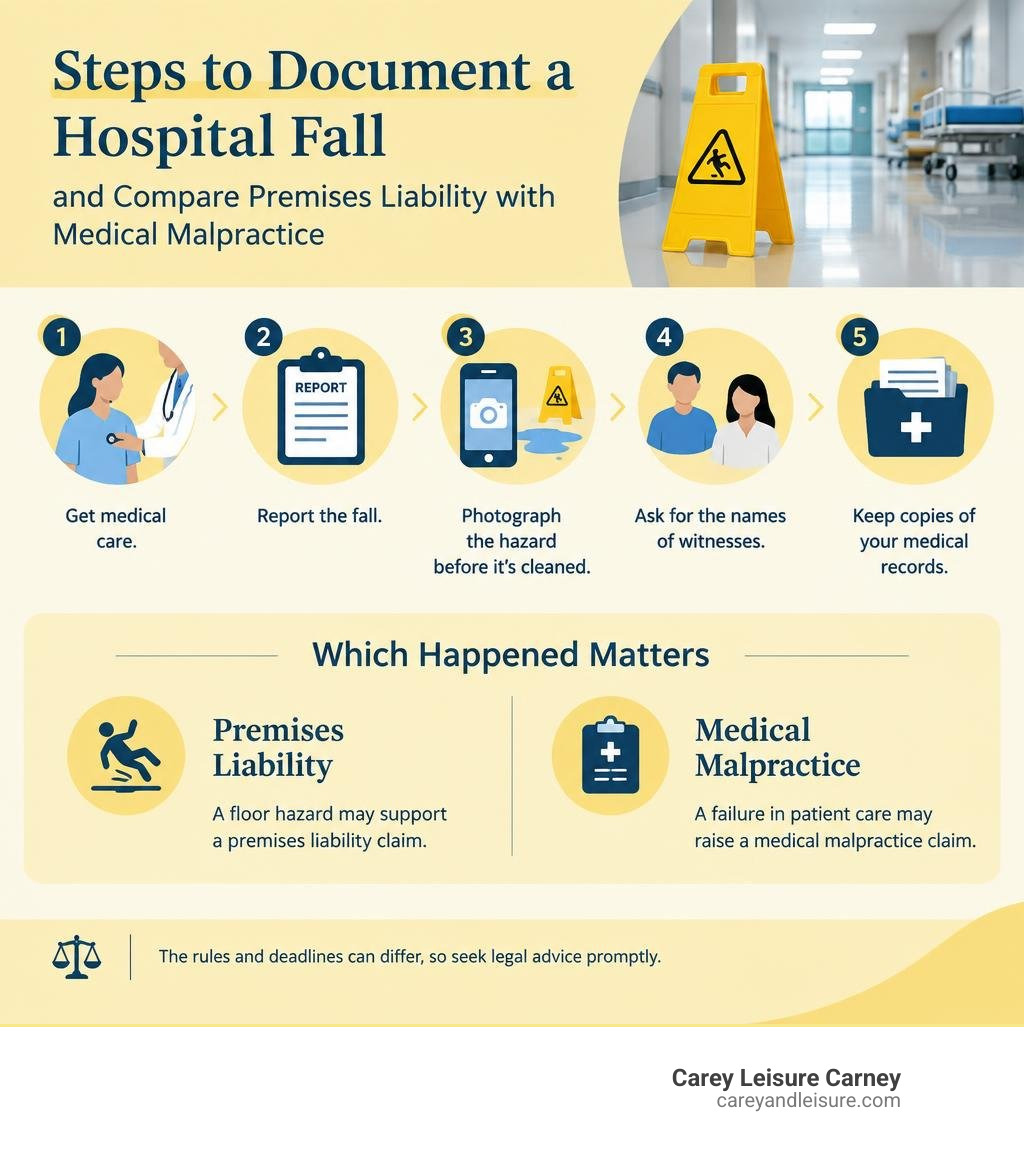
Essential hospital slip and fall terms:
Understanding Legal Theories in a Hospital Slip and Fall: Medical Malpractice vs. Premises Liability
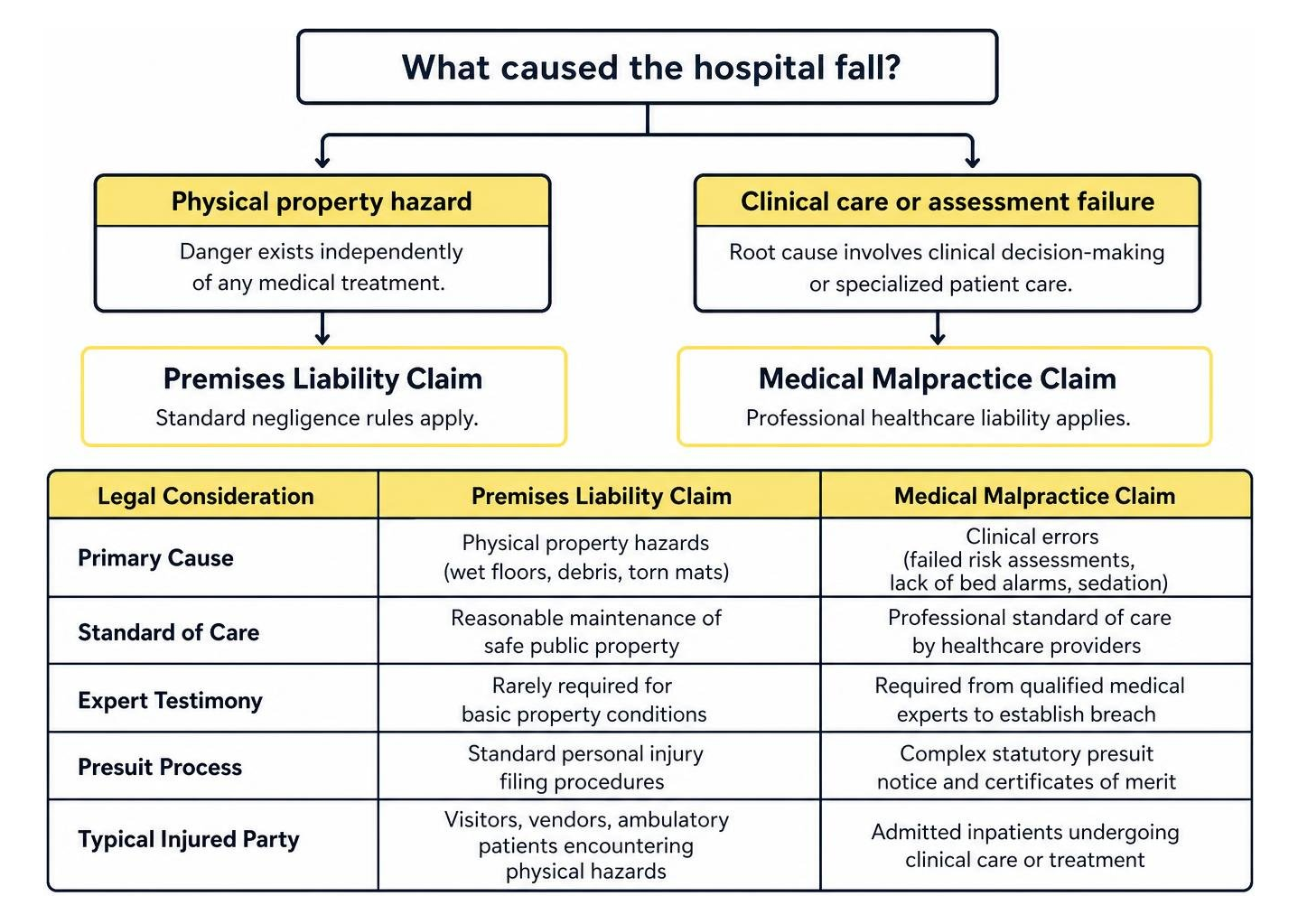
When someone falls inside a healthcare facility, pinpointing the legal theory behind the injury is essential. At first glance, a fall is simply a fall. However, the legal system divides hospital injuries into two main pathways: premises liability and medical malpractice. Navigating this boundary requires an understanding of basic tort law and premises liability principles.
The duty of care a hospital owes changes depending on whether the incident stems from ordinary facility maintenance or specialized medical judgment. When a facility fails to maintain safe physical walkways, standard negligence rules apply. Conversely, when clinical staff fail to follow proper patient safety protocols, the injury shifts into the realm of professional healthcare liability.
| Legal Consideration | Premises Liability Claim | Medical Malpractice Claim |
|---|---|---|
| Primary Cause | Physical property hazards (wet floors, debris, torn mats) | Clinical errors (failed risk assessments, lack of bed alarms, sedation) |
| Standard of Care | Reasonable maintenance of safe public property | Professional standard of care by healthcare providers |
| Expert Testimony | Rarely required for basic property conditions | Required from qualified medical experts to establish breach |
| Presuit Process | Standard personal injury filing procedures | Complex statutory presuit notice and certificates of merit |
| Typical Injured Party | Visitors, vendors, ambulatory patients encountering physical hazards | Admitted inpatients undergoing clinical care or treatment |
Understanding these distinctions ensures that the proper procedural hurdles are met and your rights remain fully protected.
How a Hospital Slip and Fall Differs from Medical Malpractice
A traditional slip and fall case involves physical defects on the property. To understand what premises liability entails, consider everyday hazards: freshly mopped tiles without warning signs, spilled beverages in a corridor, tracked-in rainwater at an entrance, or curled floor mats.
In these situations, the danger exists independently of any medical treatment. For example, in the notable decision Mooney v. Graham Hospital Association, the court addressed a situation where a patient slipped on a wet floor while walking to the restroom. The court recognized that slipping on a wet floor involves ordinary premises safety rather than complex medical judgment. When a physical hazard causes an injury, ordinary negligence rules govern the claim.
When Patient Care and Assessment Failures Trigger Malpractice
In contrast, an incident becomes medical malpractice when the root cause involves clinical decision-making or specialized patient care. Upon admission to a healthcare facility, staff must conduct a comprehensive fall-risk assessment. If a patient is elderly, recovering from surgery, or taking sedatives and diuretics, nurses and doctors must establish safety protocols.
These protocols often include:
- Installing bed and chair sensor alarms that alert nurses when a patient attempts to stand unaided
- Providing non-slip socks and assistive walking devices
- Keeping bedside call buttons within immediate reach and responding promptly
- Providing direct physical assistance during bathroom transfers
When an admitted patient falls because staff failed to conduct an accurate assessment, ignored a sounding bed alarm, or administered improper medication doses, the failure relates to professional healthcare duties rather than an uncleaned spill.
Establishing Fault: Hospital Duties and Notice of Dangerous Conditions
Property owners must maintain reasonably safe environments for individuals invited onto the premises. In healthcare facilities across Florida communities such as Clearwater, St. Petersburg, and New Port Richey, hospitals welcome thousands of individuals daily, creating an ongoing duty to inspect the facility for dangerous conditions.
A central issue in these cases involves warning systems. When maintenance crews clean floors or when leaks occur, failing to place visible markers can lead to severe injuries, illustrating what really happens when missing caution signs cause wet floor accidents.
Patient vs. Visitor Legal Status and Property Safety
Under premises liability law, patients and visitors are classified as business invitees. This status grants them the highest level of legal protection on the property. Hospitals owe invitees a duty to:
- Maintain the grounds, hallways, rooms, and restrooms in a reasonably safe state.
- Regularly inspect the property to discover hidden or developing dangers.
- Repair dangerous conditions promptly or provide adequate warnings of their presence.
Distinguishing between premises liability and general negligence helps clarify these duties. While a visitor expects dry, clear hallways while walking to a loved one’s room, an admitted inpatient is particularly vulnerable. In either scenario, the hospital must ensure that environmental hazards do not create unnecessary risks for people moving through the facility.
Proving Constructive Notice and Staff Negligence
To hold a facility liable for an uncorrected property hazard, an injured person must demonstrate that the facility had notice of the condition. Notice can be proven in two ways:
- Actual Notice: The hospital staff created the hazard (e.g., mopping without signs or spilling a liquid) or were directly informed about it before the fall.
- Constructive Notice: The dangerous condition existed for a long enough time that hospital employees exercising reasonable care should have discovered and corrected it.
In Croake v. Flushing Hospital and Medical Center, the court emphasized that facility owners must demonstrate adequate and timely inspection routines to defeat claims of constructive notice. An inspection conducted hours before an incident may not suffice to prove a safe environment.
Staff conduct can also directly create liability. In a Florida case, Capital Regional Medical Center was hit with a $1.1 million verdict after an employee dragged wet, soiled laundry bags across a hallway floor. A visitor slipped on the resulting moisture outside a utility room, suffering a shattered kneecap that required multiple surgeries and led to permanent pain. The jury found the facility fully liable because staff actions directly generated the dangerous condition.
Steps to Secure Compensation for a Hospital Fall Injury
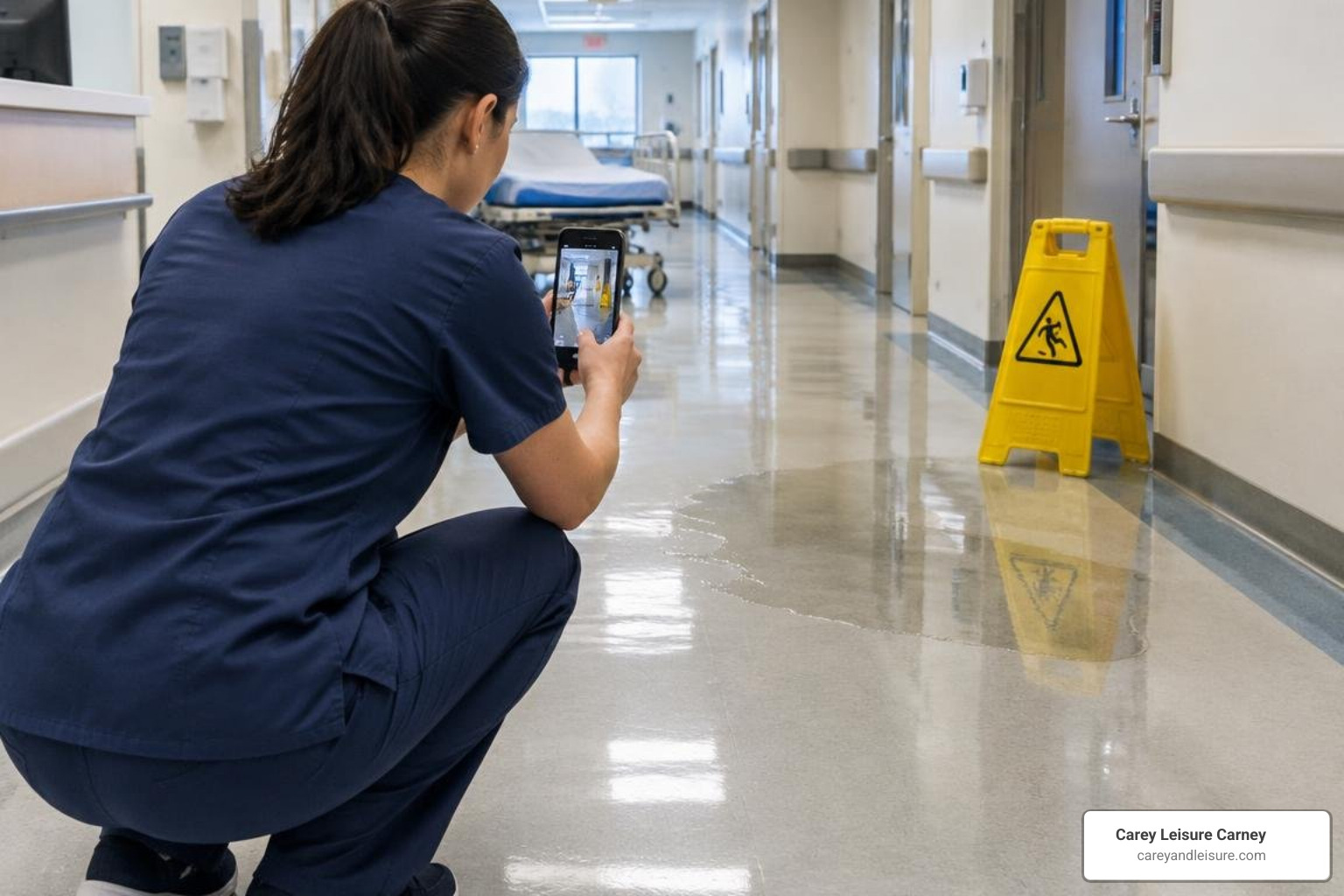
Taking immediate, methodical action after a fall is critical to protecting your health and any future legal claim. Following established protocols on what to do after a slip and fall accident helps preserve crucial evidence before it is lost or destroyed.
Crucial Evidence to Prove a Hospital Slip and Fall Case
Hospitals are environments where physical evidence can disappear quickly. Housekeeping teams clean spills, maintenance crews adjust equipment, and digital surveillance video may be automatically overwritten within days.
Building a strong case requires documenting evidence effectively through several key sources:
- Scene Photography: Capture wide and close-up images of the floor surface, liquid spills, lighting levels, missing caution signs, and surrounding area.
- Incident Reports: Request that the facility administration create an internal incident report. Ask for a copy or the incident reference number.
- Witness Information: Collect names, phone numbers, and statements from other visitors, patients, or facility staff who witnessed the fall or the hazardous condition.
- Housekeeping Logs: Obtain maintenance and custodial records to determine when the area was last inspected or cleaned.
- Surveillance Footage: Send a formal spoliation letter demanding the preservation of all security video capturing the area before, during, and after the incident.
- Expert Testimony: In complex disputes, leveraging the use of expert witnesses—such as safety engineers or medical professionals—can establish standards of maintenance and causation.
Procedural Timelines and Statutory Notice Requirements
Understanding the applicable deadlines is vital. A standard premises liability claim follows different procedural rules than a medical malpractice lawsuit. If a claim involves clinical negligence, Florida law mandates rigorous presuit notice requirements, an extensive investigative phase, and an affidavit of merit from a qualified medical expert before filing a complaint.
Missing these statutory filing windows can bar you from recovering compensation. To keep your claim viable, understanding how the accident statute of limitations operates in Florida ensures every required legal step is taken well ahead of strict deadlines.
Recoverable Damages and Overcoming Hospital Defense Tactics
A serious fall can result in broken hips, fractured wrists, spinal injuries, or traumatic brain damage. Securing fair financial recovery requires evaluating every aspect of how the injury affects your life. Exploring real payout factors in premises liability settlements illustrates the types of damages available in these claims.
Financial and Non-Economic Compensation Available
Victims of hospital negligence can seek compensation for both economic and non-economic losses, including:
- Medical Bills: Emergency treatment, surgical interventions, hospitalization fees, physical therapy, and ongoing prescription medications.
- Future Medical Care: Long-term rehabilitation, assistive equipment, home modifications, and future corrective operations.
- Lost Wages: Income lost during recovery and medical appointments.
- Diminished Earning Capacity: Compensation for lasting impairments that restrict your ability to work.
- Pain and Suffering: Physical discomfort, physical limitations, and chronic pain resulting from the trauma.
- Loss of Enjoyment of Life: Inability to participate in hobbies, family activities, and daily personal routines.
Defeating Comparative Fault and Footwear Defenses
Hospital defense attorneys and insurance adjusters frequently attempt to shift blame onto the injured party. They may claim the hazard was open and obvious, or argue that the victim should have watched their step more carefully.
Another common defense tactic focuses on footwear. Defense teams often argue that a visitor wearing sandals, flip-flops, or smooth-soled shoes caused their own accident. However, juries frequently reject these arguments when facility maintenance failures are clear. In the Capital Regional Medical Center case, the jury assigned full fault to the hospital despite defense arguments regarding the visitor’s footwear.
Florida applies a modified comparative negligence system. Under this rule, an injured person’s financial recovery is reduced by their percentage of fault, provided they are not found to be more than 50% responsible for the incident. Thorough evidence gathering helps counter these defense strategies and establish property owner accountability.
Frequently Asked Questions About Hospital Falls
How do courts decide whether a hospital fall is medical malpractice or premises liability?
Courts examine whether the injury resulted from a breach of professional healthcare duties or a standard property hazard. If the fall involved medical decision-making, patient monitoring, physician orders, or clinical equipment, it is generally treated as a medical malpractice claim. If the fall was caused by an unsafe floor surface, liquid spill, or physical facility defect, it is evaluated under standard premises liability rules.
How long do I have to file a slip and fall lawsuit against a hospital in Florida?
In Florida, standard negligence and premises liability lawsuits are governed by statutory limitation periods that require filing within two years from the date of the incident. Medical malpractice claims are also subject to a two-year deadline from when the injury was discovered or should have been discovered with reasonable diligence, along with strict presuit requirements. Consulting an attorney promptly helps ensure your claim meets all applicable deadlines.
Can I still recover damages if the hospital claims my footwear caused the fall?
Yes. Property owners have a legal obligation to maintain safe walkways regardless of what footwear invitees wear. While defense insurers may argue that footwear contributed to the slip, Florida’s comparative fault system permits financial recovery as long as you are not found more than 50% at fault for the accident.
Conclusion
A fall inside a hospital can cause serious physical injuries and significant financial stress. Whether you slipped on an unmarked wet floor in a hallway or suffered an injury due to institutional oversights, determining who is held liable is the first step toward recovery.
Navigating the nuances between medical malpractice and premises liability requires experienced legal advocacy. At Carey Leisure Carney, our board-certified trial attorneys represent the top 2% of Florida lawyers, offering direct attorney access and over 100 years of combined legal experience to clients across Clearwater, Largo, St. Petersburg, New Port Richey, Spring Hill, Trinity, and Wesley Chapel. If you or a family member was hurt on healthcare property, contact our office to learn more about pursuing a premises liability claim and safeguarding your rights.