
Facing a Drunk-in-Charge Allegation in Clearwater?
If you’re searching for a drunk in charge solicitor in Clearwater, look for a Florida criminal defense attorney who handles DUI cases. Florida can bring a DUI charge even when a vehicle is parked if you were in actual physical control of it while impaired or over the legal alcohol limit. Get advice promptly, and preserve details such as where you sat, where the keys were, and why you were in the vehicle.
The issue is not simply whether the engine was running. Under Florida’s DUI law, the circumstances of your control of the vehicle matter. A charge can also put your driving privileges at risk.
I’m Thomas W. Carey, founding partner of Carey Leisure Carney. My work on DUI-related injury cases and anti-impaired-driving advocacy informs this guide for readers seeking a drunk in charge solicitor; defending a Florida DUI charge calls for a criminal defense attorney.
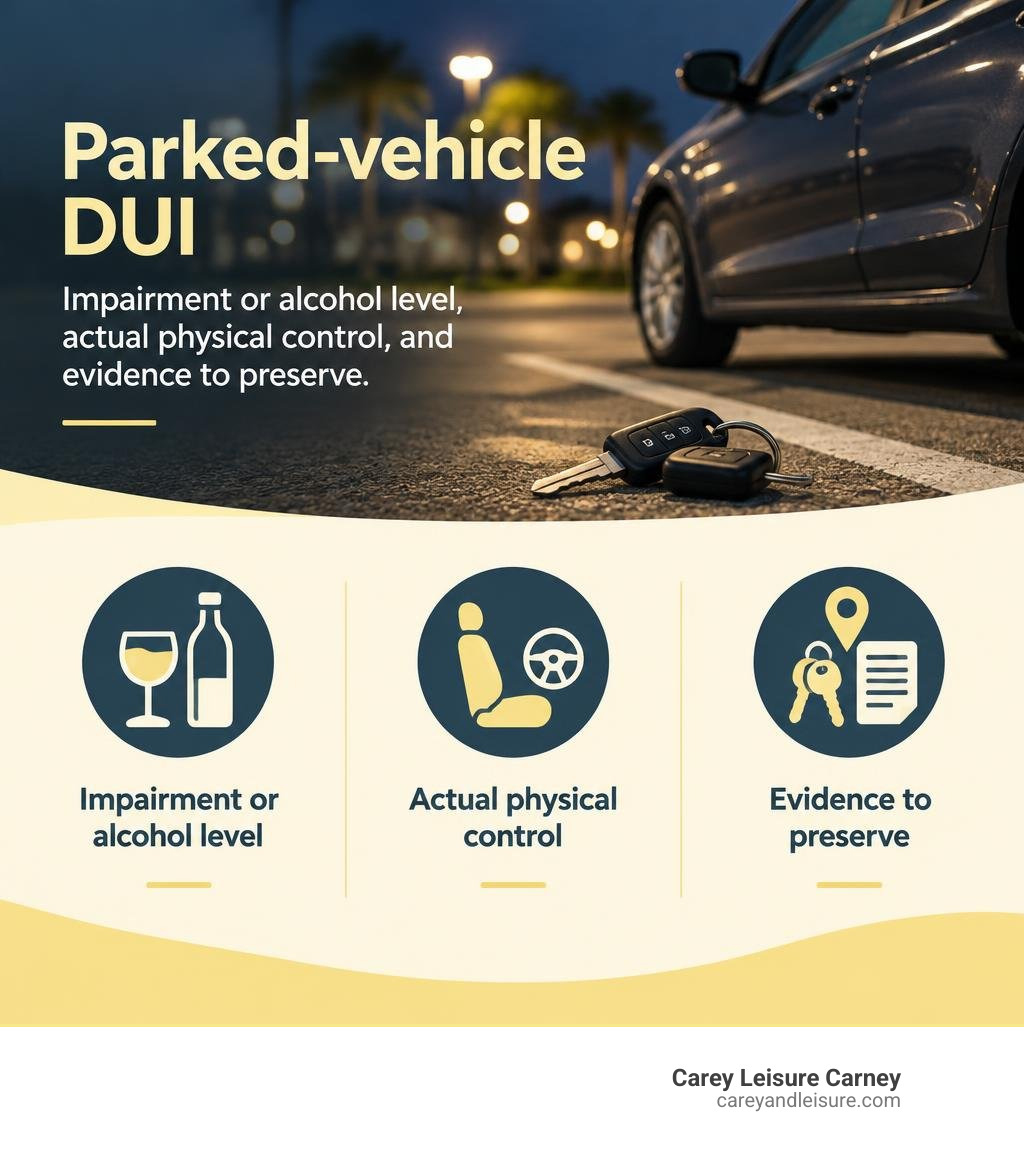
Drunk in charge solicitor vocab to learn:
Understanding the Offence: What Constitutes DUI in a Parked Vehicle?
Under Florida law, specifically Florida Statutes § 316.193, a person is guilty of driving under the influence if they are driving or in actual physical control of a vehicle within the state while impaired by alcohol or drugs, or while possessing a blood-alcohol level (BAL) or breath-alcohol level (BrAC) of .08% or higher.
The critical phrase here is actual physical control. In Florida, you do not need to be actively pressing the accelerator down Courtney Campbell Causeway or cruising through Largo to face an allegation. If you have the present physical ability to operate the vehicle, law enforcement officers can treat the situation as an active DUI.
When reviewing impaired driving legal nuances, courts examine the totality of the circumstances to determine whether actual physical control existed. These factors include:
- Where the keys were located (in the ignition, on the dashboard, in your pocket, or outside the car).
- Whether the engine was running or the key was in the accessory position to run the air conditioning.
- Which seat you occupied (the driver’s seat versus the passenger side or back seat).
- Whether the vehicle was operable (e.g., functioning tires, battery, and mechanical parts).
- Where the vehicle was parked (on a public road, shoulder, public parking lot, or private property).
| Element | Moving DUI | Parked Vehicle DUI (Actual Physical Control) |
|---|---|---|
| Vehicle State | In motion on a road or highway | Stationary, parked, or idling |
| Location | Public roadways, streets, intersections | Roadways, shoulders, public lots, private property |
| Driver Location | Behind the steering wheel operating controls | Driver’s seat, passenger seat, or sleeping in cabin |
| Key Position | In ignition, engine engaged | In ignition, console, pocket, or nearby |
| Legal Basis | Florida Statutes § 316.193 (Driving) | Florida Statutes § 316.193 (Actual Physical Control) |
| Primary Proof | Observation of bad driving, traffic stops | Ability and proximity to operate the vehicle |
Legal Limits and Measuring Alcohol
In Florida, the legal threshold for blood alcohol concentration (BAC) or breath alcohol concentration (BrAC) is .08 grams of alcohol per 100 milliliters of blood or 210 liters of breath.
To measure this, law enforcement uses preliminary roadside screening tools and approved evidential breath-testing instruments (such as the Intoxilyzer 8000) at the station or detention center. Blood testing is typically conducted in cases involving serious injury or when a breath test cannot be administered, while urine tests look for controlled substances.
Law enforcement officers must strictly adhere to administrative rules set forth by the Florida Department of Law Enforcement (FDLE). This includes ensuring a mandatory 20-minute continuous observation period before administering a breath test to rule out mouth alcohol contamination from burping, vomiting, or using oral sprays.
Sleeping in a Car or Campervan While Intoxicated
Many responsible people believe that sleeping it off in their car after an evening out in St. Petersburg or Clearwater Beach is the safest choice. While making the conscious decision not to drive is commendable, Florida law does not provide an automatic statutory exception for someone sleeping inside a parked car or campervan.
If you are asleep in the driver’s seat with the keys in your ignition to keep the air conditioning running during a hot Florida evening, prosecutors may argue that you were in actual physical control. However, if you were asleep in the back of a campervan or the rear seat of a sedan, with the keys tucked away in the glove box or exterior storage compartment, the argument for actual physical control is significantly weaker.
Penalties and Sentencing Guidelines for Florida DUI Offenses
Being convicted of a DUI involving actual physical control carries the exact same criminal penalties under Florida law as a DUI involving active driving. The court does not give automatic discounts simply because the car was stationary.
For a first-time conviction under Florida law:
- Fines: Between $500 and $1,000 (increases to $1,000–$2,000 if your BAC is .15% or higher, or if a minor was in the vehicle).
- Incarceration: Up to 6 months in county jail (up to 9 months for high BAC or minor present).
- Probation: Up to 1 year, with mandatory conditions.
- Community Service: A mandatory minimum of 50 hours (or a buyout permitted by the court).
- Vehicle Impoundment: Mandatory 10-day immobilization of the vehicle used in the incident.
- DUI School: Completion of an approved Level I DUI education course and psychosocial evaluation.
Understanding the strategies used to challenge DUI charges is vital to defending against these serious statutory consequences.
Licence Consequences and Possible Disqualification
A DUI arrest triggers two separate tracks: administrative actions handled by the Florida Department of Highway Safety and Motor Vehicles (FLHSMV) and criminal proceedings handled in county court.
- Administrative Suspension: If you submit to a test and register a BAC of .08% or higher, FLHSMV will suspend your driving privileges for 6 months. If you refuse testing, your license is suspended for 12 months for a first refusal (and 18 months for subsequent refusals). You have exactly 10 days from the arrest date to request a formal review hearing or seek a business purposes only (hardship) license.
- Court-Ordered Revocation: Upon a criminal conviction, the court must impose a minimum 180-day to 1-year driver’s license revocation for a first offense.
Why Legal Advice Is Important When Facing a Florida DUI Allegation
The state carries the burden of proving every single element beyond a reasonable doubt: that you were impaired or exceeded the legal limit, and that you maintained actual physical control of the vehicle.
Retaining experienced legal counsel provides you with the resources necessary to challenge state evidence, explore procedural flaws, and evaluate toxicology reports. Knowing how to assess retaining experienced legal counsel helps ensure your rights remain protected throughout every stage of the legal process.
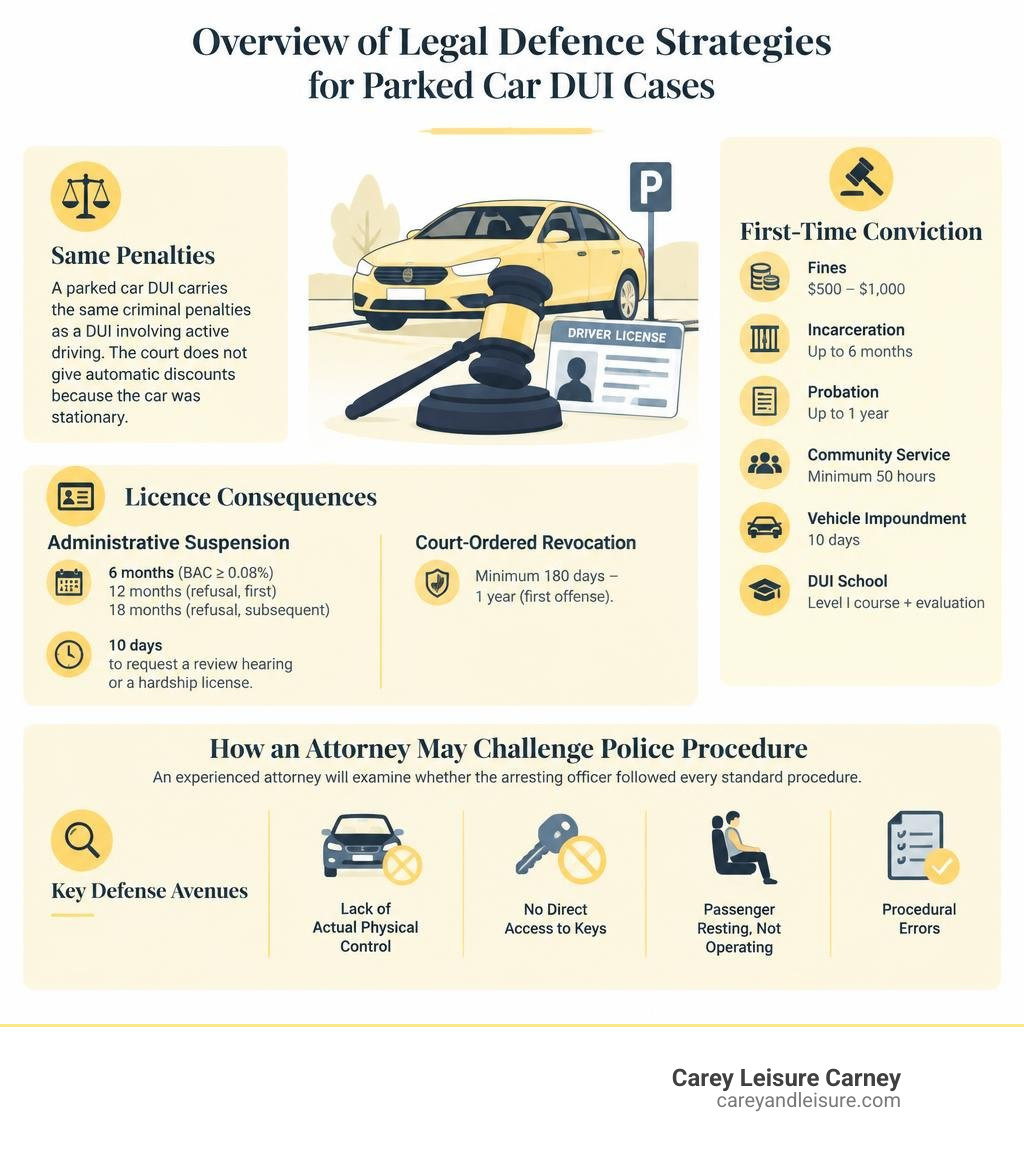
How an Attorney May Challenge Police Procedure
A skilled defense attorney will examine whether the arresting officer complied with every standard operating procedure. Key defense avenues include:
- Lack of Actual Physical Control: Proving that the vehicle was inoperable, that the defendant lacked direct access to keys, or was positioned strictly as a passenger resting without intent to operate.
- Challenging the Initial Encounter: Reviewing whether law enforcement had reasonable suspicion or consensual contact grounds to approach and detain you in a parked car.
- Testing Inaccuracies: Demonstrating that the Intoxilyzer 8000 was improperly calibrated, lacked regular maintenance, or that officer observation times were cut short.
- Mouth Alcohol & GERD: Showing that gastroesophageal reflux disease, dental work, or breath sprays created a false high breath-alcohol reading.
- Post-Operation Drinking: Demonstrating that alcohol was consumed only after parking the vehicle and turning off the engine.
Key Questions to Ask an Attorney During Consultation
When consulting an attorney in communities like New Port Richey, Spring Hill, or Wesley Chapel, ask targeted questions:
- How many parked-vehicle or actual physical control DUI cases have you handled?
- What are the specific weaknesses you see in the state’s proof regarding vehicle control?
- What is your fee structure (flat fee versus hourly rates), and what additional costs might arise for expert witnesses?
- How do you approach the 10-day FLHSMV administrative license suspension deadline?
- Do you handle both the administrative license hearing and the criminal court proceedings?
What to Do If You Are Arrested for DUI
If law enforcement approaches your stationary car and begins questioning you about alcohol consumption:
- Remain Polite but Exercise Your Right to Remain Silent: You are required to provide your driver’s license, registration, and proof of insurance. However, you do not have to answer questions like “Where are you coming from?” or “How much have you had to drink tonight?”
- Understand Field Sobriety Exercises: Roadside agility exercises (such as the walk-and-turn or one-leg stand) are voluntary under Florida law. You can decline them calmly and respectfully.
- Know the Implied Consent Rules: Under Florida Statutes § 316.1932, driving or holding physical control of a vehicle in Florida implies consent to approved chemical testing once lawfully arrested. Refusing an evidential test after an arrest leads to administrative license suspensions and can be used as evidence against you in court.
- Document the Scene Details: As soon as you are able, write down every fact you recall: key location, engine temperature, where you were sitting, lighting, and names of potential witnesses.
Frequently Asked Questions About DUI Allegations Involving a Parked Vehicle
Can I be charged with DUI if the engine was switched off?
Yes. Florida law does not require the engine to be running for a finding of actual physical control. If you have the keys readily accessible (such as in your hand, pocket, or on the passenger seat) and are sitting in a position where you could start and drive the vehicle, prosecutors can file charges.
Is a driving ban mandatory after a Florida DUI conviction?
Yes. If convicted in criminal court, Florida Statutes mandate a minimum driver’s license revocation period of 6 months for a first offense. However, many individuals qualify to apply for a hardship license (business purposes only) after completing certain prerequisites, such as enrolling in DUI school.
How much does it cost to hire an attorney for a Florida DUI case?
Legal representation costs vary based on case complexity, whether expert witnesses (like forensic toxicologists) are needed, and whether the case proceeds to a jury trial. Most private criminal defense lawyers work on a flat-fee basis. Those who qualify financially may request representation from the Public Defender’s Office at their initial court appearance.
Conclusion
Facing an allegation of driving under the influence while parked is confusing and stressful. When you made the conscious choice not to drive on Tampa Bay roadways, finding yourself in handcuffs is the last thing you expected.
Because Florida’s actual physical control doctrine hinges on fine factual details—where the keys were, your seating posture, and vehicle operability—early action is critical. Gathering witness statements, securing surveillance video from nearby businesses, and challenging breath-testing equipment compliance can make all the difference in protecting your driving record and your future.
At Carey Leisure Carney, our board-certified personal injury trial attorneys have represented clients throughout Clearwater, Largo, St. Petersburg, New Port Richey, Spring Hill, Trinity, and Wesley Chapel for decades. While our firm focuses on representing victims in auto accident and personal injury claims, we strongly advocate for broad public education surrounding practical Florida alcohol regulations and legal guidance. If you are facing criminal accusations for a parked-car DUI, we encourage you to seek out qualified criminal defense representation immediately to safeguard your constitutional rights.