

Premises Liability Settlements: Real Payout Factors and Case Values
What Determines Premises Liability Settlement Amounts?
There is no reliable average payout for a premises liability claim. A settlement depends on the severity of your injury, your medical bills and lost income, the effect on your daily life, the evidence that the property owner was negligent, and whether you share any fault. Insurance coverage also matters. Large reported verdicts can show what is possible, but they are not a sound estimate for a typical claim.
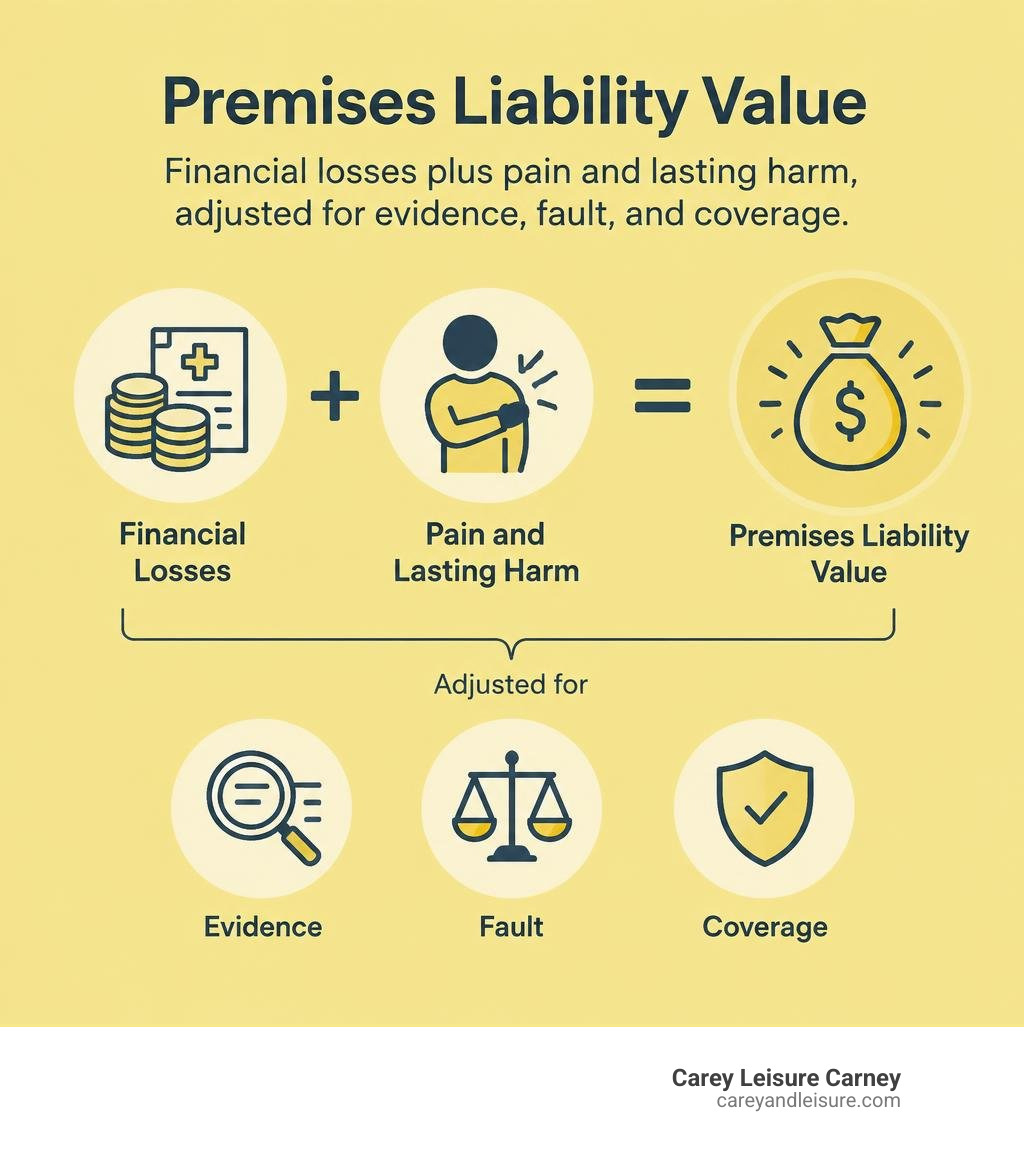
A useful starting point is to add your past and expected financial losses, then consider pain, suffering, and any lasting limits. From there, the strength of the evidence and Florida’s fault rules help shape what you may actually recover.
I’m Thomas W. Carey, founding partner of Carey Leisure Carney and a board-certified civil trial lawyer. Decades of handling Florida injury cases inform how I evaluate premises liability settlement amounts and explain them to injured clients.
Premises liability settlement amounts further reading:
Understanding Premises Liability Settlement Amounts and Valuation Benchmarks
When evaluating premises liability settlement amounts, establishing the legal foundation of your claim is essential. Under basic legal principles, property owners owe a duty of reasonable care to maintain safe grounds for visitors. A clear definition of liability establishes that when an owner breaches this duty through carelessness or inadequate maintenance, they become financially responsible for the resulting harm. Understanding what is premises liability requires looking at how economic and non-economic damages combine to create a comprehensive claim value.
High-profile reported verdicts and settlements in premises liability cases span a broad spectrum, ranging from $2.5 million to upwards of $148 million, with high-end reported cases showing a typical figure of $19.2 million. While these figures represent catastrophic or complex claims, routine premises liability payouts are tailored strictly to the specific medical bills, wage losses, and human suffering of the injured individual.
| Injury Severity Level | Typical Injury Types | Economic Factors Involved | General Settlement Range |
|---|---|---|---|
| Minor to Moderate | Sprains, contusions, minor fractures, clean cuts | Emergency care, physical therapy, brief missed work | $15,000 – $75,000 |
| Severe | Complex fractures, torn ligaments, herniated discs, mild TBI | Surgery, extensive rehab, prolonged wage loss | $100,000 – $500,000 |
| Catastrophic | Spinal cord injury, paralysis, severe TBI, permanent disability | Lifelong attendant care, home modification, total earning loss | $1,000,000 – $10,000,000+ |
How Severe Injuries Impact Premises Liability Settlement Amounts
The severity of physical harm serves as the primary engine driving case valuation. Minor soft-tissue strains resolve over weeks, while traumatic brain injuries and spinal cord trauma fundamentally alter a person’s life forever. In cases resulting in paraplegia or quadriplegia, evaluating case worth requires calculating decades of specialized care, medical equipment, and the total loss of future earning capacity.
Properly navigating personal injury settlements means working with medical life-care planners and economic experts. We ensure that every future surgery, prescription, and rehabilitation session is accounted for before entering settlement talks with corporate insurers.
Why Non-Economic Damages Dominate Premises Liability Settlement Amounts
While economic damages reimburse direct monetary outlays, non-economic damages account for the human cost of an accident. These damages compensate for physical pain, emotional distress, disfigurement, and loss of consortium. In catastrophic premises claims, non-economic awards regularly eclipse medical bills by wide margins.
Securing full compensation for pain and suffering in Florida involves detailing how an injury dismantles daily independence, hobbies, and family relationships.

A notable example of this dynamic occurred in a landmark Florida case where a man suffered partial quadriplegia after falling on an unsafe staircase at a bar. The jury returned a $644,751,855.08 verdict. Remarkably, $638.5 million of that total was allocated to past and future pain, suffering, and loss of consortium, while economic damages for medical expenses and lost earnings totaled $6.25 million. This illustrates how heavily juries weigh permanent human suffering over pure balance-sheet costs.
Key Factors That Drive High-Value and Nuclear Verdicts in Florida
Across Florida, juries are increasingly holding commercial property owners accountable when blatant safety shortcuts cause life-altering injuries. The legal industry monitors “nuclear verdicts”—awards exceeding $10 million that substantially outpace initial defense expectations. In 2026, the median for reported nuclear verdicts reached approximately $52 million. Juror attitudes have shifted considerably: recent polling indicates only 56% of people believe there are too many lawsuits (down from 90% a decade ago), and 76% view jury damage awards as either appropriate or too low.
Reviewing 8 eye-opening premises liability case examples reveals common themes: juries penalize corporate defendants who prioritize cost-cutting over public safety. Under a guide to torts law and premises liability, proving deliberate indifference or reckless disregard remains the swiftest route to high-value recovery.
Known Hazards and Withheld Safer Alternatives
One of the most inflammatory facts in a premises liability case is evidence that management knew a feature was hazardous but kept a safer route reserved exclusively for staff. In that $644.75 million Florida staircase verdict, trial evidence revealed that venue operators maintained a safer, code-compliant set of stairs that was kept off-limits to patrons and reserved for employees, leaving guests to navigate the dangerous staircase.
When property owners knowingly subject customers to risks while shielding their own staff, juries respond decisively. In cases involving trip and fall design defects, uncovering internal communications or architectural records showing an owner withheld safer alternatives often transforms settlement negotiations.
Building Code Violations and Maintenance Records
Documenting violations of local building and safety codes establishes compelling evidence of negligence. Commercial properties must maintain clear stairways, compliant handrails, even walking surfaces, and adequate illumination.
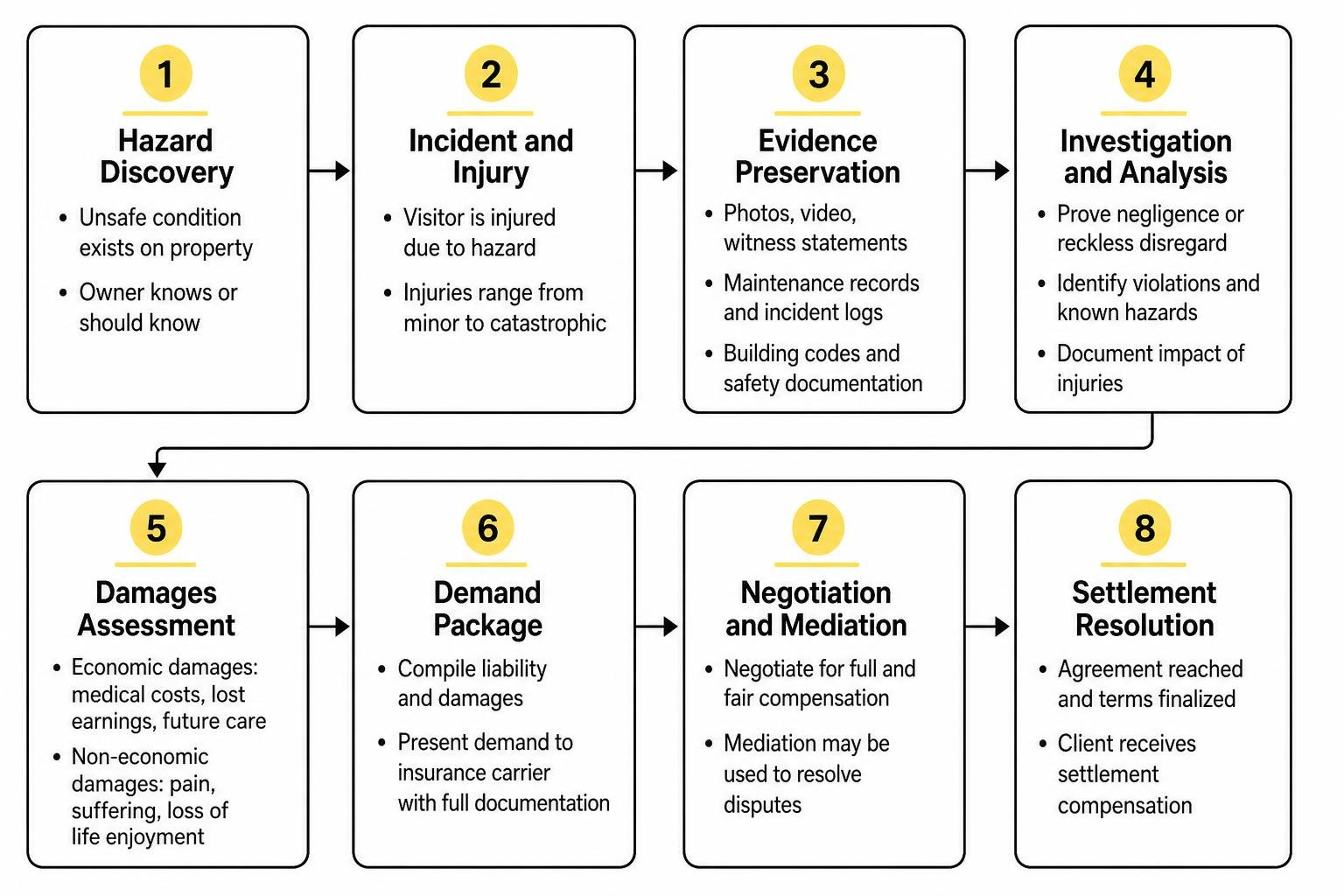
Routine corporate failures include:
- Failing to clean spills or post warnings, as explored in what happens when missing caution signs cause slip and falls.
- Ignoring maintenance for entryways, such as securing commercial floor mats to prevent bunching and sliding.
- Concealing internal incident logs that prove multiple people tripped over the exact same structural defect in preceding months.
How Florida Negligence Laws and Comparative Fault Affect Payouts
Understanding Florida’s statutory framework is vital when projecting settlement outcomes. In March 2023, Florida overhauled its tort laws, transitioning from a pure comparative fault system to a modified comparative fault standard under Florida Statute § 768.81. Under current law, an injured plaintiff is barred from recovering damages if they are found to be more than 50% at fault for their accident (the 51% bar rule). If a plaintiff’s fault is 50% or less, their recovery is reduced proportionally.
Understanding the difference between general premises liability vs negligence helps clarify how insurance adjusters use comparative fault allegations to discount settlement offers.
Proving Property Owner Notice and Liability
Under Florida Statute § 768.0755, business invitees injured by transitory foreign substances (such as spilled liquids or fallen retail items) must prove the business establishment had actual or constructive knowledge of the dangerous condition and should have remedied it.
Constructive knowledge can be established by proving:
- The dangerous condition existed for such a length of time that, in the exercise of ordinary care, the business establishment should have known of it.
- The condition occurred with regularity and was therefore foreseeable.
Working with an experienced advocate, as outlined in our slip and fall attorney guide, ensures critical evidence such as surveillance video, sweeping logs, and employee witness statements are preserved before they disappear.
Settlement Negotiations vs. Trial Verdicts: When Lowball Offers Backfire
Insurance carriers for major commercial retailers frequently make nominal pre-trial settlement offers, hoping injured victims will accept quick cash rather than endure litigation. However, taking a well-documented case to a jury can lead to outcomes far beyond those initial offers.
In October 2025, a Florida jury awarded an injured shopper more than $11.3 million after she tripped over an unmarked, abrupt elevation change between asphalt and a concrete gutter in a Target parking lot, suffering severe fractures. Before trial, the defense’s highest settlement offer was $250,000. The ultimate verdict was more than 45 times the pre-trial offer, demonstrating why injured Floridians need a slip and fall attorney willing to reject unreasonable settlement proposals and proceed to trial.
Commercial Retailers and Negligent Security Claims
Commercial premises liability extends beyond wet floors. Retail centers, apartment complexes, and parking lots must provide adequate security and safe outdoor environments. Poor lighting, overgrown landscaping, and unmaintained pavement create severe safety risks.
When commercial operators fail to address known criminal activity on their property, victims can pursue compensation under Florida law with the help of our negligent security lawyer guide.
Frequently Asked Questions About Premises Liability Settlements
What is the average payout for a slip and fall on commercial property?
There is no true universal average because payouts vary widely based on injury severity, medical costs, wage loss, and available insurance coverage. Minor injury claims may settle between $15,000 and $50,000, while severe or permanent injuries requiring surgery routinely reach hundreds of thousands or millions of dollars.
How does Florida’s modified comparative fault law affect claim value?
Under Florida’s modified comparative fault rule (Florida Statute § 768.81), your compensation is reduced by your assigned percentage of fault. If you are awarded $100,000 but found 20% responsible, you receive $80,000. If you are found 51% or more at fault, you are barred from recovering any compensation.
How long does it take to settle a premises liability claim in Florida?
A premises liability claim typically takes between six months to over two years to resolve. Negotiations generally should not conclude until you reach Maximum Medical Improvement (MMI), ensuring all past and future medical costs are fully identified before finalizing a settlement.
Conclusion
Maximizing the value of a premises liability claim requires thorough investigation, careful economic calculation, and aggressive trial preparation. At Carey Leisure Carney, our board-certified personal injury trial lawyers—representing the top 2% of attorneys in Florida—bring over 100 years of combined legal experience to every case we handle. We provide direct attorney access and dedicated representation across Clearwater, Largo, New Port Richey, Spring Hill, St. Petersburg, Trinity, and Wesley Chapel, Florida.
If you or a loved one suffered injuries due to a negligent property owner, consult an experienced premises liability attorney at Carey Leisure Carney today for a free consultation.