
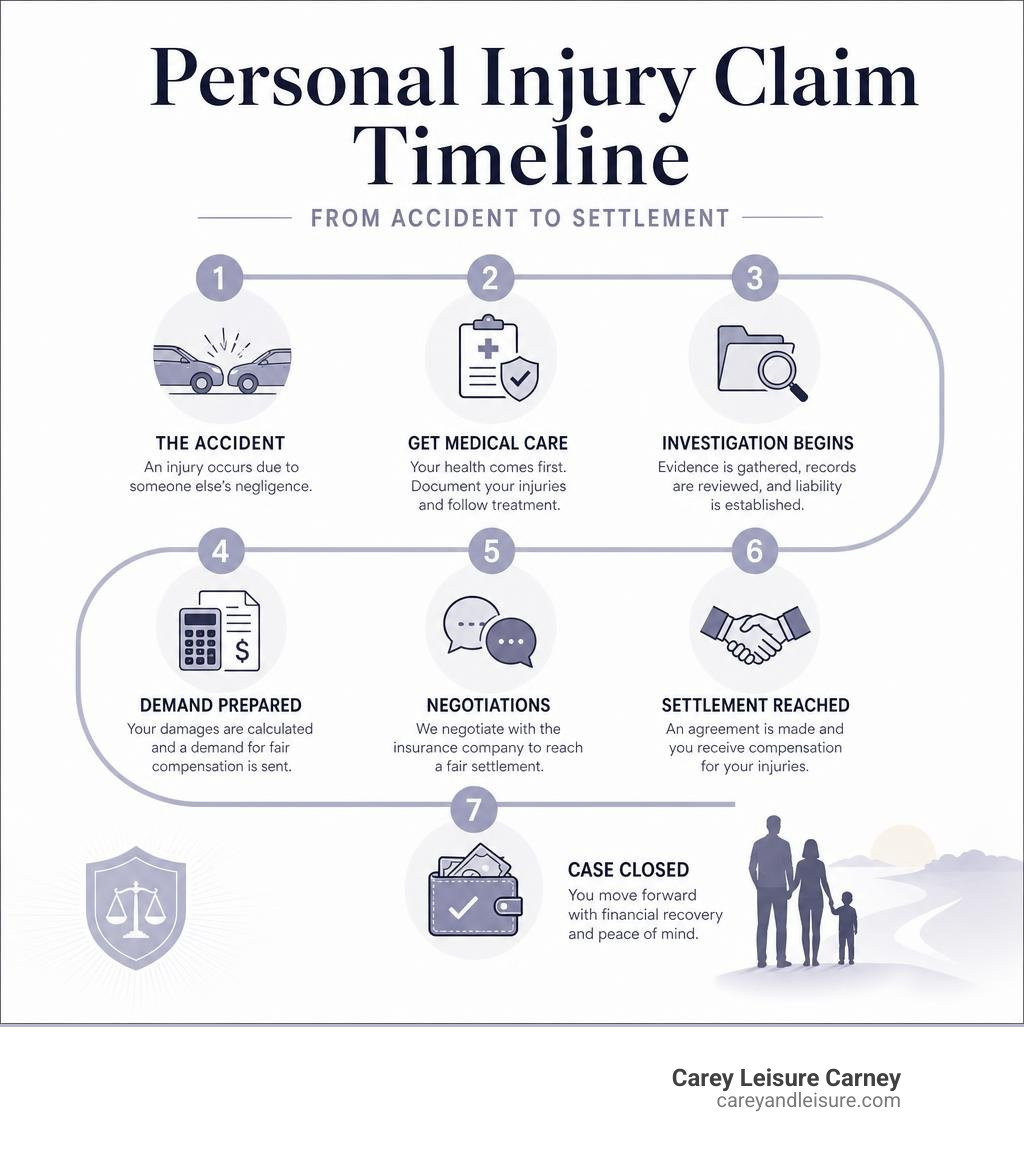
Navigating the Path to Personal Injury Settlements
What You Need to Know to Get Compensation for Injury
If you’re trying to get compensation for injury, here’s a quick overview of your main options:
| Route | Best For | Key Benefit |
|---|---|---|
| Workers’ compensation | Workplace injuries | No-fault, faster process |
| Personal injury claim | Accidents caused by negligence | Includes pain and suffering |
| Car accident / PIP claim | Florida auto accidents | Covers medical bills quickly |
| Federal programs (CICP) | Vaccine or countermeasure injuries | Specialized federal coverage |
Dealing with an injury is already hard enough. Then come the medical bills, missed paychecks, and the pressure to accept whatever the insurance company offers first.
Here’s the reality: 96% of personal injury cases settle before trial — but unrepresented victims receive on average 3.5 times less than those with legal help. The median personal injury settlement in the US sits around $31,000, yet what you actually receive depends heavily on how your case is handled from day one.
This guide walks you through every step — from understanding your rights to knowing what your claim is actually worth.
I’m Thomas W. Carey, founding partner of Carey Leisure Carney and a board-certified civil trial lawyer who has guided roughly 40,000 injury matters across Florida since 1988 — helping clients get compensation for injury in cases ranging from auto accidents to medical malpractice. Whether your case settles early or goes to trial, my team and I are here to make sure you understand your options and never leave money on the table.
Related content about Get compensation for injury:
- Auto accident legal help
- compensation for pain and suffering after a car accident
- compensation for ptsd after car accident
How to Get Compensation for Injury in Florida

Florida’s beautiful Gulf Coast is a wonderful place to live and work, but accidents happen every single day on our busy roads and in local workplaces. When negligence or unexpected circumstances disrupt your life, understanding Florida personal injury law is the first step toward recovery.
To successfully get compensation for injury in Florida, you must establish liability. In personal injury claims, this generally means proving that another party was negligent—meaning they owed you a duty of care, breached that duty, and directly caused your injuries and financial losses.
Whether you are navigating an auto accident in Clearwater, a slip-and-fall in Tampa, or a workplace incident in St. Petersburg, the legal path you take depends entirely on how and where the injury occurred. For a broader overview of what happens after a crash or fall, read our More info on compensation after an accident.
Because the legal landscape varies by city and county, working with a local legal team who understands the local courts makes a significant difference. Having dedicated representation in your specific area—whether in Largo, New Port Richey, Spring Hill, St. Petersburg, or Wesley Chapel—helps ensure your case is handled with the local expertise it requires.
Steps to Get Compensation for Injury After a Workplace Accident
If you are hurt while performing your job duties, your primary path to recovery is through the workers’ compensation system. Unlike standard personal injury claims, workers’ compensation is a no-fault system. This means you do not need to prove your employer did anything wrong to receive benefits; you only need to prove that the injury occurred “in the course and scope” of your employment.
To protect your rights and secure these benefits, you must act quickly:
- Report the Injury Immediately: In Florida, you must notify your employer of a workplace injury within 30 days of the accident (or within 30 days of a doctor diagnosing a work-related illness). Failing to meet this strict deadline can result in a complete denial of your claim.
- Seek Authorized Medical Care: Your employer or their insurance carrier has the right to select the treating physician. Except in emergencies, you must see an approved doctor for your medical bills to be covered.
- Understand Your Benefits: Workers’ comp programs generally provide:
- Medical Benefits: 100% coverage for authorized medical treatments, prescriptions, and physical therapy related to the injury.
- Lost Wage Benefits: Temporary partial or temporary total disability benefits, which typically cover about 66.67% of your average weekly wage while you are unable to work.
- Vocational Rehabilitation: Training or education if your injury prevents you from returning to your previous line of work.
If your employer disputes your claim, fails to report the accident to their insurance, or delays your payments, you may need to file a formal Petition for Benefits to start a contested proceeding before an administrative judge. Having experienced legal advocacy on your side can help ensure your workplace rights are fully protected.
How to Get Compensation for Injury in a Car Accident Claim
Florida operates under a “no-fault” auto insurance system, which drastically changes how you seek compensation after a car crash. Under state law, every driver is required to carry a minimum of $10,000 in Personal Injury Protection (PIP) insurance.
When an accident occurs, your own PIP insurance is your first line of defense. It covers 80% of your necessary medical expenses and 60% of your lost wages, up to the $10,000 limit, regardless of who caused the accident. However, to qualify for full PIP benefits, you must seek medical attention within 14 days of the crash.
Because medical bills from a moderate or severe collision can easily exceed $10,000, you will often need to step outside of the no-fault system to recover the rest of your damages. To file a lawsuit or claim against the at-fault driver’s Bodily Injury Liability (BIL) coverage, your injuries must meet Florida’s “injury threshold,” which includes permanent injury, significant scarring, or permanent loss of an important bodily function.
To maximize your recovery after a collision, read our comprehensive Guide to maximizing car accident settlements. Additionally, recovering compensation for your physical injuries is only half the battle; you must also address your property losses. You can find strategies for managing your property damage in our guide on Winning your vehicle damage claim. If your vehicle was repaired but is now worth less simply because it has an accident history, learn how to claim that lost equity through our guide on Diminished car value in Florida.
What is the Countermeasures Injury Compensation Program (CICP)?
While workers’ comp and personal injury claims handle everyday accidents, the federal government has established highly specialized programs for rare situations. One such program is the Countermeasures Injury Compensation Program (CICP).
Administered by the Health Resources and Services Administration (HRSA), the CICP provides compensation for extremely serious physical injuries or deaths directly resulting from the administration of “covered countermeasures.” These countermeasures include vaccines, medications, and medical devices used by the government to treat or prevent public health emergencies or security threats (such as those deployed during pandemics).
The CICP differs from traditional personal injury or workers’ compensation claims in several key ways:
- Filing Window: Requesters must file a complete Request for Benefits package within one year of receiving the countermeasure.
- No Pain and Suffering: Unlike personal injury lawsuits, the CICP does not provide compensation for non-economic damages like pain and suffering. It only covers unreimbursed medical expenses, lost employment income, and survivor death benefits.
- Administrative Review: The program is entirely administrative. Requesters must submit all medical records themselves, as the CICP will not contact healthcare providers on your behalf.
Calculating the Value of Your Personal Injury Settlement

When we evaluate a personal injury claim, we divide damages into two main categories: economic damages (your measurable financial losses) and non-economic damages (the emotional and physical toll of the injury).
To calculate non-economic damages, insurance adjusters and attorneys generally use one of two common legal formulas:
- The Multiplier Method: This is the most common approach. We take your total economic damages (medical bills + lost wages) and multiply that number by a figure between 1.5 and 5 (or sometimes higher for catastrophic injuries), depending on the severity of your pain, suffering, and lifestyle disruption.
- The Per Diem Method: This method assigns a specific daily dollar amount (often equivalent to a day’s wages) for every day you must live with the pain caused by the accident, from the date of the crash until you reach Maximum Medical Improvement (MMI).
While the median US personal injury settlement is roughly $31,000, your case’s value depends entirely on the specific facts of your accident. To understand how insurance companies value these claims under Florida law, read our detailed analysis of What is my personal injury case worth?.
Factors That Influence Your Settlement Value
Every personal injury case is unique, and several critical variables can cause two seemingly similar accidents to result in completely different settlement amounts:
- Injury Severity: A soft-tissue sprain will be valued differently than a permanent spinal injury or a traumatic brain injury. For a closer look at how insurance companies evaluate head trauma, read our guide on Mild traumatic brain injury settlements.
- Total Medical Bills and Lost Wages: High, documented economic losses provide a solid foundation for a larger multiplier.
- Comparative Fault: Florida operates under a modified comparative negligence system. If you are partially at fault for the accident, your final compensation will be reduced by your percentage of blame. Crucially, under Florida’s “50% bar rule,” if you are found to be more than 50% responsible for the accident, you are legally barred from recovering any damages from the other party.
To see how these factors play out in real life, review our collection of Personal injury settlement examples.
Comparing US Settlement Models to International Systems
It can be helpful to compare how we get compensation for injury in the United States with how other countries handle minor injuries.
In England and Wales, for example, the government introduced the Official Injury Claim (OIC) portal to streamline minor road traffic accident claims valued under £5,000 for bodily injuries (and £10,000 total).
Instead of negotiating pain and suffering damages using wild multipliers, the UK system utilizes a fixed, statutory whiplash tariff based strictly on the duration of the injury. Unrepresented claimants can navigate this self-service government portal independently by following the official Official Injury Claim Guide or by reviewing the Five steps to using the online Official Injury Claim Service.
While this international system reduces legal costs for insurance companies, the American civil justice system remains highly protective of an individual’s right to personalized, full compensation. In Florida, we do not use rigid, state-mandated tariffs for pain and suffering; instead, we fight to ensure that your unique pain, lifestyle limitations, and emotional distress are fully compensated based on your specific life circumstances.
Navigating Specific Accident Types in Florida
The type of accident you experience heavily dictates the insurance policies involved, the federal or state regulations that apply, and the overall settlement potential.
To give you an idea of how different injuries are valued nationwide:
- Car Accidents: The median settlement for a standard car accident in the US is $16,000, while the mean (average) settlement is $24,500.
- Dog Bites: Dog bite claims often involve severe scarring and emotional trauma, resulting in a much higher average national payout of $64,555.
- Online Estimators: Over 75,000 Americans have utilized online accident compensation calculators to get a baseline understanding of their claim’s value before speaking with an attorney.
Commercial Truck and Uber Accident Claims
If you are involved in a collision with a commercial semi-truck on US Route 19, or if you are injured while riding in an active rideshare vehicle, your claim becomes significantly more complex than a standard two-car accident.
Commercial truck accidents involve commercial insurance policies that often carry millions of dollars in coverage. However, trucking companies employ rapid-response teams of investigators and lawyers to minimize their liability immediately after a crash. Navigating these claims requires a deep understanding of Federal Motor Carrier Safety Administration (FMCSA) regulations. To learn more about how these high-value cases are resolved, read our guide on Commercial vehicle accident settlements.
Similarly, rideshare accidents involve a complex “three-tier” insurance system. Whether Uber’s $1 million liability policy applies depends entirely on whether the app was on, if the driver was waiting for a ride request, or if they were actively transporting a passenger. If you were hurt in a rideshare vehicle, you can find a step-by-step roadmap in our guide on Uber accident lawsuits.
Frequently Asked Questions About Injury Compensation
Can I receive compensation for pain and suffering under workers’ compensation?
No. Under Florida’s workers’ compensation laws, you cannot receive compensation for pain, suffering, loss of enjoyment of life, or emotional distress. Workers’ comp is strictly limited to medical expenses and a portion of your lost wages.
However, if a negligent third party (someone other than your employer or a direct co-worker) caused your workplace injury—such as a negligent driver hitting you while you were driving for work, or a defective piece of machinery malfunctioning—you can file a separate personal injury lawsuit against that third party. This third-party claim allows you to pursue full compensation, including pain and suffering damages. For more details on how these damages work, read our guide on More info on Florida pain and suffering.
What is the statute of limitations for personal injury claims in Florida?
In Florida, the statute of limitations for most personal injury claims is two years from the date of the accident.
This strict deadline applies to car accidents, slip-and-falls, and general negligence claims. If you do not file a formal lawsuit in court before this two-year window closes, you will lose your legal right to pursue compensation forever.
How does comparative negligence affect my Florida injury settlement?
Florida utilizes a modified comparative negligence rule with a 50% bar.
This means you can recover damages as long as you are not more than 50% at fault for the accident. Your final compensation will be reduced by your exact percentage of fault. For example, if you are awarded $100,000 in damages but are found to be 20% at fault for the crash, you will receive $80,000. If you are found to be 51% at fault, however, you will receive nothing.
Conclusion
Securing the compensation you deserve after an injury is a complex process. Insurance companies are businesses, and their primary goal is to settle your claim for as little as possible.
At Carey Leisure Carney, we believe you shouldn’t have to face them alone. We are a premier personal injury law firm based in Clearwater, Florida, serving clients across Pinellas, Pasco, and Hernando counties—including Largo, New Port Richey, Spring Hill, St. Petersburg, Trinity, and Wesley Chapel.
Our unique advantage is simple: we have Board-Certified civil trial attorneys (a distinction held by less than 2% of Florida lawyers) with over 100 years of combined experience. We do not hand your case off to paralegals or case managers; instead, we offer direct attorney access and personalized, compassionate service from day one.
With 96% of cases resolving before trial, having a board-certified trial attorney on your side signals to insurance companies that you are fully prepared to fight for your rights in court if they refuse to offer a fair settlement. Statistics show that represented victims walk away with an average of 3.5 times more compensation than those who go it alone.
Don’t leave your recovery to chance. Consult a Clearwater Personal Injury Attorney at Carey Leisure Carney today for a free, no-obligation consultation, and let us help you navigate the path to a fair settlement.