
How Florida Alcohol Distribution Laws Work
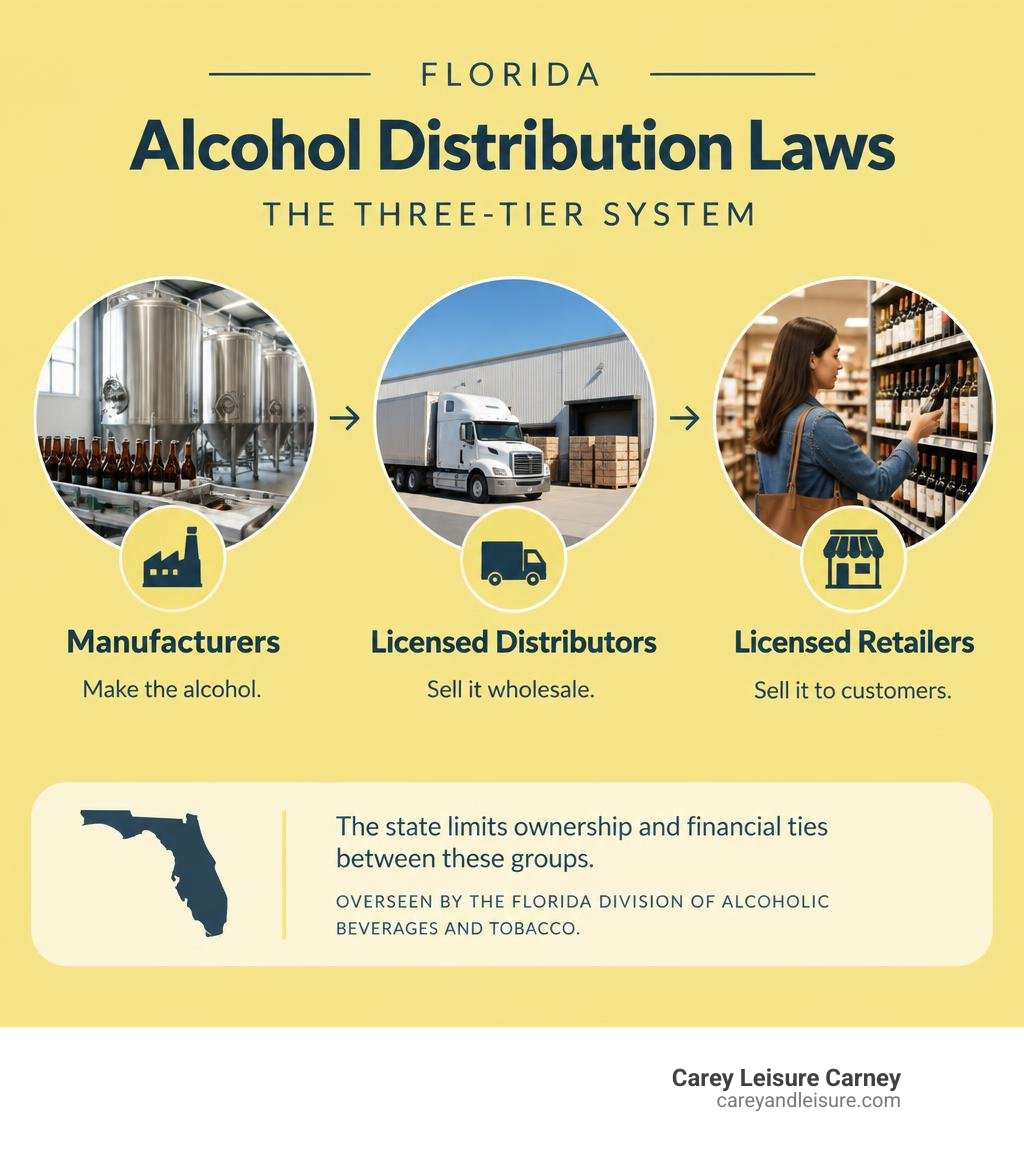
Florida alcohol distribution laws generally require alcohol to move through three separate businesses: a manufacturer makes it, a licensed distributor sells it wholesale, and a licensed retailer sells it to customers. The state limits ownership and financial ties between these groups. Its Division of Alcoholic Beverages and Tobacco oversees licensing and enforcement.
The rules also cover distributor warehouses, beer sales territories, retailer deliveries, advertising, and penalties. If you run a business, start by confirming which license and sales activities your business needs before buying, storing, or selling alcohol.
I’m Thomas W. Carey, a board-certified civil trial lawyer and founding partner of Carey Leisure Carney in Clearwater. My work on DUI crashes and wrongful death gives me a safety-focused perspective on Florida alcohol distribution laws and why responsible alcohol sales matter.
Related content about florida alcohol distribution laws:
Core Pillars of Florida Alcohol Distribution Laws: The Three-Tier System
Florida’s regulatory framework for alcoholic beverages is built upon the historic three-tier system established following the repeal of Prohibition under the Twenty-First Amendment. The primary objective of this structure is to prevent monopolies, vertical integration, and aggressive sales tactics by legally separating the production, wholesale distribution, and retail sale of alcoholic beverages.
Under Florida’s statutory foundations outlined in Chapters 561 through 565 of the Florida Statutes, cross-tier financial interests and operational control are strictly restricted. The Division of Alcoholic Beverages and Tobacco (DABT), operating within the Department of Business and Professional Regulation (DBPR), oversees the entire pipeline across the state, from Pinellas and Hillsborough to Pasco and Hernando counties.
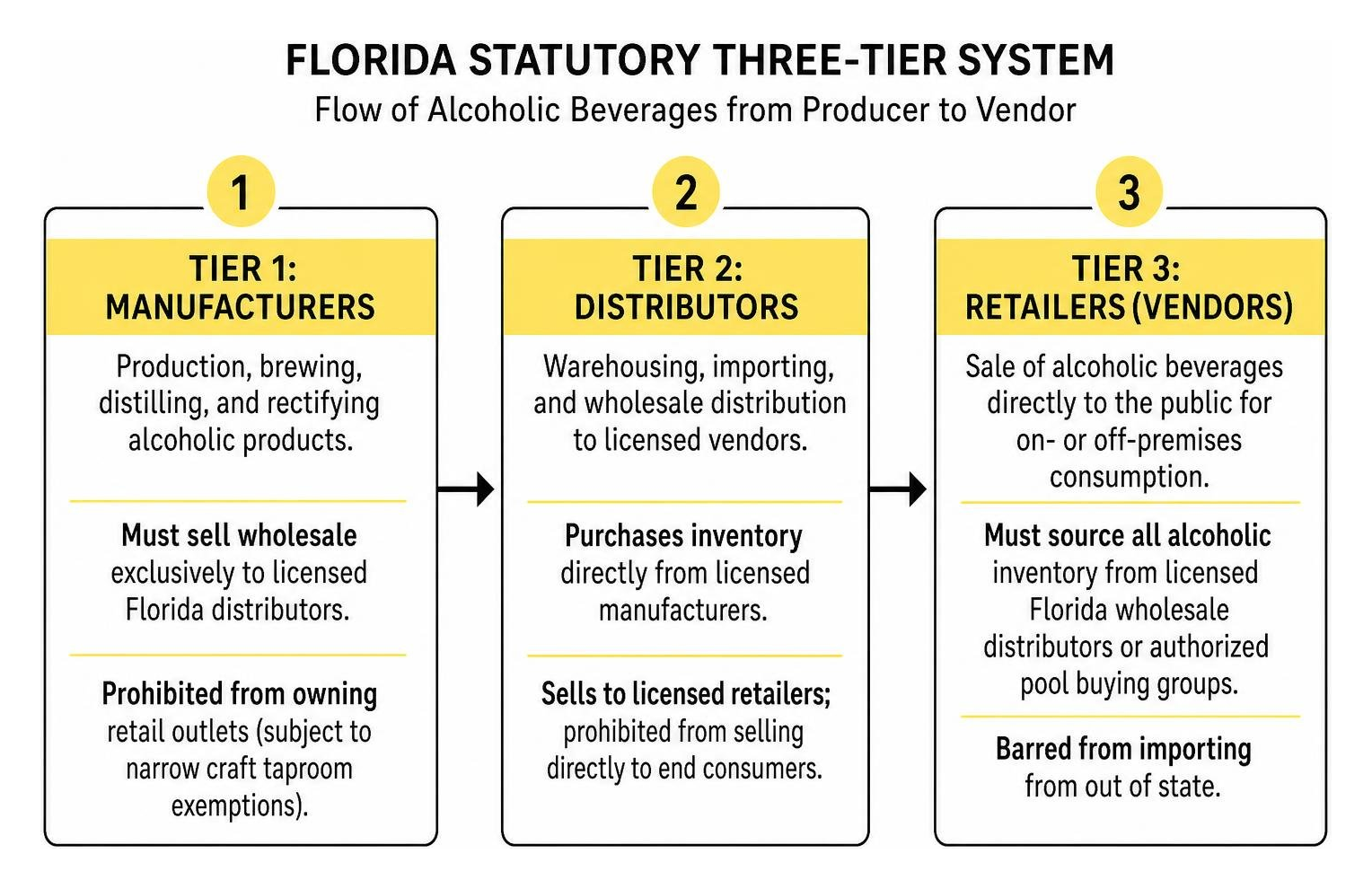
| Tier Classification | Primary Statutory Role | Key Operational Privileges & Restrictions |
|---|---|---|
| Tier 1: Manufacturers | Production, brewing, distilling, and rectifying alcoholic products. | Must sell wholesale exclusively to licensed Florida distributors; prohibited from owning retail outlets (subject to narrow craft taproom exemptions). |
| Tier 2: Distributors | Warehousing, importing, and wholesale distribution to licensed vendors. | Purchases inventory directly from licensed manufacturers; sells to licensed retailers; prohibited from selling directly to end consumers. |
| Tier 3: Retailers (Vendors) | Sale of alcoholic beverages directly to the public for on- or off-premises consumption. | Must source all alcoholic inventory from licensed Florida wholesale distributors or authorized pool buying groups; barred from importing from out of state. |
Tier Classifications: Manufacturers, Distributors, and Retailers
To keep commercial operations orderly, the state categorizes licensees into specific statutory classes under Section 561.14 of the Florida Statutes:
- Manufacturers: Breweries, wineries, and distilleries that produce beverages containing 0.5% or more alcohol by volume (ABV).
- Wholesale Distributors: Entities holding specific state distribution licenses, such as JDBW (Beer and Wine Distributor), KLD/KLD2 (Spirituous Beverages Distributor), JDSW (Sacramental Wine), or EDB (Dry County Distributor).
- Retail Vendors: Bars, restaurants, grocery stores, and package liquor stores operating under quota licenses or specialized permits.
Under standard statewide drinking regulations, commercial retailers cannot bypass local distributors to import inventory from out of state. Every bottle of wine, keg of beer, and case of spirits must flow through licensed distribution channels before it reaches store shelves or bar counters.
Licensing Requirements Under Florida Alcohol Distribution Laws
Securing and maintaining a wholesale distributor license in Florida involves strict operational, physical, and financial hurdles. The state imposes these rules to ensure distributors are legitimate commercial operations rather than pass-through entities or shell companies.
- Warehouse Storage Mandates: A licensed distributor must maintain a physical, commercial warehouse facility capable of storing an inventory of alcoholic beverages equal to at least 10% of the distributor’s annual case sales to retailers, or maintain continuous inventory with an acquisition cost of at least $100,000.
- Continuous Inventory Thresholds: Distributors must maintain active warehouse inventory equal to at least 5% of their annual sales volume or stock with an acquisition cost of at least $100,000 at all times.
- General Retailer Servicing Rules: To satisfy the legal requirement of serving licensed vendors generally, a distributor must sell to at least 25% of the licensed retailers in the county where their warehouse is located, or ensure that at least 50% of total wholesale volume to retailers consists of individual orders of ten cases or fewer.
- Surety Bonds: In-state manufacturers and distributors must post surety bonds ranging from $25,000 to $100,000 to guarantee excise tax payments.
- State Licensing Fees: Annual distributor license fees generally range from $140 to $4,000 depending on beverage type and operational scope, with temporary license fees set at the greater of $100 or one-quarter of the annual fee.
Tied-House Evil Prohibitions and Statutory Exceptions
Florida Statute § 561.42—commonly known as the “Tied-House Evil” law—is designed to prevent manufacturers and distributors from exercising financial control over retail vendors. In the pre-Prohibition era, national breweries frequently owned saloons outright, forcing aggressive sales quotas that contributed to public disorder. Modern Florida law blocks these arrangements by demanding strict financial independence between tiers.
Financial Separation and Prohibited Things of Value
Under Section 561.42, industry members (manufacturers, importers, and distributors) are prohibited from directly or indirectly giving financial gifts, loans, property, or unapproved rebates to retail vendors. Prohibited trade practices include:
- Slotting Fees: Paying retailers for dedicated shelf space, floor placement, or tap handle priority.
- Commercial Equipment & Gifts: Providing free commercial draft systems, refrigeration units, or furniture to bars and restaurants.
- Exterior Signage: Furnishing outdoor branded signs, custom building awnings, or exterior billboards for specific retail premises.
- Selective Rebates & Terms: Offering undisclosed, retroactive, or discriminatory volume discounts that are not available on identical terms to all competing retailers within the same license class.
To ensure compliance, distributors and vendors must maintain complete transaction records, sample invoices, and delivery manifests for at least three years, making them readily available for audits by the DABT Bureau of Auditing.
Permitted Trade Practices, Branded Displays, and Tastings
To balance market competition with practical merchandising, Florida law recognizes narrow statutory exceptions that allow distributors to support retailers without violating tied-house rules.
- Point-of-Sale Displays: Distributors may supply branded product displays (such as wine racks, standalone bins, or cardboard endcaps) to retailers, provided the total value of all displays for a single brand does not exceed $300 per retail premises at any given time (excluding setup and shipping).
- Interior Promotional Signage: Distributors may supply interior neon or illuminated brand signs for window display, limited to one sign per brand per retail vendor.
- Consumer Tastings: Off-premise malt beverage tastings must be conducted in licensed package stores or retail establishments with a minimum interior floor space of 10,000 square feet. Individual tasting samples cannot exceed 3.5 ounces per serving.
- In-Store Servicing: Beer and wine distributors are permitted to rotate, shelve, and price-stamp their products inside retail stores for quality control. However, distilled spirits distributors are strictly barred from providing in-store stocking services.
- Brewpub Carve-Out: Under Section 561.221(3), licensed brewpubs are permitted to manufacture up to 10,000 kegs of beer (15.5 gallons per keg) annually for direct on-premise retail consumption, creating a unique statutory exception to standard cross-tier separation. Reviewing county-specific alcohol regulations helps clarify how local zoning overlays apply to these production facilities.
Florida Beer Franchise Law and Territory Protections

Unlike distilled spirits and wine distribution, which are largely governed by standard commercial contract principles, malt beverage distribution in Florida is heavily protected under Section 563.022 of the Florida Statutes, known as the Beer Franchise Law.
Distributor Franchise Protections and Exclusive Territories
The Beer Franchise Law recognizes distributors as independent franchisees with protected equity in their distribution rights. Key statutory protections under Chapter 563 Section 022 of the Florida Statutes include:
- Exclusive Designated Sales Territories: Brewers must designate a specific, exclusive geographic sales territory (by county or defined region) for each brand assigned to a distributor. A brewer cannot appoint multiple competing wholesalers for the same brand within the same territory.
- Resale Pricing Autonomy: Wholesalers retain total legal autonomy to establish their own wholesale prices to retailers. Brewers are strictly prohibited from fixing resale prices or coercing pricing structures.
- Protection Against Coercive Quotas: Manufacturers cannot force distributors to accept unrequested inventory, mandate participation in manufacturer-funded advertising schemes, or unilaterally alter management structure.
- Succession Rights: Family-owned distributors have statutory rights to pass ownership and operational control to designated heirs upon the death or retirement of a principal owner without arbitrary manufacturer rejection.
Good Cause Termination Standards and Notice Windows
Terminating a beer distribution agreement in Florida requires meeting high statutory standards. A manufacturer cannot drop a distributor over minor disagreements or a desire to consolidate brands into a larger house.
- Standard Termination (90-Day Notice): Manufacturers must provide at least 90 days’ written notice by certified mail establishing legitimate “good cause.” Good cause requires showing that the distributor failed to comply with an essential, reasonable, and non-discriminatory contract requirement.
- Corrective Action and Cure Periods: Upon receiving a 90-day deficiency notice, the distributor has 30 days to submit a formal corrective action plan and an additional 90 days to cure the alleged deficiency. If cured, the termination notice is void.
- Emergency 15-Day Termination: Expedited 15-day termination is permitted only under severe circumstances, including distributor insolvency, felony convictions of principal owners, license revocations exceeding 60 days, or intentional fraud.
- Valuation and Dispute Remedies: If a manufacturer unlawfully terminates an agreement, the distributor can seek circuit court injunctions without posting a bond, sue for compensatory damages, and demand binding arbitration through the American Arbitration Association (AAA) to recover the fair market value of the distribution rights.
Retail Logistics: Delivery Rules, Marketing, and Compliance
Consumer ordering habits and retail delivery models have evolved rapidly, prompting state lawmakers to establish clear statutory boundaries for direct-to-consumer alcohol transport and commercial marketing.
Direct-to-Consumer Delivery and Age Verification Mandates
Licensed retailers holding off-premise sales privileges are permitted to deliver sealed alcoholic beverages directly to consumers. However, these operations must comply with clear safety rules:
- Approved Delivery Vehicles: Deliveries can be made using vehicles owned or leased directly by the retail vendor or through contracted third-party delivery services.
- Mandatory Age Verification: Delivery drivers must physically inspect government-issued photo identification to verify that the recipient is at least 21 years old. Leaving alcohol unattended on doorsteps or passing it to unverified individuals violates Florida law.
- Manufacturer Delivery Bans: Independent craft breweries operating taprooms under retail licenses cannot deliver beer directly to consumers’ homes. Delivery privileges remain restricted to traditional retail licensees.
Reviewing Florida age verification standards helps delivery drivers and retail staff avoid citations for unlawful service to minors, which can trigger both criminal charges and administrative license suspension.
Advertising Regulations and Cooperative Marketing Restrictions
Cooperative advertising—where a manufacturer or distributor subsidizes or shares the cost of a retailer’s local advertisement—is strictly prohibited under Florida tied-house regulations.
- Multi-Vendor Advertising Rule: A producer or distributor may mention retail locations where their products are sold on social media or in print advertisements only if the ad lists at least two unaffiliated retailers, displays the names in uniform, inconspicuous font, and involves no cost-sharing or promotional payments.
- Trade Association Ads: Industry members may purchase advertisements in non-profit vendor association publications or programs, provided total annual advertising expenditures do not exceed $300 per association per year.
Compliance and Penalties Under Florida Alcohol Distribution Laws
Florida enforces beverage distribution compliance through administrative audits, civil fines, and criminal prosecution under the Chapter 562 beverage enforcement code.
- Unlicensed Commercial Sales: Selling or distributing alcohol without an active license at a commercial establishment is a third-degree felony, carrying statutory fines between $5,000 and $10,000 for a first offense. A second offense escalates to a second-degree felony with fines between $15,000 and $20,000.
- Inventory Forfeiture: Law enforcement officers are statutorily required to seize all unauthorized alcohol inventory found at unlicensed venues. Upon conviction, the court orders the immediate forfeiture and destruction of the seized products.
- Administrative Sanctions: Licensed distributors and vendors facing tied-house violations risk civil administrative fines up to $1,000 per violation, mandatory license suspensions, or total license revocation by the DABT.
- Public Safety and Civil Liability: When commercial alcohol operations bypass safety rules, sell after legal hours, or distribute illicit inventory, the danger to the public increases significantly. Serious injuries caused by over-service or illegal sales can lead to personal injury claims and commercial dram shop liability under Florida Statute § 768.125.
Frequently Asked Questions About Florida Alcohol Distribution
What is the three-tier system under Florida alcohol distribution laws?
Florida’s three-tier system is a statutory structure dividing the beverage industry into three independent levels: manufacturers (producers), wholesale distributors, and retail vendors. Under Florida law, manufacturers must sell their products to licensed wholesale distributors, who then sell to licensed retailers. Retailers sell directly to the consuming public. Cross-tier ownership and financial ties are tightly restricted to prevent monopolies and unfair trade practices.
How does Florida’s Beer Franchise Law protect distributors from sudden contract termination?
Under Section 563.022 of the Florida Statutes, beer distributors are treated as franchisees with protected equity rights in their designated brand territories. A brewer cannot terminate a distributor without establishing statutory good cause and providing at least 90 days’ written notice. The distributor must be given 30 days to submit a corrective plan and 90 days to cure the alleged breach. Wholesalers facing unlawful termination can seek court injunctions and fair market compensation through binding arbitration.
Can Florida alcohol retailers deliver beverages directly to consumers?
Yes, licensed vendors with off-premise sales privileges can deliver sealed alcoholic beverages to consumers using owned vehicles or contracted third-party delivery platforms. However, delivery drivers must verify that the recipient is at least 21 years old by inspecting a valid government-issued photo ID upon drop-off. Alcohol cannot be left unattended.
Conclusion
Understanding Florida’s complex beverage laws is essential for business operators, hospitality managers, and community members across Tampa Bay and Central Florida. The statutory separation of manufacturers, distributors, and retailers helps maintain a competitive commercial market while protecting public safety across our roadways and neighborhoods.
When alcohol distribution or retail operations cut corners, ignore mandatory age checks, or violate safety standards, the resulting crashes and injuries can alter lives in an instant. For more insights on state compliance and community safety, explore our comprehensive guide to Florida alcohol laws. If you or a loved one has suffered an injury caused by an impaired driver or reckless alcohol vendor in Clearwater, Largo, St. Petersburg, New Port Richey, Spring Hill, Trinity, or Wesley Chapel, our team of board-certified personal injury attorneys is here to provide the dedicated legal guidance you need.