
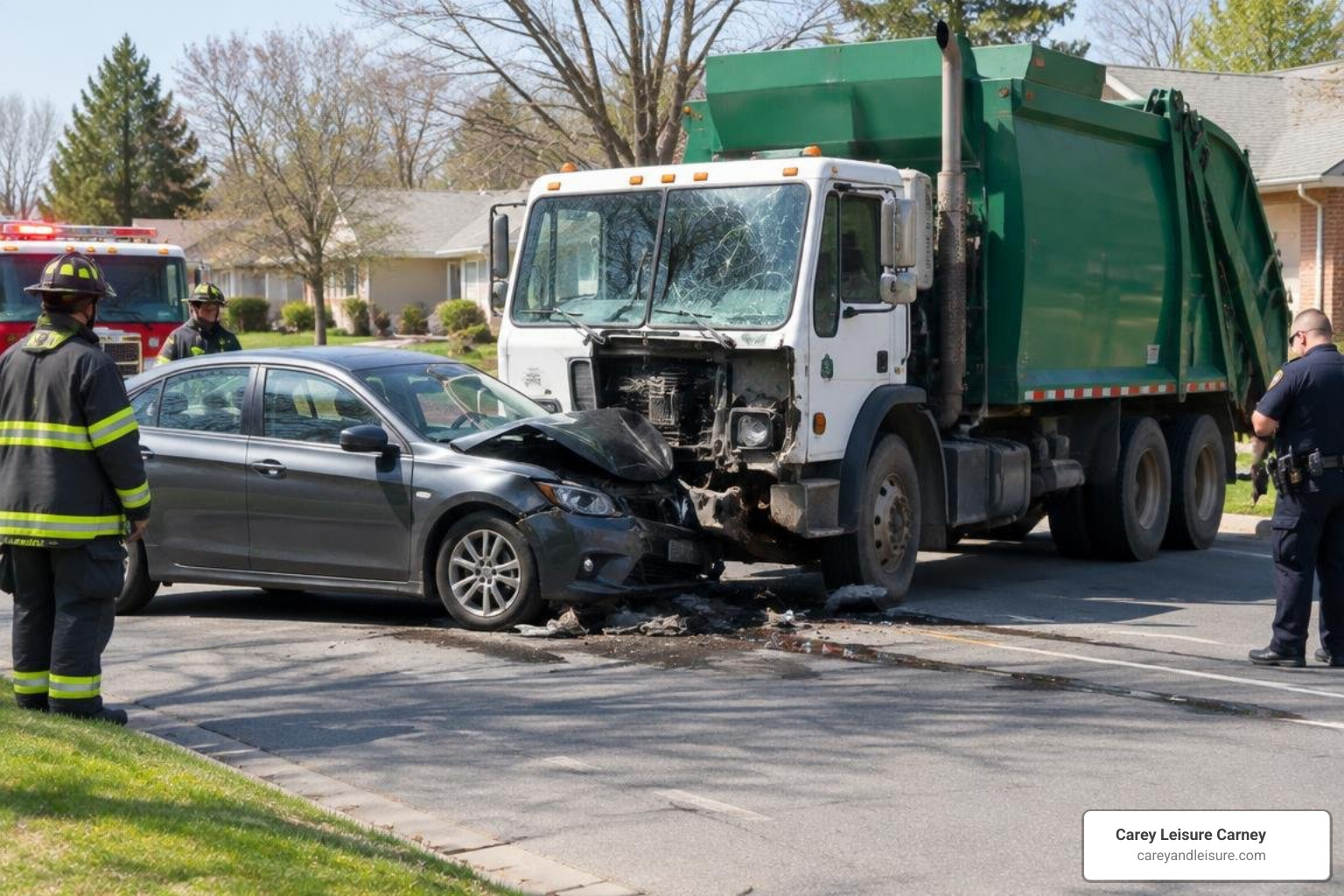
Why a Garbage Truck Accident Lawyer Matters
If a garbage truck hit you near Clearwater, get medical care, report the crash, and photograph the scene if you can do so safely. A garbage truck accident lawyer can find out who owned and operated the truck, preserve records that may be lost, and help you pursue compensation for your injuries.
These crashes can be especially serious because heavy trucks make frequent stops and travel close to people in neighborhoods. Who operated the truck also matters: a claim involving a city vehicle may follow different rules and deadlines than one involving a private company.
I’m Thomas W. Carey, founding partner of Carey Leisure Carney and a board-certified civil trial lawyer with decades of experience in Florida motor vehicle injury cases. As a garbage truck accident lawyer, I draw on that trial experience to investigate who was responsible and what evidence can support your claim.
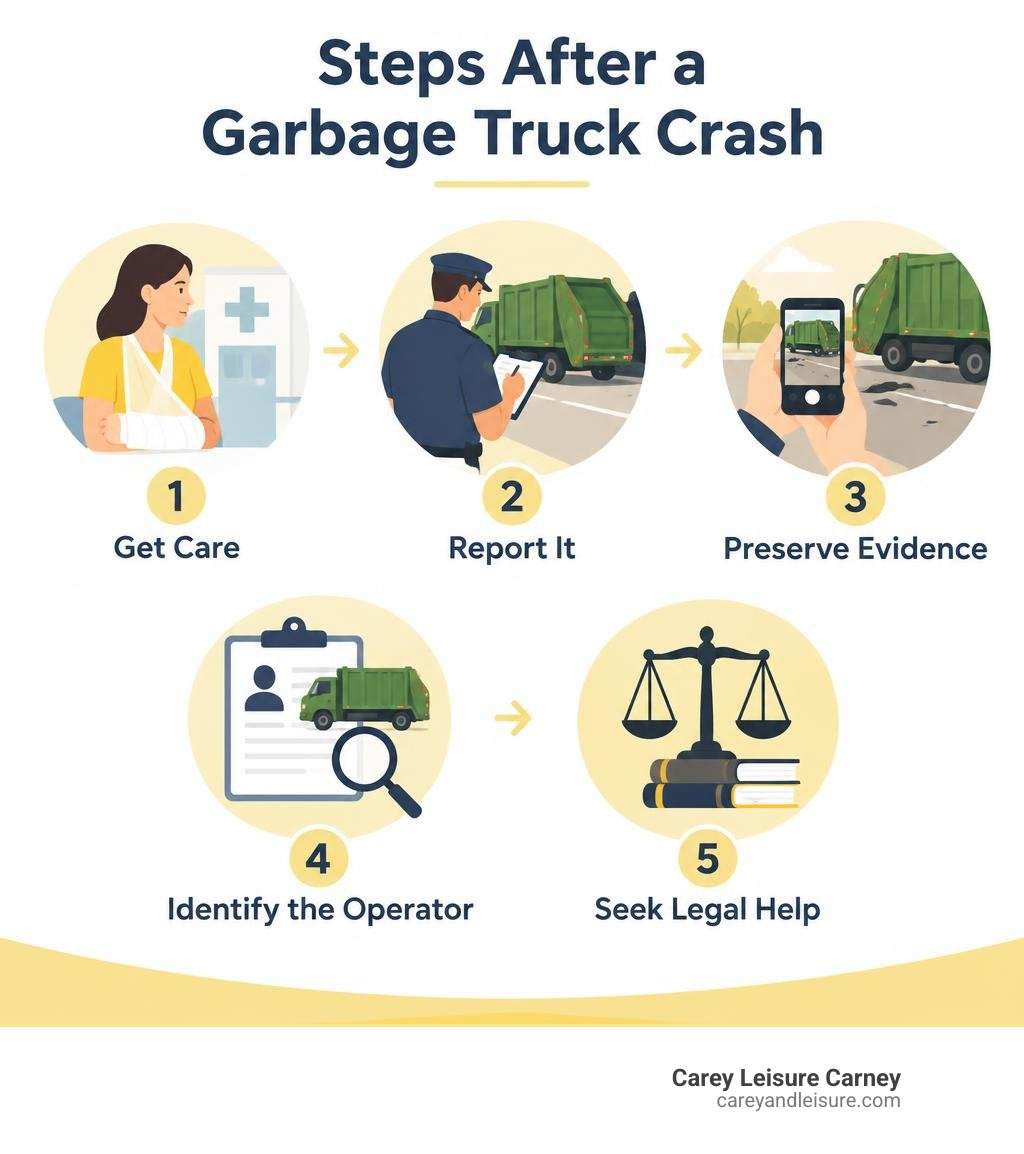
Simple guide to Garbage truck accident lawyer:
Unique Hazards of Commercial Waste Collection Vehicles
Commercial waste collection vehicles present dangers unlike almost any other vehicle on the road. When fully loaded with compacted waste, these machines can weigh between 40,000 and 64,000 pounds (or even more). By comparison, the average passenger car weighs around 3,000 to 4,000 pounds. When a vehicle of that immense mass collides with a standard sedan, an SUV, or an unprotected pedestrian, basic physics dictates that the smaller party absorbs the brunt of the kinetic energy.
Beyond their sheer mass, refuse haulers operate under grueling mechanical and physical conditions. They must navigate narrow suburban lanes, crowded alleyways, and dense commercial corridors. These vehicles rely heavily on complex hydraulic compactors, automated mechanical lift arms, and external packer blades. When hydraulic systems fail or mechanical arms malfunction, devastating accidents can happen in seconds.
Operational pressure also plays a massive role. Refuse drivers often begin their shifts well before dawn, navigating dark streets while racing against tight pickup schedules. Driver fatigue frequently sets in during long morning shifts, and as we explore in our guide on fatigue-related truck accident causes, exhaustion severely slows reaction times and impairs spatial judgment. Furthermore, mechanical flaws in steering linkages, braking systems, and suspension components can turn a garbage truck into an uncontrollable hazard, as seen in official federal recalls such as the NHTSA waste vehicle safety recall.
Frequent Stops, Blind Spots, and Dense Residential Risks
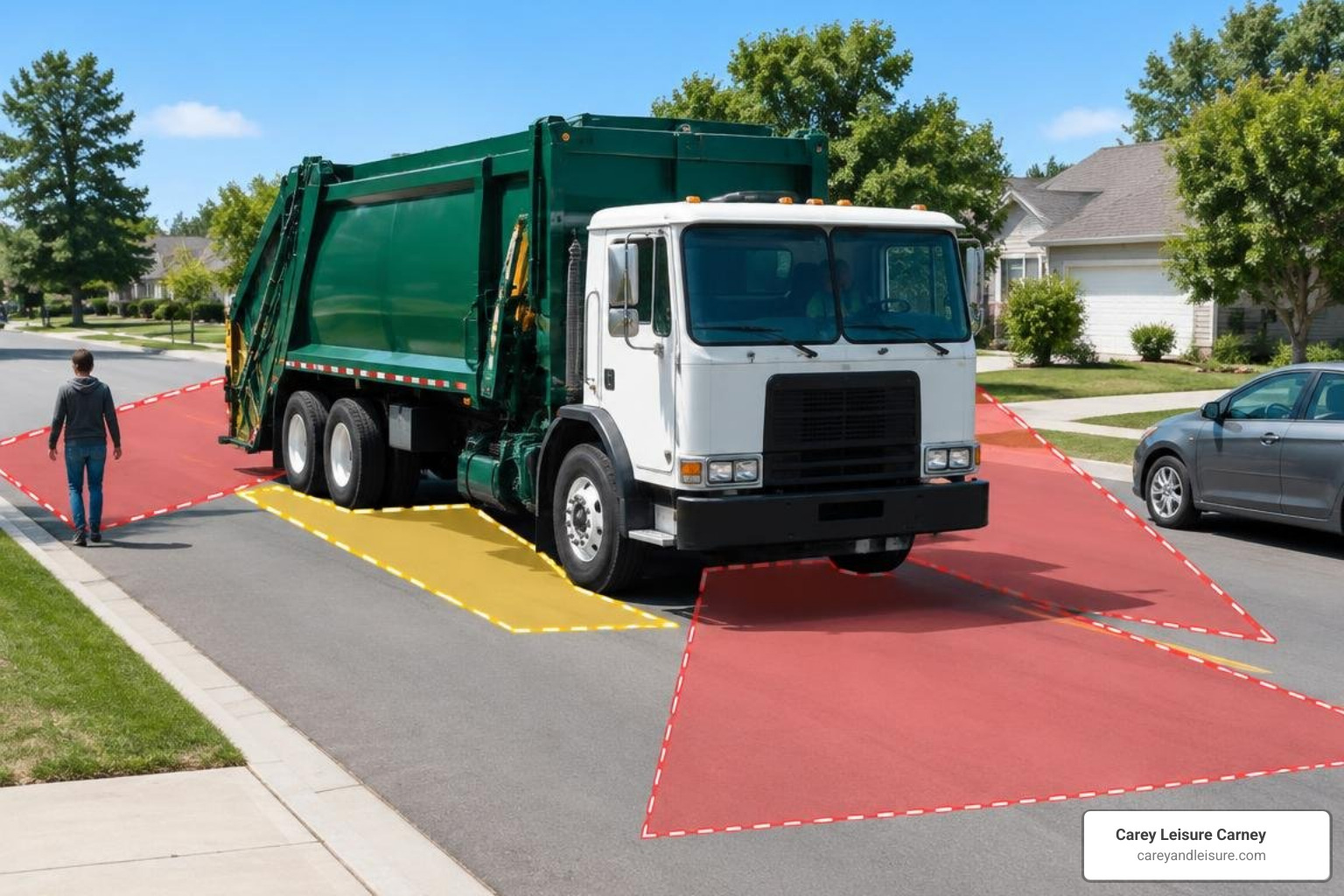
Waste collection routes require hundreds of starts and stops every single day. This constant stop-and-go cycle creates unique hazards:
- Immense Blind Spots: Refuse trucks have massive blind spots along all four sides—especially directly in front of the high cab, immediately behind the rear hopper, and alongside the passenger door.
- Backing Maneuvers: Backing up a 30-foot commercial vehicle down residential cul-de-sacs or tight driveways is inherently hazardous. Inaudible backup alarms or obscured rear-view cameras often lead to tragic collisions.
- Early Morning Lighting: Most collection routes run during pre-dawn hours when ambient lighting is poor, making it difficult for drivers to spot early morning joggers, dog walkers, or children heading toward school bus stops.
- Vulnerable Road Users: Pedestrians, cyclists, and neighborhood children are uniquely exposed. Because collection happens right at the curb, these vehicles share intimate physical space with individuals who have zero protection against impact.
Common Severe Injuries Suffered by Victims
The severe force generated during a collision with a 20-ton waste vehicle rarely results in minor cuts or bruises. Instead, victims frequently suffer life-altering trauma. As detailed in our breakdown of catastrophic truck accident injuries, the most common outcomes include:
- Traumatic Brain Injuries (TBIs): Ranging from severe concussions to permanent cognitive impairment, brain trauma often occurs when a vehicle’s cabin collapses or an occupant strikes the interior frame.
- Spinal Cord Injuries and Paralysis: Massive axial loading and sudden deceleration can fracture vertebrae, herniate discs, or sever the spinal cord, leading to paraplegia or quadriplegia.
- Crush Injuries and Traumatic Amputations: The extreme weight of the vehicle and its mechanical loading arms can crush limbs, frequently requiring surgical amputation.
- Internal Organ Damage: Blunt-force trauma frequently leads to lacerated livers, ruptured spleens, punctured lungs, and severe internal bleeding.
- Wrongful Death: Tragically, many refuse vehicle collisions prove fatal, leaving families devastated and facing sudden emotional and financial hardship.
Establishing Liability in Refuse Truck Collisions
Determining who is legally responsible for a garbage truck crash is rarely as simple as exchanging auto insurance cards. Multiple corporate and municipal entities often share operational control over a single waste collection vehicle. Understanding the legal maze of trucking company liability is crucial to recovering full compensation.
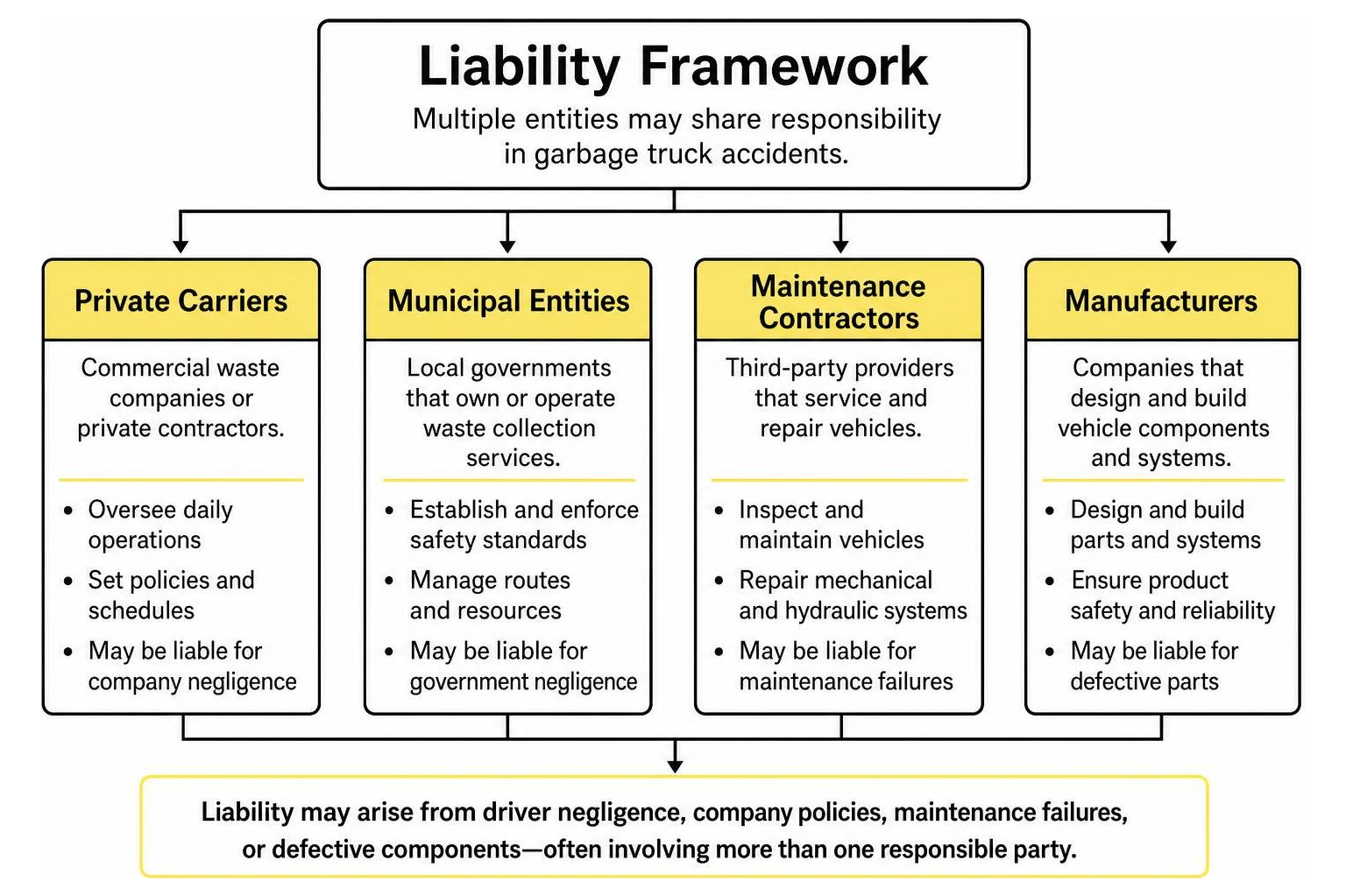
Private Waste Contractors vs. Driver Negligence
When a collision involves a commercial carrier (such as Waste Management, Republic Services, or independent private contractors), multiple layers of liability may apply:
- The Truck Driver: If the driver was speeding, texting, operating under the influence, or failing to yield, their personal negligence is a primary factor.
- The Commercial Waste Carrier (Employer): Under the doctrine of respondeat superior (vicarious liability), employers are legally responsible for the negligent acts of their employees performed within the scope of employment. Additionally, private carriers can be held directly liable for negligent hiring, improper driver training, or forcing drivers to exceed Federal Motor Carrier Safety Administration (FMCSA) hours-of-service limits.
- Third-Party Maintenance Providers: Many private waste companies outsource fleet servicing. If worn brakes, bald tires, or malfunctioning hydraulic lifts caused the crash, the independent repair facility may share liability.
- Vehicle and Parts Manufacturers: If a mechanical failure stemmed from a design or manufacturing defect (such as an uncommanded hydraulic arm deployment or defective steering gear), product liability claims may be pursued.
Claims Against Municipal and City Government Entities
In many communities across Clearwater, St. Petersburg, Largo, and surrounding areas, waste collection is managed directly by city or county municipal departments. Pursuing a claim against a government entity involves an entirely different legal landscape governed by Florida sovereign immunity laws.
| Feature | Private Waste Carrier Claims | Municipal Sanitation Claims (FL) |
|---|---|---|
| Primary Defendant | Private corporation / Contractor | City, County, or State agency |
| Statutory Damage Caps | None (Limited only by policy limits/assets) | Subject to Florida Sovereign Immunity caps (FL Statute § 768.28) |
| Pre-Suit Notice Requirement | None required before filing lawsuit | Mandatory formal written notice to agency & FL Dept. of Financial Services |
| Investigation Response Time | Governed standard civil discovery rules | Mandatory 6-month administrative investigation waiting period |
| Applicable Safety Rules | Federal FMCSA regulations & state laws | State traffic statutes, municipal operating policies |
Claims against municipal entities require strict adherence to administrative procedures. If you fail to file the required statutory notice properly, your claim can be permanently dismissed regardless of how severe your injuries are.
How a Garbage Truck Accident Lawyer Investigates and Builds Your Case
Building an airtight claim against a multi-million-dollar waste conglomerate or a municipal legal department requires rapid, comprehensive investigation. Insurers for commercial vehicles dispatch rapid-response defense teams to the crash site within hours to minimize their financial exposure. Before you make any recorded statements, review our analysis on dump truck collisions and insurer defense tactics to understand what you are up against.
Why You Need a Garbage Truck Accident Lawyer Immediately
Evidence in waste collection crashes disappears quickly. Rain washes away skid marks, vehicles are repaired or scrapped, and street sweepers clear debris. Furthermore, commercial fleet operators routinely overwrite digital records unless they receive a formal legal demand to preserve them.
When we take on your case, we immediately issue formal spoliation letters. These legal notices require the trucking company, municipality, and their insurance providers to preserve all physical, mechanical, and electronic evidence connected to the collision. This prevents the intentional or accidental destruction of vital records needed when suing trucking companies after an accident.
Preserving Electronic Logging, Route Telematics, and Maintenance Records

Modern commercial waste trucks are equipped with advanced digital monitoring systems. We work with leading accident reconstruction experts to extract and analyze:
- Engine Control Modules (ECM / “Black Box”): Records vehicle speed, throttle position, braking application, and seatbelt usage in the seconds leading up to impact.
- Route Telematics & GPS Data: Maps the truck’s exact movements, stops, backing speeds, and route deviations.
- Onboard Video Cameras: Many trucks have forward-facing, rear-facing, and cabin cameras that document driver distraction or line-of-sight conditions.
- Driver Qualification Files (DQF): Reveals background checks, prior driving infractions, commercial driver’s license (CDL) medical certifications, and drug/alcohol test results.
- Daily Vehicle Inspection Reports (DVIR): Documents whether the driver or maintenance crew noted mechanical defects (such as failing brakes or non-functioning backup beepers) before the truck was dispatched.
Compensation Available for Injured Victims and Families
A catastrophic injury alters your entire life, impacting your physical abilities, mental health, and family finances. When pursuing a claim, our goal is to recover full and fair compensation for all past, present, and future losses.
Economic vs. Non-Economic Damages in Commercial Vehicle Claims
Florida law allows injured victims to seek both economic (tangible financial losses) and non-economic (intangible personal losses) damages:
Economic Damages:
- Emergency medical transport and hospital bills
- Surgical procedures, hospital stays, and intensive care
- Ongoing physical therapy, occupational therapy, and rehabilitation
- Lost wages and benefits during your recovery period
- Diminished future earning capacity if you cannot return to your previous profession
- Home and vehicle modifications (such as wheelchair ramps or adaptive controls)
- Read our resource on managing medical bill options post-truck crash to learn how medical liens and coverage interact.
Non-Economic Damages:
- Physical pain and suffering
- Emotional distress, anxiety, depression, and post-traumatic stress disorder (PTSD)
- Permanent bodily disfigurement and scarring
- Loss of enjoyment of life and inability to participate in beloved hobbies
- Loss of consortium (damages awarded to a spouse for the loss of companionship and intimacy)
How a Garbage Truck Accident Lawyer Maximizes Your Financial Recovery
Commercial waste carriers often carry liability policies worth millions of dollars, frequently structured across primary, excess, and commercial umbrella layers. To maximize your financial recovery, we:
- Uncover All Insurance Layers: We investigate every applicable policy across the vehicle owner, driver, leasing agency, and maintenance contractor.
- Collaborate with Medical and Economic Experts: We work with board-certified physicians, life-care planners, and forensic economists to project your true lifetime medical costs and lost earning potential.
- Prepare Every Case for Trial: Insurance carriers offer real settlements only when they know your legal team is ready, willing, and fully equipped to take the case to a jury verdict.
Immediate Steps to Protect Your Rights After a Sanitation Truck Collision
What you do in the moments and days following a waste collection collision directly influences your physical recovery and legal rights.
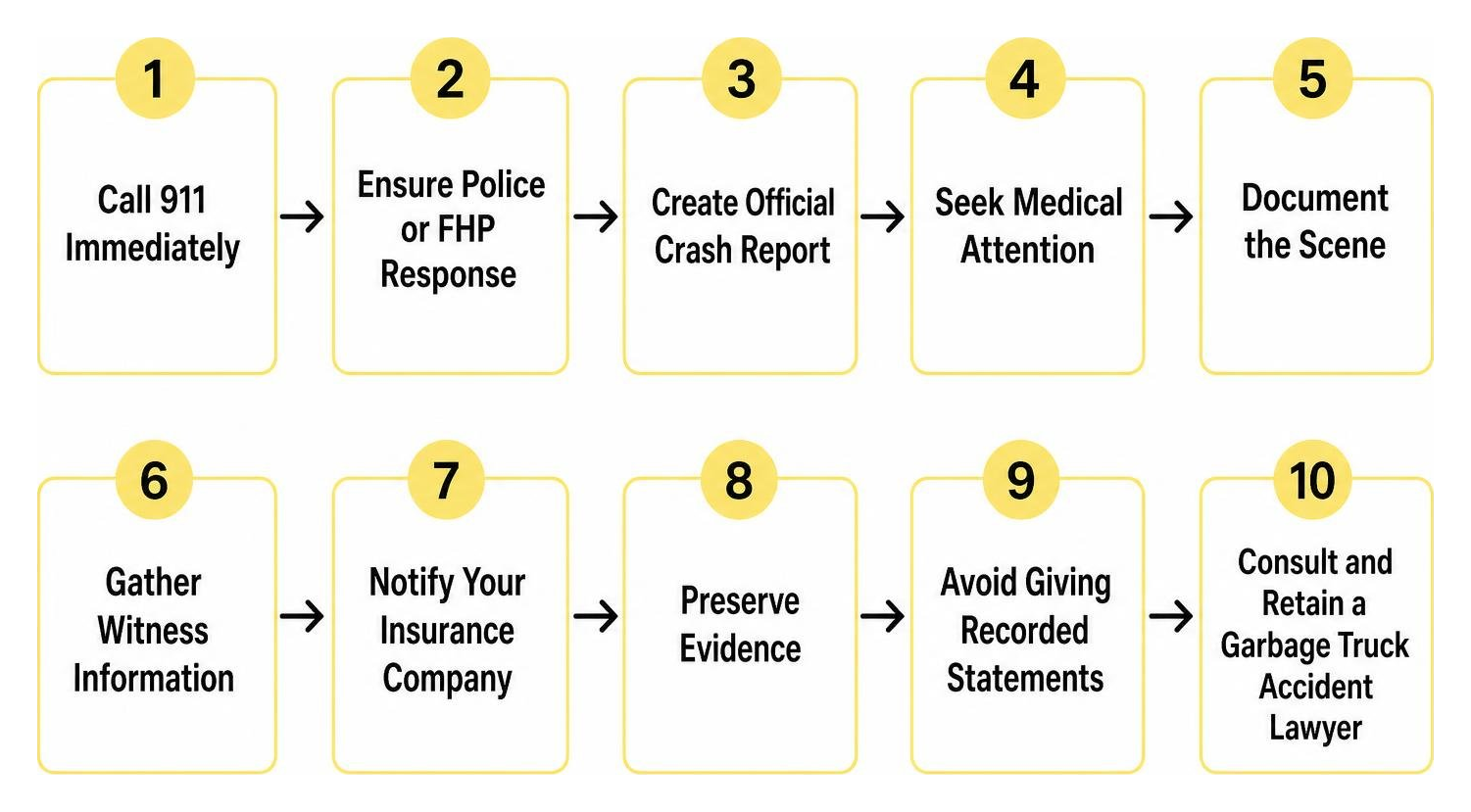
Critical Evidence to Gather at the Accident Scene
If you are physically able to do so safely and do not require immediate emergency transport, take these critical steps at the scene:
- Call 911 Immediately: Ensure local police or the Florida Highway Patrol responds to create an official crash report.
- Photograph Everything: Capture wide-angle and close-up photos of vehicle positions, skid marks, broken vehicle parts, traffic signs, road conditions, and visible injuries.
- Identify the Truck and Operator: Note the company name or municipal agency painted on the cab or hopper, the truck’s specific fleet unit number, and the license plate. Obtain the driver’s name and commercial driver’s license details.
- Collect Eyewitness Information: Secure names, phone numbers, and addresses of nearby pedestrians, homeowners, or other drivers who saw the collision.
- Seek Comprehensive Medical Attention: Even if you feel adrenaline masking your pain, visit an emergency room or urgent care center immediately to diagnose hidden internal injuries.
Navigating Sovereign Immunity and Strict Statutory Deadlines
If the vehicle involved is owned by a city, county, or regional government entity (such as municipal sanitation services operating in Pinellas, Pasco, or Hillsborough counties), strict procedural hurdles apply under Florida Statute § 768.28.
Before any lawsuit can be filed against a public entity, a formal written Notice of Claim must be drafted and presented to the appropriate agency and the Florida Department of Financial Services. The agency is then granted a mandatory statutory six-month investigation period to review the claim. Missing these strict notification windows can forever bar your right to seek financial recovery. Retaining experienced counsel immediately ensures every statutory notice is executed flawlessly.
Frequently Asked Questions About Sanitation Vehicle Collisions
Who pays for damages if the garbage truck was city-owned?
If the garbage truck is owned and operated by a municipal government, compensation is typically paid through municipal self-insurance funds or governmental risk pools. Under Florida’s sovereign immunity statute (Florida Statute § 768.28), recovery against a governmental entity is capped at statutory limits per person and per incident, unless the Florida Legislature approves a specific legislative claims bill for higher damages. In cases where private contractors or defective third-party parts contributed to the crash, additional non-governmental claims can be pursued without these sovereign immunity limits.
Can sanitation workers injured on the job file a third-party lawsuit?
Yes. While an injured sanitation worker is typically entitled to standard workers’ compensation benefits through their direct employer, they may also file a third-party personal injury lawsuit if someone other than their direct employer or co-worker contributed to their injury. For example, if a sanitation worker is struck by a negligent commuter vehicle, or if they are injured due to a defective hydraulic compaction mechanism manufactured by an outside equipment company, they can pursue both workers’ compensation and a third-party tort claim.
How long do I have to file a claim after being hit by a waste truck?
In Florida, standard negligence lawsuits involving private commercial vehicles are governed by the applicable statute of limitations for personal injury claims. However, if the at-fault vehicle belongs to a municipal or state agency, you face strict pre-suit notice requirements and administrative deadlines that must be initiated much sooner. Because critical electronic logging data can be legally purged by fleet owners in as little as 30 to 90 days, you should consult an attorney as soon as possible after the accident.
Conclusion
A collision with a massive commercial waste vehicle can turn your world upside down in an instant. Dealing with catastrophic physical injuries, soaring medical bills, and aggressive corporate insurance adjusters is an overwhelming burden to face alone. You do not have to fight multi-million-dollar waste companies or municipal bureaucracies by yourself.
At Carey Leisure Carney, our attorneys are Florida Bar Board-Certified in Civil Trial Law—a distinction earned by fewer than 2% of lawyers in the state. With over 100 years of combined legal experience, we provide direct attorney access, personalized support, and aggressive courtroom advocacy. We handle every personal injury case on a contingency fee basis, meaning there are no upfront costs, and you pay no legal fees unless we successfully recover money for you.
If you or someone you love was injured in a refuse vehicle crash across Clearwater, St. Petersburg, New Port Richey, Largo, Spring Hill, Trinity, or Wesley Chapel, contact an experienced truck accident attorney at Carey Leisure Carney today for a free, no-obligation case evaluation. Let our board-certified trial team handle the legal fight so you can focus on your recovery.