
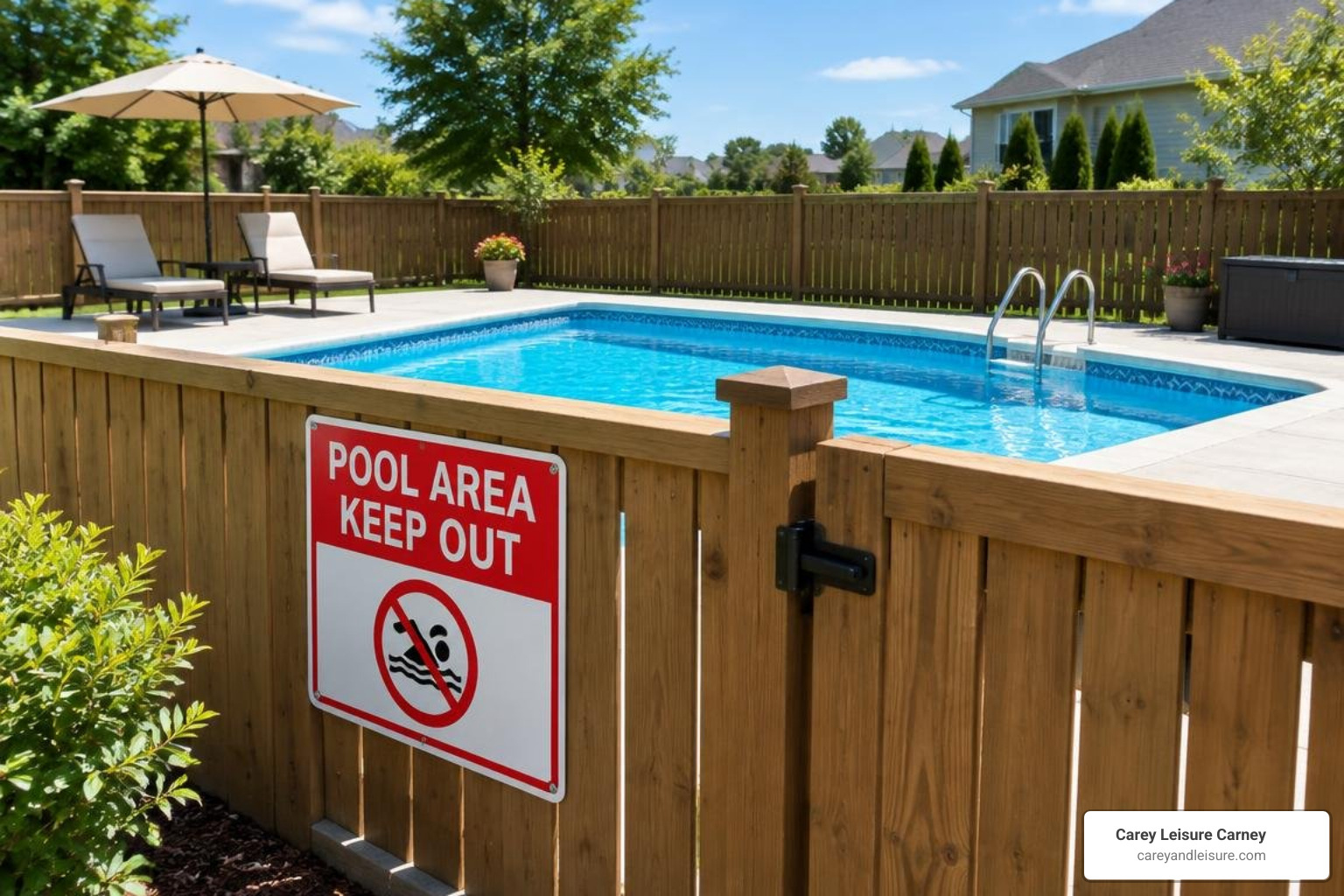
What Florida’s Attractive Nuisance Rule Means for Property Owners
A Florida property owner may be liable when a dangerous artificial condition injures a trespassing child. The child’s age, the owner’s knowledge that children may enter, and the steps taken to prevent harm all matter. Florida courts have also required proof that the hazard lured the child onto the property. The state’s trespasser law expressly preserves the attractive nuisance doctrine.
For property owners, the practical step is to secure hazards children can reach, especially when children are known to visit the area. A fence, locked gate, or guard on moving machinery may prevent an injury before liability becomes a question.
I’m Thomas W. Carey, founding partner of Carey Leisure Carney and a board-certified civil trial lawyer with decades of Florida personal injury experience. I use that experience to explain attractive nuisance Florida law and the questions families face after a child is hurt.
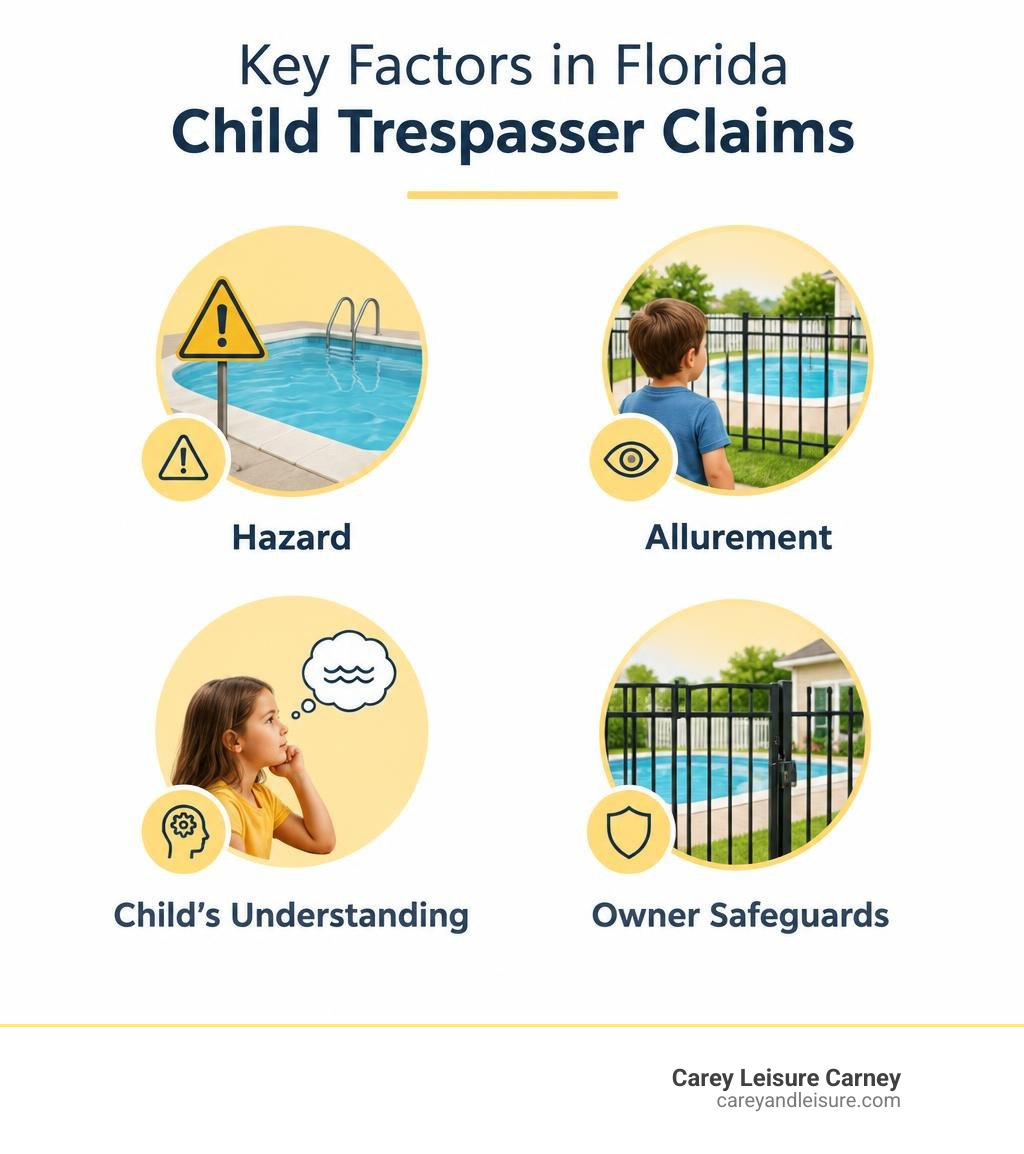
Quick attractive nuisance Florida definitions:
Legal Foundations: The Attractive Nuisance Florida Framework and Landowner Immunity
Understanding what is premises liability begins with the basic principle that property possessors owe varying duties of care to people who enter their land. Under traditional common law rules, an adult trespasser who enters land without permission is generally owed only a minimal duty: the owner must avoid inflicting intentional, willful, or wanton harm.
Children, however, lack the worldly experience and cognitive maturity to appreciate dangerous conditions. Because an inquisitive young child cannot comprehend that an unlatched swimming pool gate or an active construction site poses a life-threatening risk, the attractive nuisance doctrine carves out a vital humanitarian exception to standard trespasser rules.
| Legal Entrant Classification | Definition Under Florida Law | Landowner Duty of Care |
|---|---|---|
| Undiscovered Adult Trespasser | An entrant whose presence was not detected within the preceding 24 hours. | Must refrain from intentional misconduct or gross negligence; no duty to warn of dangerous conditions. |
| Discovered Adult Trespasser | An entrant whose presence was detected within the preceding 24 hours. | Must refrain from gross negligence/intentional harm and warn of known, concealed, man-made dangers. |
| Trespassing Minor Child (Attractive Nuisance) | A child injured by an artificial condition they lacked the maturity to appreciate. | Must exercise reasonable care to eliminate danger or prevent child access when trespass is foreseeable. |
Common Law Origins and Restatement (Second) of Torts § 339
The concept began in nineteenth-century American jurisprudence with the “turntable doctrine,” established after children were severely injured while playing on unlocked, rotating railroad turntables. In foundational legal analyses like Torts: The Attractive Nuisance Doctrine, scholars traced how courts expanded this protection to cover diverse man-made hazards.
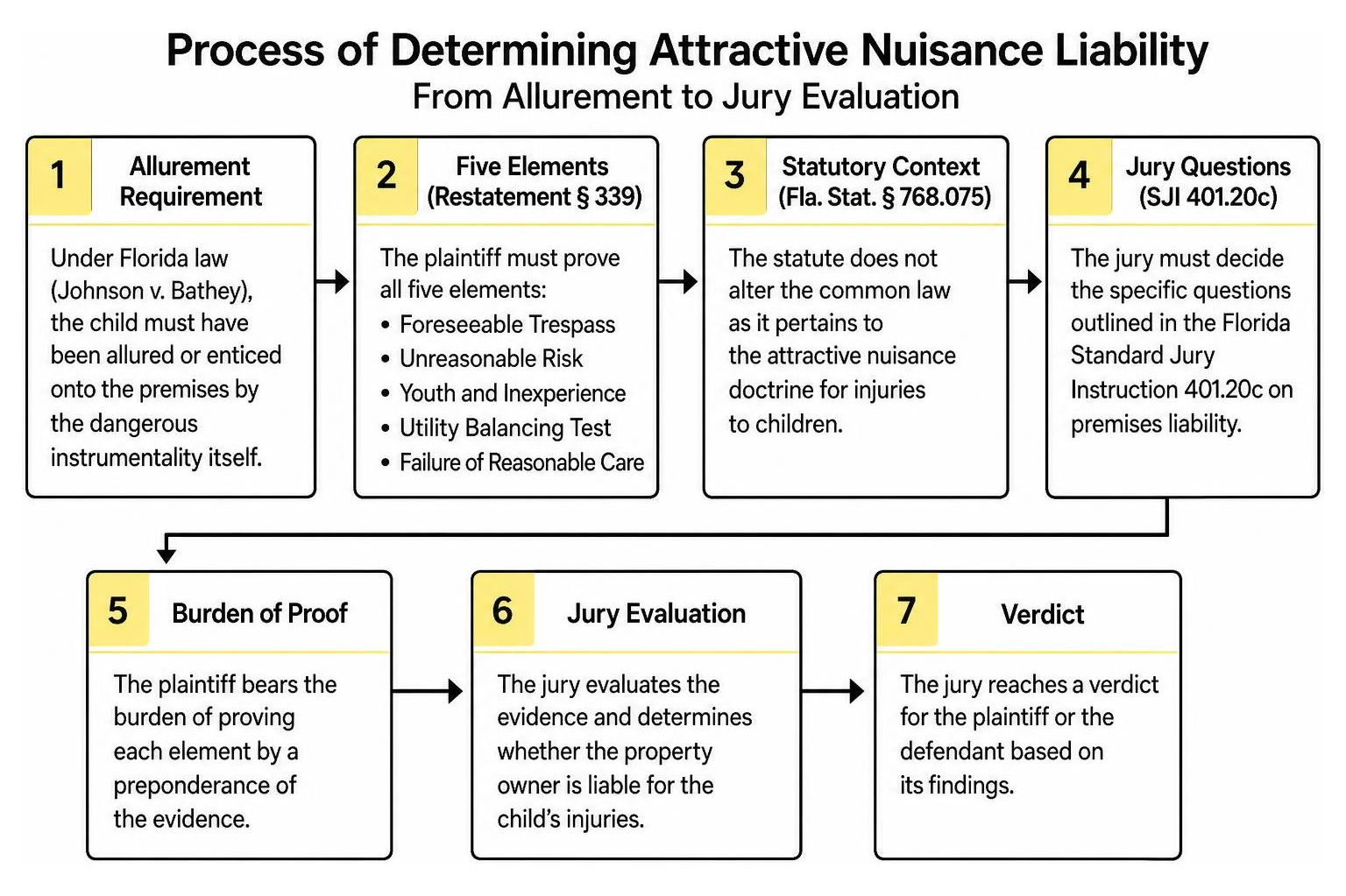
Under the Restatement (Second) of Torts § 339, which Florida courts frequently cite alongside a guide to torts law and premises liability, a possessor of land is subject to liability for physical harm to children trespassing thereon caused by an artificial condition if five core elements are met:
- Foreseeable Trespass: The possessor knows or has reason to know that children are likely to trespass on the place where the condition exists.
- Unreasonable Risk: The possessor knows or should know the condition involves an unreasonable risk of death or serious bodily harm to children.
- Youth and Inexperience: The children, because of their youth, do not discover the condition or realize the risk involved in intermeddling with it or in coming within the area made dangerous by it.
- Utility Balancing Test: The utility to the possessor of maintaining the condition and the burden of eliminating the danger are slight as compared with the risk to children involved.
- Failure of Reasonable Care: The possessor fails to exercise reasonable care to eliminate the danger or otherwise protect the children.
How Florida Statute § 768.075 Preserves Child Trespasser Claims
Florida codified broad protections for real property owners against adult trespassers under Florida Statute § 768.075. This statute shields landowners from liability for injuries sustained by uninvited entrants, distinguishing between “discovered” and “undiscovered” trespassers using a bright-line 24-hour rule.
If an adult trespasser is undiscovered, the owner owes no duty to warn them of hazardous conditions. Furthermore, property owners receive statutory immunity against civil injury claims if an adult trespasser has a blood-alcohol level of 0.08 percent or higher or is attempting to commit a felony.
Critically, the legislature recognized that young children deserve special protection. Under Florida Statute § 768.075(3)(c), the law explicitly commands that the statutory limitations on landowner liability “shall not be interpreted or construed to alter the common law as it pertains to the attractive nuisance doctrine.” As a result, standard trespasser immunity cannot be used to defeat a valid claim involving a child injured by an unguarded, dangerous artificial condition.
The Strict “Allurement” Rule vs. Foreseeability in Florida Jurisprudence

While the Restatement (Second) of Torts § 339 focuses purely on the foreseeability of child trespass, Florida developed a distinct requirement known as “allurement” or “enticement.” Exploring this requirement helps clarify key distinctions between standard premises liability vs negligence and what it means for your claim.
Johnson v. Bathey and the Enticement Requirement
In Concrete Construction, Inc. v. Petterson (1968), and later reaffirmed in the landmark case Johnson v. Bathey (1979), the Florida Supreme Court addressed whether a property owner is liable when a child enters land for an independent reason and only then encounters a hazard.
In Johnson v. Bathey, a nine-year-old boy was walking across leased agricultural land to gather surplus vegetables. While taking this shortcut, he came across an uncovered, operating irrigation water pump. His shirt became caught in the revolving universal joint of the drive shaft, resulting in severe injuries to his arm.
The Florida Supreme Court held that to recover under the attractive nuisance doctrine, the youthful plaintiff must have been allured or enticed onto the premises by the dangerous instrumentality itself. Because the child in Johnson entered the property as a shortcut rather than because the pump drew him in from beyond the property line, the strict common law attractive nuisance theory was held inapplicable.
This strict allurement rule contrasts with earlier opinions like Cockerham v. R.E. Vaughan, Inc. (1955), which approved the broader Restatement standard, and Green Springs, Inc. v. Calvera (1970), where the Florida Supreme Court famously remarked that “the phrase attractive nuisance has become an unattractive nuisance,” describing the doctrine as fundamentally a set of circumstances concerning child innocence, likelihood of trespass, and foreseeable danger.
Standard Jury Instruction 401.20c and Modern Premises Liability Standards
In modern litigation, Florida courts instruct juries using the Florida Standard Jury Instructions in Civil Cases. Under the Proposed Amendments to Standard Jury Instructions in Civil Cases on Premises Liability and Elements in Personal Injury Cases, Instruction 401.20c outlines the exact questions a jury must decide:
- Did the property owner maintain or fail to guard an artificial structure or condition on the land?
- Was the owner negligent in maintaining or failing to protect trespassing children from that condition?
- Was that negligence a legal cause of the child’s injury?
When severe or catastrophic injuries occur, parents may also pursue recovery for medical expenses, economic caregiving burdens, and loss of filial consortium under Jury Instruction 501.2. Examining historical premises liability case examples and what they cost negligent owners highlights how vital it is for property possessors to implement basic physical safeguards.
Property Hazards and Instrumentalities Subject to the Doctrine
Whether evaluating residential property or commercial job sites, Florida courts assess the nature of the condition to determine whether it presents an unreasonable, hidden risk. Property owners must understand which items are considered dangerous conditions that can lead to substantial premises liability settlements.
Common Property Hazards Classified as an Attractive Nuisance in Florida
In Crutchfield v. Adams (1963), the First District Court of Appeal held that an unguarded, revolving fan belt on pump machinery operating on residential property stated a valid cause of action when a three-year-old child’s hand was mangled in the belt. The court emphasized that moving mechanical parts on residential grounds present an extreme hazard to wandering infants.
Common conditions that frequently trigger attractive nuisance claims across Florida include:
- Heavy Machinery and Farm Equipment: Unattended tractors, backhoes, augers, and irrigation pumps left unlocked or unguarded.
- Active Construction Sites: Unfinished framing, open scaffolding, unsecured ladders, and power tools left plugged in.
- Open Excavations and Trenches: Unshored holes, retention ditch excavations, or pits that can collapse on or trap a child.
- Trampolines and Playground Sets: Backyard trampolines lacking safety nets or perimeter fencing, especially when positioned close to property lines.
- Accessible Power Sources: Open electrical junction boxes, exposed high-voltage wiring, or unmonitored chemical storage containers.
Artificial Water Hazards and the Concealed Trap Rule in Florida Case Law
Florida has more private swimming pools and retention ponds than almost any other state. Under established Florida common law, a natural or artificial body of water is generally not considered an attractive nuisance as a matter of law, because the danger of drowning is deemed an open and obvious risk that even young children should recognize.
However, an important exception exists: the concealed trap rule. In Allen v. William P. McDonald Corp. (1951), an artificial pond was excavated with sloping banks of fine white sand that led into deep, murky water. The Florida Supreme Court held that the artificial white sandbanks created an unusual allure while concealing a sudden drop-off, transforming an ordinary body of water into an actionable hidden trap.
Today, this common law precedent operates alongside strict legislative mandates. The Florida Residential Swimming Pool Safety Act (Florida Statutes Chapter 515) requires private residential pools to feature protective safety barriers, such as four-sided fencing at least four feet high, self-closing and self-latching gates opening outward, pool covers, or exit alarms on perimeter doors.
Statutory Attractive Nuisances: Discarded Refrigerators and Airtight Units under Chapter 823
While most attractive nuisance rules develop through court decisions, the Florida Legislature enacted a direct criminal and civil mandate regarding airtight appliances.
Under Florida Statutes Chapter 823, the state established strict regulations for discarded containers:
- Florida Statute § 823.07: Prohibits abandoning or leaving unattended any icebox, refrigerator, deep-freeze locker, clothes washer, or dryer having an interior storage capacity of 1.5 cubic feet or more without first completely detaching the door or latching mechanism.
- Florida Statute § 823.08: Expressly declares such abandoned or discarded airtight units to be an attractive nuisance to children “whether or not such children are trespassers.”
- Florida Statute § 823.09: Imposes criminal penalties for violations, classifying an improper discard as a misdemeanor of the second degree. If a minor child suffers permanent physical or mental injury or death as a result of culpable negligence, the offense is elevated to a third-degree felony.
Landowner Defenses and Practical Risk Mitigation Strategies
Property owners facing premises liability allegations have several affirmative defenses available under Florida law, while proactive risk management can eliminate liability entirely.
Defenses Landowners Can Assert in an Attractive Nuisance Florida Claim
- Lack of Allurement (The Enticement Defense): Establishing that the artificial condition was not visible from off the property and did not lure the child into entering the land.
- Child’s Age, Maturity, and Appreciation of Risk: If the injured minor possessed the cognitive capacity and experience to appreciate the specific hazard, the doctrine does not apply.
- No Reason to Anticipate Trespass: If the property is in a remote location where children have never been known to visit or pass through, the owner had no reason to foresee their presence.
- Utility of the Hazard and Burden of Care: Demonstrating that the practical utility of the equipment was essential and that eliminating all risk would impose an impossible or economically unfeasible burden.
- Comparative Negligence and Parental Supervision: Arguing that the child’s own comparative negligence or a failure of basic parental oversight was the sole or primary cause of the incident.
Proactive Safety Protocols for Residential and Commercial Property Owners
To protect neighborhood children and shield yourself from catastrophic legal liability, follow these straightforward safety standards:
- Install Complete Enclosures: Enclose all swimming pools, hot tubs, and backyard play equipment with a four-sided fence at least four feet tall, equipped with self-closing, self-latching gates that lock securely.
- Lock and Secure Machinery: Never leave commercial equipment, farm pumps, or lawnmowers unattended with keys in the ignition or engine covers off. Install protective belt guards over all moving parts.
- Remove Appliance Doors Prior to Disposal: Always detach doors, lids, and latching hardware from refrigerators, freezers, and dryers before placing them out for trash collection or storing them in carports.
- Secure Construction Projects: Erect sturdy perimeter security fencing around unfinished building sites, remove access ladders leading to upper levels, and cover and barricade all ground trenches and excavations.
- Post Conspicuous Warning Signs: While warning signs alone do not relieve owners of the duty to physically secure hazards from young children, they provide clear evidence of an owner’s attempt to identify and manage risks.
Frequently Asked Questions About Florida Attractive Nuisance Claims
What is the age limit for a child under the attractive nuisance doctrine in Florida?
There is no rigid statutory age cut-off in Florida. Instead, courts evaluate the child’s chronological age alongside their individual mental capacity, maturity, and intelligence.
While the doctrine is most frequently applied to toddlers and elementary-school-aged children (typically under age 12), teenagers may still be covered if the hazard involves an unusual, highly technical trap that an adolescent cannot reasonably appreciate.
Does a standard backyard swimming pool automatically qualify as an attractive nuisance?
No. Under long-standing Florida case law, an ordinary swimming pool with visible depth variations and standard water conditions is not considered an attractive nuisance per se, as water is viewed as an open and obvious danger.
However, if the pool contains a concealed trap (such as a hidden drop-off obscured by opaque, unmaintained algae water) or violates mandatory safety barrier laws under Florida Statutes Chapter 515, a landowner may face significant premises liability for a child’s injury or drowning.
What should property owners do if an uninvited child is discovered near a hazard?
Under Florida Statute § 768.075, discovering a trespasser’s physical presence on your land within a 24-hour window elevates the legal duty you owe them.
If you discover an uninvited child near an artificial hazard, you must immediately warn them, instruct them to leave the danger zone safely, and take immediate steps to lock, fence, or disable the hazard to prevent future unauthorized access.
Conclusion
The attractive nuisance doctrine in Florida strikes a necessary balance between property ownership rights and the societal imperative to protect vulnerable children from preventable, life-threatening hazards.
Whether you manage an active commercial construction site or maintain a private residential property with a pool, taking simple, proactive steps to secure dangerous artificial conditions protects both your community and your peace of mind.
If your child was injured by an unsecured, dangerous condition on someone else’s land, or if you need guidance on child trespasser liability, our team of Board-Certified civil trial attorneys at Carey Leisure Carney is here to help. Serving families across Clearwater, Largo, New Port Richey, Spring Hill, St. Petersburg, Trinity, and Wesley Chapel, we bring over 100 years of combined legal experience to personal injury and Florida premises liability claims. Contact our office today for a free, confidential case evaluation.