
The 14 Day Rule Explained: Key Deadlines and Common Exceptions
Florida’s 14 Day Rule: Why Your First Medical Visit Matters
Florida’s 14 day rule requires you to receive initial medical care within 14 days of a motor vehicle crash to qualify for personal injury protection (PIP) medical benefits. A visit with a qualifying provider can preserve coverage, but it does not guarantee the full $10,000 benefit. Without a qualifying determination of an emergency medical condition, medical benefits are generally limited to $2,500.
Don’t wait for pain to get worse. Seek care promptly, and keep records showing the crash date, your first visit, and who provided your care. The sections below explain which providers qualify and how the benefit limits work.
I’m Thomas W. Carey, founding partner of Clearwater-based Carey Leisure Carney and a board-certified civil trial lawyer who has guided thousands of injury matters. I know how important it is to understand the 14 day rule before a missed deadline puts medical benefits at risk.
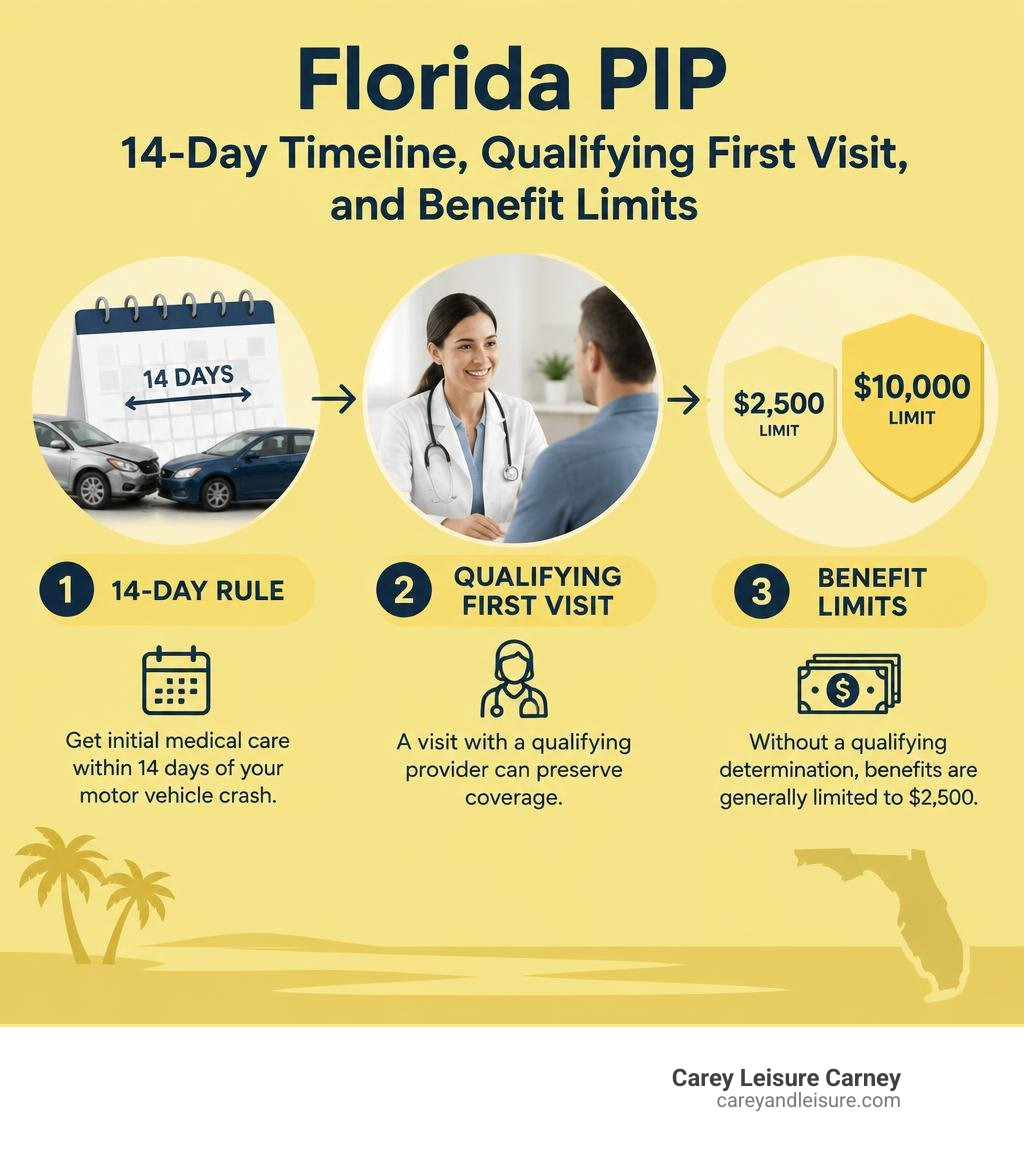
Simple 14 day rule word guide:
Understanding the Florida PIP 14 Day Rule and Medical Deadlines
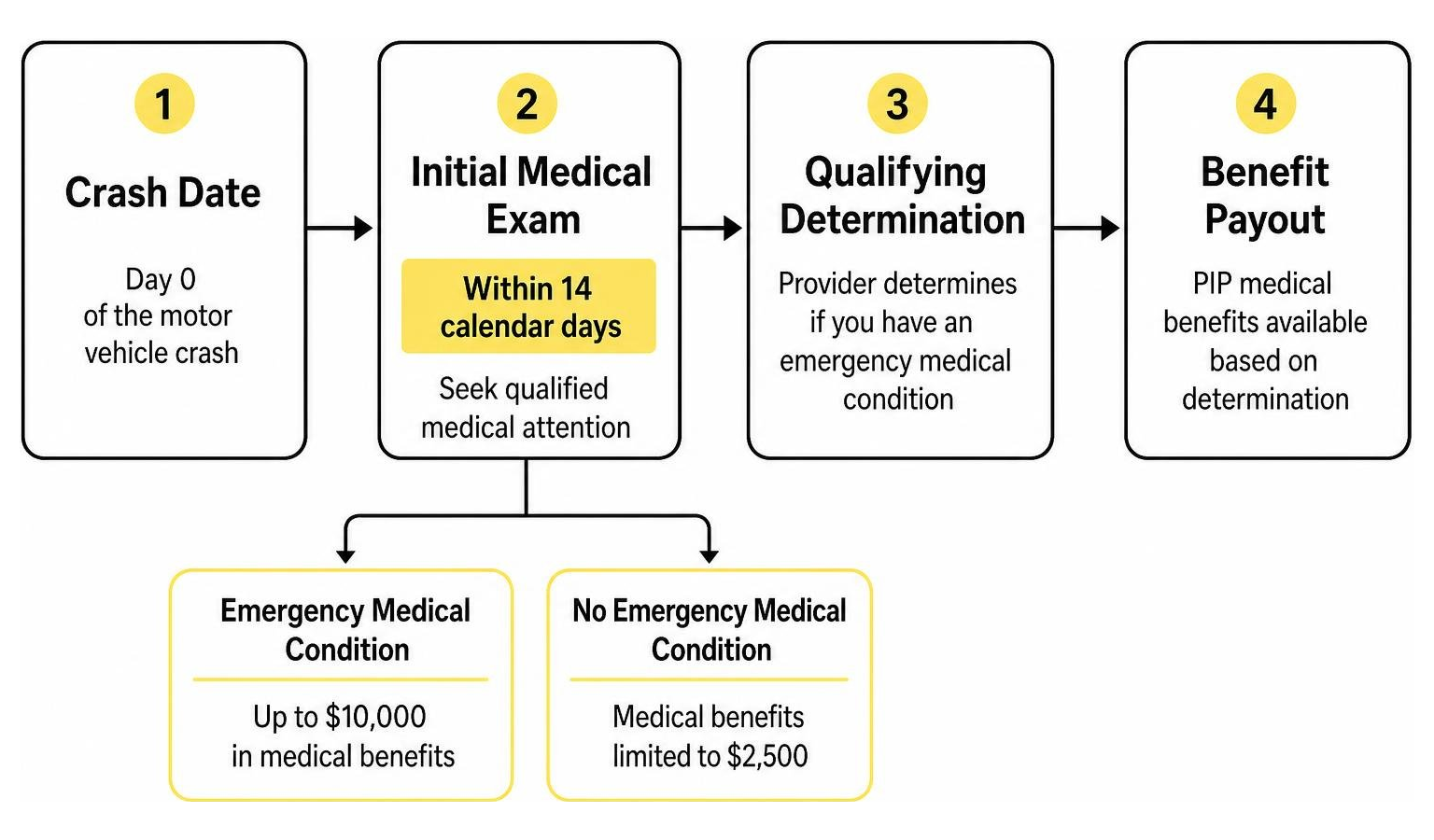
Under Florida law, specifically outlined in Florida Statutes Section 627.736, motorists injured in a collision have exactly 14 calendar days from the moment of the crash to seek qualified medical attention. This statutory deadline is an absolute prerequisite to accessing any financial reimbursement through your personal injury protection coverage.
Florida operates under a comprehensive no-fault framework. When you sustain injuries on local roadways across Clearwater, St Petersburg, or New Port Richey, your own auto insurance policy steps in first to cover medical bills and lost wages. To learn more about how this system works, you can explore What Is PIP Insurance in Florida: No-Fault Coverage – LegalClarity.
When you comply with the statutory timeline, your policy provides several core financial protections:
- 80% of Reasonable Medical Expenses: Covers initial emergency care, diagnostic imaging, physician visits, and necessary rehabilitative treatment.
- 60% of Gross Lost Wages: Reimburses a significant portion of your income if your injuries prevent you from working.
- $5,000 Death Benefit: Paid per deceased individual to help family members manage funeral and burial costs.
Once you submit proper written notice and documentation of a covered loss, the insurance carrier has a strict 30-day window to process and pay your benefits. If the carrier fails to pay covered benefits within this 30-day period without legitimate legal cause, the overdue payments accrue statutory interest.
How Florida No-Fault Insurance Operates
Florida requires every owner of a four-wheeled motor vehicle registered in the state to carry at least $10,000 in PIP coverage alongside $10,000 in Property Damage Liability (PDL). Our guide on no-fault insurance Florida details how these mandatory minimums function during daily commutes.
This coverage attaches directly to you as the named policyholder, but its protective umbrella extends further. It also covers qualifying relatives residing in your household, passengers in your vehicle who do not own an insured vehicle of their own, and even pedestrians struck by your car.
Because Florida is a no-fault state, your insurer pays regardless of who caused the wreck. If you are rear-ended along US-19 in Largo or involved in a collision in Wesley Chapel, you turn to your own insurer first. Reviewing Florida no-fault car accidents explained simply can help clarify why fault does not determine your immediate medical access.
That selected policy deductibles apply first. If you carry a $1,000 deductible, you must satisfy that out-of-pocket threshold before the 80% medical reimbursement formula takes effect.
What Happens If You Miss the 14 Day Rule Deadline?
Failing to see a qualifying medical provider within the strict 14-day window results in the complete and total forfeiture of all PIP medical benefits. There is no statutory grace period, no extension for weekends, and no administrative appeal process if you simply delay your initial visit.
Many accident victims feel fine immediately following a wreck due to elevated adrenaline. Soft-tissue injuries, whiplash, micro-tears in muscles, and disc herniations often take several days to produce noticeable pain. If you ask how much time do I have to see doctor after car accident, the answer is always as soon as possible, but never later than day 14.
If you wait until day 15:
- Your auto insurer will issue a formal denial of all medical claims associated with the crash.
- You become personally responsible for 100% of your outstanding medical bills.
- Private health insurance may dispute initial payments, citing auto insurance as the primary payer.
- Your ability to establish causal medical evidence against an at-fault driver’s bodily injury liability policy is severely compromised.
Qualifying Healthcare Providers Under Florida PIP Law

You cannot visit just any wellness practitioner to satisfy the statutory requirement. Florida law sets clear licensing standards for providers authorized to deliver initial services and care. Seeking treatment from an unapproved provider within the two-week window is treated under the law the same as receiving no care at all.
| Provider / Service Type | Satisfies Initial 14-Day Visit? | Covered for Follow-Up Care? | Key Statutory Restrictions |
|---|---|---|---|
| Medical Doctor (MD) / DO | Yes | Yes | Fully authorized; can diagnose Emergency Medical Conditions (EMC). |
| Chiropractic Physician (DC) | Yes | Yes | Can satisfy initial visit; cannot independently diagnose an EMC. |
| Dentist (DDS / DMD) | Yes | Yes | Authorized for oral and maxillofacial injuries resulting from a crash. |
| Advanced Practice Registered Nurse (APRN) | Yes | Yes | Authorized to provide initial care and make EMC determinations. |
| Hospital / Emergency Room | Yes | Yes | Hospital-owned outpatient facilities and emergency facilities qualify. |
| Physical Therapist (PT) | No | Yes | Only covered for follow-up care pursuant to a referral from a qualifying provider. |
| Massage Therapist (LMT) | No | No | Completely excluded from PIP reimbursement under Florida statute. |
| Acupuncturist | No | No | Completely excluded from PIP reimbursement under Florida statute. |
Which Medical Providers Satisfy the 14 Day Rule?
To protect your coverage, your initial examination must be lawfully provided, supervised, ordered, or prescribed by one of the following licensed practitioners or entities:
- Licensed Physicians (MD or DO): Medical doctors and osteopathic physicians working in private practices, clinics, or hospitals.
- Chiropractic Physicians (DC): Licensed chiropractors who evaluate musculoskeletal trauma and spinal alignment.
- Dentists: Licensed dental practitioners addressing crash-related oral trauma.
- Advanced Practice Registered Nurses (APRNs) or Physician Assistants (PAs): Licensed mid-level practitioners working under appropriate medical supervision.
- Hospital and Ambulatory Surgical Centers: Emergency department visits or treatment rendered at hospital-owned outpatient facilities.
- Emergency Medical Technicians and Paramedics: Emergency transportation and pre-hospital medical care provided via ambulance.
Receiving care at an emergency room or walk-in urgent care facility in Spring Hill or Trinity within the two-week timeline ensures compliance with this statutory threshold.
Excluded Services and Non-Qualifying Initial Providers
Florida law strictly bars certain healthcare practitioners from conducting your initial examination, and completely excludes specific modalities from PIP reimbursement entirely.
Understanding what is covered under personal injury protection protects you from unexpected out-of-pocket bills. The most notable exclusions include:
- Massage Therapy: Florida statute explicitly states that medical benefits do not include massage therapy, regardless of who prescribes, orders, or administers the treatment.
- Acupuncture: All forms of acupuncture therapy are completely non-reimbursable through PIP insurance.
- Physical Therapy as Initial Care: While licensed physical therapists provide critical rehabilitation, an initial evaluation by a physical therapist does not satisfy the 14-day statutory rule. Physical therapy is only reimbursable for follow-up care if referred by a qualifying physician, chiropractor, dentist, or APRN.
Emergency Medical Conditions and PIP Coverage Limits

Satisfying the initial visit requirement unlocks basic PIP eligibility, but it does not automatically give you access to your full policy balance. For an extensive analysis of statutory caps and litigation deadlines, review Florida 14-Day Accident Law: PIP Rules and Deadlines – LegalClarity.
Florida law establishes a two-tiered reimbursement structure:
- $10,000 Maximum Benefit: Available only if a qualified medical professional determines that the injured person sustained an Emergency Medical Condition (EMC).
- $2,500 Limited Benefit: If no qualified provider makes an EMC determination, your total PIP medical reimbursement is capped at $2,500.
Additionally, auto insurers are statutorily required to reserve $5,000 of your total PIP benefits for 30 days following notice of the crash to ensure emergency medical providers and hospital systems can be paid for trauma care.
Establishing an Emergency Medical Condition (EMC)
Under Florida law, an Emergency Medical Condition is defined as a medical condition manifesting itself by acute symptoms of sufficient severity (including severe pain) such that the absence of immediate medical attention could reasonably be expected to result in:
- Serious jeopardy to patient health;
- Serious impairment to bodily functions; or
- Serious dysfunction of any bodily organ or part.
Only specific medical providers are authorized under Florida law to make an official EMC diagnosis:
- Licensed Physicians (MD or DO);
- Advanced Practice Registered Nurses (APRNs);
- Physician Assistants (PAs); and
- Licensed Dentists.
Chiropractors can deliver qualifying initial care within 14 days, but Florida law does not permit a chiropractic physician to issue an EMC determination. If you see a chiropractor in New Port Richey or Clearwater for initial treatment, you must also be evaluated by an MD, DO, APRN, or PA to secure the full $10,000 medical benefit limit. As discussed in beyond the bump navigating injuries and no-fault after a car crash, documenting acute symptoms in your medical charts immediately after a crash is vital.
Suing Beyond PIP: The Serious Injury Threshold
Because PIP benefits cap out at $10,000—and only cover 80% of medical bills—severe collisions quickly exceed no-fault insurance limits. When medical costs surpass these coverage caps, injured victims must evaluate whether they can step outside the no-fault system.
Florida law shields negligent motorists under a limited tort exemption unless your injuries meet the statutory “serious injury threshold.” You may file a liability claim or lawsuit against the at-fault driver for non-economic damages, including pain and suffering, if your injuries result in:
- Significant and permanent loss of an important bodily function;
- Permanent injury within a reasonable degree of medical probability;
- Significant and permanent scarring or disfigurement; or
- Death.
Understanding hit in a no-fault state when to call an accident lawyer helps protect your right to compensation when recovering from major trauma. That Florida’s general statute of limitations for motor vehicle negligence claims requires filing a lawsuit within two years of the crash date.
Frequently Asked Questions About Florida PIP Deadlines
Does the 14-day clock include weekends and holidays?
Yes. The statutory timeline runs on continuous calendar days. The countdown begins the day immediately following your accident and includes all Saturdays, Sundays, and state or federal holidays. If your 14th day falls on a holiday or weekend, do not wait until the next business day—visit an urgent care center or emergency department immediately to preserve your rights.
Can I receive PIP benefits if I first visit an urgent care clinic?
Yes, provided the urgent care facility is staffed and your examination is conducted or directly supervised by a licensed MD, DO, APRN, or PA. Urgent care centers are often one of the most convenient ways to ensure compliance with the statutory window while avoiding long emergency room waits. Ensure that all intake documentation explicitly connects your symptoms to the motor vehicle collision.
What documentation is required to prove compliance with the 14-day window?
To prove timely compliance to an auto insurer, you should maintain and provide:
- Intake sheets and electronic health record logs displaying the exact date and time of your initial examination.
- Medical chart notes signed by an authorized qualifying provider.
- Itemized billing records utilizing standardized CMS-1500 or UB-04 claim forms.
- Formal written notice of the claim submitted to the auto insurer alongside the initial medical records.
Conclusion: Protecting Your Rights After a Florida Auto Accident
Navigating no-fault insurance rules, qualifying provider categories, and emergency medical condition determinations can be overwhelming while you are trying to heal. Missing statutory deadlines or failing to secure proper documentation can cost you thousands of dollars in lost medical benefits.
At Carey Leisure Carney, our board-certified civil trial attorneys represent the top 2% of lawyers in Florida. With over 100 years of combined legal experience, we provide direct attorney access and personalized legal guidance to injured victims throughout Clearwater, St Petersburg, New Port Richey, Largo, Spring Hill, Trinity, and Wesley Chapel. To stay informed on evolving insurance legislation, explore our guide on new PIP Florida law changes. If you or a loved one has been injured in a crash, contact us today for a free consultation to protect your claim.