Why Parking Lot Accidents Are Legally More Complex Than You Think
Why a Parking Garage Accident Can Involve More Than One Claim
A parking garage accident lawyer can help identify every party whose carelessness may have caused your injury. That may include the driver, but it can also include the garage owner, manager, security company, or maintenance contractor when poor lighting, blocked sightlines, unsafe ramps, missing signs, or neglected hazards played a role.
Parking crashes may happen at low speeds, but they are not always minor. Pedestrians are especially exposed in tight lanes and blind corners, and a collision or fall can cause injuries that worsen after the scene. Nationwide, parking lots and garages cause about 60,000 injuries and more than 500 deaths each year, according to National Safety Council research.
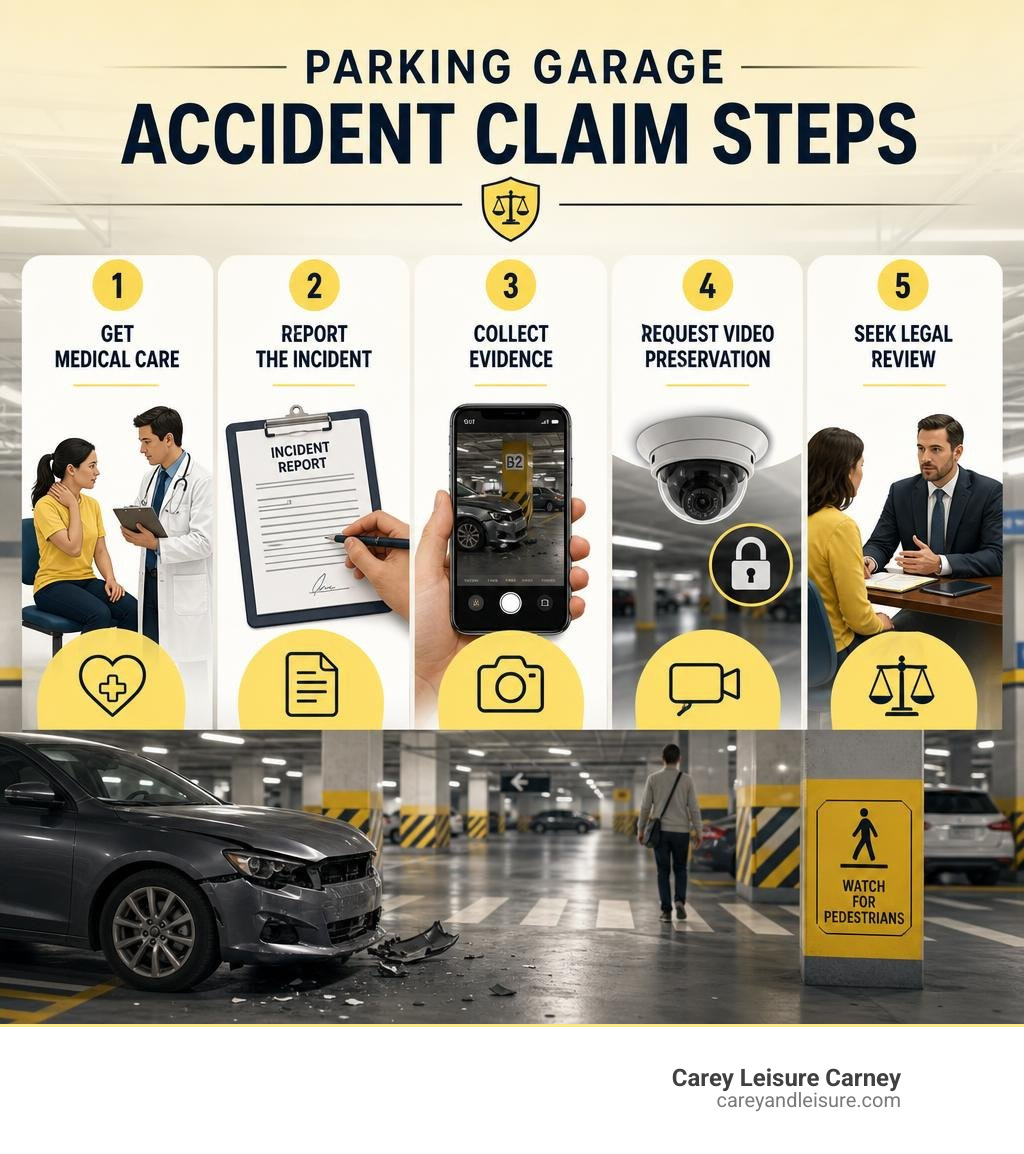
If you were hurt, get medical care, report the incident, photograph the vehicles and garage conditions, collect witness details, and ask the facility to preserve any surveillance video. Camera footage can be overwritten quickly, and early evidence often decides whether a claim involves only an insurer or a separate premises-liability case.
I am Thomas W. Carey, a board-certified civil trial lawyer who has guided or overseen roughly 40,000 injury matters involving motor-vehicle crashes and unsafe-property claims. As a parking garage accident lawyer advocate, I focus on finding the facts and responsible parties that insurance companies may overlook.
Parking garage accident lawyer vocab to learn:
Unique Hazards and Structural Causes of Parking Garage Collisions
Multi-level parking structures present a dense concentration of vehicular traffic, pedestrian movement, and structural obstructions. While standard surface roads are designed with broad visibility, clear setbacks, and uniform traffic signals, commercial parking decks maximize vehicular density within confined spaces.

This spatial compression creates distinct physical risks:
- Obstructed Sightlines and Blind Corners: Heavy, load-bearing concrete pillars obstruct cross-traffic visibility at aisle intersections, hiding oncoming vehicles and pedestrians.
- Tight Turning Radiuses: Narrow driving aisles and steep, spiral ascending/descending ramps force drivers into awkward maneuvers, increasing sideswipe and head-on collision risks.
- Distracted Driving: Motorists frequently search for vacant spaces, look at mobile navigation apps, manage digital parking passes, or check dashboard displays rather than focusing on the transit lane.
- Reversing Hazards: Backing out of perpendicular or angled stalls creates severe blind zones. While modern vehicle safety technology (such as rearview cameras combined with cross-traffic alerts and automatic emergency braking) can reduce backing crashes by up to 78%, drivers reversing between large sport utility vehicles or adjacent concrete columns still face severe sightline limitations.
Driver Negligence vs. Property Maintenance Failures
Determining fault requires examining both motorist actions and the structural environment. A crash may stem from pure driver error, property maintenance failures, or a combination of both.
When garage owners neglect basic maintenance—such as leaving oil slicks on polished concrete or failing to replace burnt-out fluorescent tubes in dark stairwells and ramps—they create an environment where collisions and pedestrian strikes become inevitable.
Navigating Dual Liability: Traffic Collisions and Premises Liability
Parking garages exist as privately owned or commercially operated spaces open to the public. Consequently, an injury claim rarely mirrors a typical two-car crash on a public thoroughfare. Instead, these claims often bridge automobile tort law and premises liability principles. Understanding what is premises liability is critical when evaluating a parking garage collision.
Under Florida law, patrons entering a commercial garage (such as a facility servicing a shopping center, medical plaza, or office park) are classified as business invitees. Property owners and management companies owe invitees the highest duty of care:
- Maintain the Premises: Keep the property in a reasonably safe condition for both motorists and pedestrians.
- Duty to Inspect: Conduct regular, documented inspections to uncover hidden structural defects, equipment failures, or hazardous conditions.
- Duty to Warn: Provide conspicuous warnings regarding known, non-obvious dangers that cannot be remedied immediately.
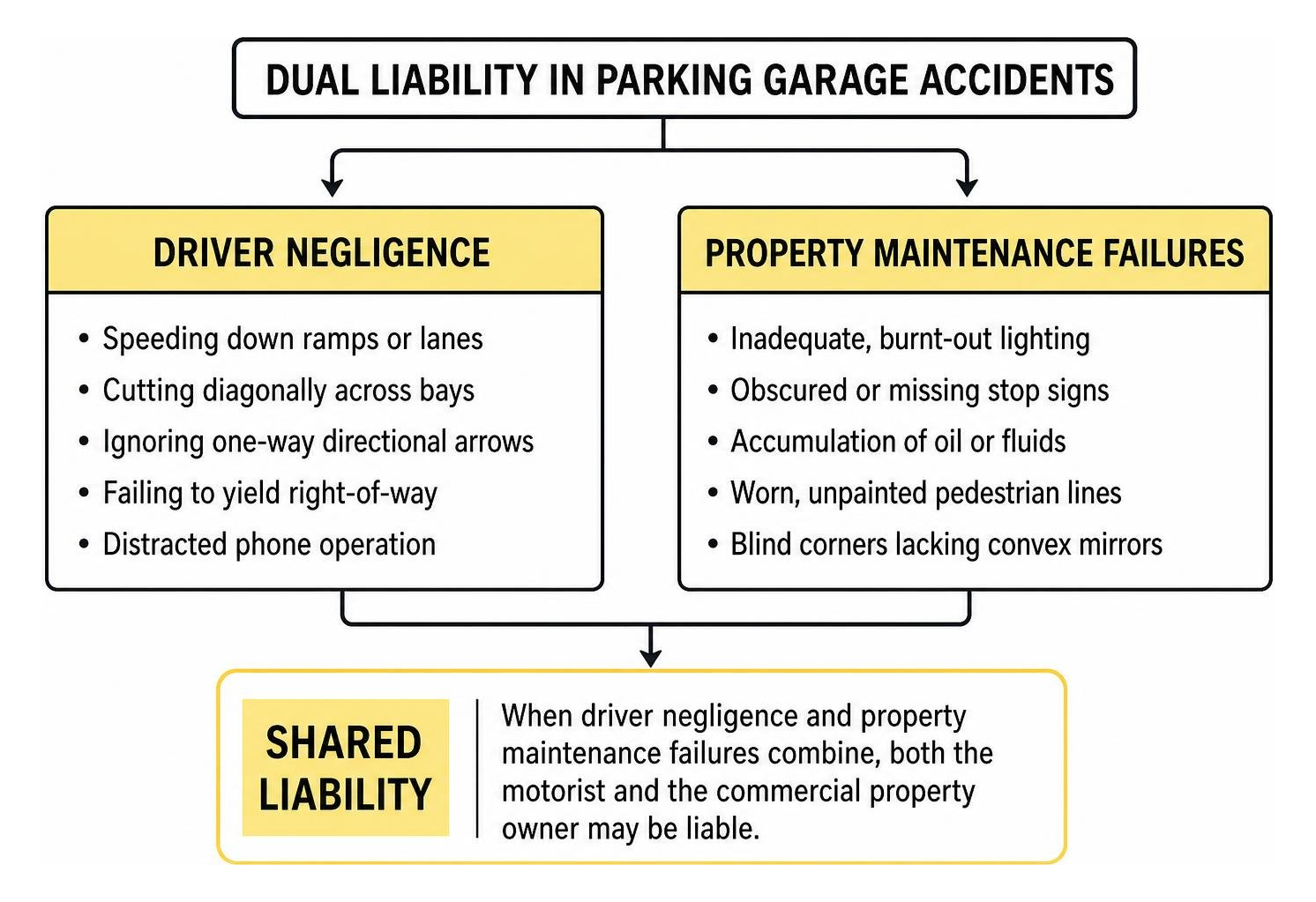
When an accident occurs because a driver could not see a pedestrian due to non-functioning overhead lighting, or because missing directional arrows led two motorists into a head-on collision on a ramp, liability may rest with both the at-fault driver and the commercial property owner.
Multi-Party Fault: Operators, Security, and Maintenance Contractors
Commercial parking structures are frequently managed through multi-layered contracts involving several commercial entities. Identifying all liable defendants ensures all potential insurance policies are identified.
Depending on the operational structure, responsible parties may include:
- Property Owners and Real Estate Trusts: Entities holding title to the building and surrounding structures.
- Professional Parking Management Operators: Companies contracted to manage daily operations, ticketing, and traffic flow.
- Third-Party Janitorial and Maintenance Vendors: Contractors tasked with sweeping debris, removing fluid spills, or maintaining drainage systems to prevent hydroplaning and slip-and-fall hazards.
- Third-Party Security Firms: Companies hired to patrol garages, manage access gates, and maintain safety. If poor surveillance or broken gates facilitate an assault or allow a hit-and-run driver to escape, an injured victim may need to review our negligent security lawyer ultimate guide to evaluate a third-party claim.
How a Parking Garage Accident Lawyer Proves Complex Liability
Establishing multi-party liability requires prompt, methodical investigation. Because private property owners are not immediately compelled to turn over internal records without formal legal action, a structured investigative strategy is vital.
Our team focuses on documenting evidence in personal injury claims by:
- Securing Digital Surveillance: Demanding closed-circuit television (CCTV) footage from every angle, including entry/exit barrier gates that log license plates.
- Subpoenaing Maintenance Records: Reviewing sweep logs, lighting replacement tickets, and prior incident reports to prove constructive notice of dangerous conditions.
- Conducting Forensic Scene Inspections: Utilizing engineering experts to measure aisle widths, ramp slope gradients, surface slip resistance, and illumination lumen levels against local building codes.
- Analyzing Digital Event Data: Extracting Event Data Recorder (EDR) information from involved vehicles to prove vehicle speeds, braking inputs, and steering angles.
Critical Steps to Take Immediately After a Parking Deck Crash
The steps you take immediately following a collision inside a parking deck substantially impact both your medical recovery and legal rights.

- Call Emergency Services: Contact local law enforcement immediately. Even though the crash occurred on private property, having an official police report or crash exchange report generated is critical.
- Seek Immediate Medical Evaluation: Low-speed impacts often mask significant cervical strain, lumbar disc herniations, and closed-head concussions due to adrenaline. A prompt medical assessment ensures hidden injuries are diagnosed and treated early.
- Notify Facility Management: Report the crash to the parking attendant, building security, or property management office. Request a copy of their internal incident report and note the name and contact details of the manager on duty.
- Document the Entire Environment: Take broad photographs and videos showing:
- Vehicle positioning, impact points, and tire marks.
- Overhead lighting status (including flickering or dead bulbs).
- Structural pillars, blind corner convex mirrors, and directional pavement arrows.
- Mounted security cameras overlooking the scene.
- Collect Witness Information: Gather names, phone numbers, and statements from other patrons, parking attendants, or pedestrians who witnessed the impact.
- Consult a Legal Advocate: Review standard procedures by reading what to do after a car accident florida before engaging in recorded interviews with adverse insurance adjusters.
Preserving Time-Sensitive Digital and Physical Evidence
Unlike collisions on public roadways where physical debris remains for hours, evidence inside a commercial parking garage disappears quickly. Commercial security systems regularly overwrite recorded video on 7-to-30-day automated loops.
Once retained, an attorney can issue formal spoliation letters to the property owner, parking operator, and surrounding commercial tenants. These legal notices place parties under a statutory obligation to preserve digital video recordings, gate access logs, maintenance schedules, and employee shift records relevant to your crash.
When to Hire a Parking Garage Accident Lawyer
Navigating a parking garage claim independently can expose you to aggressive insurance pushback. Commercial property carriers and auto insurers routinely argue that low-speed impacts cannot cause significant personal injury.
Furthermore, under Florida’s modified comparative fault rule, an injured person is barred from recovering damages if they are found to be more than 50% at fault for the accident. If an insurance company attempts to shift 51% of the blame onto you—arguing you were driving too fast in the aisle or backing carelessly—you could be denied any compensation.
A knowledgeable attorney protects your position by managing insurer communications, establishing objective fault through physical evidence, and seeking full financial recovery for your:
- Past and future medical expenses
- Lost earnings and diminished earning capacity
- Physical pain, suffering, and mental anguish
- Vehicle repair or total loss compensation
For guidance on navigating these hurdles, read our crash course in florida law finding the right accident attorney.
What to Look for in a Board-Certified Parking Garage Accident Lawyer
Personal injury claims involving commercial premises demand seasoned courtroom experience. Less than 2% of Florida attorneys achieve Florida Bar Board Certification in Civil Trial Law—a distinction that demonstrates rigorous peer review, extensive jury trial experience, and verified trial competence.
When selecting representation:
- Verify Trial Board Certification: Work with attorneys who routinely try cases before judges and juries rather than settling early for reduced amounts.
- Look for Direct Attorney Access: Ensure you work directly with your trial lawyer rather than having your file delegated solely to paralegals or non-lawyer case managers.
- Demand a Contingency Fee Structure: You should pay zero upfront costs or attorney fees unless your legal team successfully recovers compensation on your behalf.
- Confirm Dual Experience: Your attorney should have a proven track record handling both auto negligence and complex commercial premises claims, such as those handled by an experienced slip and fall attorney clearwater fl.
Frequently Asked Questions About Parking Structure Claims
Can I sue the garage owner if another driver hit me in a commercial parking deck?
Yes. If an unsafe condition on the property contributed to the crash—such as non-working lighting, missing directional signage, blind corners lacking safety mirrors, or structural sightline obstructions—the garage owner or management entity may share legal liability alongside the negligent driver under Florida premises liability principles.
What should I do if a driver hit my parked car and fled the garage?
Notify law enforcement immediately to file a hit-and-run report. Request that parking garage management secure all entry and exit gate camera footage, which often records license plate numbers and timestamps of departing vehicles. If the fleeing driver cannot be identified, you can typically pursue compensation through your own Uninsured Motorist (UM) auto policy or collision coverage.
How long do I have to file an injury claim after a parking lot accident in Florida?
In Florida, the statute of limitations for filing a personal injury lawsuit based on negligence is generally two years from the date of the incident. However, waiting to act is dangerous: critical evidence, such as surveillance video and maintenance logs, can be overwritten or destroyed within weeks if formal preservation demands are not issued immediately.
Conclusion
Parking garage collisions present distinct legal and structural challenges that extend well beyond standard fender-benders. Proving liability demands a complete investigation into driver behavior, commercial management practices, lighting conditions, and structural design standards.
At Carey Leisure Carney, our Board-Certified civil trial attorneys bring over 100 years of combined legal experience to motor-vehicle and premises liability claims across Clearwater, St. Petersburg, Largo, New Port Richey, Trinity, Spring Hill, and Wesley Chapel. We provide every client with direct attorney access, thorough trial preparation, and focused advocacy designed to secure full financial recovery.
If you or a loved one suffered an injury in a parking structure collision or fall, reach out to our legal team today for a free, confidential case consultation.