

Why You Need a Pro to Handle Your Big Rig Legal Battle
Why a Truck Accident Lawyer Can Protect Your Claim
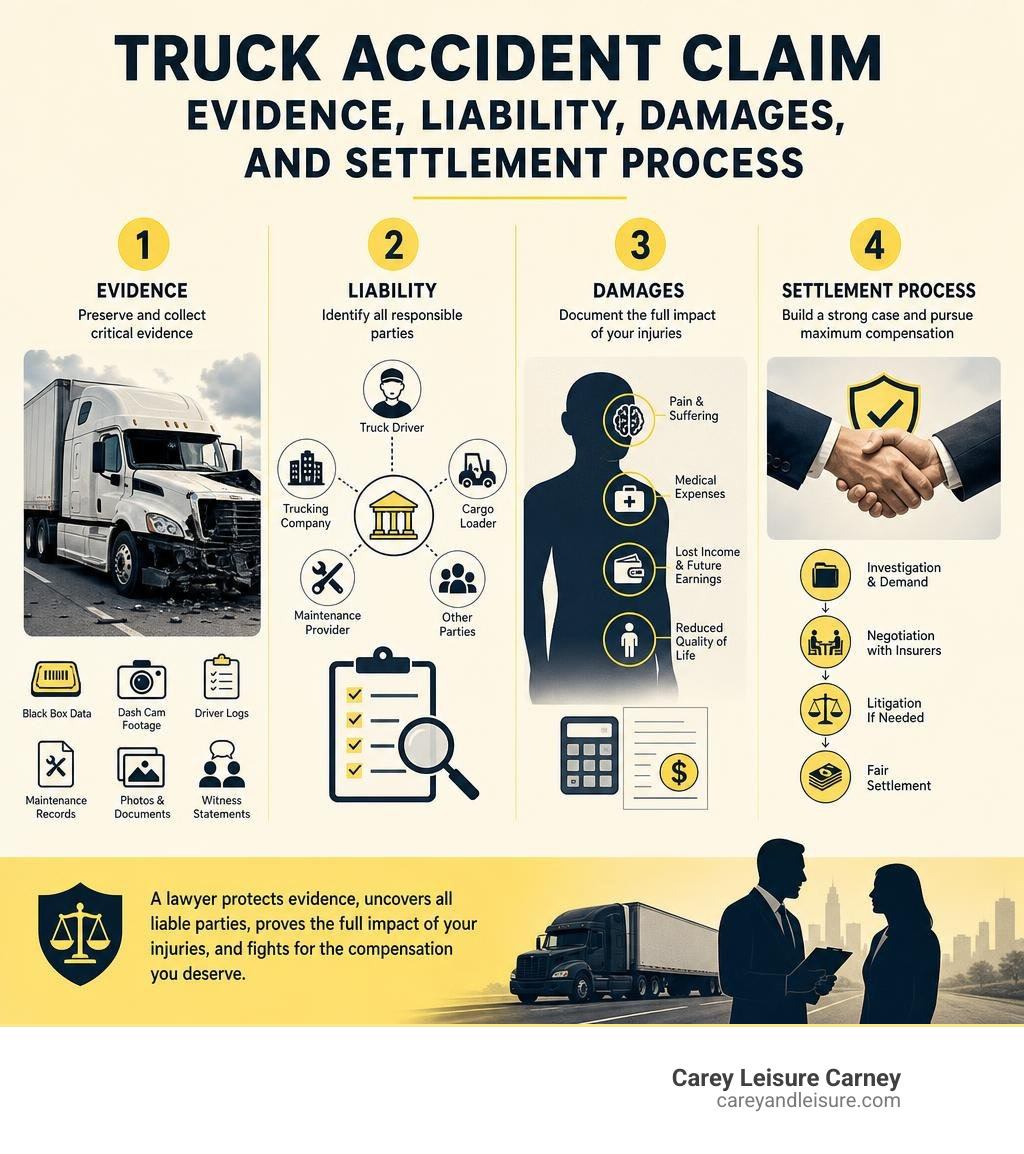
A truck accident lawyer helps you act fast to protect evidence, find every party that may be responsible, and pursue the full value of your injuries. After a serious crash, the most useful first steps are to get medical care, save photos and documents, avoid recorded statements to the trucking insurer, and speak with a lawyer before signing a release.
Commercial truck claims are not ordinary car-accident claims. A fully loaded big rig can weigh up to 80,000 pounds, and the trucking company may send investigators, adjusters, and defense lawyers to the scene quickly. Meanwhile, key evidence such as electronic logging device records, engine data, dash camera footage, and maintenance files can be lost or overwritten.
A lawyer can send preservation notices, investigate whether federal safety rules were broken, and look beyond the driver to the motor carrier, cargo loader, maintenance company, or another responsible business. They can also work with medical and financial experts to document future treatment, lost income, and the daily impact of a life-changing injury.
I am Thomas W. Carey, a Florida Board-Certified civil trial lawyer who has handled and overseen thousands of injury matters since 1988. In this guide, I explain how can a truck accident lawyer help people and families protect their rights after a serious commercial vehicle crash.
Relevant articles related to how can a truck accident lawyer help:
The Critical First 48 Hours: Securing Perishable Trucking Evidence
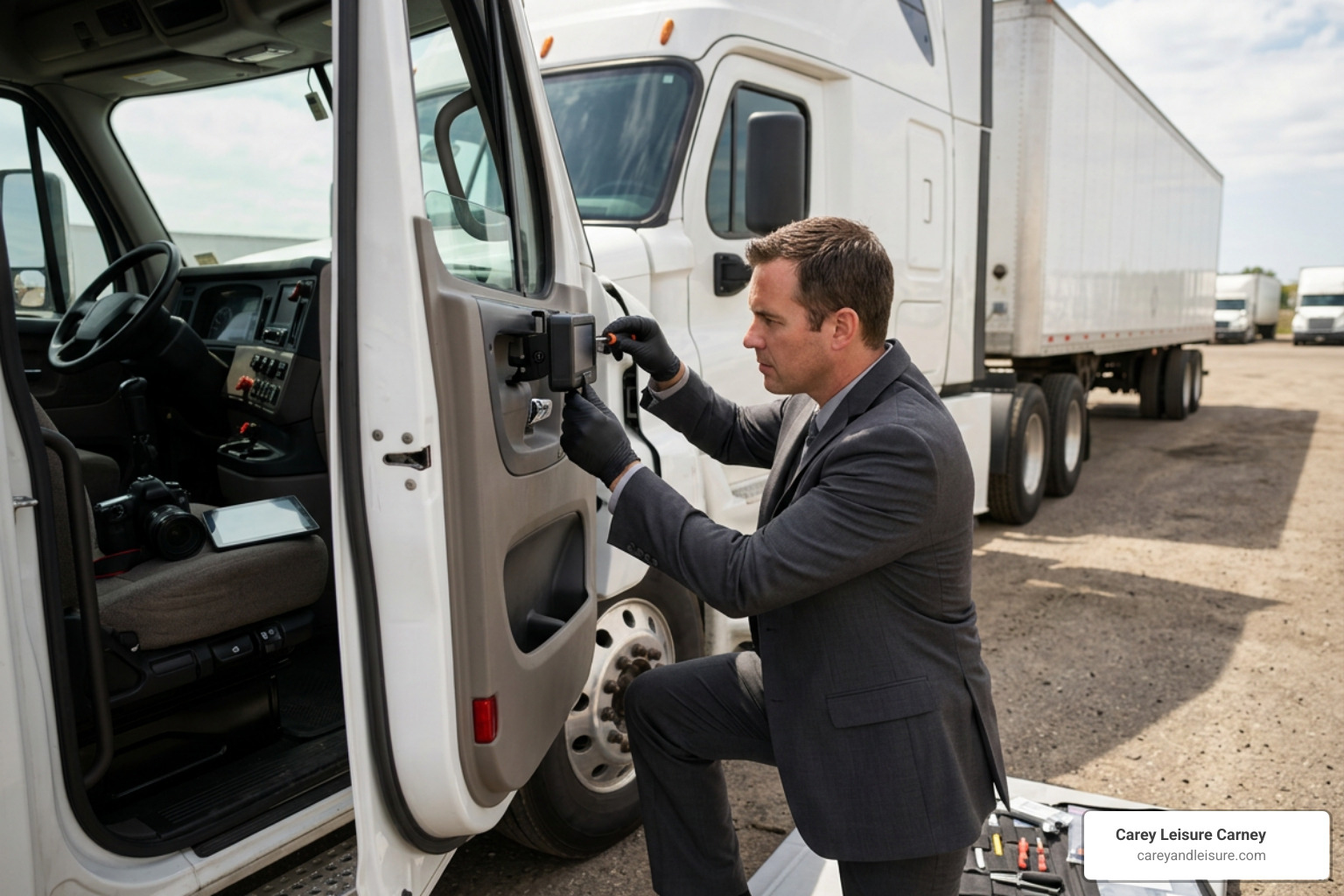
When an 80,000-pound semi-truck collides with a standard passenger vehicle, the playing field is uneven from the second impacts occur. While you or your loved ones are being rushed to emergency care, the motor carrier’s corporate machine is already spinning into high gear. Trucking companies do not wait to see how you are doing; they deploy rapid-response teams within hours to manage claim exposure and protect their bottom line.
To stand on equal footing, the most urgent priority in the initial 24 to 48 hours is stopping the destruction of digital and physical proof. In the trucking industry, crucial operational data is recorded continuously, but it is also subject to automatic overwriting cycles. Without formal legal intervention, the very facts required to establish fault can vanish.
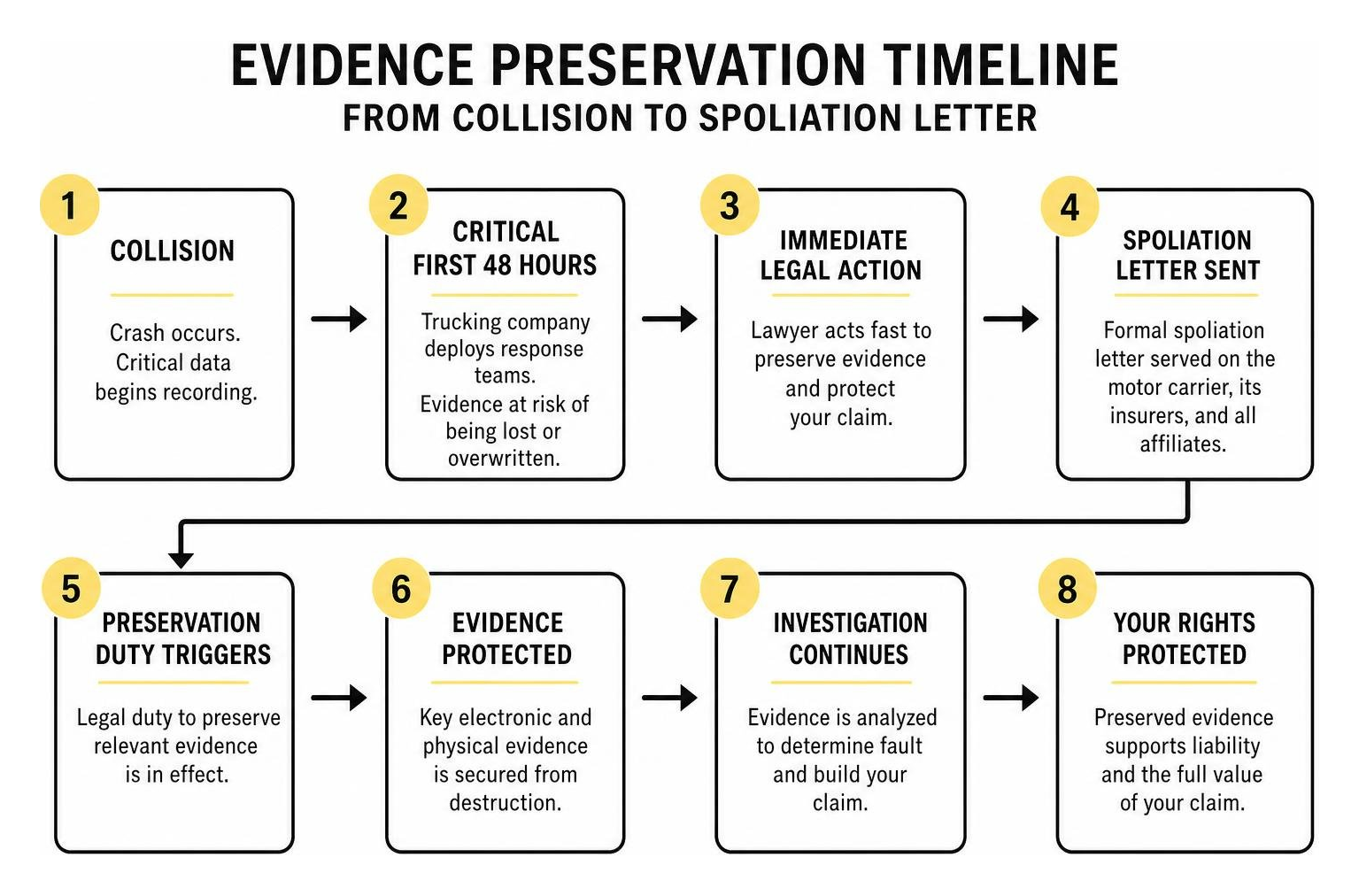
A qualified legal team acts immediately by drafting and serving a comprehensive formal spoliation letter to the motor carrier, its insurance underwriters, and all third-party affiliates. This legal directive commands the preservation of:
- Engine Control Module (ECM) and Event Data Recorder (EDR) diagnostic data
- Electronic Logging Device (ELD) records and telematics feeds
- Forward-facing and cab-facing dashcam video
- Driver qualification files (DQFs) and post-crash drug/alcohol screening results
- Dispatch records, text communications, and bill of lading documents
- Maintenance, repair, and annual inspection logs
How Can a Truck Accident Lawyer Help Uncover Black Box and ELD Data?
Modern commercial vehicles are rolling supercomputers. The truck’s “black box”—which includes the Engine Control Module (ECM) and Event Data Recorder (EDR)—captures critical telemetry in the seconds before, during, and after an impact. This diagnostic data records vehicle speed, throttle position, brake application, engine RPM, seatbelt usage, and steering angles.
However, many ECM systems overwrite diagnostic fault data within 30 days or during subsequent driving cycles. By sending immediate preservation notices and deploying forensic download technicians, a lawyer secures this raw telemetry before it is erased.
Furthermore, under Federal Motor Carrier Safety Administration (FMCSA) mandates, commercial carriers must record driving time using Electronic Logging Devices (ELDs). These digital logs track compliance with strict Hours of Service limits designed to prevent fatigue behind the wheel.
Our attorneys do not just look at the ELD summary; we cross-examine the electronic logs against time-stamped GPS pings, electronic toll passes, weigh-station records, and diesel fuel receipts. When a trucker falsifies logs to push beyond legal driving limits, this forensic audit catches the discrepancies. For a broader overview of these investigative procedures, read this comprehensive legal guide on truck collisions.
Countering the Motor Carrier’s Defense Team Immediately
Commercial trucking insurers do not handle claims like everyday auto insurers. Major carriers maintain on-call accident reconstructionists, corporate investigators, and defense counsel who arrive at the crash scene before the tow trucks have even cleared the wreckage. Their singular goal is to control the narrative, photograph skid marks from angles favorable to their driver, inspect vehicle damage, and identify any pretext to push fault onto you.
Having aggressive legal representation counterbalances this corporate advantage. We deploy our own independent investigators and accredited accident reconstruction specialists to document physical road evidence, evaluate crush damage patterns, measure coefficient of friction on the asphalt, and locate nearby commercial surveillance cameras that may have captured the wreck.
Securing this independent analysis early ensures the defense cannot quietly dispose of physical components or manipulate witness accounts. To understand how technical professionals assist in proving these claims, review our article on expert witness analysis.
How Can a Truck Accident Lawyer Help Build an Undeniable Claim?
According to research from the Insurance Research Council (IRC), injury victims represented by legal counsel secure settlements nearly 3.5 times higher than unrepresented claimants negotiating directly with insurance companies—even after legal fees are deducted. Furthermore, 85% of all insurance payouts for bodily injury claims nationwide are distributed to represented individuals.
These numbers reflect the severe complexity of commercial transport litigation. Under federal law (49 CFR Part 387), interstate motor carriers transporting non-hazardous freight must maintain a minimum of $750,000 in public liability coverage, while hazardous material haulers are frequently insured up to $5,000,000 or more.
Because the policy limits are massive, commercial insurers protect these funds with dedicated defense firms. An experienced advocate handles these layered insurance towers and constructs an undeniable chain of liability.
How Can a Truck Accident Lawyer Help Identify Multi-Party Corporate Liability?
In a standard two-car crash, liability usually begins and ends with the opposing driver. In a commercial big-rig collision, multiple corporate entities often share legal responsibility for the safe operation of that single vehicle.
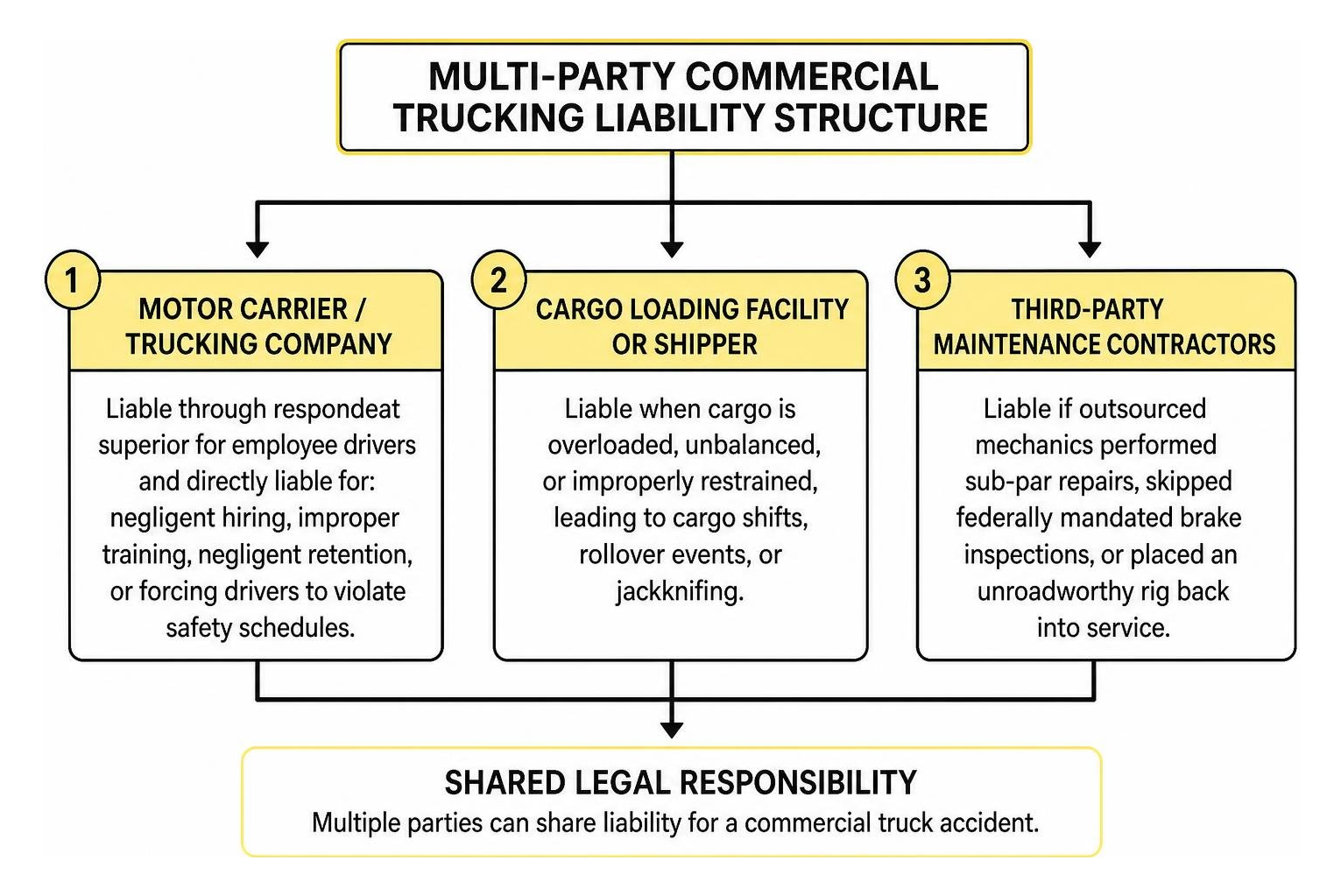
When evaluating a case, an attorney examines the entire commercial supply and operating chain:
- The Motor Carrier / Trucking Company: Liable through respondeat superior (vicarious liability) for the careless acts of its employee drivers, as well as directly liable for negligent hiring, improper training, negligent retention, or forcing drivers to violate safety schedules. Learn more about the processes of suing trucking companies.
- The Cargo Loading Facility or Shipper: Liable when cargo is overloaded, unbalanced, or improperly restrained, leading to cargo shifts, rollover events, or jackknifing.
- Third-Party Maintenance Contractors: Liable if outsourced mechanics performed sub-par repairs, skipped federally mandated brake inspections, or placed an unroadworthy rig back into service.
- Vehicle and Component Manufacturers: Liable under product liability principles for defective steer tires, faulty air brake lines, or malfunctioning electronic stability control systems.
- Freight Brokers: Liable if they breached their duty by hiring an unsafe, unvetted, or underinsured “chameleon carrier” with a documented history of safety violations.
Unrepresented victims rarely look past the truck driver’s commercial driver’s license (CDL). Failing to identify every liable entity can mean losing access to the necessary commercial insurance policies required to cover severe damages. For additional criteria on evaluating your claim, review this guide on assessing legal representation needs.
Proving FMCSA Regulatory Violations and Systemic Negligence
Commercial carriers operate under a strict, uniform federal safety umbrella: the Federal Motor Carrier Safety Regulations (FMCSRs). Violating these rules provides direct evidence of negligence under state law.
A knowledgeable attorney leverages these regulations to prove systemic corporate misconduct:
- Hours of Service (49 CFR Part 395): Limits property-carrying commercial drivers to a maximum of 11 hours of driving within a 14-hour duty window following 10 consecutive hours off-duty. Proving a breach establishes acute driver fatigue.
- Driver Qualification Standards (49 CFR Part 391): Requires carriers to thoroughly investigate a driver’s safety history, conduct annual background reviews, maintain current medical examiner certificates, and mandate road testing. If a company hired a driver with a record of reckless driving or medical disqualifications, it faces direct liability for negligent entrustment.
- Parts and Accessories Necessary for Safe Operation (49 CFR Part 393): Outlines mandatory mechanical standards, including commercial brake performance, lighting configurations, and strict cargo securement rules (49 CFR Part 393 Subpart I) requiring cargo to withstand specified acceleration and deceleration forces.
- Inspection, Repair, and Maintenance (49 CFR Part 396): Dictates that motor carriers systematically inspect, repair, and maintain all motor vehicles under their control, requiring documented pre-trip (DVIR) and post-trip driver vehicle inspection reports.
Proving that a trucking company skipped these safety requirements transforms a simple traffic collision into a case of systemic corporate negligence. For a deeper breakdown of how these rules apply, review our analysis of semi-truck accident claims.
Navigating Florida Laws, Complex Regulations, and Severe Damages
Commercial truck collisions cause catastrophic harm far more frequently than passenger vehicle crashes. According to recent federal crash data, thousands of individuals lose their lives each year, and over 150,000 suffer serious injuries in accidents involving heavy commercial vehicles. Over the past decade, fatal crashes involving large trucks increased by 43%.
When dealing with injuries of this magnitude, an accurate case valuation requires projecting lifetime care requirements rather than tallying up initial hospital bills.
Calculating Long-Term and Catastrophic Truck Injuries
Traumatic brain injuries (TBIs), spinal cord damage, crushed limbs, multiple fractures, and severe internal trauma demand comprehensive financial modeling. Settling a claim before understanding the full medical outlook can leave an injured victim with massive out-of-pocket medical debt years down the road.
A trial attorney coordinates with your treating physicians and retains board-certified medical experts, vocational consultants, and certified life-care planners to calculate:
- Future Medical Interventions: Projected costs for subsequent corrective surgeries, revision procedures, and specialist visits.
- Ongoing Rehabilitation and Therapy: Physical, occupational, and psychological care.
- Home and Vehicle Modifications: Accessible housing alterations, ramps, motorized wheelchairs, and adapted transport.
- Diminished Earning Capacity: The economic delta between what you earned prior to the wreck versus what you can realistically earn given your permanent physical or cognitive restrictions.
- Non-Economic Losses: Quantifying physical pain, emotional distress, disfigurement, loss of capacity for the enjoyment of life, and loss of consortium.
We ensure that negotiations do not take place until you have reached Maximum Medical Improvement (MMI)—the point where your medical condition has stabilized, allowing physicians to accurately forecast your lifetime care expenses. To learn more about funding medical care during an open claim, see our guide on post-crash medical bill options, as well as our resource on understanding commercial settlements.
Navigating Florida Fault Rules and Contingency Fee Structures
Pursuing a commercial truck claim in Florida requires strict adherence to state statutory mandates, which were overhauled by recent tort legislation:
- Modified Comparative Fault (Florida HB 837 / F.S. § 768.81): Florida operates under a strict 51% modified comparative fault bar. If an injured victim is found to be greater than 50% at fault for the crash, they are completely barred from recovering any financial compensation from the other parties. If you are found 20% at fault, your final recovery is reduced by 20%. Commercial insurers frequently use this rule to shift blame onto passenger vehicle drivers; our job is to preserve the evidence that proves the commercial carrier was primarily responsible.
- Two-Year Statute of Limitations (F.S. § 95.11): Under updated Florida law, the statutory deadline to file a personal injury lawsuit based on negligence is two years from the date of the accident (shortened from the prior four-year limit). Missing this absolute statutory cutoff forfeits your legal right to seek compensation forever.
| Claim Factor | Self-Represented Claimant | Attorney-Represented Claimant |
|---|---|---|
| Evidence Preservation | High risk of lost ECM data, erased dashcam footage, and overwritten ELD records. | Immediate spoliation letters served within 24–48 hours to preserve all electronic data. |
| Defendant Identification | Typically targets only the individual commercial truck driver. | Conducts corporate audits to identify carriers, cargo loaders, maintenance shops, and brokers. |
| Regulatory Proof | Relies primarily on basic police accident reports and traffic citations. | Audits FMCSA compliance across Hours of Service (Part 395) and Driver Files (Part 391). |
| Damages Valuation | Focuses on past medical bills, leaving future lifetime care uncalculated. | Retains life-care planners and economists to establish maximum lifetime economic loss. |
| Average Settlement | Subject to lowball offers and insurer comparative fault traps. | Averages ~3.5x higher net recoveries based on Insurance Research Council statistics. |
At Carey Leisure Carney, our firm operates entirely on a contingency fee basis. This means:
- You pay zero upfront retainers or out-of-pocket costs.
- We advance 100% of the capital needed to retain world-class expert witnesses, pay court filing fees, perform accident reconstructions, and conduct depositions.
- We only receive an attorney fee (typically 33.3% to 40% in accordance with the Rules Regulating The Florida Bar) if we successfully recover financial compensation through a negotiated settlement or courtroom verdict. If there is no recovery, you owe us nothing in fees.
For a detailed look at fee arrangements and litigation expenses, visit our guide on truck accident legal costs.
Frequently Asked Questions About Commercial Truck Claims
When should I contact a truck accident attorney?
You should contact an attorney immediately—ideally within 24 to 48 hours following the collision. While Florida law allows up to two years under the statute of limitations to file a lawsuit, the physical and electronic evidence required to prove your claim does not last that long.
Truck black box data, forward-facing video, and electronic driver logs are routinely overwritten within 30 to 90 days if a formal spoliation notice is not received by the motor carrier. Contacting counsel right away allows our team to preserve critical evidence before it disappears.
What if the truck driver was clearly at fault?
Even when a commercial driver receives a traffic ticket at the scene, the trucking company’s corporate insurer will rarely offer a fair settlement voluntarily. Adjusters know how to exploit Florida’s 51% modified comparative fault threshold, attempting to pin partial blame on you to reduce their financial exposure.
Furthermore, a traffic citation does not establish the full scope of corporate liability—such as systemic driver overworking, deferred brake maintenance, or negligent hiring—nor does the investigating police officer calculate your future medical expenses or lost earning capacity. Legal counsel ensures the full economic value of your claim is backed by undeniable evidence.
How does a contingency fee work for a truck crash case?
Under a standard personal injury contingency fee agreement, you do not pay any hourly rates, upfront retainers, or out-of-pocket expenses. Our firm finances the entire investigation, expert witness retention, medical evaluations, and court litigation costs.
Our fee is collected as an agreed-upon percentage of the final gross settlement or jury verdict. If we do not obtain a financial recovery for you, you do not owe us any attorney fees.
Conclusion
A serious collision with an 80,000-pound commercial vehicle is a life-altering event. Taking on a national motor carrier, a fleet of defense lawyers, and multi-million-dollar insurance policies on your own places your physical and financial recovery at serious risk.
At Carey Leisure Carney, based in Clearwater, Florida, our Board-Certified civil trial attorneys bring over 100 years of combined legal experience to the table. Board Certification is an honor achieved by fewer than 2% of licensed attorneys in Florida, demonstrating recognized expertise, ethics, and courtroom trial ability. We believe in providing personalized service, direct attorney access, and thorough trial preparation for every client we represent across Clearwater, St. Petersburg, Largo, New Port Richey, Spring Hill, Trinity, and Wesley Chapel.
Do not let the trucking company control the outcome of your recovery. If you or a loved one was injured in a commercial vehicle collision, contact our dedicated legal team today to schedule a consultation with a Florida truck accident attorney and protect your rights.