Winning Justice with a Fatal Car Accident Claim
Steps to Start a Fatal Car Accident Claim in Florida
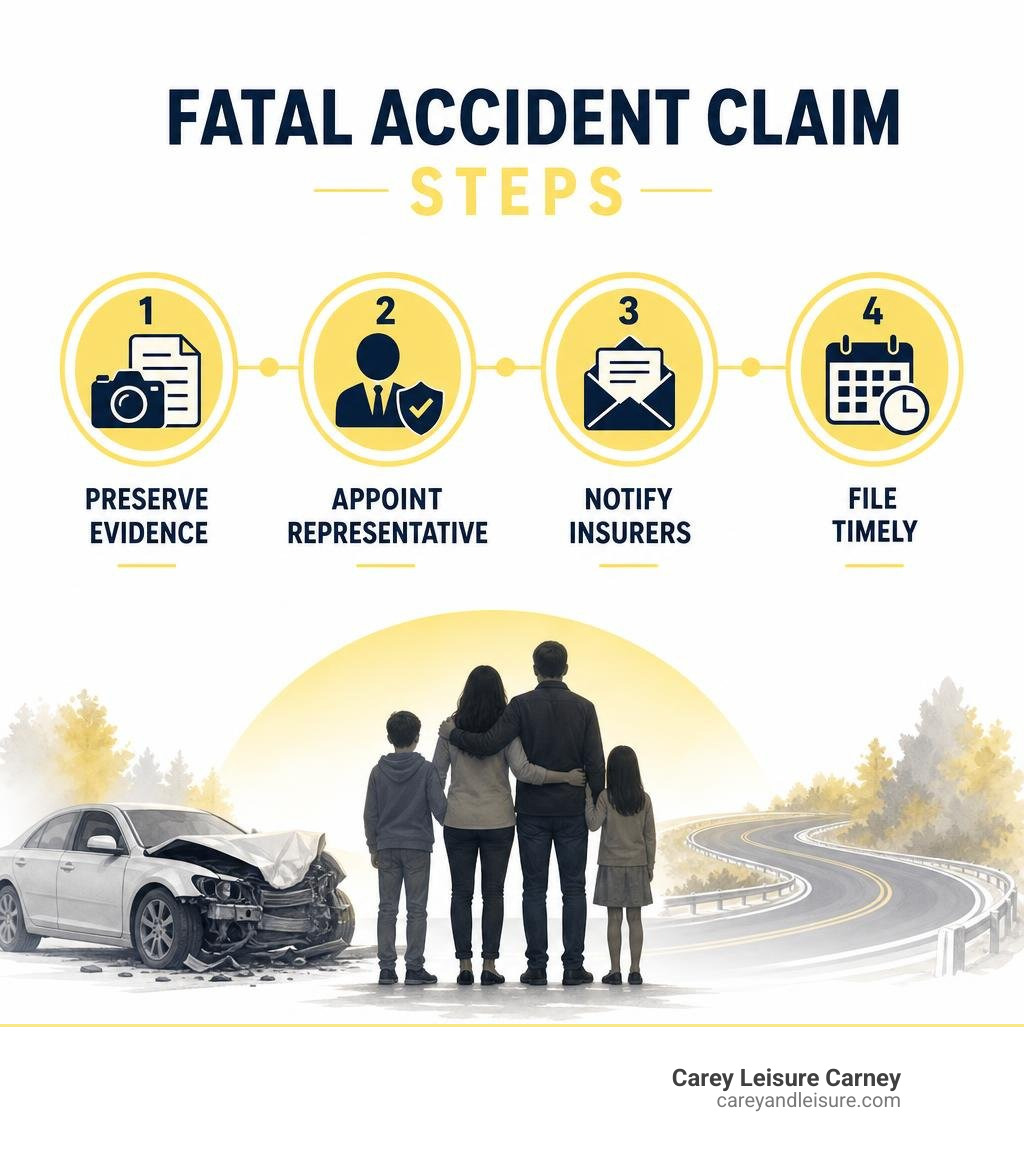
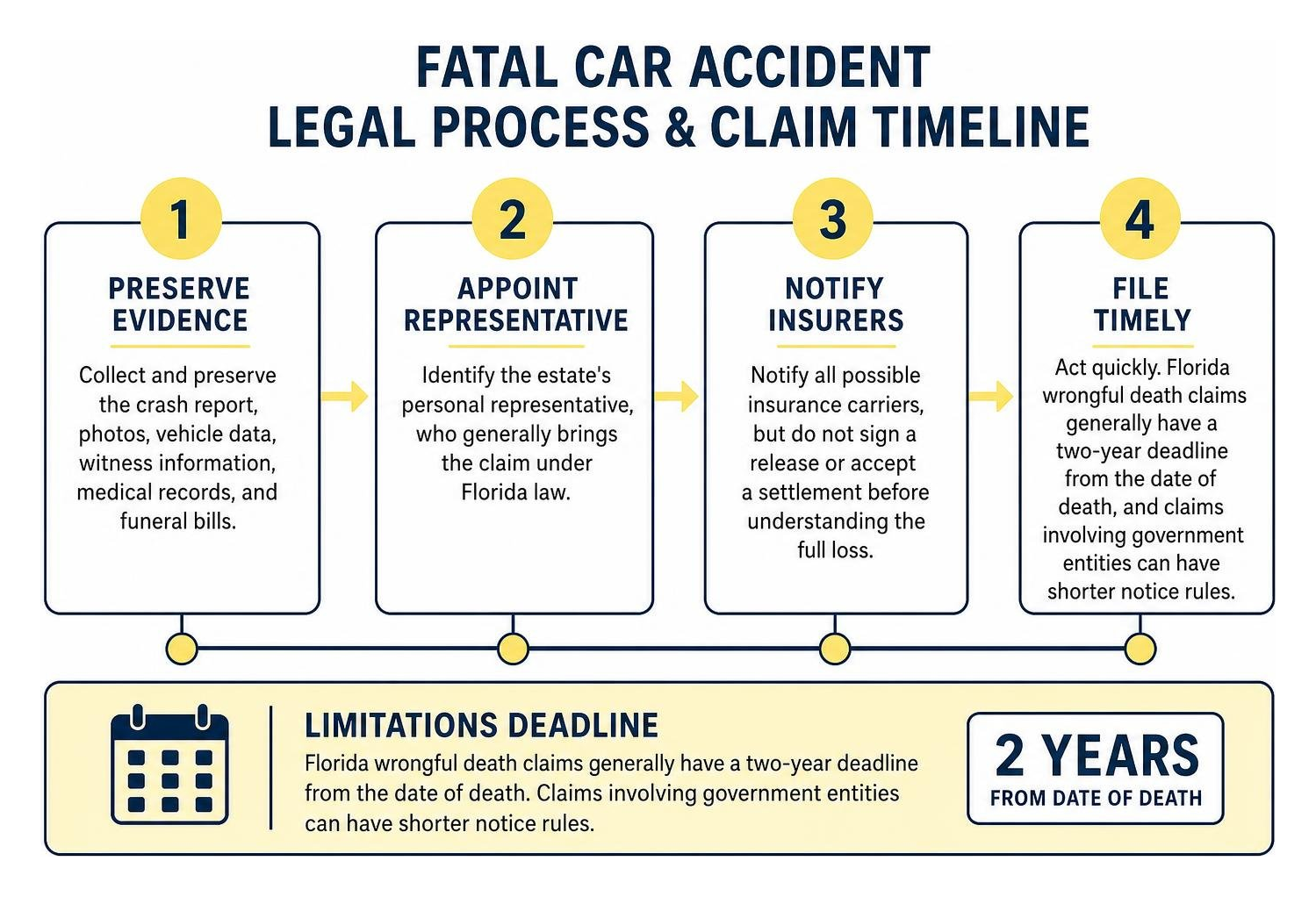
After a fatal crash, your family may be able to seek compensation through a wrongful death claim. The most important first steps are to:
- Preserve evidence, including the crash report, photos, vehicle data, witness information, medical records, and funeral bills.
- Identify the estate’s personal representative, who generally brings the claim under Florida law.
- Notify all possible insurance carriers, but do not sign a release or accept a settlement before understanding the full loss.
- Act quickly. Florida wrongful death claims generally have a two-year deadline from the date of death, and claims involving government entities can have shorter notice rules.
A civil claim cannot undo a devastating loss. It can, however, pursue accountability and financial support for medical expenses, funeral costs, lost income and household services, and the loss surviving family members now face. NHTSA estimated that 40,990 people died in U.S. motor vehicle crashes in 2023, a reminder that these tragedies remain far too common.
I am Thomas W. Carey, founding partner of Carey Leisure Carney and a Board-Certified civil trial lawyer who has handled or overseen thousands of injury matters in Florida, including fatal car accident claim cases. After losing my own wife to a drunk driver, I have devoted much of my career to helping families pursue answers, accountability, and fair compensation.
Quick fatal car accident claim definitions:
Introduction
When sudden motor vehicle collisions occur, the aftermath can alter a family’s reality permanently. Beyond the profound emotional devastation, surviving relatives are often confronted with unexpected financial burdens, ranging from outstanding emergency medical invoices to the sudden loss of a primary household income. Preliminary NHTSA estimates for the first nine months of 2024 recorded 29,135 traffic fatalities across the nation, illustrating the sheer scope of roadway dangers that continue to impact our communities.

While criminal courts focus on punishing traffic law violations or reckless conduct, the civil legal system provides a distinct pathway: the pursuit of financial justice and civil accountability. Through a civil legal action, surviving dependents and the decedent’s estate can demand that negligent drivers, trucking corporations, or vehicle manufacturers answer for the real-world harm they caused. We have dedicated our practice to walking beside families through every phase of this complex process, ensuring they never have to confront major insurance carriers alone.
Understanding Wrongful Death vs. Survival Actions After a Crash
When a loved one passes away due to crash injuries, state legal statutes divide the potential legal remedies into two distinct categories: wrongful death claims and survival actions. Understanding how these actions operate—and how they intersect under the statutory framework detailed in A Complete Guide to Florida Wrongful Death Claims—is crucial for maximizing recovery for both the estate and individual beneficiaries.
Under Florida law, when personal injuries result in death, the underlying personal injury claim does not survive as a standard bodily injury claim. Instead, it transforms under the Florida Wrongful Death Act. The primary difference lies in whose losses are being compensated:
| Legal Action Type | Purpose of Claim | Primary Beneficiaries | Types of Recoverable Damages |
|---|---|---|---|
| Wrongful Death Claim | Compensates surviving family members for their personal losses resulting from the death | Surviving spouse, minor children, dependent parents | Loss of financial support, loss of companionship, mental pain and suffering |
| Survival Action / Estate Claims | Compensates the decedent’s estate for losses incurred prior to death and direct estate expenses | The decedent’s estate (distributed via will or intestacy) | Medical expenses prior to death, funeral and burial costs, lost net accumulations |
A wrongful death claim belongs to the statutory survivors. It addresses the ongoing future vacuum left in their daily lives—the loss of guidance, protection, parental companionship, and regular financial contributions. Conversely, direct estate claims recover the tangible expenses absorbed by the estate itself, such as pre-death medical intervention and the loss of prospective financial assets that the deceased would have saved over their natural lifetime.
Who Has Legal Standing to Seek Compensation?
Navigating who can legally file a claim can be confusing during a period of intense grief. Many families assume that any close relative can walk into a courthouse and file a lawsuit. However, procedural rules require specific legal standing to initiate formal litigation.

According to established legal frameworks for Bringing a Wrongful Death Claim After a Fatal Car Accident, the claim must be brought directly by the personal representative (also referred to as an executor or administrator) of the deceased person’s estate. If the deceased left a valid will, that document usually names the personal representative. If no will exists, the local probate court appoints a qualified administrator—often the surviving spouse or an adult child.
Although the personal representative files the lawsuit, they do so on behalf of all statutory survivors and the estate itself. Eligible survivors who may recover damages include:
- The Surviving Spouse: Entitled to recover for the loss of companionship, protection, and mental pain and suffering from the date of injury.
- Minor Children: Children under 25 years of age can recover for lost parental companionship, instruction, guidance, and emotional suffering.
- Adult Children: Eligible to recover for lost parental companionship and mental pain if there is no surviving spouse.
- Parents: Parents of deceased minor children can recover for mental pain and suffering; parents of deceased adult children may also recover under specific statutory conditions when no other primary survivors exist.
- Dependent Relatives: Any blood relative or adoptive sibling who was partly or wholly dependent on the decedent for support or services.
Properly identifying every eligible distributee ensures all available damages are accounted for in the initial demand.
Step-by-Step Guide to Filing a Fatal Car Accident Claim
Building a successful case requires a structured legal approach to prevent insurance adjusters from exploiting procedural mistakes. A comprehensive strategy, such as outlined in Claiming Compensation: A Step-by-Step Guide to Fatal Accident Claims, ensures no critical detail is missed.
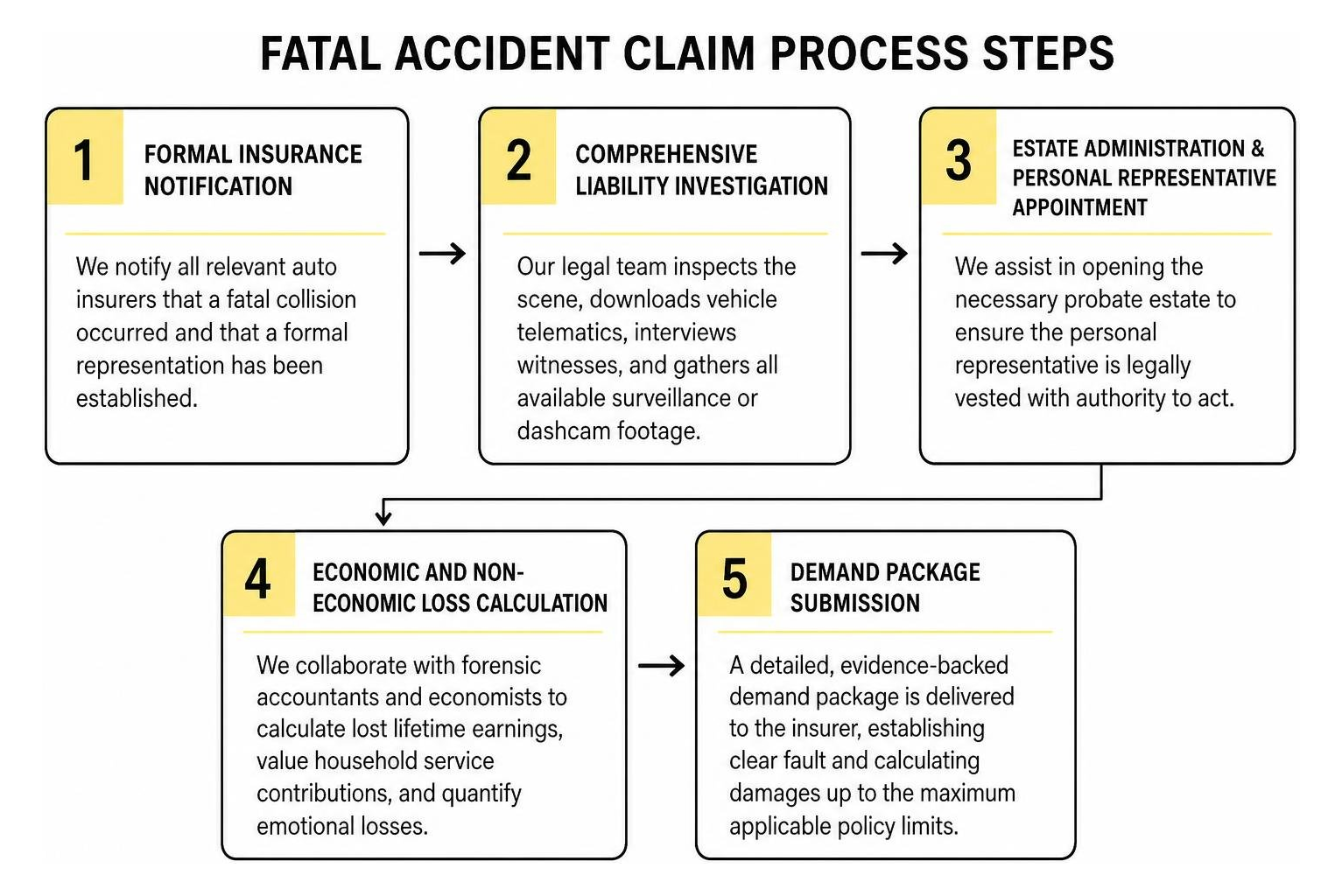
- Formal Insurance Notification: We notify all relevant auto insurers that a fatal collision occurred and that a formal representation has been established. This halts harassing adjuster phone calls to grieving family members.
- Comprehensive Liability Investigation: Our legal team inspects the scene, downloads vehicle telematics, interviews witnesses, and gathers all available surveillance or dashcam footage.
- Estate Administration & Personal Representative Appointment: We assist in opening the necessary probate estate to ensure the personal representative is legally vested with authority to act.
- Economic and Non-Economic Loss Calculation: We collaborate with forensic accountants and economists to calculate lost lifetime earnings, value household service contributions, and quantify emotional losses.
- Demand Package Submission: A detailed, evidence-backed demand package is delivered to the insurer, establishing clear fault and calculating damages up to the maximum applicable policy limits.
- Pre-Suit Negotiations or Formal Litigation: If the insurer refuses to tender policy limits or disputes liability, we initiate a lawsuit before the statutory deadline expires, keeping in mind that The Clock Is Running: A Guide to Accident Statute of Limitations.
Essential Evidence to Prove a Fatal Car Accident Claim
Insurance companies and defense counsel do not simply hand over policy payouts; they demand concrete evidence demonstrating causation and fault. Following the protocols of Unraveling the Truth: A Guide to Fatal Accident Investigations, our team secures vital pieces of proof before they can be altered, overwritten, or lost:
- Police Crash Reports & Homicide Investigation Files: Detailed diagrams, officer narratives, citations issued, and blood-alcohol chemical test results.
- Event Data Recorders (EDRs): Modern vehicles contain “black boxes” that record speed, braking inputs, throttle percentage, seatbelt usage, and steering angles seconds prior to impact.
- Digital Surveillance & Dashcam Footage: Traffic cameras, nearby commercial storefront security videos, and residential doorbell cameras that captured the collision.
- Eyewitness Testimony: Sworn statements from third-party motorists and pedestrians who observed driver impairment, speeding, or red-light violations.
- Accident Reconstruction Analysis: Specialized forensic engineers who calculate closing speeds, crush damage metrics, and collision angles to scientifically prove how the crash occurred.
- Medical Records & Autopsy Reports: Documentation proving that the injuries sustained in the motor vehicle collision were the direct and proximate cause of death.
How Comparative Fault Affects a Fatal Car Accident Claim
To prevail in any auto collision lawsuit, the claimant must prove the four fundamental elements of negligence: duty of care, breach of duty, causation, and damages. Every driver owes a legal duty to operate their motor vehicle safely. Violating traffic laws, driving under the influence, or texting behind the wheel constitutes a clear breach of that duty.
However, defense attorneys routinely attempt to shift blame onto the deceased driver to reduce payout obligations. Under Florida’s modified comparative negligence system, a claimant’s total financial recovery is reduced by their apportioned percentage of fault. For example, if total damages are determined to be $1,000,000 but the decedent is deemed 20% responsible for speeding, the net recovery becomes $800,000.
Crucially, under the 51 percent bar rule, if the deceased is found to be greater than 50% at fault for the crash, surviving family members are completely barred from recovering compensation from the other driver. This makes aggressive evidence collection essential to disprove unfair defense allegations.
Recoverable Damages in Fatal Crash Lawsuits
The financial and personal losses resulting from a fatal collision are multifaceted. Reviewing The ABCs of Fatal Accident Compensation Claims helps families identify both direct economic losses and intangible emotional damages.
Economic Damages
Economic damages account for quantifiable, out-of-pocket financial losses resulting from the fatal crash:
- Medical Expenses Prior to Death: Hospital bills, surgical costs, emergency transport, and life-support measures incurred between the moment of impact and passing.
- Funeral and Burial Expenses: Reasonable expenses paid by the estate or surviving family members for memorial services, cremation, or burial.
- Loss of Financial Support and Services: The present value of financial earnings and household services the deceased would have provided to their dependents over their expected working lifespan.
- Loss of Prospective Net Accumulations: The estimated value of assets and savings the deceased likely would have accumulated and left to the estate had they lived a full life.
Non-Economic Damages
Non-economic damages address the profound human losses suffered by surviving loved ones, reflecting the principles discussed in Compensation for Pain and Suffering in Florida What You Need to Know:
- Mental Pain and Suffering: Emotional distress, grief, depression, and mental anguish experienced by the surviving spouse, children, and parents.
- Loss of Companionship and Protection: The loss of an emotional partner, protector, and marital companion.
- Loss of Parental Guidance and Instruction: The loss of moral instruction, life advice, and nurture sustained by minor and dependent children.
Punitive Damages
In cases involving gross negligence, intentional misconduct, or extreme recklessness—such as high-speed street racing, extreme drunk driving, or fleeing the scene of a crash—courts may allow claims for punitive damages. These damages are designed to punish the wrongdoer and deter others from engaging in similarly dangerous behavior.
Frequently Asked Questions About Fatal Collision Claims
How Long Do Families Have to File a Wrongful Death Lawsuit in Florida?
Under Florida statutes, wrongful death actions generally carry a two-year statute of limitations from the date of death. This deadline is strictly enforced. If a lawsuit is not filed before the statutory period expires, the court will dismiss the case, permanently eliminating the family’s right to pursue compensation.
If the fatal crash involved a government vehicle (such as a county transit bus, city police car, or municipal maintenance truck), claimants must provide formal written pre-suit notice under Florida’s sovereign immunity statutes, which imposes stringent administrative deadlines. Consulting an attorney immediately ensures these procedural timelines are properly met.
What Happens If the At-Fault Driver Is Uninsured or Underinsured?
Many negligent drivers carry only minimal insurance coverage or illegally drive with no insurance at all. When an at-fault driver’s policy limits are insufficient to cover the staggering damages of a fatal collision, we explore several vital alternative avenues:
- Uninsured/Underinsured Motorist (UM/UIM) Coverage: Families can file claims through their own auto insurance policies if they carry UM/UIM coverage. In Florida, policyholders who stack UM coverage across multiple vehicles can combine coverage limits to secure a much higher financial recovery.
- Commercial & Vicarious Liability: If the at-fault driver was working, delivering goods, or operating a commercial vehicle at the time of the collision, the employer’s commercial liability policy can often be held responsible.
- Third-Party Product Liability: If vehicle defects—such as tire blowouts, airbag failures, or seatback collapses—contributed to the fatal injuries, claims may be brought against the automotive manufacturer.
How Do Insurance Companies Attempt to Minimize Wrongful Death Payouts?
Insurance companies are profit-driven corporations. When faced with a potential seven-figure fatal collision claim, their primary objective is minimizing their financial exposure. Common defense strategies include:
- Rushing Lowball Settlements: Adjusters often contact grieving survivors shortly after the crash, offering quick cash settlements before the family has hired an attorney or understood the long-term economic value of the claim.
- Exploiting Broad Release Forms: Insurers often draft release agreements that waive all future claims against every potential party, cutting off access to umbrella or commercial policies.
- Blaming the Deceased: Defense teams may allege that the deceased was distracted, speeding, or not wearing a seatbelt to invoke comparative negligence and eliminate or reduce payout amounts.
- Delaying the Claim Process: Insurers sometimes use unnecessary bureaucratic delays, hoping the statute of limitations will run out or that the family will settle out of exhaustion.
Conclusion
Navigating the aftermath of a fatal car accident is an overwhelming ordeal. While civil compensation cannot restore what has been taken, obtaining a full and fair financial recovery provides stability, covers unexpected obligations, and ensures that negligent parties are held accountable for their actions.
At Carey Leisure Carney, our Board-Certified trial attorneys bring over 100 years of combined legal experience to every case we handle. We take pride in offering direct attorney access, personal attention, and relentless courtroom advocacy for families throughout Clearwater, Largo, New Port Richey, Spring Hill, St Petersburg, Trinity, and Wesley Chapel.
If your family has experienced a catastrophic loss due to a negligent driver, do not face the insurance companies alone. Contact an experienced wrongful death attorney at Carey Leisure Carney today for a compassionate, no-obligation consultation to understand your rights and begin your path toward justice.