
Everything You Need to Know About Hiring a Rideshare Accident Attorney
When to Call a Lawyer After an Uber Accident in Clearwater
If you’re hurt in an Uber crash, get medical care, report the crash to police, and save a screenshot of your trip. Then speak with a rideshare accident lawyer before accepting an insurance settlement. A lawyer can help identify who may be responsible, preserve evidence, and seek compensation for medical bills, lost income, and other losses.
Uber’s insurance coverage can depend on what the driver was doing in the app when the crash happened. You don’t have to sort that out while you’re recovering.
I’m Thomas W. Carey, founding partner of Carey Leisure Carney and a board-certified civil trial lawyer with decades of Florida motor-vehicle injury experience. If you’re looking for a lawyer for Uber accident injuries in Clearwater, this guide will help you understand what to ask and what to do next.
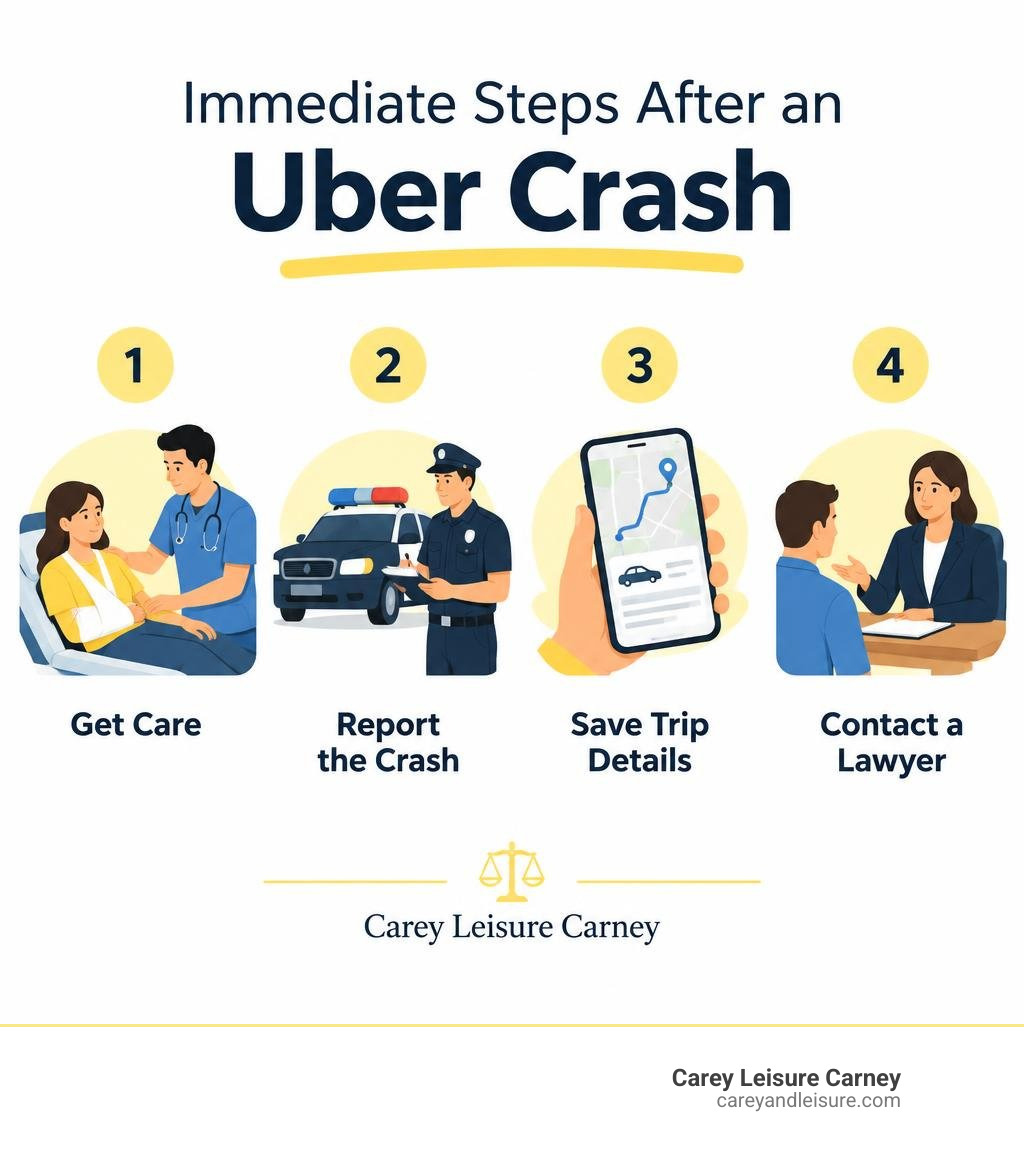
Lawyer for uber accident vocab explained:
Understanding Liability and When to Hire a Lawyer for Uber Accident Claims
Rideshare collisions are not standard two-car fender benders. When a crash involves an app-based transportation network, determining liability quickly becomes a tangled web of overlapping corporate policies, individual drivers, and third parties. In a typical passenger vehicle crash, you look at the drivers involved. In an Uber crash, liability can involve the rideshare driver, another motorist on the road, vehicle manufacturers, or even the rideshare corporation itself.
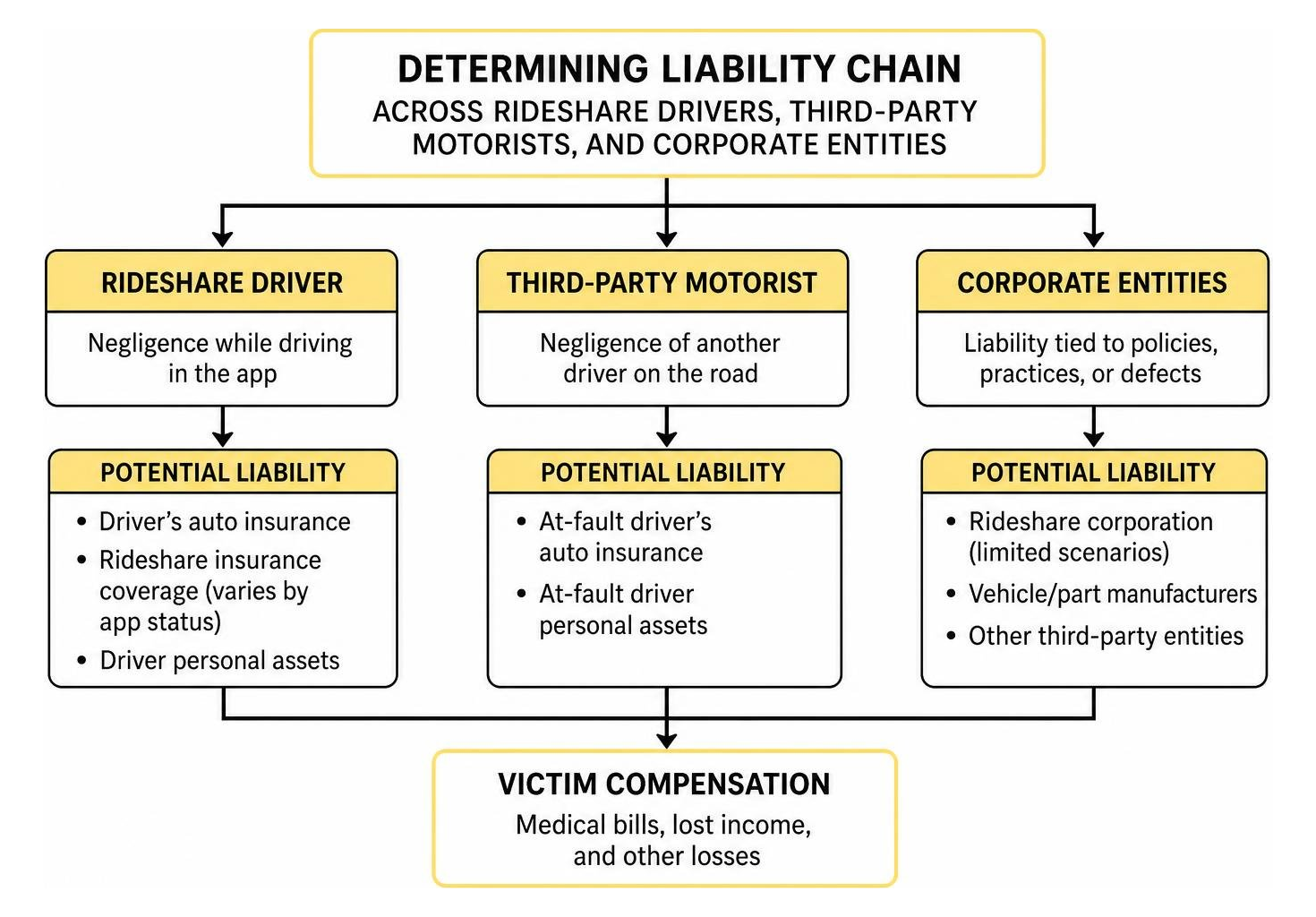
A central complexity is that rideshare companies classify their drivers as independent contractors rather than direct employees. This legal distinction is designed to shield the corporation from traditional vicarious liability. However, victims still have substantial protections. In fact, studies show that in rideshare crashes, 68% of victims are passengers, while 32% are occupants of other vehicles or pedestrians. Because passengers rarely contribute to the cause of a collision, their right to compensation is strong. Exploring evaluating negligence in rideshare collisions helps clarify how fault is apportioned when multiple drivers point fingers at each other. Furthermore, understanding your passenger rights following a crash ensures you do not inadvertently surrender your right to full financial recovery.
How a Lawyer for Uber Accident Cases Determines Fault
Proving negligence requires an attorney to gather technical and physical evidence before it disappears. In standard car accidents, physical skid marks and police reports do most of the talking. In a rideshare crash, digital telematics play a pivotal role.
Rideshare drivers often juggle navigation tools, incoming ride requests, and passenger communications while driving. This digital multitasking creates dangerous cognitive and visual distractions. When we investigate these collisions, we subpoena specific server-side data logs directly from the platform, including:
- App status records indicating whether the driver was active, searching for fares, or mid-trip.
- Telematics data tracking speed, sudden braking, and route deviations.
- GPS time-stamps pinpointing vehicle location at the exact second of impact.
- Mobile phone activity records revealing active texting or app interactions.
Following proper Florida rideshare collision protocol allows us to reconstruct the scene accurately, identify moving violations, and hold all negligent parties accountable.
Critical Deadlines and When to Seek Legal Representation
Waiting to seek legal guidance can jeopardize your claim. Under Florida law, personal injury claims have strict statutory deadlines. Missing these filing windows permanently forfeits your ability to seek compensation in court.
Beyond statutory limitations, critical evidence degrades rapidly. Dashcam footage is frequently overwritten within days, and rideshare companies do not preserve internal electronic logs indefinitely without a formal legal spoliation letter. Additionally, Florida’s no-fault insurance framework requires injured motorists and passengers to seek initial medical treatment within 14 days of an incident to access Personal Injury Protection (PIP) benefits. Preparing for your case using an essential legal consultation checklist ensures you have all necessary documentation ready from day one.
How Uber’s Multi-Tier Insurance Coverage Works
Uber provides substantial commercial insurance coverage, but access to these policies depends entirely on the driver’s app status at the precise moment of the crash. The system is split into distinct operational periods.
| App Status Period | Driver Activity | Active Insurance Coverage | Applicable Liability Limits |
|---|---|---|---|
| Period 0 | App is closed / offline | Driver’s personal auto insurance | Driver’s personal policy limits |
| Period 1 | App is on / waiting for ride request | Uber contingent liability insurance | $50,000 bodily injury per person / $100,000 per accident / $25,000 property damage |
| Period 2 | Ride accepted / en route to pick up | Uber commercial liability policy | Up to $1,000,000 third-party liability and UM/UIM |
| Period 3 | Passenger inside vehicle / ride active | Uber full commercial coverage | Up to $1,000,000 liability plus contingent comprehensive/collision |
Understanding this structure is essential for securing fair compensation, as detailed in our rideshare insurance payout guide.
Period 0 and Period 1: App Offline vs. Driver Available
When a driver is operating their vehicle with the app turned off (Period 0), they are driving purely as a private citizen. Uber provides zero insurance coverage during this time. Any crash falls entirely under the driver’s personal automobile insurance policy.
Once the driver logs into the platform and makes themselves available for fares (Period 1), a hybrid tier applies. The driver’s personal policy remains primary, but personal insurers frequently deny coverage if they discover the car was being used for commercial purposes without a specific rideshare endorsement. In this scenario, Uber maintains contingent liability coverage providing up to $50,000 per person for bodily injury, $100,000 per accident total bodily injury, and $25,000 for property damage.
Period 2 and Period 3: Ride Accepted and Passenger on Board
The moment a driver accepts a ride request (Period 2) and throughout the entire duration of the trip until the passenger exits the vehicle (Period 3), Uber’s primary commercial insurance policy takes over.
This policy includes up to $1 million in commercial third-party liability coverage and $1 million in uninsured/underinsured motorist (UM/UIM) coverage. If another driver causes a collision but lacks adequate insurance, Uber’s UM/UIM policy can step in to cover passenger injuries. Reviewing the factors that shape an understanding settlement amounts helps injured clients see how these higher policy limits protect them against catastrophic losses.
Common Challenges in Rideshare Claims and How Legal Counsel Helps

Filing a claim against a multi-billion-dollar transportation network presents unique obstacles that everyday auto accident victims rarely encounter. Commercial insurers often deploy aggressive defense tactics designed to delay claims, minimize severity, or shift blame between insurers to avoid paying out benefits.
Rideshare carriers routinely dispute which coverage tier applied at the exact second of impact, claiming the driver was in Period 1 rather than Period 2 to limit their financial exposure. Insurers may also assert bad faith delays, hoping victims settle for lowball offers out of financial desperation. Relying on the role of rideshare injury attorneys levels the playing field against corporate legal teams, while also assisting victims with managing vehicle property damage efficiently.
Differences Between Suing Uber Directly and Pursuing the Driver
A common question is whether an injured party sues the driver personally, files a claim with the insurance carrier, or sues Uber directly.
Because rideshare drivers are independent contractors, you generally cannot sue Uber directly under standard vicarious liability (respondeat superior) solely because the driver made a driving error. However, Uber’s commercial insurance policy covers the driver’s negligence during active ride periods.
Direct legal action against Uber as a corporate entity is reserved for cases involving direct corporate negligence, such as:
- Negligent Hiring and Screening: Retaining a driver with a documented history of reckless driving, license suspensions, or violent offenses.
- Inadequate Safety Oversight: Failing to deactivate a driver following verified safety complaints or impaired driving reports.
- App-Induced Hazards: Platform designs that force drivers to interact with their screens in an unreasonably hazardous manner while operating a vehicle.
Our team has extensive experience navigating rideshare accident lawsuits to ensure every potential avenue of corporate and individual recovery is pursued.
Essential Evidence a Lawyer for Uber Accident Lawsuits Collects
Building an unshakeable injury claim requires securing diverse forms of physical and digital documentation. Critical evidence we gather includes:
- Digital trip receipts, screenshots of ride confirmations, and route manifests.
- Server-level GPS tracking logs and driver telematics from the rideshare platform.
- High-definition dashcam video, municipal traffic camera recordings, and local surveillance footage.
- Official police crash reports, officer body-camera footage, and citation records.
- Eyewitness statements and contact information gathered at the scene.
- Comprehensive medical records, emergency room intake logs, diagnostic scans, and physician treatment plans.
Compensation Types and Fee Structures in Rideshare Cases

The average settlement for an Uber accident injury claim ranges from $10,000 to $100,000, with severe and catastrophic injury settlements reaching significantly higher figures depending on policy limits and fault. Approximately 40% of victims hire a dedicated attorney, which consistently results in higher net settlements compared to those navigating the insurance landscape alone. Our comprehensive rideshare lawyer guide provides additional context on how claim values are assessed.
Calculating Full Settlement Value for Your Injuries
Evaluating your damages requires looking at both immediate out-of-pocket costs and long-term financial consequences.
Economic Damages:
- Past, current, and future medical treatment, surgeries, and hospitalizations.
- Physical rehabilitation, in-home care, and medical equipment.
- Lost wages and loss of future earning capacity if you cannot return to your previous occupation.
- Out-of-pocket transportation and prescription expenses.
Non-Economic Damages:
- Physical pain, suffering, and ongoing discomfort.
- Emotional distress, anxiety, and post-traumatic stress related to the crash.
- Permanent physical impairment, scarring, or disfigurement.
- Loss of enjoyment of life and inability to participate in daily hobbies.
Partnering with an experienced personal injury attorney representation team ensures that these non-economic impacts are thoroughly documented and backed by medical and financial expert testimony.
Understanding Contingency Fees and Upfront Costs
Recovering from a serious car accident is stressful enough without worrying about hourly legal bills. Personal injury law operates on a contingency fee model.
Under a contingency fee agreement, you pay nothing out of pocket to hire your legal team. We cover all upfront case expenses, including hiring accident reconstructionists, obtaining medical records, conducting depositions, and paying court filing fees. If we do not successfully recover compensation through an insurance settlement or jury verdict, you owe no attorney fees. Learning about choosing the right rideshare injury lawyer will help you evaluate potential representation with confidence.
Frequently Asked Questions About Uber Accident Claims
How much does it cost to hire an Uber accident attorney?
Hiring our firm costs zero dollars upfront. We handle rideshare injury cases on a contingency fee basis. Our legal fee is calculated as an agreed-upon percentage of your final settlement or verdict. If we do not win compensation for your claim, you do not pay us any legal fees.
What should I do immediately after an accident as an Uber passenger?
Prioritize your health by seeking emergency medical care right away. Take screenshots of your active ride receipt, driver information, and map route within the app before ending the trip. Call law enforcement so an official police report is generated, and avoid giving recorded statements to any insurance adjusters until you consult a lawyer.
How long do I have to file a claim after an Uber crash in Florida?
In Florida, personal injury lawsuits are subject to strict statutory deadlines, making it crucial to act quickly. Furthermore, you must seek professional medical treatment within 14 days of the crash to maintain eligibility for Personal Injury Protection (PIP) benefits. Contacting an attorney immediately protects both your statutory rights and physical evidence.
Conclusion
Rideshare accident claims require a deep understanding of multi-tiered insurance coverage, corporate defense tactics, and digital evidence collection. When you are injured in a crash, you need strong advocates in your corner.
At Carey Leisure Carney, our board-certified civil trial attorneys represent the top 2% of lawyers in Florida. With over 100 years of combined legal experience, we provide direct attorney access and personalized representation to clients throughout Clearwater, Largo, New Port Richey, Spring Hill, St. Petersburg, Trinity, and Wesley Chapel, Florida. You never have to navigate corporate insurers alone. Contact our team today for dedicated rideshare accident attorney representation and protect your right to full compensation.