
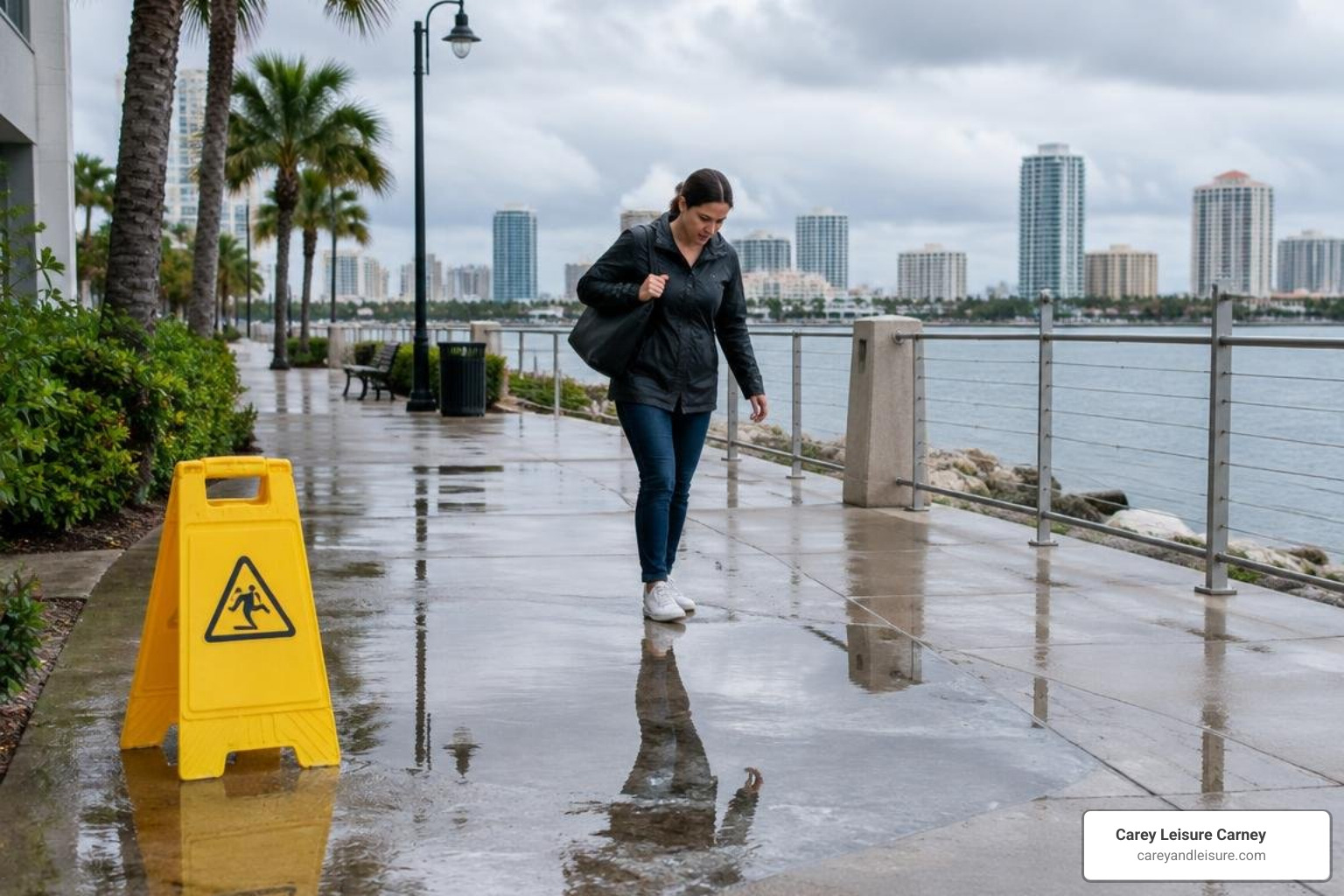
What to Do After a Slip and Fall in St. Petersburg
Get medical care, report the fall, and photograph the hazard before it changes. Keep the shoes you wore, collect witness names, and avoid giving the property owner’s insurer a recorded statement before you understand your injuries. A slip and fall attorney St Petersburg residents trust can help preserve video, investigate whether the property owner knew or should have known about the danger, and seek compensation for your losses.
You do not have to sort out fault or legal deadlines while you are recovering. But taking these first steps can protect evidence that may be hard to find later.
I’m Thomas W. Carey, a slip and fall attorney St Petersburg residents can turn to at Carey Leisure Carney. As a board-certified civil trial lawyer with decades of injury-case experience, I know how much the early details can matter.
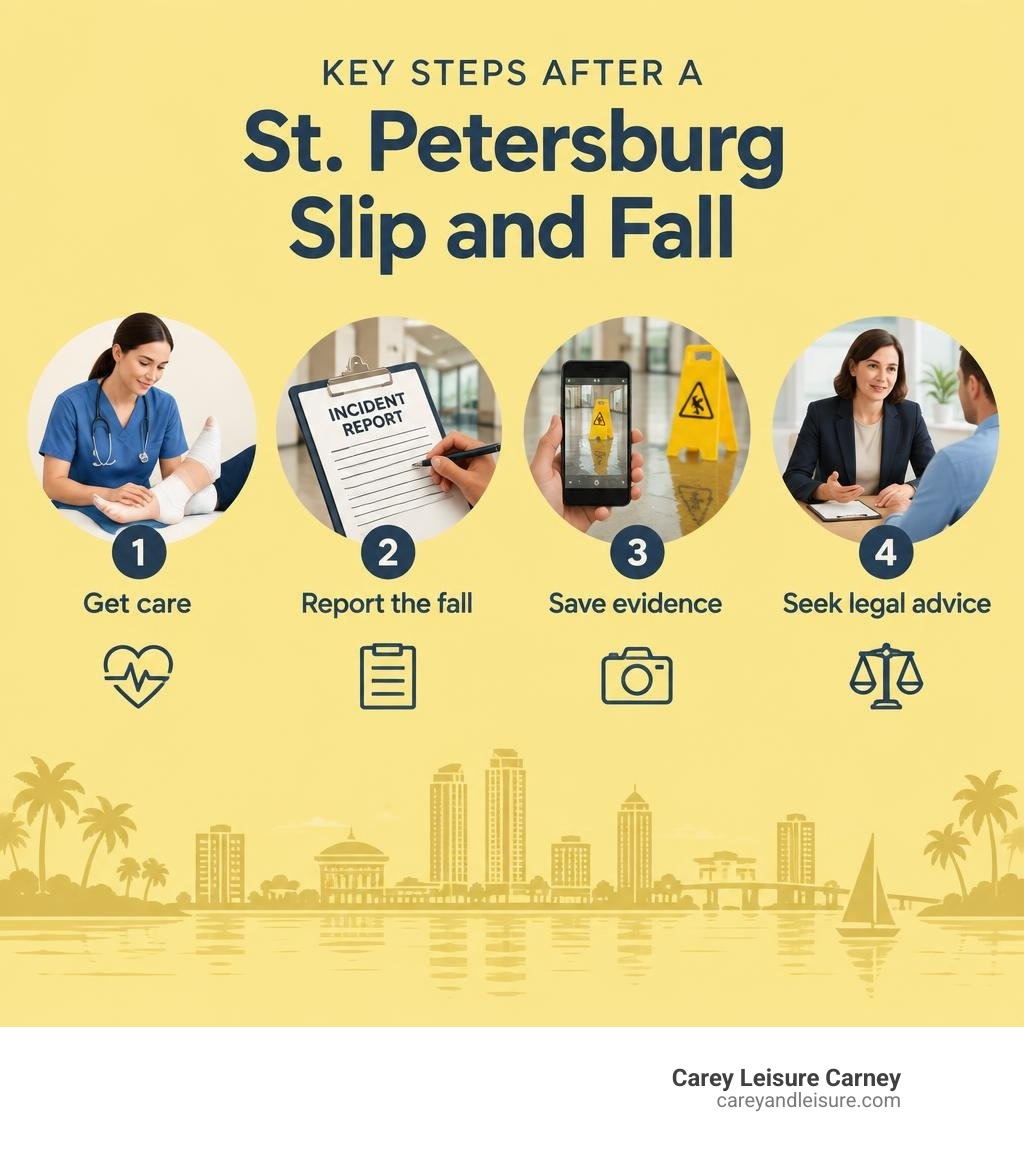
Slip and fall attorney St Petersburg word guide:
Understanding Florida Premises Liability and St. Petersburg Slip and Fall Hazards

When you walk into a grocery store, a beachfront café, or a hotel lobby, you have a reasonable expectation that the walking surfaces are safe. In Florida, businesses invite customers onto their premises to generate revenue, and with that invitation comes a specific legal duty of care.
Under the principles of premises liability, a property owner, manager, or tenant must maintain their property in a reasonably safe condition and warn visitors of any concealed dangers they knew about—or should have known about through reasonable inspections. When business owners cut corners, ignore spills, or fail to fix broken walkways, innocent walkers suffer serious, life-altering injuries.
According to the CDC’s data on older adult falls, falls remain the leading cause of injury-related death for adults aged 65 and older nationwide, and Florida’s emergency rooms see countless fall-related visits every year. In our vibrant coastal communities across St. Petersburg, balancing active lifestyles with busy commercial corridors means slip and fall risks are constantly present, which is why many injured residents turn to a slip and fall attorney St Petersburg families recommend after a serious fall.
Common Causes of Pedestrian and Visitor Falls in St. Petersburg
St. Petersburg has a unique blend of historic architecture, bustling downtown sidewalks, waterfront piers, and busy retail centers. These environments present distinctive hazards:
- Waterfront and Marina Moisture: Smooth outdoor decking, boat ramps, and docks along the St. Petersburg waterfront frequently collect algae, condensation, and sea spray, creating slick walking surfaces.
- Rainwater Intrusion: Sudden afternoon thunderstorms in Florida cause water to pool rapidly near building entrances, particularly when businesses forget to secure entry mats or fail to place adequate warning signs. When commercial entryways lack protection, missing caution signs during wet floor incidents routinely lead to dangerous falls.
- Slick Retail Flooring: Highly polished tile, marble, or sealed concrete floors in shopping centers turn into skating rinks when liquid leaks from refrigeration units, spilled beverages, or recent mopping go unaddressed.
- Defective Walkways and Curbs: Uneven pavers, cracked sidewalks, unpainted curb transitions, and hidden potholes in parking lots create severe trip hazards for unsuspecting pedestrians.
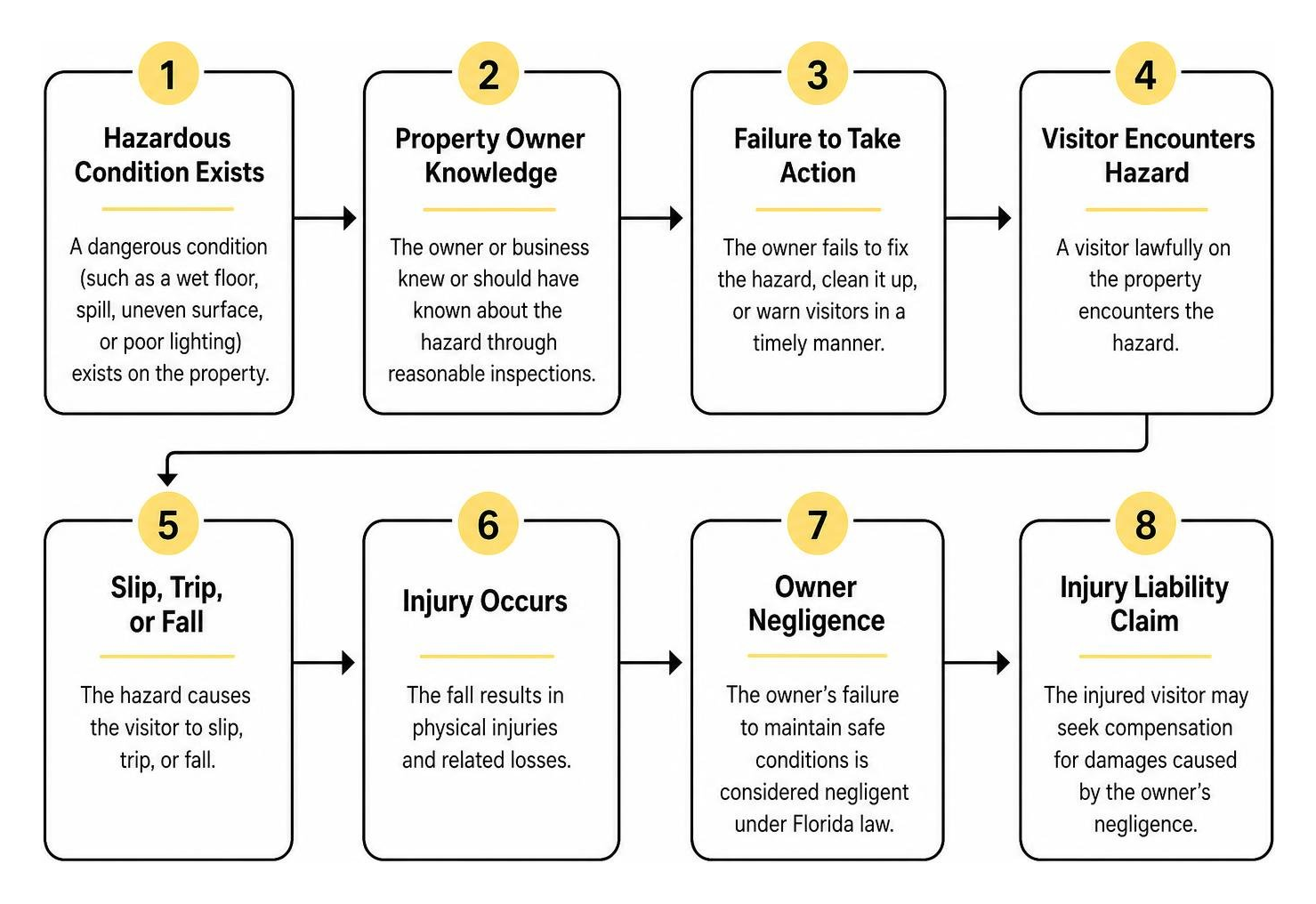
How Florida Law Defines Property Owner Negligence
Proving liability in a Florida slip and fall case requires more than just showing that you fell on someone else’s property. Florida Statute § 768.0755 governs premises liability for transitory foreign substances in commercial establishments. To succeed, an injured person must prove that the business establishment had actual or constructive knowledge of the dangerous condition and should have taken action to fix it.
Understanding the difference between premises liability and general negligence comes down to how the law views notice:
- Actual Knowledge: The business owner, manager, or employee directly knew about the hazard. For example, an employee saw a customer drop a bottle of olive oil five minutes before your fall or created the spill themselves while mopping.
- Constructive Knowledge: Even if the owner claims they did not see the hazard, Florida law holds them responsible if the condition existed for such a length of time that, in the exercise of ordinary care, the business should have discovered it. Constructive notice can also be shown if the dangerous condition occurred with such regularity that it was reasonably foreseeable (such as a chronically leaking ice machine).
Critical Evidence and Actions Immediately Following a Fall

The moments immediately following an unexpected fall can feel overwhelming. Adrenaline surges, embarrassment often sets in, and shock can mask significant physical pain. However, what you do in the minutes, hours, and days following a fall can make or break your ability to secure compensation for your medical bills and lost wages.
Following the proper steps after a slip and fall accident ensures your rights remain protected from the start.
How a Slip and Fall Attorney St Petersburg Proves Business Negligence
Commercial establishments and their insurance carriers act quickly to protect themselves. Often, a spill is mopped up within minutes of an accident, and digital security camera footage can be automatically overwritten in as few as 7 to 30 days.
When our legal team steps in, we immediately move to secure crucial evidence before it vanishes:
- Formal Spoliation Letters: We serve formal legal notices demanding the commercial property preserve all relevant video surveillance, sweep logs, cleaning records, and internal incident reports.
- Reviewing Maintenance Schedules: Many large retailers use digital “sweep sheets” or inspection logs. We analyze time-stamped logs to uncover whether inspections were skipped or falsified.
- Employee Depositions: We cross-examine managers and maintenance staff under oath to determine whether employees were properly trained in hazard detection and floor safety.
Immediate Steps Every Injured Person Should Take
If you or a loved one is injured in a fall, taking the following actions establishes the foundation of your claim:
- Seek Prompt Medical Attention: Go to an emergency room, urgent care clinic, or your primary physician right away. Some traumatic injuries—such as concussions, hairline fractures, and herniated discs—worsen significantly over 24 to 48 hours. Medical records create a clear link between the fall and your physical injuries.
- Report the Incident: Notify the store manager, property supervisor, or landlord immediately. Ensure they generate a written incident report, and ask for a copy or the incident report reference number.
- Photograph the Hazard and Surroundings: Use your phone to photograph the puddle, broken tile, debris, lighting conditions, and the absence of warning cones. Take both close-up photos and wide-angle shots of the surrounding area.
- Preserve Your Shoes and Clothing: Place the footwear and clothing you wore during the fall into a clean plastic bag and store them in a safe place. Do not clean or continue wearing the shoes, as insurance adjusters frequently inspect tread wear to shift blame.
- Identify Witnesses: Collect the names, phone numbers, and brief statements of anyone who saw you fall or noticed the hazard beforehand.
- Decline Recorded Statements: Insurance adjusters often call within days of an accident, sounding friendly while asking leading questions designed to minimize their financial liability. Politely decline to provide recorded statements until you speak with legal counsel.
Florida Legal Standards: Comparative Fault, Defenses, and Deadlines
Property owners and their insurance carriers rarely admit fault without a fight. They rely on standard legal defenses to eliminate or reduce your payout under Florida’s modified comparative fault rules.
| Property Owner Defense | Defense Strategy / Argument | Effective Legal Counterargument |
|---|---|---|
| Open and Obvious Hazard | The property owner argues the hazard was so apparent you should have seen and avoided it. | The hazard was obscured by poor lighting, foot traffic, or promotional displays designed to attract your gaze away from the floor. |
| Comparative Negligence (Distracted Walking) | The insurer claims you were looking at your phone, walking too fast, or not paying attention. | Phone records, witness testimony, and surveillance show normal walking behavior in an area where safe passage was reasonably expected. |
| Lack of Notice / Foreign Substance | The business asserts the spill happened seconds before your fall and they had no time to discover it. | Surveillance footage, track marks through the liquid, or dried edges demonstrate the liquid sat unattended for an extended period. |
| Inappropriate Footwear | The defense argues your shoes, flip-flops, or high heels caused the slip rather than their surface defect. | Preserved footwear demonstrates intact tread, confirming the low coefficient of friction on the untreated floor was the direct cause. |
| Pre-Existing Physical Conditions | The defense claims your pain, back problems, or joint injuries existed prior to the fall. | Medical imaging, physician testimony, and comparative medical records prove the fall caused new trauma or aggravated a dormant condition. |
Property Owner Defenses in St. Petersburg Claims
Under Florida’s modified comparative fault statute, an injured walker can recover damages as long as their share of fault is 51 percent or less. However, if you are found to be partially responsible, your final financial compensation is reduced by your percentage of fault.
For instance, if a jury awards $100,000 for your medical bills and pain, but determines you were 20% at fault for looking at a store shelf instead of the floor, your net recovery is $80,000. If the defense successfully argues that you were 51% or more at fault, you are barred from recovering any compensation at all. This makes countering bad-faith defense tactics essential from day one.
Understanding Florida’s Two-Year Statute of Limitations
Timing is critical. Florida law sets a two-year statute of limitations for personal injury claims arising from negligence.
If you fail to file a lawsuit in the appropriate civil court within two years from the exact date of your fall, you forfeit your legal right to pursue compensation forever. Claims involving government entities (such as municipal sidewalks, public transit hubs, or city buildings) require formal pre-suit administrative notices with even tighter statutory windows. Reaching out to an attorney promptly ensures all statutory deadlines are properly met.
Damages and Settlement Recovery in St. Petersburg Fall Claims
A severe slip and fall can disrupt your life physically, emotionally, and financially. Florida personal injury law allows victims to recover both economic and non-economic damages caused by a negligent property owner.
- Economic Damages:
- Past and future medical expenses (hospital visits, surgeries, physical therapy, diagnostic MRIs, and medications).
- Lost wages from missed work shifts during your initial recovery.
- Loss of future earning capacity if your injuries result in permanent disability or force you into a lower-paying job.
- Out-of-pocket expenses for medical equipment, travel to specialists, and in-home care assistance.
- Non-Economic Damages:
- Physical pain and suffering endured during and after treatment.
- Emotional distress, anxiety, and depression stemming from reduced mobility.
- Loss of enjoyment of life, preventing you from participating in hobbies, sports, and family activities.
- Permanent physical impairment or visible scarring.
While minor soft-tissue injury claims in Florida often settle between $10,000 and $50,000, severe injuries involving broken hips, spinal fractures, torn ligaments, or traumatic brain injuries can result in settlements and verdicts exceeding $100,000 into seven-figure territory.
Why You Need a Slip and Fall Attorney St Petersburg After a Waterfront or Hotel Injury
St. Petersburg welcomes millions of visitors every year to our beach resorts, downtown cultural venues, and waterfront dining spots. Handling a slip and fall claim against a hotel chain, luxury resort, or commercial property management firm involves complex layers of commercial liability insurance, third-party maintenance contractors, and corporate defense teams.
When you work with a dedicated slip and fall attorney in St. Petersburg, FL, you gain an advocate who understands the local courts, judges, and corporate practices in St. Petersburg and throughout Florida. Our legal team cuts through corporate bureaucracy, coordinates with medical experts to document your long-term prognosis, and demands the full compensation you deserve.
When to Hire a Slip and Fall Attorney St Petersburg for Your Claim
You should contact an attorney as soon as possible after receiving medical treatment. Attempting to negotiate with insurance adjusters on your own often results in lowball settlement offers that do not account for future medical care, lingering pain, or diminished working ability.
At Carey Leisure Carney, we represent injured clients on a contingency fee basis. This means:
- You pay zero upfront fees to retain our firm.
- We cover all investigation costs, court filing fees, and expert witness expenses.
- You pay no attorney fees or costs unless we successfully recover money for you through a negotiated settlement or courtroom verdict.
Our Board-Certified trial attorneys bring over 100 years of combined legal experience to your side. We give you direct attorney access, ensuring your questions are answered clearly at every stage of your recovery.
Frequently Asked Questions About St. Petersburg Slip and Fall Accidents
What is the average settlement for a slip and fall in Florida?
Settlement values vary widely based on injury severity, medical costs, and available insurance coverage. Typical minor-to-moderate injury claims settle between $10,000 and $50,000, while severe injuries requiring surgery, joint replacement, or long-term rehabilitation regularly resolve for amounts exceeding $100,000 to well over $500,000.
Can I recover compensation if I was partially at fault for my fall?
Yes. Under Florida’s modified comparative fault law, you can recover damages as long as you were not more than 50% responsible for the accident. Your total financial award will simply be reduced in direct proportion to your assigned percentage of fault.
How much does it cost to hire an injury attorney in St. Petersburg?
Hiring Carey Leisure Carney costs nothing out of pocket. We operate on a pure contingency fee structure. If we do not win your case, you owe us nothing in attorney fees.
Conclusion
A sudden slip and fall can change your daily life in a fraction of a second. When a negligent property owner leaves hazards unchecked in St. Petersburg, Clearwater, Largo, New Port Richey, Spring Hill, Trinity, or Wesley Chapel, you should not be left carrying the financial and physical burden alone.
At Carey Leisure Carney, our Board-Certified civil trial lawyers represent the top 2% of attorneys in Florida. We combine aggressive courtroom advocacy with compassionate, personalized guidance to help you rebuild your life.
If you or someone you care about has been injured on commercial or private property, schedule a consultation with an experienced slip and fall attorney at Carey Leisure Carney today to protect your rights and explore your legal options.