

How to Hire a Rideshare Injury Lawyer Without Losing Your Mind
Why a Rideshare Injury Lawyer Can Make a Complex Claim Simpler
A rideshare injury lawyer helps people hurt in Uber or Lyft crashes understand who may be responsible, which insurance policy applies, and what compensation they may seek. These cases can be more complicated than a typical car crash because the driver, another motorist, the rideshare company, and several insurers may all be involved.
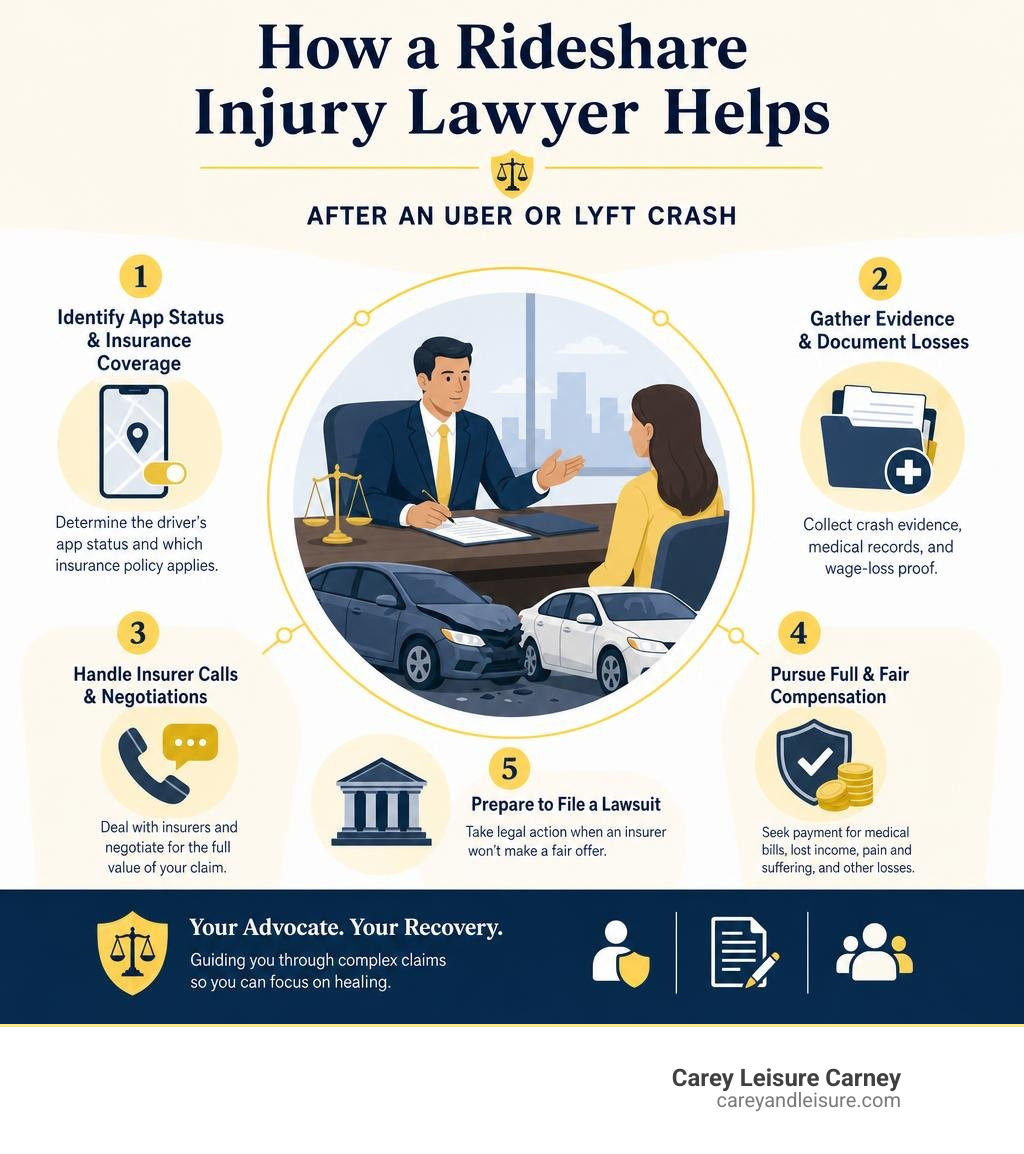
In simple terms, the right lawyer should help you:
- Identify the driver’s app status and available insurance coverage.
- Gather crash evidence, medical records, and wage-loss proof.
- Handle insurer calls and settlement negotiations.
- Pursue payment for medical bills, lost income, pain and suffering, and other covered losses.
- Prepare to file a lawsuit when an insurer will not make a fair offer.
I am Thomas W. Carey, a founding partner at Carey Leisure Carney and a board-certified civil trial lawyer who has guided or overseen roughly 40,000 Florida injury matters. My experience as a rideshare injury lawyer includes the same core work these cases demand: investigating negligence, dealing with insurers, and helping injured people seek a fair path forward.
Simple guide to rideshare injury lawyer terms:
What Makes Rideshare Accidents Different From Regular Auto Crashes?

If you get into a collision with a neighbor on US-19 in Clearwater or near Downtown St. Petersburg, the legal roadmap is relatively straight line: driver meets driver, exchange insurance cards, file a Personal Injury Protection (PIP) claim, and hold the at-fault driver liable for damages exceeding policy limits.
When you introduce a Transportation Network Company (TNC) like Uber or Lyft into the equation, that straight road turns into a tangled interchange with dynamic insurance tiers, corporate legal defenses, and multi-party disputes. To dig deeper into these dynamics, take a look at our guide on Rideshare Wreck Realities: What to Know About Uber and Lyft Accidents.
In a standard auto crash, you typically deal with one primary driver and their personal vehicle insurance policy. In a rideshare crash, however, several entities are immediately drawn into the fight:
- The rideshare driver’s personal auto insurance carrier
- The rideshare company’s multi-tiered commercial insurance provider
- Third-party drivers who may have contributed to the collision
- Corporate legal teams working tirelessly to minimize giant payout liabilities
The most frustrating part for injured passengers, pedestrians, or hit motorists is the immediate fingerprint-pointing session. Personal insurance providers routinely deny coverage the instant they learn their policyholder was driving for commercial hire without a specific ride-hailing endorsement. Meanwhile, the rideshare company’s legal department might claim their coverage does not apply because of the driver’s exact digital status on the app at the second of impact.
Navigating this maze requires an experienced rideshare injury lawyer who knows how to pierce corporate deflection, secure digital app logs, and pin down the correct insurance coverage.
Driver App Status and Insurance Coverage Tiers
The level of financial coverage available after an Uber or Lyft crash depends directly on what the driver was doing on their app at the precise moment the crash occurred. In Florida, state regulations govern rideshare insurance requirements across three distinct phases or “periods.”
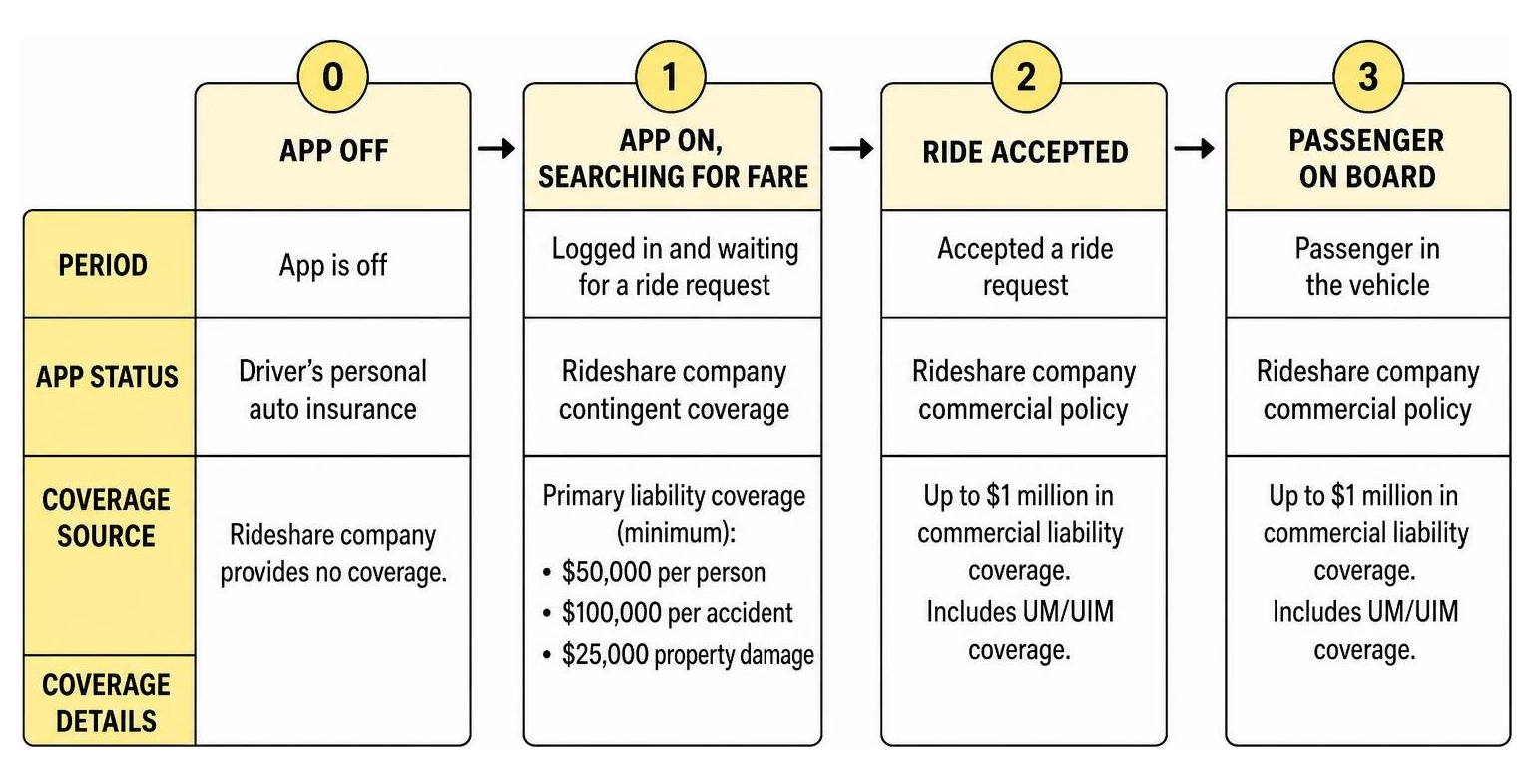
Here is how those insurance tiers break down:
- Period 0 (App Off): The driver is operating their personal vehicle for private use with the rideshare app turned off completely. Only the driver’s personal auto insurance applies. The rideshare company bears zero financial responsibility.
- Period 1 (App On, Searching for a Fare): The driver has logged into the app and is actively waiting for a ride request, but has not accepted a trip yet. If a crash occurs during Period 1, Florida law mandates primary liability coverage of at least $50,000 per person for bodily injury, $100,000 per accident for bodily injury, and $25,000 for property damage. The rideshare company provides contingent coverage if the driver’s personal insurance denies the claim.
- Period 2 & 3 (Ride Accepted or Passenger On Board): The moment a driver accepts a ride request on the app (Period 2) or has a passenger in the vehicle (Period 3), coverage jumps dramatically. Uber and Lyft maintain $1 million in commercial liability insurance policies. This tier also provides robust uninsured/underinsured motorist (UM/UIM) coverage to protect passengers if another driver causes the crash and flees or lacks adequate insurance.
If you were involved in an active ride, learning What to Do If Your Uber Gets Into an Accident in Florida will help you protect your rights during Period 2 or Period 3 claims.
Can You Sue Uber or Lyft Directly After a Crash?
A common question injured clients ask us in our Clearwater and St. Petersburg offices is: “Can I sue Uber or Lyft directly for my injuries?”
The legal answer is nuanced. Under standard vicarious liability rules (commonly known as respondeat superior), employers are usually legally responsible for the negligent acts committed by their employees while on the job. However, rideshare giants structure their business models by classifying drivers as independent contractors rather than traditional employees.
Because of this independent contractor designation, you generally cannot sue Uber or Lyft directly purely for a driver’s individual traffic mistakes—such as failing to yield, running a red light, or driving while distracted. The legal claim or lawsuit must typically name the at-fault driver directly, triggering the $1 million commercial insurance coverage that the rideshare company is legally mandated to carry for active rides.
However, direct lawsuits against the rideshare corporation itself are possible under specific legal theories of direct corporate negligence, including:
- Negligent Hiring or Retention: Retaining or approving a driver with a dangerous history of reckless driving, major traffic violations, or severe criminal records.
- Failure to Deactivate Dangerous Drivers: Allowing a driver to remain active on the platform despite repeated passenger complaints or reported safety red flags.
- App System Mismanagement: Designing app features or dispatch algorithms that actively encourage distracted driving or unsafe speeding to meet strict pickup deadlines.
For a comprehensive look at how driver classification impacts your legal strategy, review our overview on Understanding Lyft’s Legal Challenges for Drivers and Riders.
How to Choose the Right Rideshare Injury Lawyer for Your Case

When you are coping with painful injuries, missed work, and calls from persistent insurance adjusters, choosing legal representation can feel overwhelming. You do not just need any lawyer who handles traffic tickets; you need a dedicated rideshare injury lawyer who understands local Florida courts and high-stakes commercial policy disputes.
Selecting the right attorney is about establishing confidence, transparency, and strategic power. You want a team that combines compassionate personal communication with aggressive courtroom readiness. To avoid common pitfalls, read our detailed guide on Don’t Get Taken for a Ride: How to Pick the Best Rideshare Accident Lawyer.
What to Look for in a Rideshare Injury Lawyer
Not all personal injury attorneys bring the same credentials to the table. When evaluating potential firms across Clearwater, Largo, New Port Richey, Spring Hill, St. Petersburg, Trinity, or Wesley Chapel, look for these vital criteria:
- Board Certification in Civil Trial Law: In Florida, less than 2% of licensed attorneys earn the distinction of Board Certification. Board-certified trial attorneys are officially recognized by the Florida Bar as specialists in civil litigation and courtroom trial practice.
- Direct Attorney Access: Many large “billboard” law firms assign your file to paralegals or case managers whom you can rarely reach. Make sure you hire a firm where you have direct communication with your actual lawyer. At Carey Leisure Carney, our clients get direct access to their attorney throughout their entire case.
- Proven Commercial Litigation Track Record: Rideshare cases involve heavy corporate insurers that routinely push back against maximum policy payouts. You need a lawyer with extensive experience fighting commercial insurance defense teams in court.
- Contingency Fee Structure: You should never pay upfront legal fees or out-of-pocket costs. A reputable firm operates strictly on a contingency fee basis—meaning you pay nothing unless your attorney successfully recovers financial compensation for you.
To streamline your selection process, check out our Crash Course: What to Look for in an Uber or Lyft Accident Lawyer.
Questions to Ask a Rideshare Injury Lawyer During Consultation
Your initial consultation is your opportunity to interview the attorney and confirm they are the right fit for your case. Here are fundamental questions you should ask:
- “Are you Board-Certified in Civil Trial Law by the Florida Bar?”
- “Will I be communicating directly with you, or will my case be handed off to legal assistants?”
- “How many rideshare and commercial auto accident claims have you handled in Pinellas, Pasco, or Hernando County?”
- “How do you plan to handle the insurance coverage tiers if the rideshare company denies liability?”
- “Are you fully prepared to file a lawsuit and take my case to trial if the insurance company offers an unfair settlement?”
- “What is your fee structure, and will I owe anything out of pocket if we do not win?”
For a step-by-step preview of what a lawyer does behind the scenes during these initial stages, read The Rideshare Accident Lawyer: What They Do and How They Help Your Case.
Proving Fault and Navigating Insurance Coverage After a Crash
Winning a rideshare injury claim requires proving negligence under Florida law. To establish a valid personal injury claim, your legal team must prove four fundamental legal elements:
- Duty of Care: The driver (or other responsible party) owed you a legal obligation to operate their vehicle safely.
- Breach of Duty: The driver failed to fulfill that duty through reckless, negligent, or unlawful behavior (e.g., speeding, running a light, texting while driving).
- Causation: The driver’s breach directly caused the motor vehicle crash.
- Measurable Damages: You suffered real, verifiable physical, emotional, or financial harms as a direct result of the crash.
Unpacking these legal burdens is essential to securing full recovery. To learn more about how fault is evaluated, see our deep-dive analysis on The Blame Game: Unpacking Negligence in Rideshare Accidents.
Uninsured and Underinsured Motorist Coverage Issues
What happens when you are riding in an Uber or Lyft in Pinellas County or Pasco County, and another driver crashes into your vehicle, but that at-fault driver has no liability insurance or hit-and-runs the scene?
This is where commercial Uninsured/Underinsured Motorist (UM/UIM) coverage becomes vital. During active rides (Period 2 and Period 3), Uber and Lyft carry $1 million in commercial UM/UIM coverage in Florida. This policy kicks in to cover your medical expenses, lost earnings, and pain and suffering when the third-party driver who caused the accident lacks sufficient insurance coverage.
However, accessing these UM funds is rarely automatic. Commercial insurance adjusters will analyze the crash to argue that the third-party driver was not entirely at fault, or they may challenge the severity of your medical injuries. Having an experienced rideshare injury lawyer ensures that UM claims are prepared with airtight medical and liability proof. To understand how UM coverage impacts your payout, read our guide on the Uber Accident Settlement.
Comparative Fault Rules and Shared Liability
In many traffic collisions, fault is not entirely one-sided. Perhaps the rideshare driver was speeding slightly, but a third-party driver made an illegal left turn across oncoming traffic.
Under Florida’s modified comparative fault rule, any financial damages you recover will be reduced in direct proportion to your percentage of fault. Furthermore, under Florida’s updated modified comparative fault law, if an injured party is found to be more than 50% at fault for the accident, they are completely barred from recovering compensation from other parties.
Consider this example breakdown:
Because assigning even a small percentage of fault can significantly lower your compensation—or eliminate it entirely if it exceeds 50%—insurance companies fight hard to shift blame onto you or other involved parties. Our team works diligently to gather scene telemetry, traffic camera evidence, and witness testimony to protect our clients from unfair blame assignments. For regional legal guidance, check out our resources on Tampa Rideshare Accident: Here’s How to Reach Legal Help.
Immediate Steps to Take and Compensation Available After an Accident
Knowing what types of financial compensation you can recover—and taking correct immediate actions after a crash—is critical to building a strong case.
In Florida, victims of rideshare accidents can seek both economic and non-economic damages:
| Damage Category | Examples Included | Proof Required |
|---|---|---|
| Economic Damages | Emergency room bills, surgical costs, physical therapy, prescription medication, lost wages, diminished earning capacity, property damage | Medical invoices, billing records, pay stubs, tax records, repair estimates |
| Non-Economic Damages | Physical pain and suffering, mental anguish, loss of enjoyment of life, emotional distress, physical impairment, scarring | Doctor notes, psychological evaluations, personal impact journals, expert testimony |
To map out your full recovery plan, review our resource on Your Legal Journey: What to Do After a Rideshare Accident.
Essential Steps at the Crash Scene
If you are physically able to do so safely following an Uber or Lyft accident in Clearwater, St. Petersburg, or anywhere nearby, take these crucial steps to protect your health and legal rights:
- Call 911 Immediately: Ensure law enforcement officers respond to create an official police crash report.
- Seek Prompt Medical Care: Go directly to an emergency room or urgent care clinic. Under Florida’s PIP laws, you must seek initial medical treatment within 14 days of the accident to preserve your PIP benefits.
- Capture Scene Evidence: Take photographs and videos of all vehicles, damage points, license plates, skid marks, road conditions, and traffic control signs.
- Take Screenshot of the Rideshare App: Capture your ride status, driver details, vehicle information, and route receipt inside the Uber or Lyft app before the ride screen disappears.
- Collect Contact Details: Gather names, phone numbers, and insurance information from all involved drivers and eye witnesses.
- Avoid Detailed Statements to Insurance Adjusters: Do not give recorded statements to rideshare or third-party insurance adjusters until you have spoken with a lawyer.
For a complete checklist on managing crash logistics like an expert, consult How to Handle a Lyft Accident Like a Pro.
Available Financial Compensation and Timeline Expectations
Clients frequently ask us: “How long will it take to resolve my rideshare accident claim?”
Every case moves at its own pace depending on the complexity of medical treatments and liability disputes. Straightforward cases where medical recovery is swift and liability is clear can reach settlement within 12 months. However, complex claims involving high-dollar injuries, multiple at-fault parties, or stubborn commercial insurers may take longer, especially if formal litigation is required.
The settlement process generally follows these stages:
- Medical Treatment & Maximum Medical Improvement (MMI): Complete all doctor-recommended care until your condition stabilizes.
- Evidence & Record Gathering: Collecting all medical bills, diagnostic scans, wage records, and police reports.
- Demand Package Submission: Sending a detailed legal demand to the insurance carriers outlining clear liability and damages.
- Settlement Negotiations: Engaging in formal settlement talks with insurance claims adjusters.
- Litigation & Trial (If Necessary): Filing a lawsuit if the insurance company refuses to make a fair offer.
To learn more about financial payouts, read The Lyft Accident Payout: A Guide to Understanding Your Rights.
Frequently Asked Questions About Rideshare Injury Claims
How Long Do I Have to File a Rideshare Lawsuit in Florida?
In Florida, the statute of limitations for personal injury claims resulting from negligence is generally two years from the date of the accident.
Failing to file your lawsuit before this legal deadline strictly forfeits your right to seek financial recovery in court. Beyond the statutory deadline, critical evidence like app telemetry data, street camera footage, and witness memories can fade or disappear within weeks. It is vital to contact a rideshare injury lawyer as early as possible after a crash.
What If the Rideshare Driver Was Uninsured or Underinsured?
If the rideshare driver who caused the crash lacks adequate personal coverage, or if another driver hits your rideshare vehicle without insurance, Uber and Lyft’s $1 million commercial Uninsured/Underinsured Motorist (UM/UIM) coverage applies while the driver is actively en route or transporting passengers (Periods 2 and 3). Your lawyer will help trigger and negotiate these commercial UM benefits on your behalf.
How Long Does It Take to Settle an Uber or Lyft Claim?
Settlement timelines depend heavily on your medical treatment duration and the willingness of commercial insurers to offer fair payment. straightforward claims with clear liability can resolve in approximately 12 months. Cases requiring extensive medical care or court litigation may take longer to secure maximum financial compensation.
Conclusion
Navigating an Uber or Lyft injury claim does not have to overwhelm your life. When you work with the right legal team, you can focus on healing while board-certified specialists handle the corporate legal battles, complex insurance tiers, and settlement negotiations.
At Carey Leisure Carney, our founding attorneys bring decades of trial experience, personalized care, and a track record of success to every case. We provide direct attorney access so you can speak directly with your lawyer throughout your entire claim—with zero out-of-pocket costs unless we win your case.
If you or a loved one was hurt in a rideshare crash anywhere in Clearwater, Largo, New Port Richey, Spring Hill, St. Petersburg, Trinity, or Wesley Chapel, don’t let insurance companies take you for a ride. Contact a Rideshare Accident Attorney today for a free, confidential case evaluation.